

 Image 1 of 1
Weeping Cherry — Hajime Namiki
Premium quality canvas print of “Weeping Cherry” by Hajime Namiki
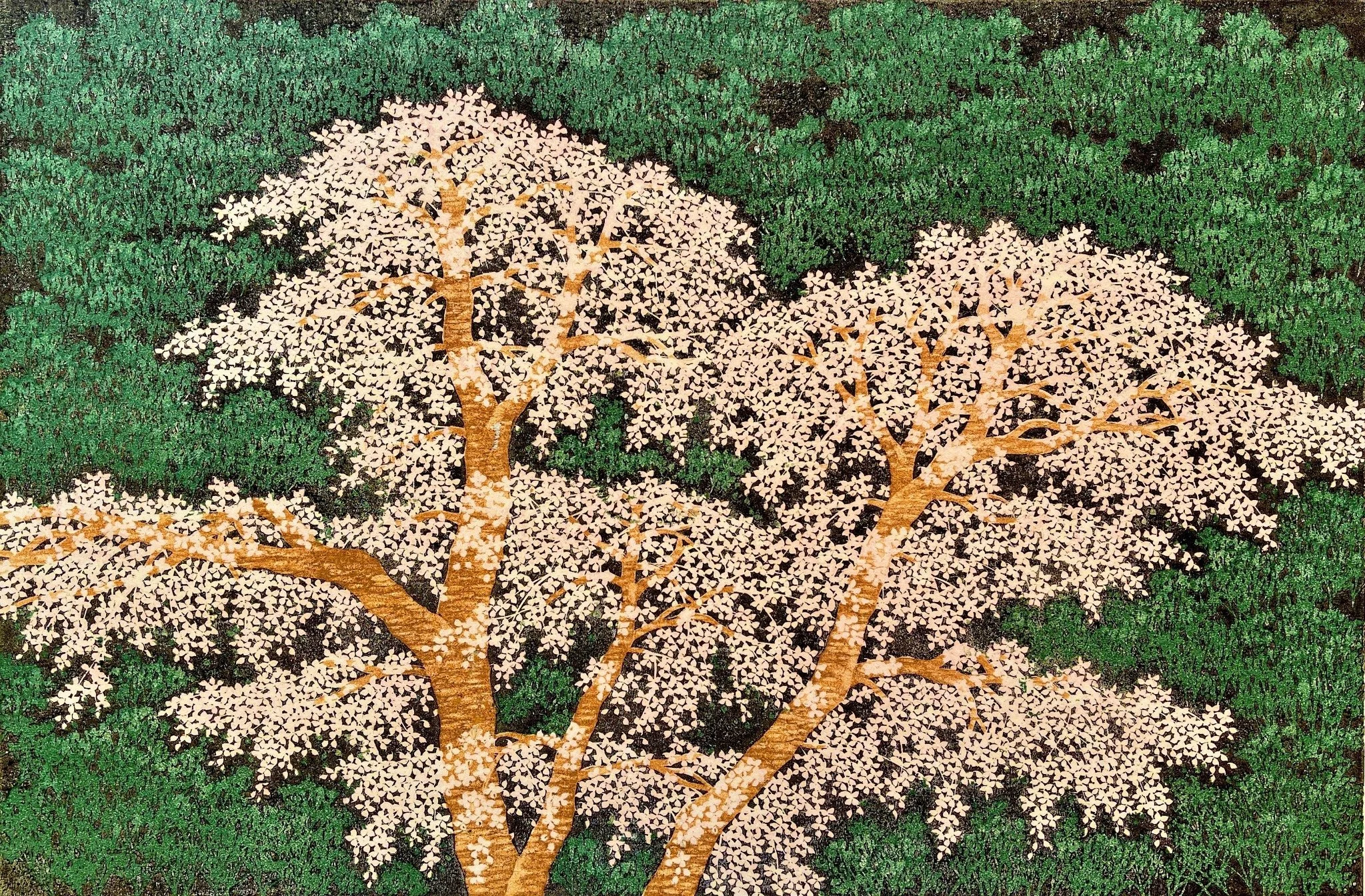
Pale blossoms gather around warm, branching trunks against a deep green background in Hajime Namiki’s Weeping Cherry. This landscape canvas reproduction presents the flowering tree over a sturdy 1.5-inch wood stretcher.
Product details: Canvas reproduction over a sturdy 1.5-inch wood stretcher. Available in 24 × 16 in. ($259 CAD) and 36 × 24 in. ($299 CAD). No returns accepted.
More About the Art
A flowering cherry tree spreads across a deep green field in Weeping Cherry. Its warm trunks divide into rising limbs, then disappear into closely gathered clusters of pale blossom. The brightest flowers form rounded crowns, while smaller branches connect them across open intervals. Hajime Namiki presents the tree with unusual clarity: the eye can follow its structure from the lower edge into the uppermost flowering tips, experiencing the image as both a living form and a carefully balanced pattern of colour and line.
The tree occupies almost the entire horizontal composition. Its trunk is cropped by the lower edge, bringing the viewer close to the branching system rather than placing the specimen within a broad surrounding landscape. No distant building or horizon competes with the flowering crown. This concentration gives the subject a strong presence. The smaller gaps between branches become particularly noticeable, allowing the green background to participate in the design through a changing sequence of openings and enclosed spaces.
Warm colour gives the limbs their distinct character. Golden brown and orange passages stand against the cooler background, with darker marks introducing texture along the larger surfaces. The branches do not divide evenly. Some carry broad masses of blossom, while others extend through narrow spaces or turn back toward the centre. Their irregular movement prevents the image from becoming a symmetrical diagram. Growth is suggested through differences of direction, thickness, and spacing, all held within a clearly organized overall shape.
The blossoms introduce a finer rhythm. Individual pale marks gather densely around the ends of branches, forming larger shapes that can be read from across a room. At closer range, those masses separate into many small points and short strokes. Warm pink notes sit beside brighter white passages. This variation keeps the flowering surfaces from feeling flat, while preserving their luminous effect against the green. The eye moves repeatedly between the tree's broad crown and the smaller marks that sustain it.
The background is equally important, although it carries less contrast. Its dense green texture changes subtly between darker and lighter areas, providing depth without establishing a detailed setting. Small marks echo the scale of the blossoms while remaining subordinate to them. The result is a surrounding field that feels active rather than empty. It allows the warm limbs and pale flowers to remain distinct, giving the tree a place to expand without requiring a conventional view into distant space.
Namiki's original woodblock practice is known for closely controlled carving, repeated colour impressions, and, in some works, metallic leaf. This product is a canvas reproduction of the supplied image. Its appeal here lies in the visible arrangement of blossom, branch, and background, which is represented through printed colour. The fine branching structure creates many paths for the eye, while the larger flowering shapes provide a coherent form to return to after examining the smaller details.
The landscape format gives the flowering crown room to spread across a wall. Its pale blossoms can bring a concentrated area of light to the composition, balanced by the surrounding green and the warmth of the trunks. Looking slowly reveals how each part contributes: a curved limb supports a separate crown, a small opening releases the background, and another spray of flowers reconnects the neighbouring shapes. The image offers a sustained encounter with spring growth through the patient organization of many closely related marks.
More About the Artist
Hajime Namiki, born in Tokyo in 1947, is a Japanese artist whose woodblock prints give trees a striking contemporary presence. Branching canopies, flowering crowns, solitary trunks, forests, and views of Mount Fuji recur across his work. Close attention to carving and colour allows familiar natural forms to become highly concentrated images. In Weeping Cherry, pale blossoms gather around warm, branching trunks against a deep green field, creating a composition that can be appreciated both as a flowering tree and as an intricate pattern of connected shapes.
Born in Tokyo, Namiki began his artistic training in sculpture. Galerie Shinkura records that he studied under the sculptor Shigeru Ogura in 1965, learning wood carving as part of that training. He joined the Japanese Sculpture Association in 1974 and began making woodblock prints in 1978. These dates describe a gradual development from working with carved form toward creating images through the carved surface of a printing block.
That background offers a useful way to appreciate his prints. A branch in a finished image may appear almost effortless, but its shape depends upon deliberate decisions about what to leave and what to remove. In Namiki’s work, a tree can be read as a structure of connected parts: trunk, limb, twig, and the small spaces between them. The balance between solidity and openness gives his compositions their distinctive clarity.
Namiki carries out the carving and printing of his works himself. An account published by the Hendricks Art Collection follows a visit to his home and studio in 1996. It describes his use of a hard cherrywood surface for fine detail, together with repeated printing in closely related shades. This direct studio observation helps explain how the branching networks in his images acquire such precise edges and rich variation.
Metallic leaf is another documented feature of his original prints. The Hendricks account describes the application of gold or silver during the printing process, and the Museum of Fine Arts, Houston catalogues Tree Scene 113 as a woodblock print with silver leaf. These materials belong to the original works on paper. In a canvas reproduction, their appearance is represented through the colours and textures captured in the source image.
His career has also reached audiences beyond Japan. Galerie Shinkura records exhibitions in several Japanese cities and woodblock lectures and demonstrations in Wisconsin during the 1990s. The Hendricks Art Collection presented his work in the United States and documented acquisitions of his prints by public institutions. LACMA’s collection includes Tree Scene 83, a colour woodblock print dated 1998, providing a museum record of his sustained exploration of the tree motif.
The appeal of that motif lies partly in its range. A single tree can suggest strength or isolation; a flowering crown can bring lightness and abundance; a canopy viewed from below can make the viewer feel enclosed within nature. Namiki’s compositions bring these possibilities into focus through the relationship between line and colour. Their emotional character develops from the visual arrangement, allowing each viewer to make a personal connection.
This canvas reproduction represents the appearance of the supplied image through printed colour. The original printmaking materials and the reproduction medium remain distinct. What carries across especially clearly is the arrangement of the tree: firm limbs branch into smaller divisions, and dense clusters of blossom create a luminous crown. Namiki's patient attention to these relationships gives the natural motif a lasting visual presence.
Sources for the artwork and artist
- Unsōdō — Hajime Namiki weeping cherry designs and official artist chronology
- Hendricks Art Collection — firsthand studio visit, carving and printing methods, exhibitions and institutional acquisitions
- Los Angeles County Museum of Art — Tree Scene 83 (1998); artist born in Tokyo in 1947 and colour woodblock medium
- Museum of Fine Arts, Houston — Tree Scene 113; Namiki Hajime and woodblock printing with silver leaf
- Unsōdō — Hajime Namiki Tree Scene 158; self-carving and printing, artistic training and career chronology
Premium quality canvas print of “Weeping Cherry” by Hajime Namiki
Pale blossoms gather around warm, branching trunks against a deep green background in Hajime Namiki’s Weeping Cherry. This landscape canvas reproduction presents the flowering tree over a sturdy 1.5-inch wood stretcher.
Product details: Canvas reproduction over a sturdy 1.5-inch wood stretcher. Available in 24 × 16 in. ($259 CAD) and 36 × 24 in. ($299 CAD). No returns accepted.
More About the Art
A flowering cherry tree spreads across a deep green field in Weeping Cherry. Its warm trunks divide into rising limbs, then disappear into closely gathered clusters of pale blossom. The brightest flowers form rounded crowns, while smaller branches connect them across open intervals. Hajime Namiki presents the tree with unusual clarity: the eye can follow its structure from the lower edge into the uppermost flowering tips, experiencing the image as both a living form and a carefully balanced pattern of colour and line.
The tree occupies almost the entire horizontal composition. Its trunk is cropped by the lower edge, bringing the viewer close to the branching system rather than placing the specimen within a broad surrounding landscape. No distant building or horizon competes with the flowering crown. This concentration gives the subject a strong presence. The smaller gaps between branches become particularly noticeable, allowing the green background to participate in the design through a changing sequence of openings and enclosed spaces.
Warm colour gives the limbs their distinct character. Golden brown and orange passages stand against the cooler background, with darker marks introducing texture along the larger surfaces. The branches do not divide evenly. Some carry broad masses of blossom, while others extend through narrow spaces or turn back toward the centre. Their irregular movement prevents the image from becoming a symmetrical diagram. Growth is suggested through differences of direction, thickness, and spacing, all held within a clearly organized overall shape.
The blossoms introduce a finer rhythm. Individual pale marks gather densely around the ends of branches, forming larger shapes that can be read from across a room. At closer range, those masses separate into many small points and short strokes. Warm pink notes sit beside brighter white passages. This variation keeps the flowering surfaces from feeling flat, while preserving their luminous effect against the green. The eye moves repeatedly between the tree's broad crown and the smaller marks that sustain it.
The background is equally important, although it carries less contrast. Its dense green texture changes subtly between darker and lighter areas, providing depth without establishing a detailed setting. Small marks echo the scale of the blossoms while remaining subordinate to them. The result is a surrounding field that feels active rather than empty. It allows the warm limbs and pale flowers to remain distinct, giving the tree a place to expand without requiring a conventional view into distant space.
Namiki's original woodblock practice is known for closely controlled carving, repeated colour impressions, and, in some works, metallic leaf. This product is a canvas reproduction of the supplied image. Its appeal here lies in the visible arrangement of blossom, branch, and background, which is represented through printed colour. The fine branching structure creates many paths for the eye, while the larger flowering shapes provide a coherent form to return to after examining the smaller details.
The landscape format gives the flowering crown room to spread across a wall. Its pale blossoms can bring a concentrated area of light to the composition, balanced by the surrounding green and the warmth of the trunks. Looking slowly reveals how each part contributes: a curved limb supports a separate crown, a small opening releases the background, and another spray of flowers reconnects the neighbouring shapes. The image offers a sustained encounter with spring growth through the patient organization of many closely related marks.
More About the Artist
Hajime Namiki, born in Tokyo in 1947, is a Japanese artist whose woodblock prints give trees a striking contemporary presence. Branching canopies, flowering crowns, solitary trunks, forests, and views of Mount Fuji recur across his work. Close attention to carving and colour allows familiar natural forms to become highly concentrated images. In Weeping Cherry, pale blossoms gather around warm, branching trunks against a deep green field, creating a composition that can be appreciated both as a flowering tree and as an intricate pattern of connected shapes.
Born in Tokyo, Namiki began his artistic training in sculpture. Galerie Shinkura records that he studied under the sculptor Shigeru Ogura in 1965, learning wood carving as part of that training. He joined the Japanese Sculpture Association in 1974 and began making woodblock prints in 1978. These dates describe a gradual development from working with carved form toward creating images through the carved surface of a printing block.
That background offers a useful way to appreciate his prints. A branch in a finished image may appear almost effortless, but its shape depends upon deliberate decisions about what to leave and what to remove. In Namiki’s work, a tree can be read as a structure of connected parts: trunk, limb, twig, and the small spaces between them. The balance between solidity and openness gives his compositions their distinctive clarity.
Namiki carries out the carving and printing of his works himself. An account published by the Hendricks Art Collection follows a visit to his home and studio in 1996. It describes his use of a hard cherrywood surface for fine detail, together with repeated printing in closely related shades. This direct studio observation helps explain how the branching networks in his images acquire such precise edges and rich variation.
Metallic leaf is another documented feature of his original prints. The Hendricks account describes the application of gold or silver during the printing process, and the Museum of Fine Arts, Houston catalogues Tree Scene 113 as a woodblock print with silver leaf. These materials belong to the original works on paper. In a canvas reproduction, their appearance is represented through the colours and textures captured in the source image.
His career has also reached audiences beyond Japan. Galerie Shinkura records exhibitions in several Japanese cities and woodblock lectures and demonstrations in Wisconsin during the 1990s. The Hendricks Art Collection presented his work in the United States and documented acquisitions of his prints by public institutions. LACMA’s collection includes Tree Scene 83, a colour woodblock print dated 1998, providing a museum record of his sustained exploration of the tree motif.
The appeal of that motif lies partly in its range. A single tree can suggest strength or isolation; a flowering crown can bring lightness and abundance; a canopy viewed from below can make the viewer feel enclosed within nature. Namiki’s compositions bring these possibilities into focus through the relationship between line and colour. Their emotional character develops from the visual arrangement, allowing each viewer to make a personal connection.
This canvas reproduction represents the appearance of the supplied image through printed colour. The original printmaking materials and the reproduction medium remain distinct. What carries across especially clearly is the arrangement of the tree: firm limbs branch into smaller divisions, and dense clusters of blossom create a luminous crown. Namiki's patient attention to these relationships gives the natural motif a lasting visual presence.
Sources for the artwork and artist
- Unsōdō — Hajime Namiki weeping cherry designs and official artist chronology
- Hendricks Art Collection — firsthand studio visit, carving and printing methods, exhibitions and institutional acquisitions
- Los Angeles County Museum of Art — Tree Scene 83 (1998); artist born in Tokyo in 1947 and colour woodblock medium
- Museum of Fine Arts, Houston — Tree Scene 113; Namiki Hajime and woodblock printing with silver leaf
- Unsōdō — Hajime Namiki Tree Scene 158; self-carving and printing, artistic training and career chronology