

 Image 1 of 1
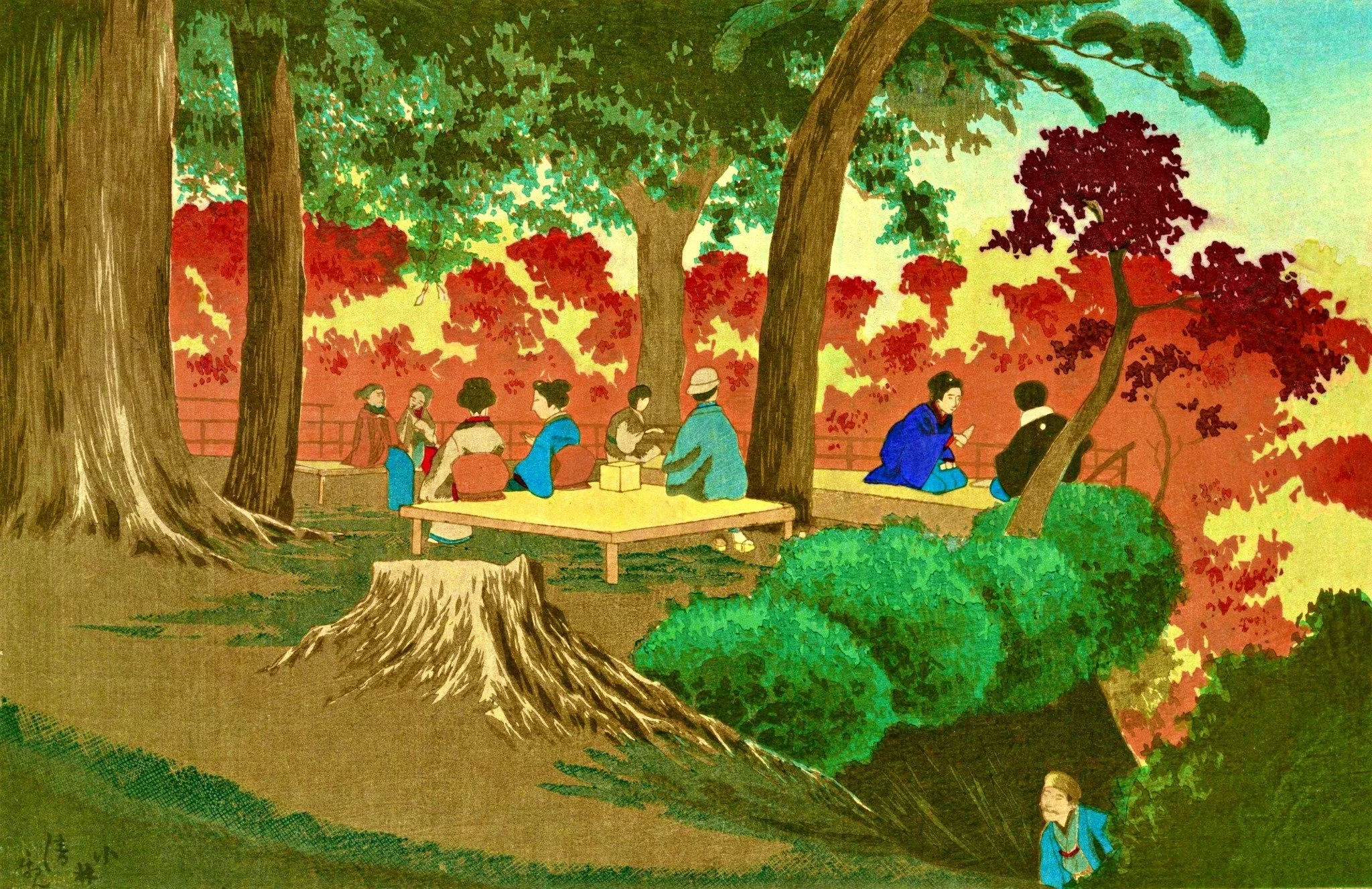
View of Takinogawa — Kobayashi Kiyochika (1878)
Premium quality canvas print of “View of Takinogawa” by Kobayashi Kiyochika
Visitors gather beneath great trees and bright autumn foliage in Kobayashi Kiyochika’s View of Takinogawa. This landscape canvas reproduction preserves the scene’s lively colour and quiet social detail over a sturdy 1.5-inch wood stretcher.
Product details: Canvas reproduction over a sturdy 1.5-inch wood stretcher. Available in 24 × 16 in. ($259 CAD) and 36 × 24 in. ($299 CAD). No returns accepted.
More About the Art
Small groups of visitors gather beneath large trees in View of Takinogawa. Some sit close together on low platforms, while others stand or turn toward their companions. Broad trunks rise through the foreground, separating the gathering into distinct spaces. Beyond them, red and orange foliage glows against darker greens. Kobayashi Kiyochika combines the ordinary pleasure of an outdoor visit with a strongly organized landscape, allowing social detail and seasonal colour to share the viewer's attention across the full horizontal composition.
The Minneapolis Institute of Art records the woodblock print as a work of 1878, published by Matsuki Heikichi. Its title identifies Takinogawa, a place associated with autumn scenery in the northern part of Tokyo. MIT's Visualizing Cultures project discusses the setting within Kiyochika's views of the city by day. The image shows how a celebrated location could be experienced through small groups of people, whose varied positions make the landscape feel occupied without reducing the trees to a decorative background.
The nearest trunks provide the picture's strongest vertical structure. Their broad surfaces are marked by changes of colour and narrow lines that suggest bark. Some rise beyond the upper edge, while a larger branching form spreads across the centre. These close shapes give the viewer a clear position within the grove. They also divide the more distant foliage into separate openings, making the warm autumn colours appear in changing concentrations rather than as a single continuous band across the landscape.
The platforms create a second system of lines. Their low horizontal surfaces and narrow supports contrast with the more irregular trees and shrubs. A pale table-like form near the centre catches the light, while other seating areas recede toward the left. The visitors' garments add small blue, green, orange, and cream accents. Their gestures remain modest, yet the differences between sitting, standing, and turning give the scene a gentle sense of activity. Attention moves from one gathering to another.
Rounded shrubs gather along the lower and middle edges, partly screening the platforms. Their closely fitted green shapes connect the large tree trunks with the brighter leaves behind them. The foreground ground is comparatively open, providing room for the eye to enter the scene. Its muted tones keep the visitors and autumn foliage distinct. This sequence of open earth, dense shrubs, seated figures, and luminous leaves establishes depth without relying on a single uninterrupted path toward a distant horizon.
Warm colour gives the farther landscape much of its expressive force. Red-orange leaves appear beside deeper crimson passages, with paler areas introducing intervals of light. The shapes are broad enough to be read from a distance, while their irregular edges suggest many individual leaves. Cooler greens remain important around and above them. The contrast makes the autumn colour feel especially concentrated, as though the gathering has been arranged within a brief seasonal transformation that gives a familiar place a different appearance.
This canvas reproduction retains the supplied image's full landscape view. The large trunks and warm foliage establish a strong overall presence, while the smaller groups invite a slower kind of looking. Following their positions reveals different encounters with the same setting: a shared seat, a turned figure, or a quiet interval between companions. Kiyochika's picture offers a landscape made memorable through human use, where the beauty of seasonal colour and the ordinary pleasure of being outdoors remain closely connected.
More About the Artist
Kobayashi Kiyochika (1847–1915) was a Japanese artist whose career connects the late world of Edo with the changing culture of Meiji-period Tokyo. He is especially known for colour woodblock landscapes that explore light, shadow, weather, and the appearance of a modernizing city. His subjects also included illustrations, humorous images, and scenes connected with contemporary events. View of Takinogawa shows another side of his observation: an outdoor gathering beneath large trees, where bright autumn foliage and small groups of people make a familiar place feel richly inhabited.
Born in Edo, Kiyochika had ties to the Tokugawa administration before the political changes of 1868. He left the capital after the shogunate's defeat and returned to the city, now called Tokyo, in 1874. The Smithsonian's exhibition Master of the Night places his art within that period of rapid transformation. Railways, brick buildings, steamships, and new forms of illumination changed the appearance of the city. His prints record an artist responding to those conditions through the possibilities of an established Japanese medium.
From the mid-1870s, his views of Tokyo brought unusual emphasis to the effects of light. Rather than relying only on firm outlines to identify a subject, he could use reflected brightness, deep silhouettes, and gradual changes of tone. His designs invite viewers to notice how a scene is being seen at a particular moment. A familiar building may become a dark mass beside a luminous sky; a street may be understood through its lamps and the figures moving between them. Atmosphere becomes part of the image's structure.
Woodblock printing gave these observations a particular form. A design was translated through carved blocks and successive impressions of colour, allowing sharp details to coexist with softer passages. In View of Takinogawa, the large trunks establish a stable foreground, while the coloured foliage spreads more freely behind the seated visitors. Differences of texture and tone allow the parts to remain distinct. The picture can be enjoyed as a social scene, a landscape, and an arrangement of colour, with each experience enriching the others.
Kiyochika's career also extended into newspaper illustration and satire. The variety of this work matters when considering his landscapes: he was attentive to human gestures and to the ordinary activities through which people occupied their surroundings. The visitors in the Takinogawa image do more than provide scale. Their separate groups and changing postures create small intervals of movement within the wider setting. Looking from one gathering to another gives the eye a path through the scene, while leaving the trees and autumn colour central.
His work is held by institutions including the National Museum of Asian Art and the Minneapolis Institute of Art. Later print designers, including his pupil Tsuchiya Koitsu, continued to explore expressive relationships between place and light. Kiyochika's own images retain the particular character of their Meiji setting. They bring together close observation, inventive composition, and a medium capable of both delicate detail and broad visual effects. This canvas reproduction offers a contemporary way to display the supplied image, preserving its full arrangement of trees, visitors, and warm seasonal colour.
Premium quality canvas print of “View of Takinogawa” by Kobayashi Kiyochika
Visitors gather beneath great trees and bright autumn foliage in Kobayashi Kiyochika’s View of Takinogawa. This landscape canvas reproduction preserves the scene’s lively colour and quiet social detail over a sturdy 1.5-inch wood stretcher.
Product details: Canvas reproduction over a sturdy 1.5-inch wood stretcher. Available in 24 × 16 in. ($259 CAD) and 36 × 24 in. ($299 CAD). No returns accepted.
More About the Art
Small groups of visitors gather beneath large trees in View of Takinogawa. Some sit close together on low platforms, while others stand or turn toward their companions. Broad trunks rise through the foreground, separating the gathering into distinct spaces. Beyond them, red and orange foliage glows against darker greens. Kobayashi Kiyochika combines the ordinary pleasure of an outdoor visit with a strongly organized landscape, allowing social detail and seasonal colour to share the viewer's attention across the full horizontal composition.
The Minneapolis Institute of Art records the woodblock print as a work of 1878, published by Matsuki Heikichi. Its title identifies Takinogawa, a place associated with autumn scenery in the northern part of Tokyo. MIT's Visualizing Cultures project discusses the setting within Kiyochika's views of the city by day. The image shows how a celebrated location could be experienced through small groups of people, whose varied positions make the landscape feel occupied without reducing the trees to a decorative background.
The nearest trunks provide the picture's strongest vertical structure. Their broad surfaces are marked by changes of colour and narrow lines that suggest bark. Some rise beyond the upper edge, while a larger branching form spreads across the centre. These close shapes give the viewer a clear position within the grove. They also divide the more distant foliage into separate openings, making the warm autumn colours appear in changing concentrations rather than as a single continuous band across the landscape.
The platforms create a second system of lines. Their low horizontal surfaces and narrow supports contrast with the more irregular trees and shrubs. A pale table-like form near the centre catches the light, while other seating areas recede toward the left. The visitors' garments add small blue, green, orange, and cream accents. Their gestures remain modest, yet the differences between sitting, standing, and turning give the scene a gentle sense of activity. Attention moves from one gathering to another.
Rounded shrubs gather along the lower and middle edges, partly screening the platforms. Their closely fitted green shapes connect the large tree trunks with the brighter leaves behind them. The foreground ground is comparatively open, providing room for the eye to enter the scene. Its muted tones keep the visitors and autumn foliage distinct. This sequence of open earth, dense shrubs, seated figures, and luminous leaves establishes depth without relying on a single uninterrupted path toward a distant horizon.
Warm colour gives the farther landscape much of its expressive force. Red-orange leaves appear beside deeper crimson passages, with paler areas introducing intervals of light. The shapes are broad enough to be read from a distance, while their irregular edges suggest many individual leaves. Cooler greens remain important around and above them. The contrast makes the autumn colour feel especially concentrated, as though the gathering has been arranged within a brief seasonal transformation that gives a familiar place a different appearance.
This canvas reproduction retains the supplied image's full landscape view. The large trunks and warm foliage establish a strong overall presence, while the smaller groups invite a slower kind of looking. Following their positions reveals different encounters with the same setting: a shared seat, a turned figure, or a quiet interval between companions. Kiyochika's picture offers a landscape made memorable through human use, where the beauty of seasonal colour and the ordinary pleasure of being outdoors remain closely connected.
More About the Artist
Kobayashi Kiyochika (1847–1915) was a Japanese artist whose career connects the late world of Edo with the changing culture of Meiji-period Tokyo. He is especially known for colour woodblock landscapes that explore light, shadow, weather, and the appearance of a modernizing city. His subjects also included illustrations, humorous images, and scenes connected with contemporary events. View of Takinogawa shows another side of his observation: an outdoor gathering beneath large trees, where bright autumn foliage and small groups of people make a familiar place feel richly inhabited.
Born in Edo, Kiyochika had ties to the Tokugawa administration before the political changes of 1868. He left the capital after the shogunate's defeat and returned to the city, now called Tokyo, in 1874. The Smithsonian's exhibition Master of the Night places his art within that period of rapid transformation. Railways, brick buildings, steamships, and new forms of illumination changed the appearance of the city. His prints record an artist responding to those conditions through the possibilities of an established Japanese medium.
From the mid-1870s, his views of Tokyo brought unusual emphasis to the effects of light. Rather than relying only on firm outlines to identify a subject, he could use reflected brightness, deep silhouettes, and gradual changes of tone. His designs invite viewers to notice how a scene is being seen at a particular moment. A familiar building may become a dark mass beside a luminous sky; a street may be understood through its lamps and the figures moving between them. Atmosphere becomes part of the image's structure.
Woodblock printing gave these observations a particular form. A design was translated through carved blocks and successive impressions of colour, allowing sharp details to coexist with softer passages. In View of Takinogawa, the large trunks establish a stable foreground, while the coloured foliage spreads more freely behind the seated visitors. Differences of texture and tone allow the parts to remain distinct. The picture can be enjoyed as a social scene, a landscape, and an arrangement of colour, with each experience enriching the others.
Kiyochika's career also extended into newspaper illustration and satire. The variety of this work matters when considering his landscapes: he was attentive to human gestures and to the ordinary activities through which people occupied their surroundings. The visitors in the Takinogawa image do more than provide scale. Their separate groups and changing postures create small intervals of movement within the wider setting. Looking from one gathering to another gives the eye a path through the scene, while leaving the trees and autumn colour central.
His work is held by institutions including the National Museum of Asian Art and the Minneapolis Institute of Art. Later print designers, including his pupil Tsuchiya Koitsu, continued to explore expressive relationships between place and light. Kiyochika's own images retain the particular character of their Meiji setting. They bring together close observation, inventive composition, and a medium capable of both delicate detail and broad visual effects. This canvas reproduction offers a contemporary way to display the supplied image, preserving its full arrangement of trees, visitors, and warm seasonal colour.