

 Image 1 of 1
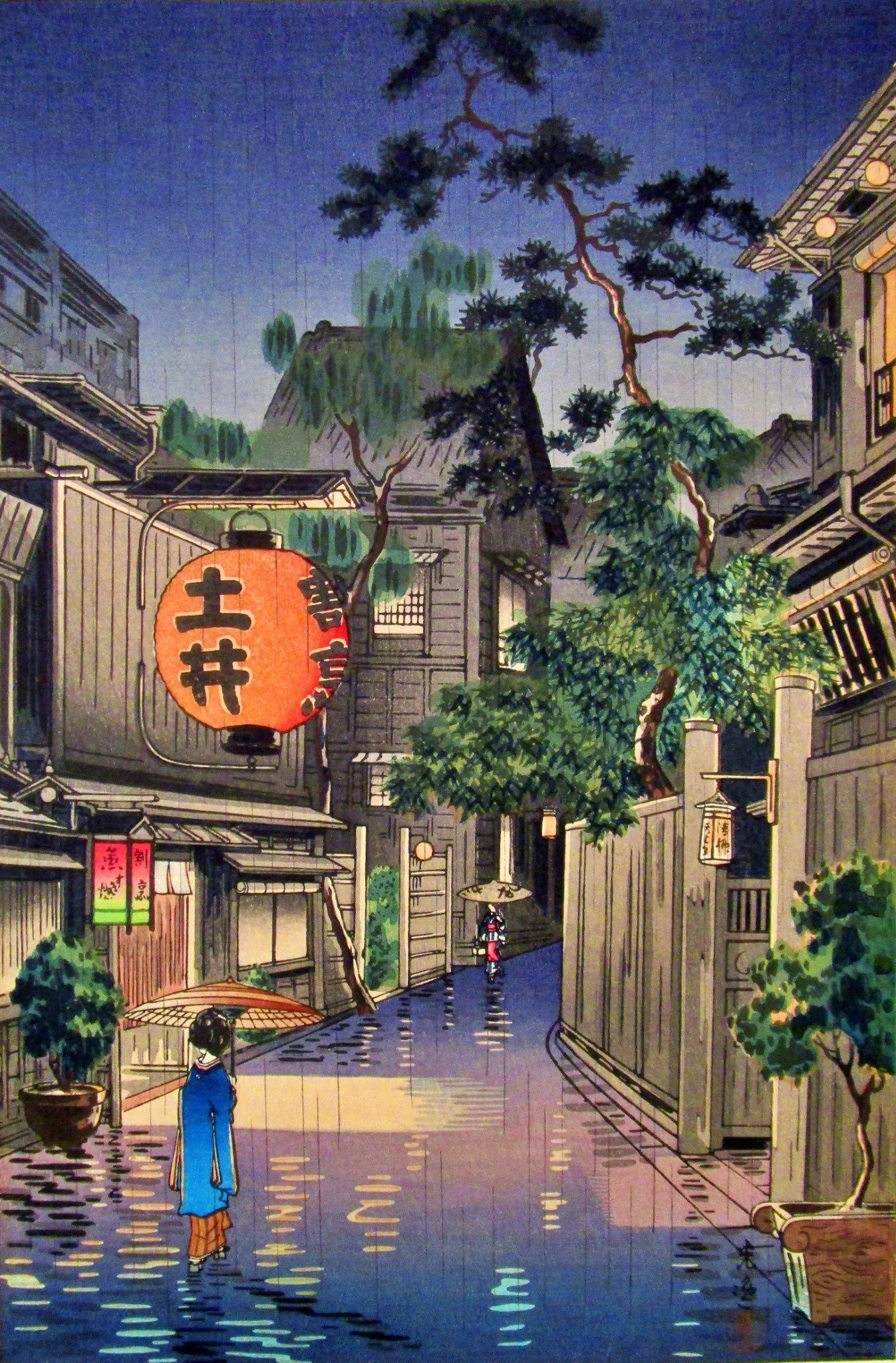
Ushigome Kagurazaka — Tsuchiya Kōitsu (1939)
Premium quality canvas print of “Ushigome Kagurazaka” by Tsuchiya Kōitsu
An orange lantern glows above a rain-washed Tokyo lane, where two umbrellas and shimmering reflections bring the evening to life. Tsuchiya Kōitsu’s Ushigome Kagurazaka creates a welcoming focal point for your home as a portrait canvas reproduction over a sturdy 1.5-inch wood stretcher.
Product details: Canvas reproduction over a sturdy 1.5-inch wood stretcher. Available in 16 × 24 in. ($259 CAD) and 24 × 36 in. ($299 CAD). No returns accepted.
More About the Art
Ushigome Kagurazaka turns a rainy Tokyo lane into an intimate theatre of colour and reflected light. A large orange lantern hangs at the left, its warm glow answered by pale windows and smaller lamps farther along the street. Beneath them, the wet pavement gathers yellow, pink, turquoise, and deep blue into broken reflections. The road curves gently between wooden buildings, drawing the eye beyond the foreground toward a more secluded passage.
Two figures beneath umbrellas establish the scale of this closely enclosed world. The nearer figure stands at the lower left in a bright blue kimono with a warm orange hem. The broad umbrella repeats the curved shape of the lantern above. A second figure appears much farther away, where a small accent of red enlivens the narrow bend. Their separation gives the street a convincing depth without disturbing its quiet atmosphere.
The buildings are described through overlapping roofs, slatted openings, projecting eaves, and long panels of weathered wood. On the right, a wall follows the curve of the lane and guides the viewer inward. Above it, a tall pine rises against the blue evening sky. Its dark clusters of needles, irregular branches, and reddish trunk create a lively vertical rhythm. Softer hanging foliage and dense greenery connect the architecture with the space above the street.
Rain falls in fine, nearly vertical lines across the scene. Its effect is clearest on the ground, where the otherwise solid surfaces become a field of shifting colour. Short horizontal strokes break the reflections into pools and dashes. Near the foreground figure, an especially broad wash of warm light crosses the road, while cooler blues collect around it. The rain gives each illuminated doorway a greater sense of welcome.
The large lantern carries the characters 土井, read Doi, which also connect the image with its publishing history. The design was created by Tsuchiya Kōitsu in August 1939, during Shōwa 14, and originally issued by Doi Sadaichi’s publishing house, Doi Hangaten. Its Japanese title is 牛込神楽坂, Ushigome Kagurazaka. Museums also record it as Kagurazaka, Ushigome, Tokyo and Evening at Ushigome. These titles identify the same evocative view of a neighbourhood street.
Kagurazaka lies in Tokyo’s historic Ushigome area. Japan’s National Diet Library describes the district in relation to the former Ushigome gate and the hill extending northwest from it. Kōitsu’s composition concentrates on the smaller spaces within that urban setting. The lane, wall, garden trees, and lanterns create a close encounter with the city, where weather and light reveal the character of familiar surroundings.
This portrait canvas reproduction preserves the supplied image composition, including the high pine branches, glowing lantern, two umbrellas, and reflections extending to the lower edge. Its appeal rests on a carefully measured balance: the lantern’s warmth meets the cool rain, the tall trees soften the buildings, and the two figures give the quiet lane a human presence. Across a room, the orange light and blue pavement make a strong impression. Closer viewing reveals the fine rain, small signs, potted plants, and subtle changes within the reflected light.
More About the Artist
Tsuchiya Kōitsu (1870–1949) was a Japanese artist celebrated for landscapes in which light changes the emotional character of a place. His views include city streets, temple grounds, bridges, coasts, and other settings seen through rain, snow, dusk, or darkness. Ushigome Kagurazaka demonstrates that sensibility through a small urban scene: illuminated buildings and a hanging lantern give warmth and clarity to a street otherwise held within cool evening rain.
Born in the Hamamatsu area of Shizuoka, Kōitsu moved to Tokyo as a young man and became a pupil of Kobayashi Kiyochika. He entered the master’s household while still in his teens and remained closely associated with it for nearly twenty years. This extended apprenticeship provided a foundation in drawing and print design. Kiyochika’s interest in the effects of light, shadow, and changing weather would remain central to Kōitsu’s own approach to landscape.
His early career included both woodblock prints and lithography. He also undertook illustration work, developing his skills across several forms of printed imagery. His later success as a shin-hanga landscape designer therefore followed many years of professional experience. The confident arrangement of architecture, figures, and illumination in his mature prints reflects an artist accustomed to shaping a complex scene into an immediately engaging image.
A new phase began in 1931, when Kōitsu met the publisher Watanabe Shōzaburō at an exhibition commemorating Kiyochika. Watanabe encouraged him to design new landscape prints, bringing him into the shin-hanga movement when he was already over sixty. Kōitsu subsequently worked with several publishers, including Doi Hangaten. This late development became one of the most productive and widely appreciated parts of his career.
The connection with Doi Sadaichi was particularly important to his mature landscape production. Ushigome Kagurazaka, dated August 1939, belongs to that collaboration. The work is now represented in museum collections including the Los Angeles County Museum of Art and Birmingham Museum of Art. Its preservation within these collections allows the design’s details, title, date, and publishing history to be studied alongside other examples of twentieth-century Japanese printmaking.
Chigasaki City Museum of Art has placed Kōitsu within a lineage of landscape artists linking him to Kiyochika and fellow pupil Inoue Yasuji. The museum has emphasized how these artists explored perspective, shading, and the expressive possibilities of familiar scenery while working through traditional print techniques. Kōitsu’s night views continue that exploration. Their subjects remain recognizable, yet carefully placed sources of light give ordinary structures and passing figures a memorable atmosphere.
Shin-hanga prints emerged through cooperation among artists, publishers, specialist carvers, and printers. Kōitsu supplied the design, while the production process required close attention to the relationship between line and colour. In the Kagurazaka scene, the fine rain, wooden latticework, small distant figure, and broken reflections call for different kinds of precision. Broad areas of blue and green hold those details together, giving the image a coherent mood without sacrificing variety.
Kōitsu’s achievement is especially clear in the way an illuminated object can organize an entire view. Here, the orange lantern is a strong focal point, but the picture continues beyond it through quieter lights, curving walls, and wet pavement. The two umbrellas connect the figures to the weather and repeat the lantern’s rounded form. The scene invites sustained looking through these relationships, offering the pleasure of a city experienced at a slower, more attentive pace.
Sources for the artwork and artist
Los Angeles County Museum of Art — Kagurazaka, Ushigome, Tokyo; Tsuchiya Kōitsu, August 1939
Otaru Art Base — Tsuchiya Kōitsu biography and Ushigome Kagurazaka; August 1939, Shōwa 14
Doi Hangaten Official Site — Tsuchiya Kōitsu, Ushigome Kagurazaka; original Japanese title
Shin-hanga Museum — Tsuchiya Kōitsu exhibition; early career, lithography and landscape practice
Art Platform Japan, Dictionary of Artists in Japan — Tsuchiya Kōitsu; dates and birthplace
National Diet Library — Ushigome / Kagurazaka; historical geography of the district
Premium quality canvas print of “Ushigome Kagurazaka” by Tsuchiya Kōitsu
An orange lantern glows above a rain-washed Tokyo lane, where two umbrellas and shimmering reflections bring the evening to life. Tsuchiya Kōitsu’s Ushigome Kagurazaka creates a welcoming focal point for your home as a portrait canvas reproduction over a sturdy 1.5-inch wood stretcher.
Product details: Canvas reproduction over a sturdy 1.5-inch wood stretcher. Available in 16 × 24 in. ($259 CAD) and 24 × 36 in. ($299 CAD). No returns accepted.
More About the Art
Ushigome Kagurazaka turns a rainy Tokyo lane into an intimate theatre of colour and reflected light. A large orange lantern hangs at the left, its warm glow answered by pale windows and smaller lamps farther along the street. Beneath them, the wet pavement gathers yellow, pink, turquoise, and deep blue into broken reflections. The road curves gently between wooden buildings, drawing the eye beyond the foreground toward a more secluded passage.
Two figures beneath umbrellas establish the scale of this closely enclosed world. The nearer figure stands at the lower left in a bright blue kimono with a warm orange hem. The broad umbrella repeats the curved shape of the lantern above. A second figure appears much farther away, where a small accent of red enlivens the narrow bend. Their separation gives the street a convincing depth without disturbing its quiet atmosphere.
The buildings are described through overlapping roofs, slatted openings, projecting eaves, and long panels of weathered wood. On the right, a wall follows the curve of the lane and guides the viewer inward. Above it, a tall pine rises against the blue evening sky. Its dark clusters of needles, irregular branches, and reddish trunk create a lively vertical rhythm. Softer hanging foliage and dense greenery connect the architecture with the space above the street.
Rain falls in fine, nearly vertical lines across the scene. Its effect is clearest on the ground, where the otherwise solid surfaces become a field of shifting colour. Short horizontal strokes break the reflections into pools and dashes. Near the foreground figure, an especially broad wash of warm light crosses the road, while cooler blues collect around it. The rain gives each illuminated doorway a greater sense of welcome.
The large lantern carries the characters 土井, read Doi, which also connect the image with its publishing history. The design was created by Tsuchiya Kōitsu in August 1939, during Shōwa 14, and originally issued by Doi Sadaichi’s publishing house, Doi Hangaten. Its Japanese title is 牛込神楽坂, Ushigome Kagurazaka. Museums also record it as Kagurazaka, Ushigome, Tokyo and Evening at Ushigome. These titles identify the same evocative view of a neighbourhood street.
Kagurazaka lies in Tokyo’s historic Ushigome area. Japan’s National Diet Library describes the district in relation to the former Ushigome gate and the hill extending northwest from it. Kōitsu’s composition concentrates on the smaller spaces within that urban setting. The lane, wall, garden trees, and lanterns create a close encounter with the city, where weather and light reveal the character of familiar surroundings.
This portrait canvas reproduction preserves the supplied image composition, including the high pine branches, glowing lantern, two umbrellas, and reflections extending to the lower edge. Its appeal rests on a carefully measured balance: the lantern’s warmth meets the cool rain, the tall trees soften the buildings, and the two figures give the quiet lane a human presence. Across a room, the orange light and blue pavement make a strong impression. Closer viewing reveals the fine rain, small signs, potted plants, and subtle changes within the reflected light.
More About the Artist
Tsuchiya Kōitsu (1870–1949) was a Japanese artist celebrated for landscapes in which light changes the emotional character of a place. His views include city streets, temple grounds, bridges, coasts, and other settings seen through rain, snow, dusk, or darkness. Ushigome Kagurazaka demonstrates that sensibility through a small urban scene: illuminated buildings and a hanging lantern give warmth and clarity to a street otherwise held within cool evening rain.
Born in the Hamamatsu area of Shizuoka, Kōitsu moved to Tokyo as a young man and became a pupil of Kobayashi Kiyochika. He entered the master’s household while still in his teens and remained closely associated with it for nearly twenty years. This extended apprenticeship provided a foundation in drawing and print design. Kiyochika’s interest in the effects of light, shadow, and changing weather would remain central to Kōitsu’s own approach to landscape.
His early career included both woodblock prints and lithography. He also undertook illustration work, developing his skills across several forms of printed imagery. His later success as a shin-hanga landscape designer therefore followed many years of professional experience. The confident arrangement of architecture, figures, and illumination in his mature prints reflects an artist accustomed to shaping a complex scene into an immediately engaging image.
A new phase began in 1931, when Kōitsu met the publisher Watanabe Shōzaburō at an exhibition commemorating Kiyochika. Watanabe encouraged him to design new landscape prints, bringing him into the shin-hanga movement when he was already over sixty. Kōitsu subsequently worked with several publishers, including Doi Hangaten. This late development became one of the most productive and widely appreciated parts of his career.
The connection with Doi Sadaichi was particularly important to his mature landscape production. Ushigome Kagurazaka, dated August 1939, belongs to that collaboration. The work is now represented in museum collections including the Los Angeles County Museum of Art and Birmingham Museum of Art. Its preservation within these collections allows the design’s details, title, date, and publishing history to be studied alongside other examples of twentieth-century Japanese printmaking.
Chigasaki City Museum of Art has placed Kōitsu within a lineage of landscape artists linking him to Kiyochika and fellow pupil Inoue Yasuji. The museum has emphasized how these artists explored perspective, shading, and the expressive possibilities of familiar scenery while working through traditional print techniques. Kōitsu’s night views continue that exploration. Their subjects remain recognizable, yet carefully placed sources of light give ordinary structures and passing figures a memorable atmosphere.
Shin-hanga prints emerged through cooperation among artists, publishers, specialist carvers, and printers. Kōitsu supplied the design, while the production process required close attention to the relationship between line and colour. In the Kagurazaka scene, the fine rain, wooden latticework, small distant figure, and broken reflections call for different kinds of precision. Broad areas of blue and green hold those details together, giving the image a coherent mood without sacrificing variety.
Kōitsu’s achievement is especially clear in the way an illuminated object can organize an entire view. Here, the orange lantern is a strong focal point, but the picture continues beyond it through quieter lights, curving walls, and wet pavement. The two umbrellas connect the figures to the weather and repeat the lantern’s rounded form. The scene invites sustained looking through these relationships, offering the pleasure of a city experienced at a slower, more attentive pace.
Sources for the artwork and artist
Los Angeles County Museum of Art — Kagurazaka, Ushigome, Tokyo; Tsuchiya Kōitsu, August 1939
Otaru Art Base — Tsuchiya Kōitsu biography and Ushigome Kagurazaka; August 1939, Shōwa 14
Doi Hangaten Official Site — Tsuchiya Kōitsu, Ushigome Kagurazaka; original Japanese title
Shin-hanga Museum — Tsuchiya Kōitsu exhibition; early career, lithography and landscape practice
Art Platform Japan, Dictionary of Artists in Japan — Tsuchiya Kōitsu; dates and birthplace
National Diet Library — Ushigome / Kagurazaka; historical geography of the district