

 Image 1 of 1
Takino River — Kawase Hasui (1929)
Premium quality canvas print of “Takino River” by Kawase Hasui
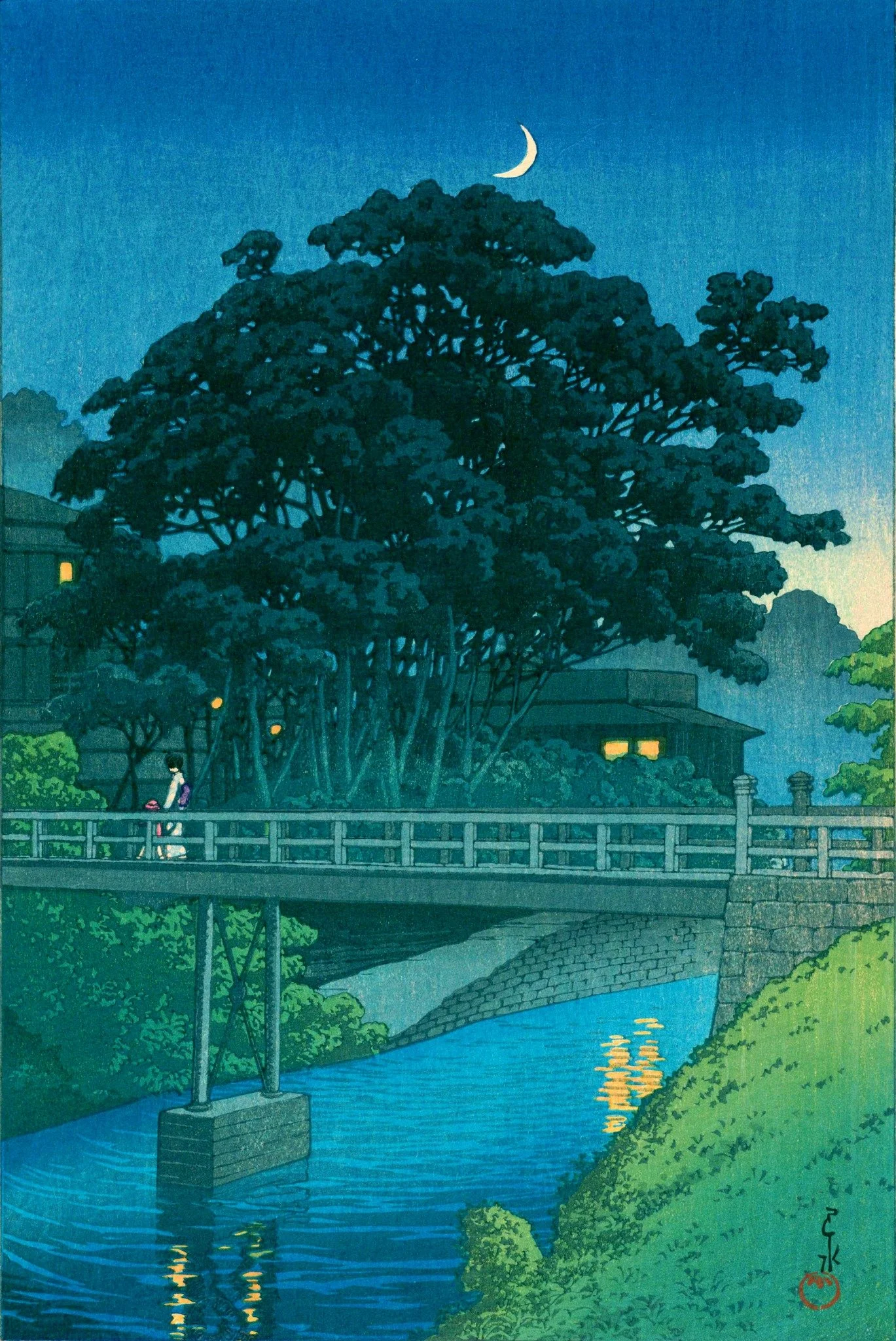
A crescent moon hangs above a leafy Tokyo neighbourhood as warm windows cast golden reflections across blue water. Kawase Hasui’s Takino River brings the gentle intimacy of a Japanese evening into your home, reproduced on canvas over a sturdy 1.5-inch wood stretcher.
Product details: Canvas reproduction over a sturdy 1.5-inch wood stretcher. Available in 16 × 24 in. ($259 CAD) and 24 × 36 in. ($299 CAD). No returns accepted.
More About the Art
Takino River gathers the life of a Tokyo neighbourhood into a quiet blue evening. A slender crescent moon hangs above the dark crown of a large tree. Below, a bridge crosses the river, with two small figures near its left side. Warm light glows from windows behind the foliage and reappears in broken reflections on the water. Green banks frame the channel, bringing a fresh, living brightness into the cool atmosphere of the scene.
The tree gives the composition its generous centre. Its clustered leaves form a broad canopy, while gaps reveal a network of branches and trunks. Rather than becoming a single dark silhouette, the foliage contains many separate shapes and changes of tone. The tree partly conceals the buildings behind it, allowing architecture and vegetation to share the setting. The houses seem embedded within a place shaped by both human use and natural growth.
Above this density, the sky feels open. Blue deepens toward the upper edge and becomes paler near the horizon at right. The crescent moon is a small, clean shape within that expanse. Its pale colour catches the eye without disturbing the composition’s calm. The space around it makes the tree below appear fuller and more sheltering, while suggesting how the neighbourhood extends beyond the limits of the view.
The bridge introduces a clear horizontal line. Repeated rails and upright posts provide a measured pattern against the irregular leaves and branches. An adult and child add a modest human presence at the left. Their scale allows the river, trees, and evening sky to remain dominant, yet their proximity gives the setting an intimate character. It is easy to imagine the familiar act of crossing a neighbourhood bridge as daylight fades.
Below, the river runs diagonally through the composition. Long blue curves describe the surface, interrupted by the bridge’s supports and patches of golden reflection. These warm marks belong to the small lights above, connecting the hidden interiors of the houses with the open water. On the right bank, vivid green foliage catches the remaining light. The scene’s depth emerges through these overlapping planes: bank, water, bridge, houses, tree, and sky.
Kawase Hasui designed Takino River in 1929 as part of Twenty Views of Tokyo, or Tokyo Nijūkei. Its Japanese title, Takinogawa, is written 瀧之川 in the Hasui catalogue. Watanabe Shōzaburō published the original woodblock design. The Edo-Tokyo Museum preserves the composition within the series, along with an original picture and a proof print that offer further evidence of its development.
The series reveals how much variety Hasui could find within the city: waterways and streets, temple precincts, changing weather, and the quieter hours of ordinary life. Here, the familiar elements of a neighbourhood become closely connected through colour and spacing. Presented as a canvas reproduction, Takino River brings that balance into a contemporary room. From across the space, its blues and greens establish a calm presence; closer viewing reveals the small figures, glowing windows, and rippling reflections. The image invites a slower look at the gentle life of the city after sunset.
More About the Artist
Kawase Hasui (1883–1957) was a Japanese artist whose landscape woodblocks made weather, season, and light central to the experience of a place. His subjects ranged from temple grounds and mountain settlements to city bridges and stretches of coast. Throughout this variety, he found ways to make a view feel both clearly observed and quietly absorbing. Takino River reflects this ability within Tokyo itself, where a familiar crossing becomes a scene of evening colour and human warmth.
Born in Tokyo with the given name Bunjiro, Hasui studied both Western-style and Japanese-style painting. His training included work with Okada Saburosuke, followed by study under Kaburaki Kiyokata from 1910. Kiyokata gave him the artist’s name Hasui. These different strands of education help explain the breadth of his visual language: strong compositional shapes coexist with a sensitive attention to distance, shading, and the changing appearance of the natural world.
The work of Itō Shinsui, a fellow pupil in Kiyokata’s circle, encouraged his interest in landscape prints. Hasui began his long association with the publisher Watanabe Shōzaburō in 1918. Their collaboration became a central part of shin-hanga, or “new prints,” the renewal of traditional Japanese woodblock production in the twentieth century. Watanabe coordinated artists, specialist carvers, and printers, allowing their different skills to contribute to the finished work.
This shared method is especially important when looking at Hasui’s landscapes. The artist supplied a design that had to be interpreted through carved blocks and repeated applications of colour. A delicate branch, a shaded sky, or a line of reflection depended on careful coordination. In Takino River, the clear rails of the bridge and the intricate mass of leaves belong to different visual rhythms, yet the finished composition brings them into a continuous atmosphere.
Travel and sketching provided Hasui with a rich supply of subjects. He visited many parts of Japan, often choosing modest views that rewarded close attention. He also returned repeatedly to his home city. Twenty Views of Tokyo joins these interests in place, memory, and everyday experience. The Metropolitan Museum of Art holds the series’ 1925 view of Zōjōji Temple in Shiba, where falling snow creates a very different mood from the blue evening of Takino River.
His working life included severe losses. The Great Kantō Earthquake of 1923 destroyed Watanabe’s premises, print stock, and woodblocks, while Hasui lost his house and sketchbooks. He continued travelling and designing afterward. The landscapes he produced in the later 1920s and beyond show a sustained commitment to observing Japan through its waterways, buildings, trees, and weather, even as the country and its cities changed around him.
Hasui remained active after the Second World War. In 1953, the production of Snow at Zōjōji Temple was documented by Japan’s Cultural Properties Protection Committee, preserving a record of the collaborative craft behind his art. By his death in 1957, his body of work encompassed more than six hundred prints. Museum collections now preserve not only finished impressions but also evidence of the design process, including materials associated with the Takinogawa composition.
His appeal rests in the relationships he creates within a view. A small figure gives scale to a bridge; a lit window gives warmth to a darkened street; water connects separate areas through reflection. These are ordinary experiences made visible with exceptional care. Takino River offers a particularly gentle introduction to that vision, combining an open sky, a sheltering canopy, and the glow of nearby homes in one enduring image of the city.
Sources
Edo-Tokyo Museum / ToMuCo — Twenty Views of Tokyo: The Takinogawa River
Edo-Tokyo Museum / ToMuCo — Takinogawa River proof print, 1929
Edo-Tokyo Museum / ToMuCo — Takinogawa River original picture
Sotheby’s — Takino River (Takinogawa); 1929 date and Watanabe publisher inscription
Kawase Hasui Catalogue — Takino-gawa River; Japanese title and series
Metropolitan Museum of Art — Zōjōji Temple in Shiba, from Twenty Views of Tokyo, 1925
Japan Museum SieboldHuis — Kawase Hasui: Capturing the Soul of Japan
Tokyo Fuji Art Museum — Kawase Hasui biography and 1953 print-production documentation
Honolulu Museum of Art — Kawase Hasui biography; Watanabe collaboration from 1918
Premium quality canvas print of “Takino River” by Kawase Hasui
A crescent moon hangs above a leafy Tokyo neighbourhood as warm windows cast golden reflections across blue water. Kawase Hasui’s Takino River brings the gentle intimacy of a Japanese evening into your home, reproduced on canvas over a sturdy 1.5-inch wood stretcher.
Product details: Canvas reproduction over a sturdy 1.5-inch wood stretcher. Available in 16 × 24 in. ($259 CAD) and 24 × 36 in. ($299 CAD). No returns accepted.
More About the Art
Takino River gathers the life of a Tokyo neighbourhood into a quiet blue evening. A slender crescent moon hangs above the dark crown of a large tree. Below, a bridge crosses the river, with two small figures near its left side. Warm light glows from windows behind the foliage and reappears in broken reflections on the water. Green banks frame the channel, bringing a fresh, living brightness into the cool atmosphere of the scene.
The tree gives the composition its generous centre. Its clustered leaves form a broad canopy, while gaps reveal a network of branches and trunks. Rather than becoming a single dark silhouette, the foliage contains many separate shapes and changes of tone. The tree partly conceals the buildings behind it, allowing architecture and vegetation to share the setting. The houses seem embedded within a place shaped by both human use and natural growth.
Above this density, the sky feels open. Blue deepens toward the upper edge and becomes paler near the horizon at right. The crescent moon is a small, clean shape within that expanse. Its pale colour catches the eye without disturbing the composition’s calm. The space around it makes the tree below appear fuller and more sheltering, while suggesting how the neighbourhood extends beyond the limits of the view.
The bridge introduces a clear horizontal line. Repeated rails and upright posts provide a measured pattern against the irregular leaves and branches. An adult and child add a modest human presence at the left. Their scale allows the river, trees, and evening sky to remain dominant, yet their proximity gives the setting an intimate character. It is easy to imagine the familiar act of crossing a neighbourhood bridge as daylight fades.
Below, the river runs diagonally through the composition. Long blue curves describe the surface, interrupted by the bridge’s supports and patches of golden reflection. These warm marks belong to the small lights above, connecting the hidden interiors of the houses with the open water. On the right bank, vivid green foliage catches the remaining light. The scene’s depth emerges through these overlapping planes: bank, water, bridge, houses, tree, and sky.
Kawase Hasui designed Takino River in 1929 as part of Twenty Views of Tokyo, or Tokyo Nijūkei. Its Japanese title, Takinogawa, is written 瀧之川 in the Hasui catalogue. Watanabe Shōzaburō published the original woodblock design. The Edo-Tokyo Museum preserves the composition within the series, along with an original picture and a proof print that offer further evidence of its development.
The series reveals how much variety Hasui could find within the city: waterways and streets, temple precincts, changing weather, and the quieter hours of ordinary life. Here, the familiar elements of a neighbourhood become closely connected through colour and spacing. Presented as a canvas reproduction, Takino River brings that balance into a contemporary room. From across the space, its blues and greens establish a calm presence; closer viewing reveals the small figures, glowing windows, and rippling reflections. The image invites a slower look at the gentle life of the city after sunset.
More About the Artist
Kawase Hasui (1883–1957) was a Japanese artist whose landscape woodblocks made weather, season, and light central to the experience of a place. His subjects ranged from temple grounds and mountain settlements to city bridges and stretches of coast. Throughout this variety, he found ways to make a view feel both clearly observed and quietly absorbing. Takino River reflects this ability within Tokyo itself, where a familiar crossing becomes a scene of evening colour and human warmth.
Born in Tokyo with the given name Bunjiro, Hasui studied both Western-style and Japanese-style painting. His training included work with Okada Saburosuke, followed by study under Kaburaki Kiyokata from 1910. Kiyokata gave him the artist’s name Hasui. These different strands of education help explain the breadth of his visual language: strong compositional shapes coexist with a sensitive attention to distance, shading, and the changing appearance of the natural world.
The work of Itō Shinsui, a fellow pupil in Kiyokata’s circle, encouraged his interest in landscape prints. Hasui began his long association with the publisher Watanabe Shōzaburō in 1918. Their collaboration became a central part of shin-hanga, or “new prints,” the renewal of traditional Japanese woodblock production in the twentieth century. Watanabe coordinated artists, specialist carvers, and printers, allowing their different skills to contribute to the finished work.
This shared method is especially important when looking at Hasui’s landscapes. The artist supplied a design that had to be interpreted through carved blocks and repeated applications of colour. A delicate branch, a shaded sky, or a line of reflection depended on careful coordination. In Takino River, the clear rails of the bridge and the intricate mass of leaves belong to different visual rhythms, yet the finished composition brings them into a continuous atmosphere.
Travel and sketching provided Hasui with a rich supply of subjects. He visited many parts of Japan, often choosing modest views that rewarded close attention. He also returned repeatedly to his home city. Twenty Views of Tokyo joins these interests in place, memory, and everyday experience. The Metropolitan Museum of Art holds the series’ 1925 view of Zōjōji Temple in Shiba, where falling snow creates a very different mood from the blue evening of Takino River.
His working life included severe losses. The Great Kantō Earthquake of 1923 destroyed Watanabe’s premises, print stock, and woodblocks, while Hasui lost his house and sketchbooks. He continued travelling and designing afterward. The landscapes he produced in the later 1920s and beyond show a sustained commitment to observing Japan through its waterways, buildings, trees, and weather, even as the country and its cities changed around him.
Hasui remained active after the Second World War. In 1953, the production of Snow at Zōjōji Temple was documented by Japan’s Cultural Properties Protection Committee, preserving a record of the collaborative craft behind his art. By his death in 1957, his body of work encompassed more than six hundred prints. Museum collections now preserve not only finished impressions but also evidence of the design process, including materials associated with the Takinogawa composition.
His appeal rests in the relationships he creates within a view. A small figure gives scale to a bridge; a lit window gives warmth to a darkened street; water connects separate areas through reflection. These are ordinary experiences made visible with exceptional care. Takino River offers a particularly gentle introduction to that vision, combining an open sky, a sheltering canopy, and the glow of nearby homes in one enduring image of the city.
Sources
Edo-Tokyo Museum / ToMuCo — Twenty Views of Tokyo: The Takinogawa River
Edo-Tokyo Museum / ToMuCo — Takinogawa River proof print, 1929
Edo-Tokyo Museum / ToMuCo — Takinogawa River original picture
Sotheby’s — Takino River (Takinogawa); 1929 date and Watanabe publisher inscription
Kawase Hasui Catalogue — Takino-gawa River; Japanese title and series
Metropolitan Museum of Art — Zōjōji Temple in Shiba, from Twenty Views of Tokyo, 1925
Japan Museum SieboldHuis — Kawase Hasui: Capturing the Soul of Japan
Tokyo Fuji Art Museum — Kawase Hasui biography and 1953 print-production documentation
Honolulu Museum of Art — Kawase Hasui biography; Watanabe collaboration from 1918