
 Image 1 of 4
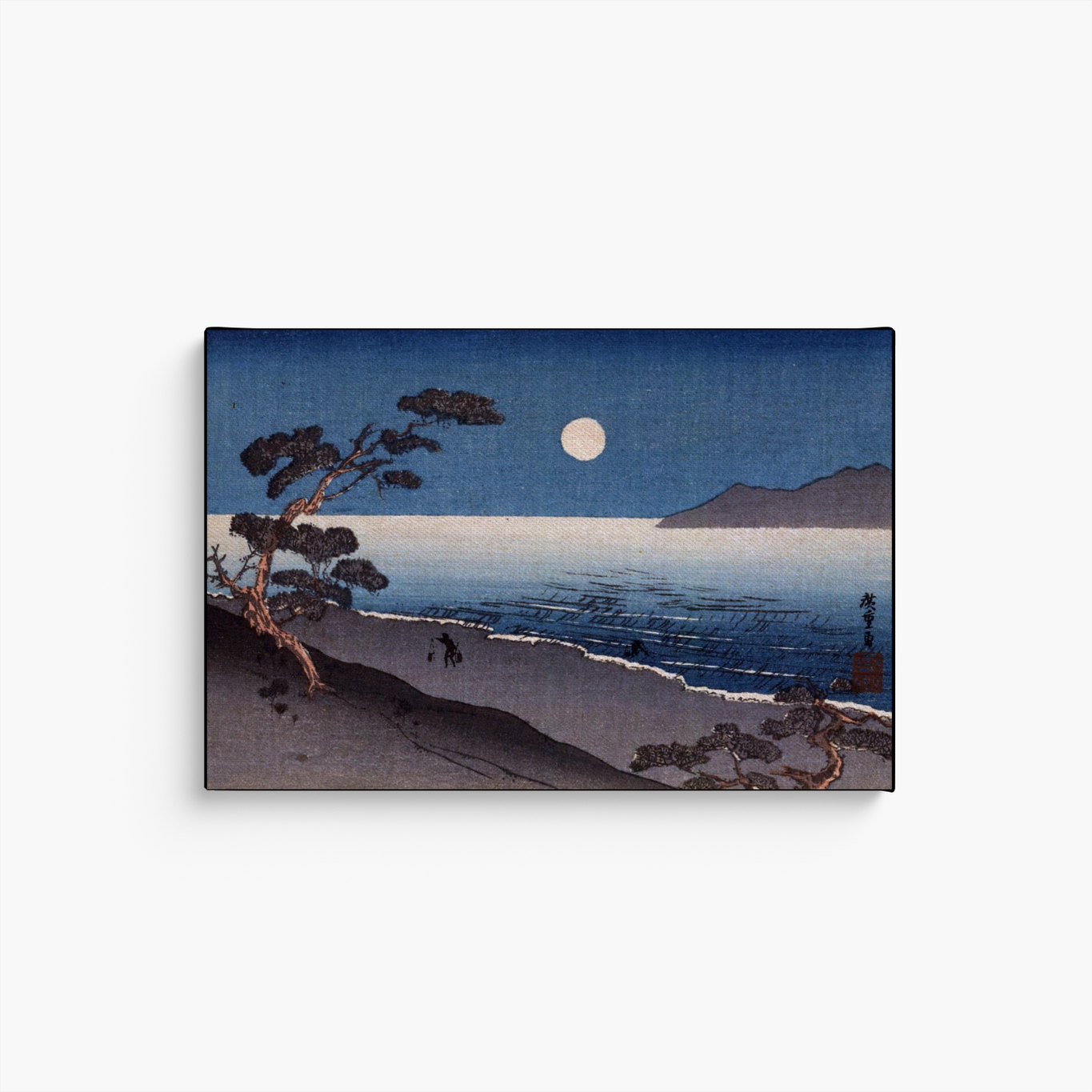 Image 2 of 4
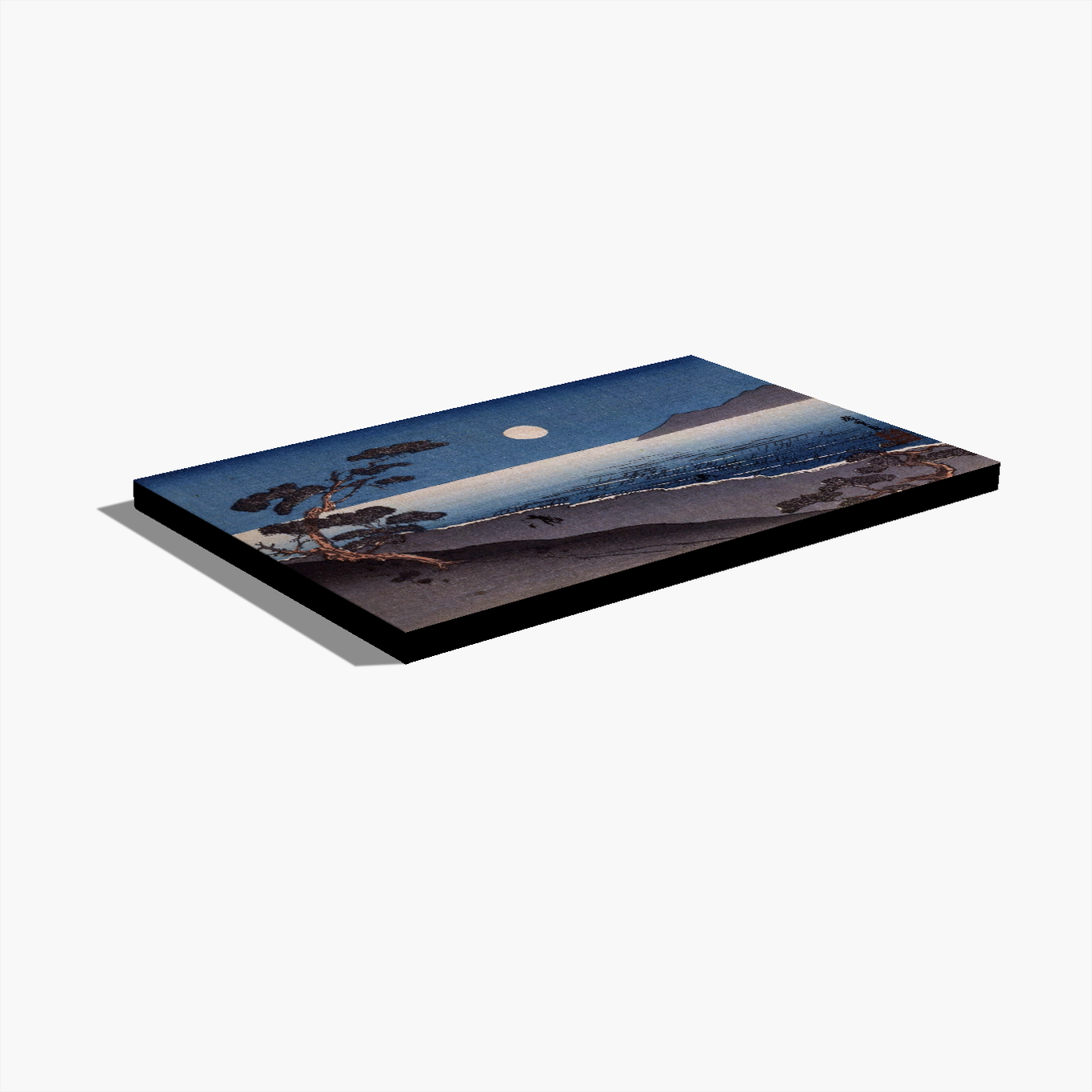 Image 3 of 4
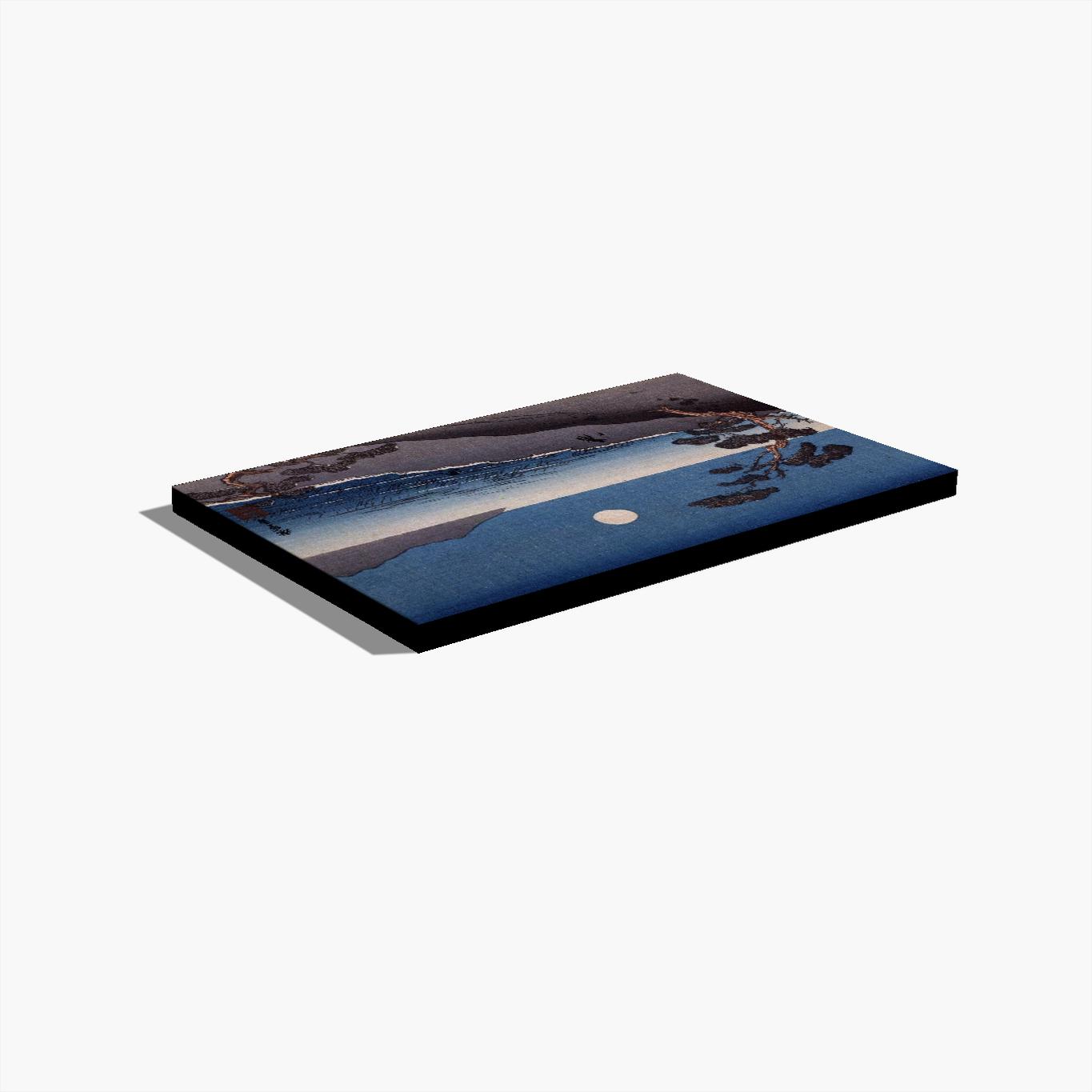 Image 4 of 4
Arai Yoshimune’s “Suma Beach at Night”
Premium quality canvas reproduction of Arai Yoshimune’s “Suma Beach at Night”
Bring the quiet of a moonlit shoreline into your home. In Arai Yoshimune’s Suma Beach at Night, a pale moon, deep blue water and sculptural pines create a scene that rewards a slower look. Reproduced on canvas over a sturdy 1.5-inch wood stretcher, it offers a calm focal point with a substantial gallery-style presence.
More About the Art:
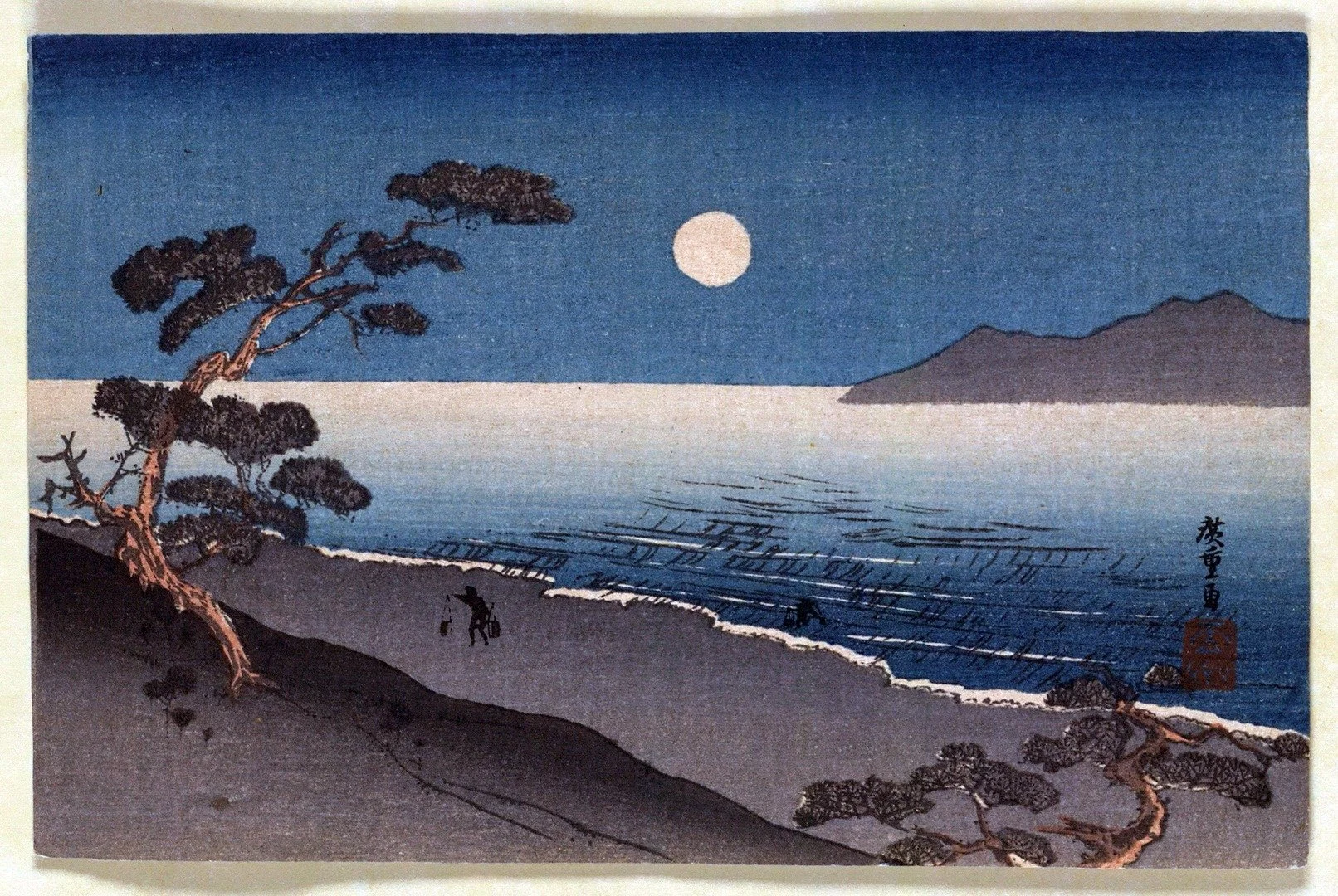
A pale, round moon hangs above an open stretch of water. At the left, a twisting pine rises from the dark foreground, its irregular branches reaching into the blue sky. Across the bay, a low, shadowed headland enters from the right. Between these darker forms, the sea opens into a broad band of light. The composition feels spacious, yet every element helps hold the view together.
The shoreline gives the scene its gentle movement. A narrow white edge of surf curves diagonally across the image, separating the blue water from the muted grey of the beach. Fine dark marks gather across the sea, suggesting ripples and the changing surface of the water. They add activity without disturbing the larger impression of quiet. Your eye can follow the shore into the distance, then return to the moon above it.
The pines provide a different rhythm. Their bent trunks and uneven clusters of foliage interrupt the broad horizontal bands of sky and sea. Warm brown tones in the bark stand out against the cool blue surroundings, bringing the foreground closer. A second pine enters at the lower right, partly cut off by the edge of the image. Together, the trees frame the open water while allowing the central view to remain clear.
A small, dark figure stands on the beach beneath the larger pine. The figure is easy to miss at first, but it changes the scale of everything around it. The trees seem taller, the shore longer and the water more expansive. The figure's identity remains indistinct, leaving their presence open to the viewer's imagination. Someone else is here, beneath the same moon, close to the sound of the surf.
The light is equally restrained. The moon is distinct and bright, while a wide, pale passage of water stretches beneath the horizon. Deeper blues gather toward the foreground, where the ripples become more visible. This movement from light to dark gives the sea a sense of distance. It also creates a gentle contrast between the clarity of the moon and the softer, more varied surface below.
Much of the image's appeal comes from its balance of openness and shelter. The water and sky offer room for the eye to wander; the pines and sloping foreground give the view a more intimate edge. You can imagine looking outward from a quiet place near the trees, with the beach opening below. The scene feels both expansive and close at hand.
As a canvas reproduction, this horizontal composition can bring a measured, restful presence to a living room, bedroom or reading space. Its blue, grey and warm brown tones offer several points of connection with an interior, while the pale moon provides a clear visual focus. The 1.5-inch wood stretcher gives the canvas a substantial presence on the wall, allowing the image itself to remain the centre of attention.
Suma Beach at Night rewards repeated looking: first the moon, then the curve of the water, then the solitary figure and the branching pines. Its beauty lies in those relationships. It offers a place for attention to settle, and a quiet coastal view to return to at the end of the day.
More About the Artist:
Arai Yoshimune was a Japanese print artist whose work extended from illustrated books to atmospheric landscapes. He is also recorded as Utagawa Yoshimune II, a name that places him within an established family of print designers. His career offers a way to explore the connections between an artist’s training, the practical work of publishing and the quieter experience of looking at a landscape.
Yoshimune was the youngest son of Utagawa Yoshimune I and spent his childhood in Tokyo. He studied with the ukiyo-e artist Tsukioka Yoshitoshi and used the artistic name Toshiyuki before working as Yoshimune II. Following his father’s death, he was adopted by the Arai family. These overlapping family and artistic names explain why his work can appear in collections under both Arai and Utagawa. He also used the name Isshōsai.
By 1893, Arai was working within the publisher Hasegawa Takejirō’s established circle of artists, alongside Suzuki Kason and Mishima Shōsō. The publisher brought together Japanese illustrators and writers working in English to produce books for readers beyond Japan. Arai’s place in this circle connects his work to a form of print publishing in which images, translated stories and the physical character of a book were closely joined.
One documented example is The Wonderful Tea Kettle, which St Olaf College’s collection credits to Arai as illustrator, with Kate James as author or translator and Hasegawa as publisher. The book first appeared in June 1896; the college holds a February 1917 printing. Its story centres on a kettle that transforms into an animal, bringing humour and movement to the illustrated page. This gives a concrete glimpse of Arai’s activity beyond the coastal landscapes associated with his name.
These books were made through a distinctive combination of picture making and skilled production. Their illustrations were printed from carved woodblocks, while the creped paper gave the finished pages a softly wrinkled, almost fabric-like surface. Text printing, image printing and binding involved different hands. Arai worked within this collaborative process as an image designer. The resulting books carried Japanese stories in a compact form that readers could hold, turn and revisit, making the encounter with an illustration part of a tactile experience.
Alongside his book illustration, Arai contributed to Hasegawa’s Night Scenes, a body of work noted in St Olaf’s account of his career. This aspect of his practice provides a useful setting for appreciating a moonlit landscape. In the coastal composition presented here, broad areas of blue, a bright moon and dark trees establish an atmosphere through a small number of clearly arranged forms.
The Smithsonian’s National Museum of Asian Art holds an impression of this composition under the descriptive title Night scene of a beach, credited to Arai Yoshimune. The museum classifies the work as a Japanese woodblock print in ink and colour on paper. That record places the design within a public collection and provides a firm reference for its attribution, while the title Suma Beach at Night is used for this canvas reproduction.
Arai’s work can be approached through these two scales of experience: the intimate world of an illustrated book and the open space of a landscape. In this beach scene, the detailed pines and small human figure coexist with wide passages of sky and water. For today’s viewer, that balance offers something easy to live with and rewarding to examine closely: a view that feels calm at first, then becomes richer as its details emerge.
Sources
Premium quality canvas reproduction of Arai Yoshimune’s “Suma Beach at Night”
Bring the quiet of a moonlit shoreline into your home. In Arai Yoshimune’s Suma Beach at Night, a pale moon, deep blue water and sculptural pines create a scene that rewards a slower look. Reproduced on canvas over a sturdy 1.5-inch wood stretcher, it offers a calm focal point with a substantial gallery-style presence.
More About the Art:
A pale, round moon hangs above an open stretch of water. At the left, a twisting pine rises from the dark foreground, its irregular branches reaching into the blue sky. Across the bay, a low, shadowed headland enters from the right. Between these darker forms, the sea opens into a broad band of light. The composition feels spacious, yet every element helps hold the view together.
The shoreline gives the scene its gentle movement. A narrow white edge of surf curves diagonally across the image, separating the blue water from the muted grey of the beach. Fine dark marks gather across the sea, suggesting ripples and the changing surface of the water. They add activity without disturbing the larger impression of quiet. Your eye can follow the shore into the distance, then return to the moon above it.
The pines provide a different rhythm. Their bent trunks and uneven clusters of foliage interrupt the broad horizontal bands of sky and sea. Warm brown tones in the bark stand out against the cool blue surroundings, bringing the foreground closer. A second pine enters at the lower right, partly cut off by the edge of the image. Together, the trees frame the open water while allowing the central view to remain clear.
A small, dark figure stands on the beach beneath the larger pine. The figure is easy to miss at first, but it changes the scale of everything around it. The trees seem taller, the shore longer and the water more expansive. The figure's identity remains indistinct, leaving their presence open to the viewer's imagination. Someone else is here, beneath the same moon, close to the sound of the surf.
The light is equally restrained. The moon is distinct and bright, while a wide, pale passage of water stretches beneath the horizon. Deeper blues gather toward the foreground, where the ripples become more visible. This movement from light to dark gives the sea a sense of distance. It also creates a gentle contrast between the clarity of the moon and the softer, more varied surface below.
Much of the image's appeal comes from its balance of openness and shelter. The water and sky offer room for the eye to wander; the pines and sloping foreground give the view a more intimate edge. You can imagine looking outward from a quiet place near the trees, with the beach opening below. The scene feels both expansive and close at hand.
As a canvas reproduction, this horizontal composition can bring a measured, restful presence to a living room, bedroom or reading space. Its blue, grey and warm brown tones offer several points of connection with an interior, while the pale moon provides a clear visual focus. The 1.5-inch wood stretcher gives the canvas a substantial presence on the wall, allowing the image itself to remain the centre of attention.
Suma Beach at Night rewards repeated looking: first the moon, then the curve of the water, then the solitary figure and the branching pines. Its beauty lies in those relationships. It offers a place for attention to settle, and a quiet coastal view to return to at the end of the day.
More About the Artist:
Arai Yoshimune was a Japanese print artist whose work extended from illustrated books to atmospheric landscapes. He is also recorded as Utagawa Yoshimune II, a name that places him within an established family of print designers. His career offers a way to explore the connections between an artist’s training, the practical work of publishing and the quieter experience of looking at a landscape.
Yoshimune was the youngest son of Utagawa Yoshimune I and spent his childhood in Tokyo. He studied with the ukiyo-e artist Tsukioka Yoshitoshi and used the artistic name Toshiyuki before working as Yoshimune II. Following his father’s death, he was adopted by the Arai family. These overlapping family and artistic names explain why his work can appear in collections under both Arai and Utagawa. He also used the name Isshōsai.
By 1893, Arai was working within the publisher Hasegawa Takejirō’s established circle of artists, alongside Suzuki Kason and Mishima Shōsō. The publisher brought together Japanese illustrators and writers working in English to produce books for readers beyond Japan. Arai’s place in this circle connects his work to a form of print publishing in which images, translated stories and the physical character of a book were closely joined.
One documented example is The Wonderful Tea Kettle, which St Olaf College’s collection credits to Arai as illustrator, with Kate James as author or translator and Hasegawa as publisher. The book first appeared in June 1896; the college holds a February 1917 printing. Its story centres on a kettle that transforms into an animal, bringing humour and movement to the illustrated page. This gives a concrete glimpse of Arai’s activity beyond the coastal landscapes associated with his name.
These books were made through a distinctive combination of picture making and skilled production. Their illustrations were printed from carved woodblocks, while the creped paper gave the finished pages a softly wrinkled, almost fabric-like surface. Text printing, image printing and binding involved different hands. Arai worked within this collaborative process as an image designer. The resulting books carried Japanese stories in a compact form that readers could hold, turn and revisit, making the encounter with an illustration part of a tactile experience.
Alongside his book illustration, Arai contributed to Hasegawa’s Night Scenes, a body of work noted in St Olaf’s account of his career. This aspect of his practice provides a useful setting for appreciating a moonlit landscape. In the coastal composition presented here, broad areas of blue, a bright moon and dark trees establish an atmosphere through a small number of clearly arranged forms.
The Smithsonian’s National Museum of Asian Art holds an impression of this composition under the descriptive title Night scene of a beach, credited to Arai Yoshimune. The museum classifies the work as a Japanese woodblock print in ink and colour on paper. That record places the design within a public collection and provides a firm reference for its attribution, while the title Suma Beach at Night is used for this canvas reproduction.
Arai’s work can be approached through these two scales of experience: the intimate world of an illustrated book and the open space of a landscape. In this beach scene, the detailed pines and small human figure coexist with wide passages of sky and water. For today’s viewer, that balance offers something easy to live with and rewarding to examine closely: a view that feels calm at first, then becomes richer as its details emerge.