

 Image 1 of 1
Spring Moon at Ninomiya Beach (Alternate Image) — Kawase Hasui (1932)
Premium quality canvas print of “Spring Moon at Ninomiya Beach (Alternate Image)” by Kawase Hasui
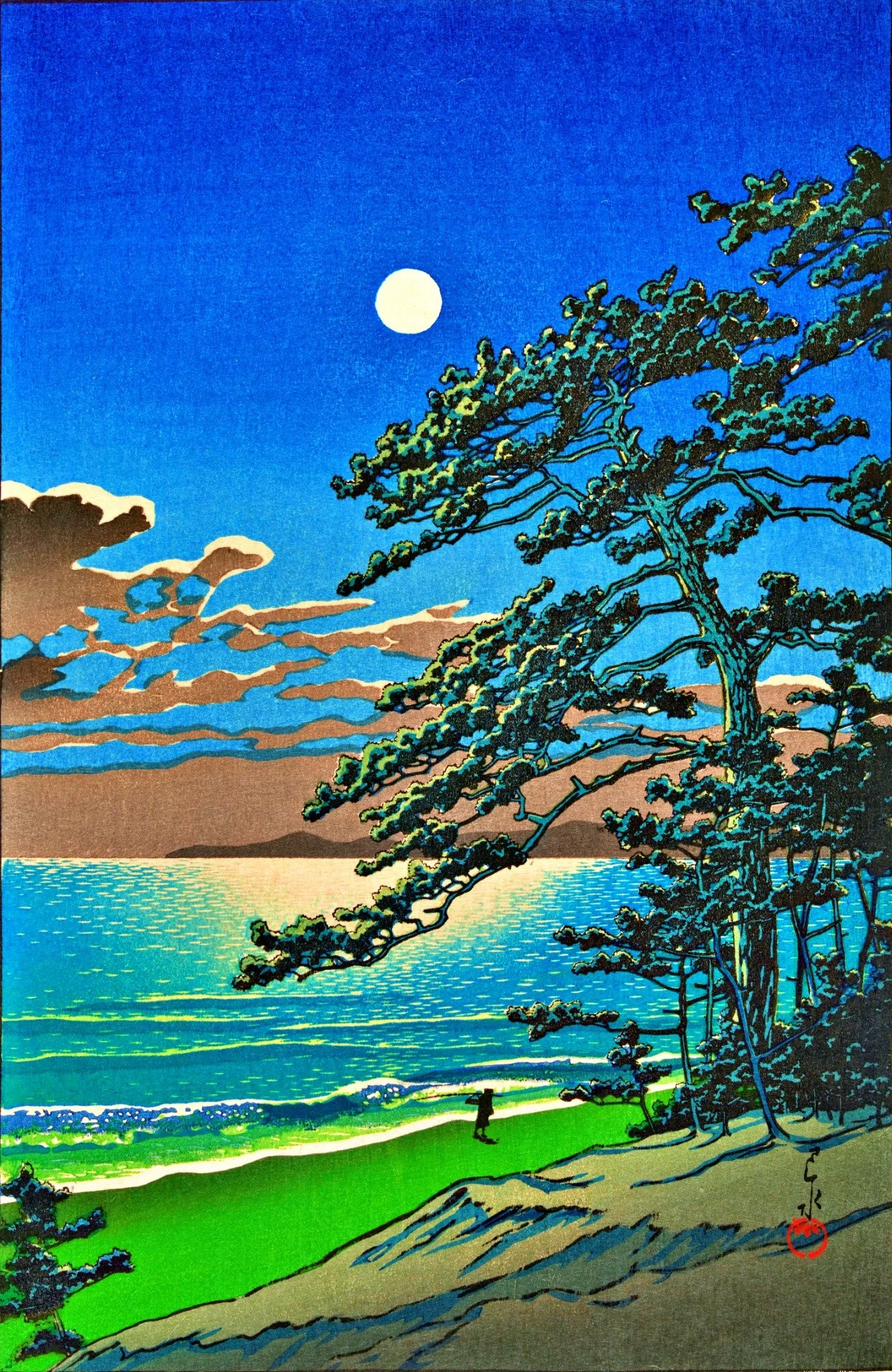
A pale full moon floats above luminous blue water, warm clouds, and sweeping coastal pines. This alternate image of Kawase Hasui’s Spring Moon at Ninomiya Beach brings vivid colour and a quiet seaside atmosphere to a portrait canvas reproduction over a sturdy 1.5-inch wood stretcher.
Product details: Canvas reproduction over a sturdy 1.5-inch wood stretcher. Available in 16 × 24 in. ($259 CAD) and 24 × 36 in. ($299 CAD). No returns accepted.
More About the Art
Spring Moon at Ninomiya Beach opens onto a coast filled with luminous colour. A pale yellow moon hangs in an expansive blue sky, while clouds in warm brown and cream stretch above the horizon. Along the right side, a stand of pines reaches outward over the water. Their intricate branches bring the nearest shore into sharp focus, framing a view that feels spacious, intimate, and remarkably still.
The moon’s simple circle provides a point of calm within this elaborate arrangement. It occupies an open area above the pine canopy, separated from the busier shapes below. The surrounding sky changes gradually in tone, giving the pale disc a clear presence. Rather than overwhelming the landscape, this small source of light sets its mood, allowing the sea, clouds, and trees to share the viewer’s attention.
The water carries that light toward the shore. Small horizontal strokes break the surface into blue, turquoise, green, and pale yellow passages. A broad luminous area beneath the distant clouds suggests moonlight spread across the sea. Nearer the beach, thin white lines mark the edges of approaching waves. These repeated bands bring a gentle sense of movement to a scene otherwise held in quiet suspension.
The pines create a different rhythm. Their trunks rise from the right foreground before leaning and dividing into long, angular limbs. Dense clusters of dark foliage alternate with openings onto the sky and sea. Pale accents catch along the needles and bark, while blue shadows cross the ground beneath them. The branches seem to reach toward the moonlit water, linking the shaded bank with the open coast beyond. Across the lower foreground, long irregular shadows reinforce the diagonal movement of the trees and give the sandy bank a gently uneven surface.
At the water’s edge, a solitary figure provides an understated human presence. The small dark silhouette stands between the bright beach and the surf, surrounded by much larger natural forms. This difference in scale makes the setting feel expansive without making it remote. The viewer can imagine the sound of the waves and the cool air beneath the trees, sharing a moment of quiet attention with the person on the shore.
Kawase Hasui designed this colour woodblock landscape in March 1932. Its Japanese title is Haru no tsuki, Ninomiya kaigan, 春の月 二宮海岸. The Smithsonian’s National Museum of Asian Art credits Doi Sadaichi as publisher, and the work remains represented in Doi’s official catalogue. The composition brings together the seasonal sensitivity and carefully balanced landscape forms associated with Hasui’s contribution to shin-hanga, the renewal of Japanese woodblock printing in the twentieth century.
This Alternate Image canvas offering uses the supplied, vividly coloured image of the 1932 design. Its portrait composition preserves the open upper sky, branching pines, moonlit water, lone figure, and patterned foreground. The meeting of clear blues, fresh greens, pale yellow light, and warm cloud forms gives the reproduction a distinctive presence. Seen from across a room, it offers a strong impression of colour and space; closer looking reveals the delicate visual rhythms that make the coastal scene so absorbing.
More About the Artist
Kawase Hasui (1883–1957) was a leading landscape designer of the shin-hanga movement, which renewed Japanese woodblock printing in the early twentieth century. His work is particularly admired for its attention to light, season, and atmosphere. Spring Moon at Ninomiya Beach brings these interests into a simple encounter between a person and the coast. The scene has recognizable trees, waves, and clouds, yet their arrangement creates an unusually concentrated feeling of stillness.
Born in Tokyo with the given name Bunjiro, Hasui studied both Western-style and Japanese-style painting. His training included work under Okada Saburosuke, followed by study with Kaburaki Kiyokata from 1910. This varied background helped him combine a sense of depth and tonal atmosphere with a strong command of line. In the Ninomiya landscape, the detailed structure of the pines and the broad passages of sky show how comfortably these approaches could work together.
His career in landscape prints began through the publisher Watanabe Shōzaburō, who issued his first designs in 1918–19. Watanabe became an essential supporter of Hasui and of shin-hanga more broadly. Their collaboration contributed many of the landscapes for which the artist is known. Hasui also worked with other publishers, including Doi Sadaichi, credited by the Smithsonian for Spring Moon at Ninomiya Beach. Recognizing those separate publishing relationships helps place each design within the wider range of his career.
Shin-hanga depended upon collaboration between designers, block carvers, printers, and publishers. Hasui supplied the image, while skilled craftspeople translated its lines and colours into a sequence of carved blocks and impressions. Such coordination made subtle changes of tone and finely articulated details possible. The pine branches, small wave marks, and quiet transitions of the sky in this composition invite attention to both the design and the craft through which a woodblock landscape took form.
Travel was central to his practice. Hasui made extensive sketching trips around Japan, gathering material from cities, villages, coastlines, and mountain settings. He often found interest in modest views as well as celebrated places. A road, a grove of trees, or a small figure near the water could become the focus of an emotionally rich landscape. His coastal pictures offer this same closeness to experience, making room for weather, distance, and the feeling of standing before a particular view.
His working life also passed through major upheavals. The Great Kantō Earthquake of 1923 destroyed Watanabe’s premises, early blocks, and print stock, and Hasui lost sketchbooks. He continued to create new work, sustaining a long career that extended beyond the Second World War. His activity included illustration as well as prints, with images appearing in magazines, menus, posters, and postcards. This variety reveals an artist whose skills reached audiences through several different forms of reproduction.
Hasui’s lasting appeal rests in the balance between careful observation and clear composition. He could make a small figure feel significant without allowing it to dominate the landscape, or use a single moon to hold together an entire coastal scene. In Spring Moon at Ninomiya Beach, the interwoven pines and open water give each other purpose. The result encourages a slower kind of looking, in which colour, line, and atmosphere remain present long after the first impression.
Sources for the artwork and artist
Premium quality canvas print of “Spring Moon at Ninomiya Beach (Alternate Image)” by Kawase Hasui
A pale full moon floats above luminous blue water, warm clouds, and sweeping coastal pines. This alternate image of Kawase Hasui’s Spring Moon at Ninomiya Beach brings vivid colour and a quiet seaside atmosphere to a portrait canvas reproduction over a sturdy 1.5-inch wood stretcher.
Product details: Canvas reproduction over a sturdy 1.5-inch wood stretcher. Available in 16 × 24 in. ($259 CAD) and 24 × 36 in. ($299 CAD). No returns accepted.
More About the Art
Spring Moon at Ninomiya Beach opens onto a coast filled with luminous colour. A pale yellow moon hangs in an expansive blue sky, while clouds in warm brown and cream stretch above the horizon. Along the right side, a stand of pines reaches outward over the water. Their intricate branches bring the nearest shore into sharp focus, framing a view that feels spacious, intimate, and remarkably still.
The moon’s simple circle provides a point of calm within this elaborate arrangement. It occupies an open area above the pine canopy, separated from the busier shapes below. The surrounding sky changes gradually in tone, giving the pale disc a clear presence. Rather than overwhelming the landscape, this small source of light sets its mood, allowing the sea, clouds, and trees to share the viewer’s attention.
The water carries that light toward the shore. Small horizontal strokes break the surface into blue, turquoise, green, and pale yellow passages. A broad luminous area beneath the distant clouds suggests moonlight spread across the sea. Nearer the beach, thin white lines mark the edges of approaching waves. These repeated bands bring a gentle sense of movement to a scene otherwise held in quiet suspension.
The pines create a different rhythm. Their trunks rise from the right foreground before leaning and dividing into long, angular limbs. Dense clusters of dark foliage alternate with openings onto the sky and sea. Pale accents catch along the needles and bark, while blue shadows cross the ground beneath them. The branches seem to reach toward the moonlit water, linking the shaded bank with the open coast beyond. Across the lower foreground, long irregular shadows reinforce the diagonal movement of the trees and give the sandy bank a gently uneven surface.
At the water’s edge, a solitary figure provides an understated human presence. The small dark silhouette stands between the bright beach and the surf, surrounded by much larger natural forms. This difference in scale makes the setting feel expansive without making it remote. The viewer can imagine the sound of the waves and the cool air beneath the trees, sharing a moment of quiet attention with the person on the shore.
Kawase Hasui designed this colour woodblock landscape in March 1932. Its Japanese title is Haru no tsuki, Ninomiya kaigan, 春の月 二宮海岸. The Smithsonian’s National Museum of Asian Art credits Doi Sadaichi as publisher, and the work remains represented in Doi’s official catalogue. The composition brings together the seasonal sensitivity and carefully balanced landscape forms associated with Hasui’s contribution to shin-hanga, the renewal of Japanese woodblock printing in the twentieth century.
This Alternate Image canvas offering uses the supplied, vividly coloured image of the 1932 design. Its portrait composition preserves the open upper sky, branching pines, moonlit water, lone figure, and patterned foreground. The meeting of clear blues, fresh greens, pale yellow light, and warm cloud forms gives the reproduction a distinctive presence. Seen from across a room, it offers a strong impression of colour and space; closer looking reveals the delicate visual rhythms that make the coastal scene so absorbing.
More About the Artist
Kawase Hasui (1883–1957) was a leading landscape designer of the shin-hanga movement, which renewed Japanese woodblock printing in the early twentieth century. His work is particularly admired for its attention to light, season, and atmosphere. Spring Moon at Ninomiya Beach brings these interests into a simple encounter between a person and the coast. The scene has recognizable trees, waves, and clouds, yet their arrangement creates an unusually concentrated feeling of stillness.
Born in Tokyo with the given name Bunjiro, Hasui studied both Western-style and Japanese-style painting. His training included work under Okada Saburosuke, followed by study with Kaburaki Kiyokata from 1910. This varied background helped him combine a sense of depth and tonal atmosphere with a strong command of line. In the Ninomiya landscape, the detailed structure of the pines and the broad passages of sky show how comfortably these approaches could work together.
His career in landscape prints began through the publisher Watanabe Shōzaburō, who issued his first designs in 1918–19. Watanabe became an essential supporter of Hasui and of shin-hanga more broadly. Their collaboration contributed many of the landscapes for which the artist is known. Hasui also worked with other publishers, including Doi Sadaichi, credited by the Smithsonian for Spring Moon at Ninomiya Beach. Recognizing those separate publishing relationships helps place each design within the wider range of his career.
Shin-hanga depended upon collaboration between designers, block carvers, printers, and publishers. Hasui supplied the image, while skilled craftspeople translated its lines and colours into a sequence of carved blocks and impressions. Such coordination made subtle changes of tone and finely articulated details possible. The pine branches, small wave marks, and quiet transitions of the sky in this composition invite attention to both the design and the craft through which a woodblock landscape took form.
Travel was central to his practice. Hasui made extensive sketching trips around Japan, gathering material from cities, villages, coastlines, and mountain settings. He often found interest in modest views as well as celebrated places. A road, a grove of trees, or a small figure near the water could become the focus of an emotionally rich landscape. His coastal pictures offer this same closeness to experience, making room for weather, distance, and the feeling of standing before a particular view.
His working life also passed through major upheavals. The Great Kantō Earthquake of 1923 destroyed Watanabe’s premises, early blocks, and print stock, and Hasui lost sketchbooks. He continued to create new work, sustaining a long career that extended beyond the Second World War. His activity included illustration as well as prints, with images appearing in magazines, menus, posters, and postcards. This variety reveals an artist whose skills reached audiences through several different forms of reproduction.
Hasui’s lasting appeal rests in the balance between careful observation and clear composition. He could make a small figure feel significant without allowing it to dominate the landscape, or use a single moon to hold together an entire coastal scene. In Spring Moon at Ninomiya Beach, the interwoven pines and open water give each other purpose. The result encourages a slower kind of looking, in which colour, line, and atmosphere remain present long after the first impression.
Sources for the artwork and artist