

 Image 1 of 1
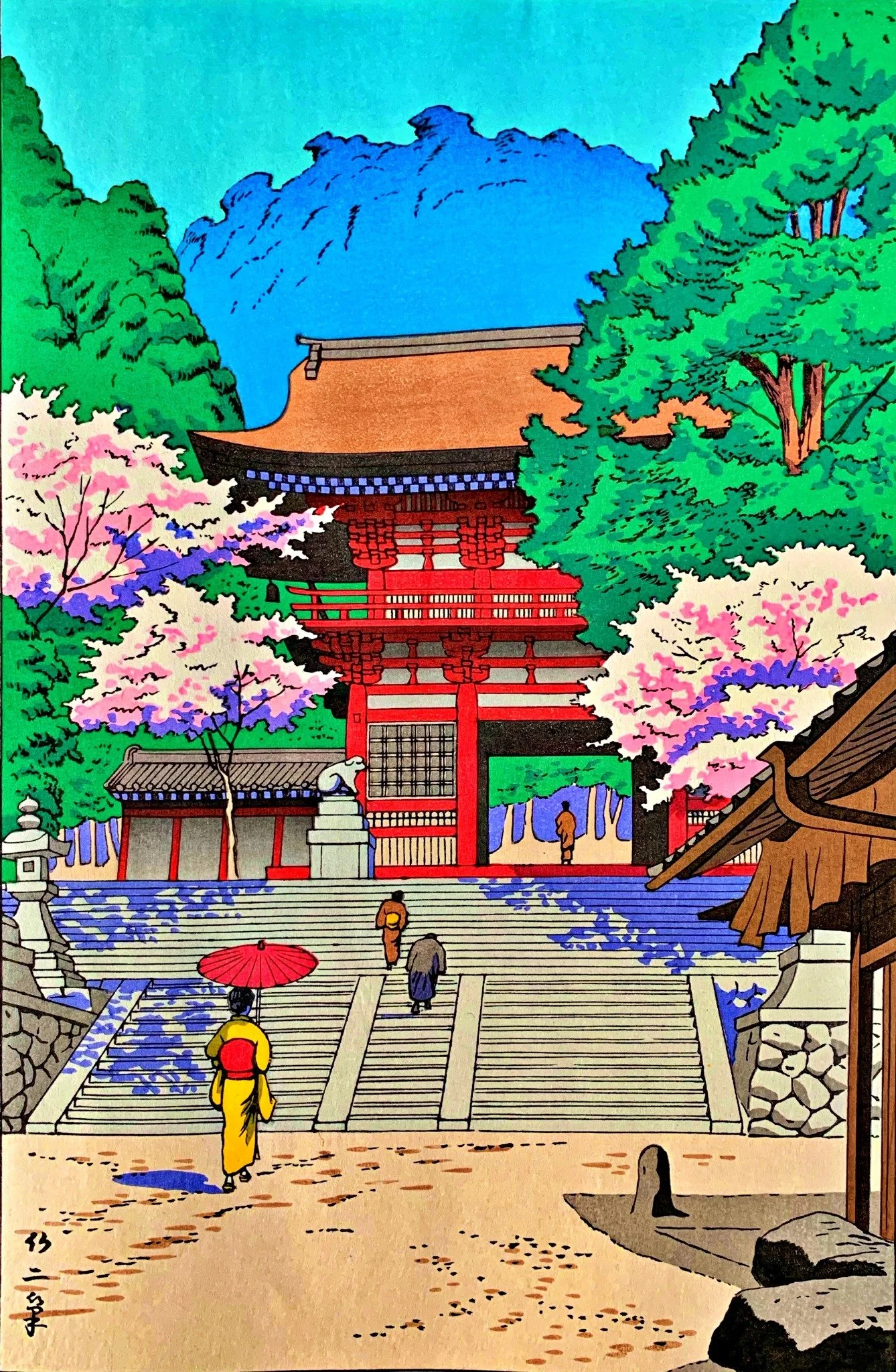
Spring in Kurama Temple (Alternate Image) — Asano Takeji (1952)
Premium quality canvas print of “Spring in Kurama Temple (Alternate Image)” by Asano Takeji
Pink cherry blossoms, a brilliant red temple gate, and a yellow kimono beneath a red parasol bring Kyoto’s springtime to life. This vivid alternate image of Asano Takeji’s Spring in Kurama Temple offers welcoming colour on portrait canvas over a sturdy 1.5-inch wood stretcher.
Product details: Canvas reproduction over a sturdy 1.5-inch wood stretcher. Available in 16 × 24 in. ($259 CAD) and 24 × 36 in. ($299 CAD). No returns accepted.
More About the Art
Spring in Kurama Temple fills its vertical composition with the freshness of a bright day among flowering trees. A vermilion gate stands at the centre, its broad roof sheltered by green foliage and a distant blue ridge. Cherry blossoms open across both sides of the entrance, spreading pale pink and cream against the darker leaves. Below them, a wide flight of stone steps leads upward from a sunlit forecourt, inviting the eye to follow the visitors into the temple grounds.
In the foreground, a figure in a yellow kimono carries a red parasol. The rounded canopy repeats the warm colour of the gate while introducing a softer shape among the straight lines of the architecture. A red obi adds another small echo. The figure’s placement near the bottom of the image gives the scene an immediate human scale: the stairs feel broad, the gate substantial, and the surrounding trees tall enough to enclose the approach.
Asano uses the steps to give this lively colour a clear structure. Narrow horizontal lines rise in successive bands, interrupted by the central stone incline and the slowly ascending visitors. Blue and violet shadows fall across the pale surfaces, suggesting branches outside the picture as well as the blossoms we can see. These strong shadows make sunlight tangible. They also connect the foreground with the blue mountain beyond, carrying a cool rhythm through the warmer portions of the design.
The temple gate forms a firm centre between these areas of movement. Its red columns, dark brackets, pale panels, and blue accents beneath the eaves are described with confident outlines. The orange roof extends sideways into the foliage, while a smaller building enters from the right edge. Asano allows this nearer roof to overlap the staircase, giving the viewer the feeling of looking from a particular place rather than surveying the scene from a detached distance.
The Japanese title, Kuramadera shunshoku (鞍馬寺春色), evokes the spring colours of Kurama Temple. The publisher, Unsodō, identifies the design’s first printing as 1952. The setting is Kurama in Kyoto, where cherry blossoms remain an important part of the mountain temple’s seasonal identity. The temple’s own account describes the winding ascent through the mountain, and Kyoto’s official tourism information notes several kinds of cherry tree in the grounds. This background gives the painted approach a recognisable seasonal setting without turning the small visitors into a specific documented event.
This listing uses a separate supplied image of the same composition already represented in the UnitedArts collection. Its vivid turquoise sky, bright greens, saturated red architecture, and violet shadows give the scene a particularly energetic presence. The designation Alternate Image identifies this reproduction image; it does not assign the pictured print to a particular historical impression, edition, or colour state.
Reproduced on canvas, the design offers a balance of welcoming colour and measured architectural detail. From across a room, the gate and blossoms establish a strong spring atmosphere. Closer inspection reveals the individual steps, fine branches, roof supports, and unhurried figures. The full supplied composition preserves that progression, from the open space at our feet to the flowering entrance and blue mountain above.
More About the Artist
Asano Takeji (1900–1998), also written Takeji Asano, was a Kyoto artist whose career joined two important directions in modern Japanese woodblock printing. He designed carefully observed landscapes for the publisher Unsodō and also made independent creative prints. His work can therefore be approached through both shin-hanga, or “new prints,” and sōsaku-hanga, or “creative prints.” Spring in Kurama Temple shows his gift for the landscape: a clearly organised place, an expressive arrangement of colour, and small figures who make the view feel lived in.
Born in Kyoto in 1900, Asano trained in the city’s art schools. The chronology maintained by YOH GRAPHICS records his graduation from the Kyoto City School of Arts and Crafts in 1919 and from the Kyoto City Painting College in 1923. His education centred on Japanese painting, although he also explored oil painting. He later studied with Tsuchida Bakusen. This combination of interests gave him experience with both the disciplined line of Japanese painting and other ways of organising colour and space.
Asano began producing woodblock prints around 1930. His early activity included groups of views of Kyoto and Osaka, and landscape remained a sustained part of his practice. Unsodō’s account notes the stimulus of Kobayashi Kiyochika’s famous views and Asano’s interest in places and events across Japan. These subjects offered more than recognisable landmarks. Changes in season, the shape of an approach to a building, or the relation between a small person and a large setting could provide the organising idea of an image.
His publishing relationship with Unsodō developed during the 1950s. Founded in Kyoto in 1891, the firm had a long involvement with art books, design, and woodblock techniques. In a published colour print, the image takes form through the work of designer, carver, printer, and publisher. Dark outlines and separate areas of colour must correspond precisely. The crisp roof brackets, stair lines, and layered foliage of the Kurama composition offer an accessible way to appreciate that coordination, even when encountered through a modern canvas reproduction.
Alongside this collaborative work, Asano pursued prints that he designed, carved, and printed himself. Fuchu Art Museum describes a growing freedom in this part of his career, with simplified forms and an affectionate, often humorous attention to people and animals. Its retrospective placed his bright famous-place views beside later images of cats, birds, and everyday encounters. Those differences reveal an artist willing to let familiar subjects change as his interests developed, while maintaining a strong feeling for the vitality of ordinary life.
In 1960, the American artist Ben Shahn visited Asano’s Kyoto studio. Fuchu Art Museum identifies their ensuing friendship as an encouragement to Asano’s individual visual world. His later work could be bold, playful, and economical in form, yet the warmth of that outlook is also easy to recognise in his landscapes. In Spring in Kurama Temple, people move without haste through an inviting public space. The blossoms, shadows, and brilliant gate share a sense of daily life made memorable through close attention. The yellow kimono and red parasol give that feeling a human centre within the larger pattern of trees and buildings.
Sources for the artwork and artist
Unsodō — company history and traditional carving and printing methods
YOH GRAPHICS — Asano Takeji chronology; Kyoto training, early print series and death in 1998
Kyoto City Tourism Association — Kurama Temple and its spring cherry blossoms
Kurama Temple — official account of the winding mountain approach
Premium quality canvas print of “Spring in Kurama Temple (Alternate Image)” by Asano Takeji
Pink cherry blossoms, a brilliant red temple gate, and a yellow kimono beneath a red parasol bring Kyoto’s springtime to life. This vivid alternate image of Asano Takeji’s Spring in Kurama Temple offers welcoming colour on portrait canvas over a sturdy 1.5-inch wood stretcher.
Product details: Canvas reproduction over a sturdy 1.5-inch wood stretcher. Available in 16 × 24 in. ($259 CAD) and 24 × 36 in. ($299 CAD). No returns accepted.
More About the Art
Spring in Kurama Temple fills its vertical composition with the freshness of a bright day among flowering trees. A vermilion gate stands at the centre, its broad roof sheltered by green foliage and a distant blue ridge. Cherry blossoms open across both sides of the entrance, spreading pale pink and cream against the darker leaves. Below them, a wide flight of stone steps leads upward from a sunlit forecourt, inviting the eye to follow the visitors into the temple grounds.
In the foreground, a figure in a yellow kimono carries a red parasol. The rounded canopy repeats the warm colour of the gate while introducing a softer shape among the straight lines of the architecture. A red obi adds another small echo. The figure’s placement near the bottom of the image gives the scene an immediate human scale: the stairs feel broad, the gate substantial, and the surrounding trees tall enough to enclose the approach.
Asano uses the steps to give this lively colour a clear structure. Narrow horizontal lines rise in successive bands, interrupted by the central stone incline and the slowly ascending visitors. Blue and violet shadows fall across the pale surfaces, suggesting branches outside the picture as well as the blossoms we can see. These strong shadows make sunlight tangible. They also connect the foreground with the blue mountain beyond, carrying a cool rhythm through the warmer portions of the design.
The temple gate forms a firm centre between these areas of movement. Its red columns, dark brackets, pale panels, and blue accents beneath the eaves are described with confident outlines. The orange roof extends sideways into the foliage, while a smaller building enters from the right edge. Asano allows this nearer roof to overlap the staircase, giving the viewer the feeling of looking from a particular place rather than surveying the scene from a detached distance.
The Japanese title, Kuramadera shunshoku (鞍馬寺春色), evokes the spring colours of Kurama Temple. The publisher, Unsodō, identifies the design’s first printing as 1952. The setting is Kurama in Kyoto, where cherry blossoms remain an important part of the mountain temple’s seasonal identity. The temple’s own account describes the winding ascent through the mountain, and Kyoto’s official tourism information notes several kinds of cherry tree in the grounds. This background gives the painted approach a recognisable seasonal setting without turning the small visitors into a specific documented event.
This listing uses a separate supplied image of the same composition already represented in the UnitedArts collection. Its vivid turquoise sky, bright greens, saturated red architecture, and violet shadows give the scene a particularly energetic presence. The designation Alternate Image identifies this reproduction image; it does not assign the pictured print to a particular historical impression, edition, or colour state.
Reproduced on canvas, the design offers a balance of welcoming colour and measured architectural detail. From across a room, the gate and blossoms establish a strong spring atmosphere. Closer inspection reveals the individual steps, fine branches, roof supports, and unhurried figures. The full supplied composition preserves that progression, from the open space at our feet to the flowering entrance and blue mountain above.
More About the Artist
Asano Takeji (1900–1998), also written Takeji Asano, was a Kyoto artist whose career joined two important directions in modern Japanese woodblock printing. He designed carefully observed landscapes for the publisher Unsodō and also made independent creative prints. His work can therefore be approached through both shin-hanga, or “new prints,” and sōsaku-hanga, or “creative prints.” Spring in Kurama Temple shows his gift for the landscape: a clearly organised place, an expressive arrangement of colour, and small figures who make the view feel lived in.
Born in Kyoto in 1900, Asano trained in the city’s art schools. The chronology maintained by YOH GRAPHICS records his graduation from the Kyoto City School of Arts and Crafts in 1919 and from the Kyoto City Painting College in 1923. His education centred on Japanese painting, although he also explored oil painting. He later studied with Tsuchida Bakusen. This combination of interests gave him experience with both the disciplined line of Japanese painting and other ways of organising colour and space.
Asano began producing woodblock prints around 1930. His early activity included groups of views of Kyoto and Osaka, and landscape remained a sustained part of his practice. Unsodō’s account notes the stimulus of Kobayashi Kiyochika’s famous views and Asano’s interest in places and events across Japan. These subjects offered more than recognisable landmarks. Changes in season, the shape of an approach to a building, or the relation between a small person and a large setting could provide the organising idea of an image.
His publishing relationship with Unsodō developed during the 1950s. Founded in Kyoto in 1891, the firm had a long involvement with art books, design, and woodblock techniques. In a published colour print, the image takes form through the work of designer, carver, printer, and publisher. Dark outlines and separate areas of colour must correspond precisely. The crisp roof brackets, stair lines, and layered foliage of the Kurama composition offer an accessible way to appreciate that coordination, even when encountered through a modern canvas reproduction.
Alongside this collaborative work, Asano pursued prints that he designed, carved, and printed himself. Fuchu Art Museum describes a growing freedom in this part of his career, with simplified forms and an affectionate, often humorous attention to people and animals. Its retrospective placed his bright famous-place views beside later images of cats, birds, and everyday encounters. Those differences reveal an artist willing to let familiar subjects change as his interests developed, while maintaining a strong feeling for the vitality of ordinary life.
In 1960, the American artist Ben Shahn visited Asano’s Kyoto studio. Fuchu Art Museum identifies their ensuing friendship as an encouragement to Asano’s individual visual world. His later work could be bold, playful, and economical in form, yet the warmth of that outlook is also easy to recognise in his landscapes. In Spring in Kurama Temple, people move without haste through an inviting public space. The blossoms, shadows, and brilliant gate share a sense of daily life made memorable through close attention. The yellow kimono and red parasol give that feeling a human centre within the larger pattern of trees and buildings.
Sources for the artwork and artist
Unsodō — company history and traditional carving and printing methods
YOH GRAPHICS — Asano Takeji chronology; Kyoto training, early print series and death in 1998
Kyoto City Tourism Association — Kurama Temple and its spring cherry blossoms
Kurama Temple — official account of the winding mountain approach