

 Image 1 of 1
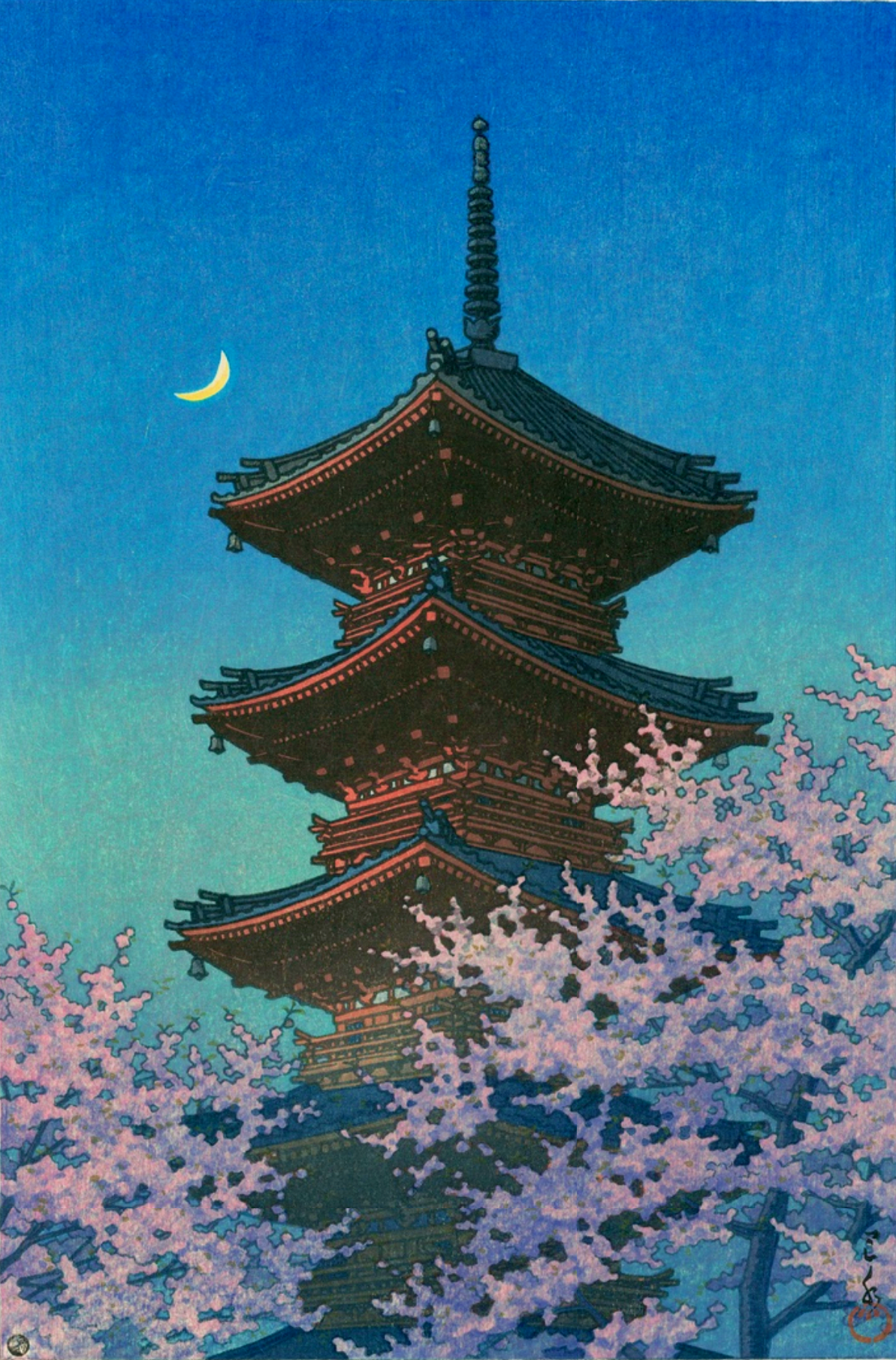
Spring Dusk at the Tōshō Shrine, Ueno — Kawase Hasui (1948)
Premium quality canvas print of “Spring Dusk at the Tōshō Shrine, Ueno” by Kawase Hasui
Pink cherry blossoms frame a graceful pagoda beneath a pale crescent moon and deepening blue sky. Kawase Hasui’s Spring Dusk at the Tōshō Shrine, Ueno brings the elegance and quiet beauty of a Japanese spring evening into your home, reproduced on canvas over a sturdy 1.5-inch wood stretcher.
Product details: Canvas reproduction over a sturdy 1.5-inch wood stretcher. Available in 16 × 24 in. ($259 CAD) and 24 × 36 in. ($299 CAD). No returns accepted.
More About the Art
Spring Dusk at the Tōshō Shrine, Ueno brings a tall pagoda into view above a profusion of cherry blossoms. A pale crescent moon hangs in the open sky at the left, while the building’s dark, curving roofs rise toward a slender finial. Warm red timber and pink flowers stand against a sky that moves from turquoise near the blossoms to deeper blue above. The image feels at once architectural and seasonal, combining a lasting structure with the brief beauty of spring.
The pagoda establishes the composition’s upward movement. Each projecting roof forms a broad horizontal shape, its edges lifting slightly before turning back toward the building. Beneath the eaves, small repeated marks describe brackets, beams, and supporting details. The tiers become narrower as they rise, leading the eye toward the long ornament at the top. Hasui makes the building feel substantial while preserving the delicacy of its construction.
The foreground blossoms create a different rhythm. Pale clusters spread from both sides and gather across the lower part of the pagoda. Small branches appear between the flowers, giving their softness a fine underlying structure. Pink, lavender, and near-white passages suggest changes of light and density. The blossoms partly conceal the building’s lower levels, so the viewer discovers the architecture through a living screen rather than seeing it as an isolated monument.
The moon provides a quiet point of focus. Its simple curved shape is surrounded by clear blue, far less detailed than either the building or the trees. That openness gives the scene room to breathe. The small moon and tall finial also establish a delicate relationship across the sky, balancing the pagoda’s strong vertical direction with a shape that seems almost weightless.
Colour holds these different elements together. The red timber remains warm even in shadow, while the roof surfaces introduce dark blue and grey. The cherry blossoms bring pale colour close to the viewer. Behind them, the sky changes gradually, creating depth without requiring a distant horizon. Looking slowly, the eye can move from an individual roof edge to the larger silhouette, then back through the flowers to the open evening sky.
Kawase Hasui designed the original colour woodblock print in 1948, and it was published by Watanabe Shōzaburō. Its Japanese title is Haru no yū (Ueno Tōshōgū), written 春の夕(上野東照宮). The setting links Ueno Tōshōgū with the nearby five-storey pagoda historically associated with Kan’ei-ji Temple, the principal building visible here. Rebuilt in 1639, the pagoda forms part of Ueno’s surviving historic landscape.
The design belongs to Hasui’s later career, when he continued finding subjects within Japan’s temples, parks, and everyday surroundings. Here, architectural detail and flowering branches create a particularly inviting balance. Presented as a canvas reproduction, Spring Dusk at the Tōshō Shrine, Ueno brings warm pinks, deep blues, and the pagoda’s graceful silhouette into a contemporary interior. From across the room, its tall shape establishes a calm presence; closer viewing reveals the patterned timber, curved roofs, slender branches, and crescent moon. It offers a moment of spring held within the stillness of dusk.
More About the Artist
Kawase Hasui (1883–1957) was a Japanese landscape artist whose colour woodblock prints connect the character of a place with the changing conditions of light, season, and weather. His subjects range from snowy streets and rain-filled temple grounds to wooded roads and moonlit coasts. He could make a familiar view feel newly absorbing through careful spacing and a sensitive palette. Spring Dusk at the Tōshō Shrine, Ueno reflects that attention in a composition built around a pagoda, flowering branches, and the evening sky.
Hasui was born in Tokyo with the given name Bunjiro. His education included Western-style painting with Okada Saburosuke and Japanese-style painting under Kaburaki Kiyokata, whose studio he joined in 1910. Kiyokata gave him his artist’s name. Experience across these approaches helped him develop an image-making language in which strong contours, convincing space, and subtle changes of colour could work together without losing their individual clarity.
The landscape prints of Itō Shinsui, a fellow artist in Kiyokata’s circle, encouraged Hasui’s interest in the woodblock medium. In 1918 he began collaborating with the publisher Watanabe Shōzaburō. Their association became central to shin-hanga, or “new prints,” the twentieth-century renewal of traditional Japanese woodblock production. This movement brought artists, specialist carvers, printers, and publishers together, allowing inherited skills to support new approaches to composition and atmosphere.
The shared production process is important to the effect of Hasui’s work. An initial drawing had to become a coordinated arrangement of carved lines and printed colours. Fine details needed to remain clear within broader passages of shade or light. In the Ueno design, the pagoda’s small architectural marks, the irregular blossoms, and the gently changing sky each call for a different treatment. Their combination makes the completed view feel both carefully constructed and naturally continuous.
Travel and sketching provided Hasui with a rich source of subjects. He journeyed widely across Japan, while also returning to Tokyo’s parks, waterways, and temple precincts. The Great Kantō Earthquake of 1923 brought major losses: Watanabe’s premises, woodblocks, and print stock were destroyed, and Hasui lost his house and sketchbooks. He continued travelling and designing afterward, producing landscapes that record a broad range of places and conditions.
His later career also unfolded against the disruption of the Second World War. Ōta City’s history museum records that he returned to Tokyo on 31 March 1948 after staying in Shiobara. Spring Dusk at the Tōshō Shrine, Ueno dates from that same year. Its flowering trees and surviving pagoda belong to the capital’s familiar landscape, presented through a composition that gives their forms and colours an especially concentrated presence.
Hasui remained active into the 1950s. In 1953, the production of Snow at Zōjōji Temple was documented by Japan’s Cultural Properties Protection Committee, preserving a record of the collaborative craft behind a finished print. His career ultimately encompassed more than six hundred designs. Museum collections now preserve the breadth of this work, making it possible to consider individual scenes alongside the recurring interests that connect them across several decades.
His lasting appeal rests in the relationships he establishes within a view. Pale flowers soften the outline of a dark roof; the open sky gives space to an intricate building; a small moon balances a rising silhouette. Spring Dusk at the Tōshō Shrine, Ueno brings these elements into a particularly serene arrangement. It offers a recognisable place with enough openness for memory and personal association, inviting the viewer to return to its details at an unhurried pace.
Sources
LACMA — Spring Dusk at the Tōshō Shrine, Ueno; colour woodblock print, 1948
Aichi Prefectural Museum of Art — 春の夕(上野東照宮); Kawase Hasui, 1948
Kawase Hasui Catalogue — Spring Dusk at Tōshō Shrine, Ueno; title and publication details
Tokyo Zoological Park Society — Former Kan’ei-ji five-storey pagoda; rebuilt in 1639
Ōta City History Museum — Hasui’s postwar work and return to Tokyo in 1948
Japan Museum SieboldHuis — Kawase Hasui: Capturing the Soul of Japan
Tokyo Fuji Art Museum — Kawase Hasui biography and 1953 print-production documentation
Premium quality canvas print of “Spring Dusk at the Tōshō Shrine, Ueno” by Kawase Hasui
Pink cherry blossoms frame a graceful pagoda beneath a pale crescent moon and deepening blue sky. Kawase Hasui’s Spring Dusk at the Tōshō Shrine, Ueno brings the elegance and quiet beauty of a Japanese spring evening into your home, reproduced on canvas over a sturdy 1.5-inch wood stretcher.
Product details: Canvas reproduction over a sturdy 1.5-inch wood stretcher. Available in 16 × 24 in. ($259 CAD) and 24 × 36 in. ($299 CAD). No returns accepted.
More About the Art
Spring Dusk at the Tōshō Shrine, Ueno brings a tall pagoda into view above a profusion of cherry blossoms. A pale crescent moon hangs in the open sky at the left, while the building’s dark, curving roofs rise toward a slender finial. Warm red timber and pink flowers stand against a sky that moves from turquoise near the blossoms to deeper blue above. The image feels at once architectural and seasonal, combining a lasting structure with the brief beauty of spring.
The pagoda establishes the composition’s upward movement. Each projecting roof forms a broad horizontal shape, its edges lifting slightly before turning back toward the building. Beneath the eaves, small repeated marks describe brackets, beams, and supporting details. The tiers become narrower as they rise, leading the eye toward the long ornament at the top. Hasui makes the building feel substantial while preserving the delicacy of its construction.
The foreground blossoms create a different rhythm. Pale clusters spread from both sides and gather across the lower part of the pagoda. Small branches appear between the flowers, giving their softness a fine underlying structure. Pink, lavender, and near-white passages suggest changes of light and density. The blossoms partly conceal the building’s lower levels, so the viewer discovers the architecture through a living screen rather than seeing it as an isolated monument.
The moon provides a quiet point of focus. Its simple curved shape is surrounded by clear blue, far less detailed than either the building or the trees. That openness gives the scene room to breathe. The small moon and tall finial also establish a delicate relationship across the sky, balancing the pagoda’s strong vertical direction with a shape that seems almost weightless.
Colour holds these different elements together. The red timber remains warm even in shadow, while the roof surfaces introduce dark blue and grey. The cherry blossoms bring pale colour close to the viewer. Behind them, the sky changes gradually, creating depth without requiring a distant horizon. Looking slowly, the eye can move from an individual roof edge to the larger silhouette, then back through the flowers to the open evening sky.
Kawase Hasui designed the original colour woodblock print in 1948, and it was published by Watanabe Shōzaburō. Its Japanese title is Haru no yū (Ueno Tōshōgū), written 春の夕(上野東照宮). The setting links Ueno Tōshōgū with the nearby five-storey pagoda historically associated with Kan’ei-ji Temple, the principal building visible here. Rebuilt in 1639, the pagoda forms part of Ueno’s surviving historic landscape.
The design belongs to Hasui’s later career, when he continued finding subjects within Japan’s temples, parks, and everyday surroundings. Here, architectural detail and flowering branches create a particularly inviting balance. Presented as a canvas reproduction, Spring Dusk at the Tōshō Shrine, Ueno brings warm pinks, deep blues, and the pagoda’s graceful silhouette into a contemporary interior. From across the room, its tall shape establishes a calm presence; closer viewing reveals the patterned timber, curved roofs, slender branches, and crescent moon. It offers a moment of spring held within the stillness of dusk.
More About the Artist
Kawase Hasui (1883–1957) was a Japanese landscape artist whose colour woodblock prints connect the character of a place with the changing conditions of light, season, and weather. His subjects range from snowy streets and rain-filled temple grounds to wooded roads and moonlit coasts. He could make a familiar view feel newly absorbing through careful spacing and a sensitive palette. Spring Dusk at the Tōshō Shrine, Ueno reflects that attention in a composition built around a pagoda, flowering branches, and the evening sky.
Hasui was born in Tokyo with the given name Bunjiro. His education included Western-style painting with Okada Saburosuke and Japanese-style painting under Kaburaki Kiyokata, whose studio he joined in 1910. Kiyokata gave him his artist’s name. Experience across these approaches helped him develop an image-making language in which strong contours, convincing space, and subtle changes of colour could work together without losing their individual clarity.
The landscape prints of Itō Shinsui, a fellow artist in Kiyokata’s circle, encouraged Hasui’s interest in the woodblock medium. In 1918 he began collaborating with the publisher Watanabe Shōzaburō. Their association became central to shin-hanga, or “new prints,” the twentieth-century renewal of traditional Japanese woodblock production. This movement brought artists, specialist carvers, printers, and publishers together, allowing inherited skills to support new approaches to composition and atmosphere.
The shared production process is important to the effect of Hasui’s work. An initial drawing had to become a coordinated arrangement of carved lines and printed colours. Fine details needed to remain clear within broader passages of shade or light. In the Ueno design, the pagoda’s small architectural marks, the irregular blossoms, and the gently changing sky each call for a different treatment. Their combination makes the completed view feel both carefully constructed and naturally continuous.
Travel and sketching provided Hasui with a rich source of subjects. He journeyed widely across Japan, while also returning to Tokyo’s parks, waterways, and temple precincts. The Great Kantō Earthquake of 1923 brought major losses: Watanabe’s premises, woodblocks, and print stock were destroyed, and Hasui lost his house and sketchbooks. He continued travelling and designing afterward, producing landscapes that record a broad range of places and conditions.
His later career also unfolded against the disruption of the Second World War. Ōta City’s history museum records that he returned to Tokyo on 31 March 1948 after staying in Shiobara. Spring Dusk at the Tōshō Shrine, Ueno dates from that same year. Its flowering trees and surviving pagoda belong to the capital’s familiar landscape, presented through a composition that gives their forms and colours an especially concentrated presence.
Hasui remained active into the 1950s. In 1953, the production of Snow at Zōjōji Temple was documented by Japan’s Cultural Properties Protection Committee, preserving a record of the collaborative craft behind a finished print. His career ultimately encompassed more than six hundred designs. Museum collections now preserve the breadth of this work, making it possible to consider individual scenes alongside the recurring interests that connect them across several decades.
His lasting appeal rests in the relationships he establishes within a view. Pale flowers soften the outline of a dark roof; the open sky gives space to an intricate building; a small moon balances a rising silhouette. Spring Dusk at the Tōshō Shrine, Ueno brings these elements into a particularly serene arrangement. It offers a recognisable place with enough openness for memory and personal association, inviting the viewer to return to its details at an unhurried pace.
Sources
LACMA — Spring Dusk at the Tōshō Shrine, Ueno; colour woodblock print, 1948
Aichi Prefectural Museum of Art — 春の夕(上野東照宮); Kawase Hasui, 1948
Kawase Hasui Catalogue — Spring Dusk at Tōshō Shrine, Ueno; title and publication details
Tokyo Zoological Park Society — Former Kan’ei-ji five-storey pagoda; rebuilt in 1639
Ōta City History Museum — Hasui’s postwar work and return to Tokyo in 1948
Japan Museum SieboldHuis — Kawase Hasui: Capturing the Soul of Japan
Tokyo Fuji Art Museum — Kawase Hasui biography and 1953 print-production documentation