

 Image 1 of 1
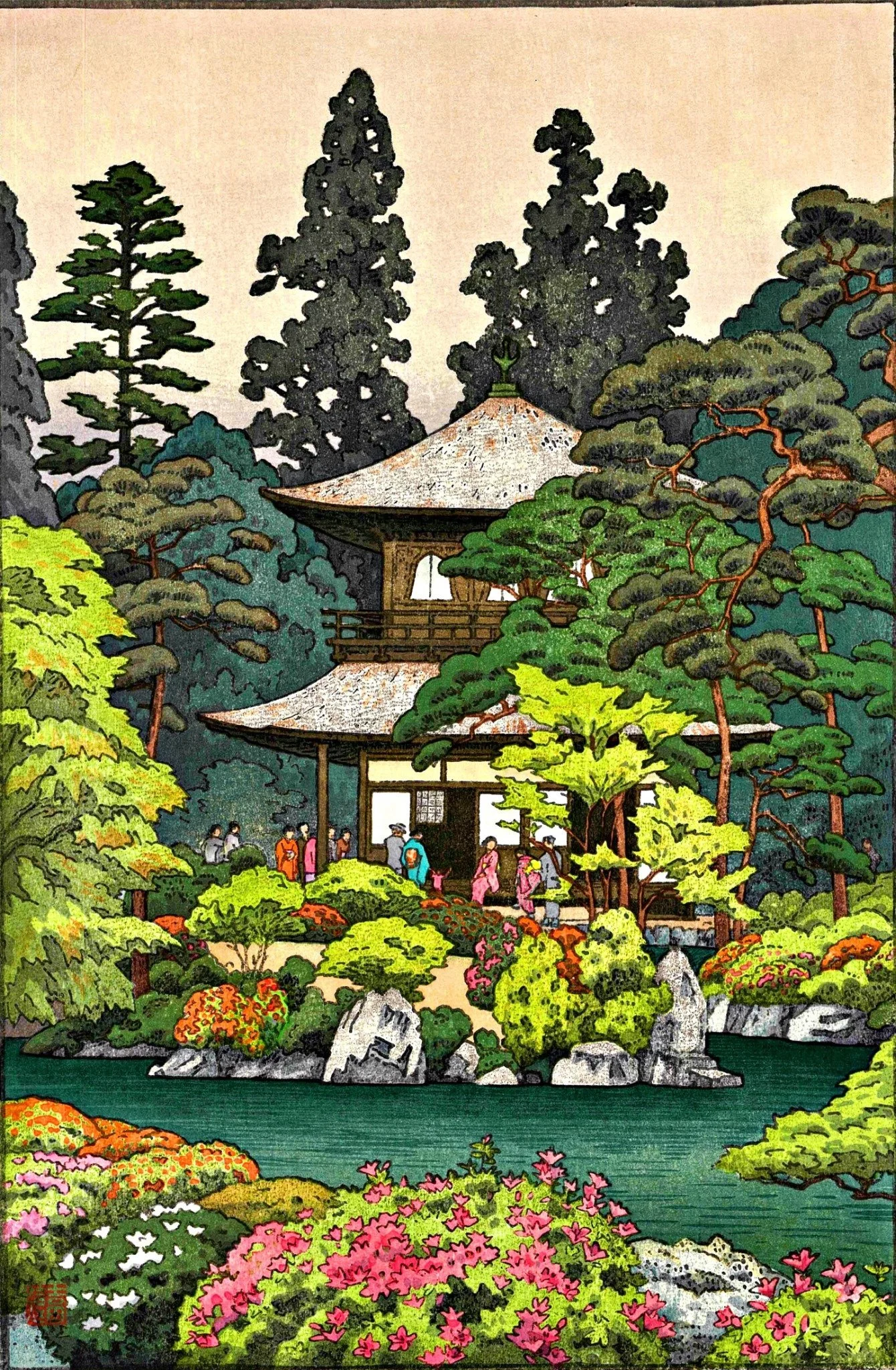
Silver Pavilion, Kyoto — Toshi Yoshida (1951)
Premium quality canvas print of “Silver Pavilion, Kyoto” by Toshi Yoshida
A quiet pavilion rises among shaped pines, flowering shrubs, stone and water in Toshi Yoshida’s Silver Pavilion, Kyoto. This portrait canvas reproduction brings the garden’s rich detail to a sturdy 1.5-inch wood stretcher.
Product details: Canvas reproduction over a sturdy 1.5-inch wood stretcher. Available in 16 × 24 in. ($259 CAD) and 24 × 36 in. ($299 CAD). No returns accepted.
More About the Art
A flowering garden fills the foreground of Silver Pavilion, Kyoto. Beyond the bright shrubs and a narrow stretch of water stands the pavilion itself, its pale roof and dark timber framed by carefully shaped pines. Tall trees rise into a softly coloured sky behind it. Small visitors gather near the lower level, giving the building a human scale. Toshi Yoshida organizes this abundance within a portrait composition, allowing the view to unfold upward through planting, architecture, and increasingly tall forms of vegetation.
The original woodblock design dates to 1951. Mokuhankan's catalogue identifies both Toshi Yoshida and that date, while its detailed views draw attention to the visitors near the structure. The title names Kyoto's Silver Pavilion, or Ginkaku. Here, the building's restrained appearance is surrounded by an especially vivid garden. The contrast allows the architecture to remain a calm centre within the scene, even as the eye is drawn to the many colours, textures, and small spatial changes around it.
The lowest part offers the closest encounter with colour. Pink and white flowers cluster among rounded green forms, with small yellow and orange passages introducing further variety. The separate plants overlap, creating a richly layered edge rather than a straight border. Their outlines remain clear enough to distinguish individual groups. This close planting gives the viewer a sense of standing at the garden's edge, looking through an arrangement of living forms toward water, stones, and the pavilion farther back.
The pond provides a quieter interval. Its blue-green surface lies between the dense planting and a line of rocks and shrubs near the building. Pale stones introduce sharper, more angular forms among the rounded bushes. These differences matter to the composition: water opens space, rocks give weight, and foliage supplies a succession of softer shapes. The eye moves between them at different speeds, pausing over a small reflection or a bright flower before finding the stronger outlines of the architecture.
The pavilion is built from a series of measured horizontals and verticals. Its roof surfaces project beyond the walls, while dark framing separates the pale areas of the upper level. The lower roof partly screens the visitors and doorway beneath it. These sheltered spaces offer another scale of detail within the garden. The small figures are easy to overlook at first, but their coloured garments and varied positions make the place feel actively visited rather than isolated from ordinary life.
Trees frame the building without forming an even enclosure. A pine on the right spreads in distinct, tiered clusters, while the taller trunks behind the pavilion rise into darker, narrower crowns. On the left, broad blue-green foliage provides a different texture. Together, these forms connect the garden's closely arranged lower shapes with the open sky above. Their varied heights keep the portrait format active, giving the pavilion space while preserving the sense that it belongs within a larger planted landscape.
This canvas reproduction retains the supplied image's full vertical arrangement. At a distance, the pale roof and tall trees establish a clear structure. Moving closer reveals small visitors, changing flower colours, irregular rocks, and the many shapes within the pines. The scene offers more than a view of a celebrated building. It invites sustained attention to the relationships that make a garden feel coherent: light and shade, open water and dense planting, precise architecture and the irregular growth surrounding it.
More About the Artist
Toshi Yoshida (1911–1995) was a Japanese painter and printmaker whose work moved between landscape, abstraction, and the observation of animals. Born in Tokyo to artists Hiroshi Yoshida and Fujio Yoshida, he grew up within a household where art was part of daily life. His father’s studio introduced him to the demanding stages of traditional woodblock production, while his later career revealed a sustained desire to explore subjects and forms on his own terms.
He learned woodblock techniques from his father and the skilled artisans working around him. He also studied painting through the Pacific Painting Association. His early prints often show an affinity with Hiroshi’s naturalistic landscapes, but the relationship between their work was never entirely simple. The Mount Holyoke College Art Museum has drawn attention to Toshi’s particular clarity of detail and his own sense of tranquillity, even in subjects that initially appear close to his father’s.
Travel expanded his artistic outlook. As a young man he accompanied Hiroshi on journeys in Asia, and he continued to travel extensively throughout his life. Landscapes, plants, and wildlife encountered abroad entered his visual vocabulary. The Muscarelle Museum of Art has emphasized the breadth of these journeys, including Canada, India, China, Argentina, Italy, Kenya, Tanzania, and the United States. His work therefore reaches beyond a single image of Japan, while remaining closely connected to Japanese printmaking practice.
After Hiroshi’s death in 1950, Toshi took over the family studio. He also pursued new directions beyond the naturalistic style associated with its earlier work. In the early 1950s he began making abstract prints, investigating relationships between colour, line, texture, and shape. These experiments connect him with sōsaku-hanga, the creative print movement that emphasized the artist’s personal engagement with the making of a print. His career crossed the boundaries that can make such movement names seem rigid.
Animals became especially important to his later work. His journeys to East Africa and other regions provided material for prints that considered wildlife within its surroundings. He also wrote and illustrated books about animals. The Tokyo National Research Institute for Cultural Properties records both this work and the cultural centre he established in Miasa, Nagano, in 1980, where woodblock printing and other crafts could be taught. Making art and sharing knowledge remained closely connected activities.
His educational role extended abroad through lectures and demonstrations of Japanese printmaking. This willingness to explain the medium helped sustain interest in its techniques across cultures. It also places his familiar, inviting images within a larger life of experimentation and exchange. A quiet tree or a small bird was never necessarily a modest ambition: such subjects allowed him to bring close observation together with the disciplined organisation of an entire picture.
His prints are held by institutions including the British Museum, MoMA, and the Cincinnati Art Museum. Silver Pavilion, Kyoto offers a particularly approachable view of his landscape practice. The building's measured lines coexist with the irregular growth of the surrounding garden. Small visitors give the architecture scale, while the bright planting establishes a distinct foreground. Looking between these different elements reveals an artist able to make a carefully observed place feel orderly, abundant, and open to individual discovery.
Sources for the artwork and artist
- Mokuhankan — Silver Pavilion, Kyoto; Toshi Yoshida, 1951
- Unsodō — official catalogue listing for 三分咲き / Cherry Blossoms and Yoshida Studio printing
- Cincinnati Art Museum — 2015 Annual Report, accession 2013.102, Cherry Blossoms, 1970, colour woodcut
- British Museum — Yoshida Tōshi; training, travel, family studio and abstract printmaking
- Mount Holyoke College Art Museum — Yoshida Family Exhibition Guide; Toshi’s individual style, detail and abstraction
- Muscarelle Museum of Art — Tree to Mountain: The Woodblock Prints of Toshi Yoshida; travel, teaching and creative print context
- Tokyo National Research Institute for Cultural Properties — Yoshida Toshi, Japanese Art Yearbook obituary; family, animal subjects, books and Miasa cultural centre
- MoMA — Toshi Yoshida artist record and numbered abstract prints of 1952
Premium quality canvas print of “Silver Pavilion, Kyoto” by Toshi Yoshida
A quiet pavilion rises among shaped pines, flowering shrubs, stone and water in Toshi Yoshida’s Silver Pavilion, Kyoto. This portrait canvas reproduction brings the garden’s rich detail to a sturdy 1.5-inch wood stretcher.
Product details: Canvas reproduction over a sturdy 1.5-inch wood stretcher. Available in 16 × 24 in. ($259 CAD) and 24 × 36 in. ($299 CAD). No returns accepted.
More About the Art
A flowering garden fills the foreground of Silver Pavilion, Kyoto. Beyond the bright shrubs and a narrow stretch of water stands the pavilion itself, its pale roof and dark timber framed by carefully shaped pines. Tall trees rise into a softly coloured sky behind it. Small visitors gather near the lower level, giving the building a human scale. Toshi Yoshida organizes this abundance within a portrait composition, allowing the view to unfold upward through planting, architecture, and increasingly tall forms of vegetation.
The original woodblock design dates to 1951. Mokuhankan's catalogue identifies both Toshi Yoshida and that date, while its detailed views draw attention to the visitors near the structure. The title names Kyoto's Silver Pavilion, or Ginkaku. Here, the building's restrained appearance is surrounded by an especially vivid garden. The contrast allows the architecture to remain a calm centre within the scene, even as the eye is drawn to the many colours, textures, and small spatial changes around it.
The lowest part offers the closest encounter with colour. Pink and white flowers cluster among rounded green forms, with small yellow and orange passages introducing further variety. The separate plants overlap, creating a richly layered edge rather than a straight border. Their outlines remain clear enough to distinguish individual groups. This close planting gives the viewer a sense of standing at the garden's edge, looking through an arrangement of living forms toward water, stones, and the pavilion farther back.
The pond provides a quieter interval. Its blue-green surface lies between the dense planting and a line of rocks and shrubs near the building. Pale stones introduce sharper, more angular forms among the rounded bushes. These differences matter to the composition: water opens space, rocks give weight, and foliage supplies a succession of softer shapes. The eye moves between them at different speeds, pausing over a small reflection or a bright flower before finding the stronger outlines of the architecture.
The pavilion is built from a series of measured horizontals and verticals. Its roof surfaces project beyond the walls, while dark framing separates the pale areas of the upper level. The lower roof partly screens the visitors and doorway beneath it. These sheltered spaces offer another scale of detail within the garden. The small figures are easy to overlook at first, but their coloured garments and varied positions make the place feel actively visited rather than isolated from ordinary life.
Trees frame the building without forming an even enclosure. A pine on the right spreads in distinct, tiered clusters, while the taller trunks behind the pavilion rise into darker, narrower crowns. On the left, broad blue-green foliage provides a different texture. Together, these forms connect the garden's closely arranged lower shapes with the open sky above. Their varied heights keep the portrait format active, giving the pavilion space while preserving the sense that it belongs within a larger planted landscape.
This canvas reproduction retains the supplied image's full vertical arrangement. At a distance, the pale roof and tall trees establish a clear structure. Moving closer reveals small visitors, changing flower colours, irregular rocks, and the many shapes within the pines. The scene offers more than a view of a celebrated building. It invites sustained attention to the relationships that make a garden feel coherent: light and shade, open water and dense planting, precise architecture and the irregular growth surrounding it.
More About the Artist
Toshi Yoshida (1911–1995) was a Japanese painter and printmaker whose work moved between landscape, abstraction, and the observation of animals. Born in Tokyo to artists Hiroshi Yoshida and Fujio Yoshida, he grew up within a household where art was part of daily life. His father’s studio introduced him to the demanding stages of traditional woodblock production, while his later career revealed a sustained desire to explore subjects and forms on his own terms.
He learned woodblock techniques from his father and the skilled artisans working around him. He also studied painting through the Pacific Painting Association. His early prints often show an affinity with Hiroshi’s naturalistic landscapes, but the relationship between their work was never entirely simple. The Mount Holyoke College Art Museum has drawn attention to Toshi’s particular clarity of detail and his own sense of tranquillity, even in subjects that initially appear close to his father’s.
Travel expanded his artistic outlook. As a young man he accompanied Hiroshi on journeys in Asia, and he continued to travel extensively throughout his life. Landscapes, plants, and wildlife encountered abroad entered his visual vocabulary. The Muscarelle Museum of Art has emphasized the breadth of these journeys, including Canada, India, China, Argentina, Italy, Kenya, Tanzania, and the United States. His work therefore reaches beyond a single image of Japan, while remaining closely connected to Japanese printmaking practice.
After Hiroshi’s death in 1950, Toshi took over the family studio. He also pursued new directions beyond the naturalistic style associated with its earlier work. In the early 1950s he began making abstract prints, investigating relationships between colour, line, texture, and shape. These experiments connect him with sōsaku-hanga, the creative print movement that emphasized the artist’s personal engagement with the making of a print. His career crossed the boundaries that can make such movement names seem rigid.
Animals became especially important to his later work. His journeys to East Africa and other regions provided material for prints that considered wildlife within its surroundings. He also wrote and illustrated books about animals. The Tokyo National Research Institute for Cultural Properties records both this work and the cultural centre he established in Miasa, Nagano, in 1980, where woodblock printing and other crafts could be taught. Making art and sharing knowledge remained closely connected activities.
His educational role extended abroad through lectures and demonstrations of Japanese printmaking. This willingness to explain the medium helped sustain interest in its techniques across cultures. It also places his familiar, inviting images within a larger life of experimentation and exchange. A quiet tree or a small bird was never necessarily a modest ambition: such subjects allowed him to bring close observation together with the disciplined organisation of an entire picture.
His prints are held by institutions including the British Museum, MoMA, and the Cincinnati Art Museum. Silver Pavilion, Kyoto offers a particularly approachable view of his landscape practice. The building's measured lines coexist with the irregular growth of the surrounding garden. Small visitors give the architecture scale, while the bright planting establishes a distinct foreground. Looking between these different elements reveals an artist able to make a carefully observed place feel orderly, abundant, and open to individual discovery.
Sources for the artwork and artist
- Mokuhankan — Silver Pavilion, Kyoto; Toshi Yoshida, 1951
- Unsodō — official catalogue listing for 三分咲き / Cherry Blossoms and Yoshida Studio printing
- Cincinnati Art Museum — 2015 Annual Report, accession 2013.102, Cherry Blossoms, 1970, colour woodcut
- British Museum — Yoshida Tōshi; training, travel, family studio and abstract printmaking
- Mount Holyoke College Art Museum — Yoshida Family Exhibition Guide; Toshi’s individual style, detail and abstraction
- Muscarelle Museum of Art — Tree to Mountain: The Woodblock Prints of Toshi Yoshida; travel, teaching and creative print context
- Tokyo National Research Institute for Cultural Properties — Yoshida Toshi, Japanese Art Yearbook obituary; family, animal subjects, books and Miasa cultural centre
- MoMA — Toshi Yoshida artist record and numbered abstract prints of 1952