

 Image 1 of 1
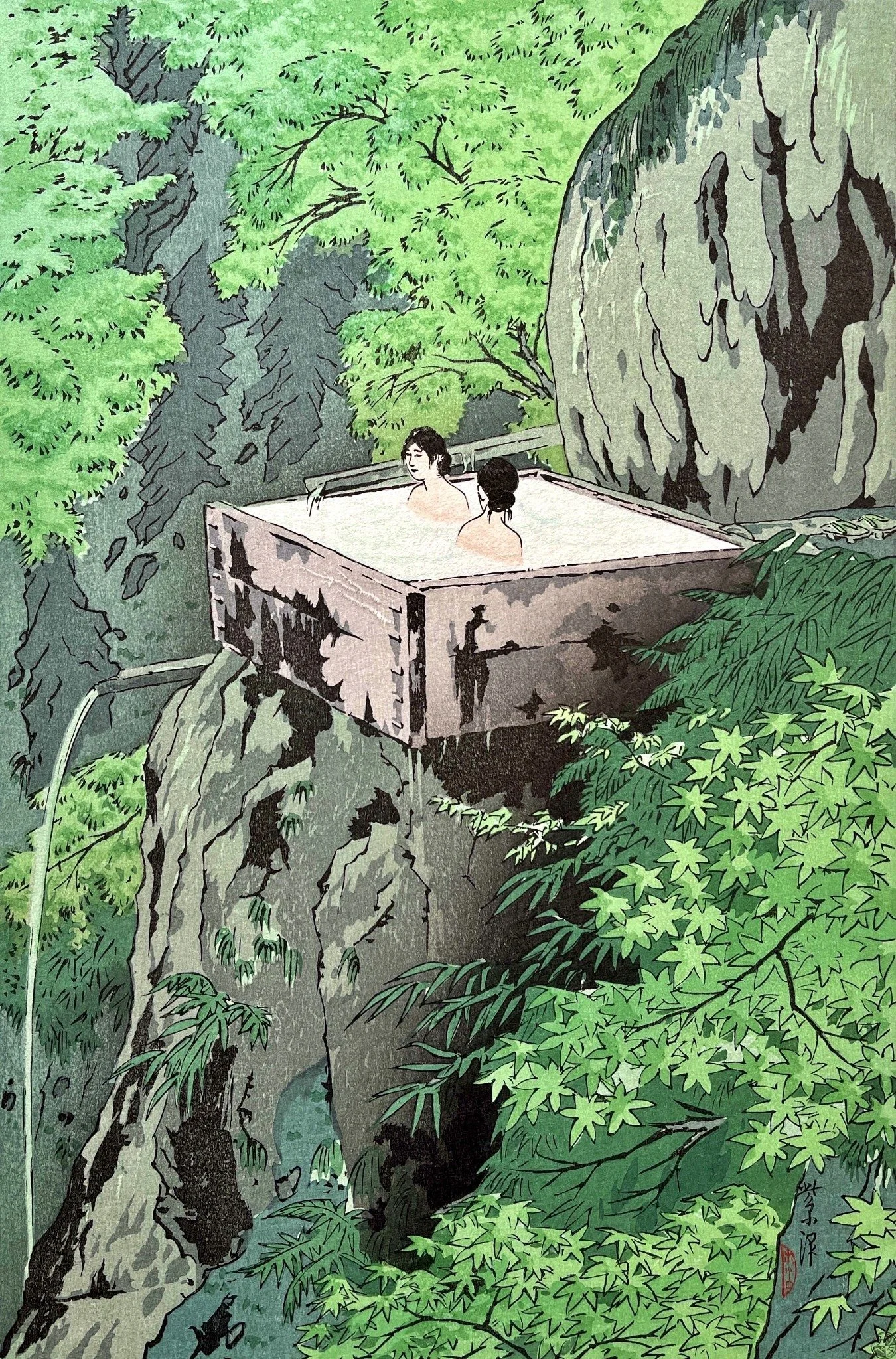
Shirahone Hot Spring, Shinshu — Shiro Kasamatsu (1935)
Premium quality canvas print of “Shirahone Hot Spring, Shinshu” by Shiro Kasamatsu
Fresh green foliage surrounds a small outdoor bath set among steep rocks in Shiro Kasamatsu’s Shirahone Hot Spring, Shinshu. This portrait canvas reproduction presents the sheltered mountain scene over a sturdy 1.5-inch wood stretcher.
Product details: Canvas reproduction over a sturdy 1.5-inch wood stretcher. Available in 16 × 24 in. ($259 CAD) and 24 × 36 in. ($299 CAD). No returns accepted.
More About the Art
A pale rectangular bath rests among steep rocks in Shirahone Hot Spring, Shinshu. Two figures sit quietly in the water, surrounded by green leaves, dark trunks, and the irregular surfaces of the mountainside. A narrow pipe supplies the pool, while water falls from a lower outlet toward the left. Shiro Kasamatsu makes this modest structure the centre of a much larger natural setting, giving the portrait composition a distinct balance between shelter, human scale, and the steep depth of the forest.
The original woodblock design was published by Watanabe Shōzaburō in 1935. The title identifies Shirahone in Shinshu, and the supplied image matches the design recorded by Ronin Gallery. Rather than presenting a distant panorama of the hot spring town, Kasamatsu brings the viewer close to a particular experience within it. The bath occupies a small opening among rocks and foliage. Its pale water becomes a calm interval within the many darker shapes and textures surrounding it.
The pool's geometry is especially clear. Straight edges establish a shallow box whose front wall projects outward above the rock face. Its upper surface is almost white, giving the two bathers a light background. Their heads and shoulders remain small and simply drawn. One figure faces partly toward the viewer, while the other turns away. This difference suggests quiet companionship without requiring a specific story. Their stillness helps establish the scene's unhurried pace and makes the surrounding growth feel especially abundant.
Rock gives the picture much of its weight. A large face rises along the right, its pale grey surface broken by long dark fissures and irregular patches of shade. Below the bath, another steep mass descends toward the bottom edge. These forms appear substantial but varied. Their outlines answer one another without repeating exactly, creating a setting that feels uneven and particular. The bath's straight sides become more noticeable because they are held within these naturally changing surfaces and contours.
The foliage introduces a different kind of detail. Bright leaves gather across the upper left and lower right, partly screening the deeper forest. Pointed maple shapes are especially distinct near the foreground, where overlapping green passages create a close and lively texture. Darker branches connect these groups, while tall shaded trunks rise behind the bath. The greens range from pale yellow-green to deeper blue-green. Their differences allow individual plants to remain visible within an overall impression of dense, encompassing woodland.
Water provides the composition's quiet movement. The bath itself appears smooth and luminous, contrasting with the rock beneath it. The slender streams at the left introduce fine pale lines that descend through darker space. Their scale is modest, yet they help explain how the structure belongs within a living landscape. The scene brings together several experiences of water: a sheltered pool, a controlled inlet, and a falling outlet, each occupying a different relationship with the surrounding stone and vegetation.
This canvas reproduction retains the full portrait arrangement of the supplied image. From a distance, the pale bath forms a clear centre among the greens and greys. Closer looking reveals the separate leaves, uneven rock markings, slender water lines, and the turned positions of the two bathers. The work offers an intimate view of landscape, where the pleasure of a place is understood through a small human pause within the larger forms, shadows, and growth of the mountain setting.
More About the Artist
Shiro Kasamatsu (1898–1991) was a Japanese painter and print designer whose long career connected the early development of shin-hanga with its continued practice after the Second World War. Born in Tokyo, he became known for landscapes, city scenes, temple grounds, and hot spring towns. His images often make a place memorable through a particular condition of light or season. In Shirahone Hot Spring, Shinshu, the small geometry of an outdoor bath becomes inseparable from the surrounding rocks, fresh green leaves, and deep forest shadows.
As a young artist, Kasamatsu studied Japanese painting under Kaburaki Kiyokata. This training placed him within a studio associated with several important modern print designers, including Kawase Hasui and Itō Shinsui. Although his teacher was especially celebrated for pictures of women, Kasamatsu developed a sustained interest in landscape. Buildings, trees, bridges, and the spaces between them supplied subjects in which he could explore both the identity of a place and the atmosphere surrounding it.
His first prints for the publisher Watanabe Shōzaburō appeared in 1919. Watanabe was a central organizer of shin-hanga, the renewed Japanese woodblock tradition that brought artists together with specialist carvers and printers. The resulting images depended on shared skills. A designer established the composition, while the carved blocks and carefully handled layers of pigment gave it material form. Kasamatsu's career began during the movement's formative years, when publishers and artists were developing new ways to present contemporary Japanese life through established printmaking methods.
The Ōta Memorial Museum of Art emphasizes his sensitive use of pale colour in views of Tokyo and hot spring areas. That restraint can be understood as a way of allowing architecture and weather to occupy the same image without one overwhelming the other. A street, roof, or distant hillside remains legible, while the surrounding air changes its appearance. His pictures reward attention to intervals as much as objects: an opening between branches, a stretch of water, or a softly coloured area of sky can become crucial to the composition.
Shirahone Hot Spring, Shinshu belongs to Kasamatsu's prewar work with Watanabe and dates to 1935. Its enclosed bath, surrounding rocks, and small figures show how a landscape can also suggest a personal experience of a place. After the war, he worked with the Kyoto publisher Unsōdō. The Ōta Memorial Museum dates this important phase of his shin-hanga production to 1952–1959. His career connects distinct periods in modern Japanese woodblock landscape while maintaining a patient attention to atmosphere, season, and ordinary human life.
Kasamatsu also explored sōsaku-hanga, producing work through his own designing, carving, and printing. His career thus encompassed both the collaborative publishing tradition and a more individually controlled printmaking practice. This breadth helps place him within the changing history of twentieth-century Japanese prints. The Ōta Memorial Museum devoted a major exhibition to his shin-hanga in 2021, bringing together early and postwar works. Looking at his images today, the enduring attraction is their patient observation: ordinary paths, buildings, trees, and waterways become places where colour, craft, and quiet human experience meet. Each scene offers a different invitation to look closely and remain for a moment.
Sources for the artwork and artist
Premium quality canvas print of “Shirahone Hot Spring, Shinshu” by Shiro Kasamatsu
Fresh green foliage surrounds a small outdoor bath set among steep rocks in Shiro Kasamatsu’s Shirahone Hot Spring, Shinshu. This portrait canvas reproduction presents the sheltered mountain scene over a sturdy 1.5-inch wood stretcher.
Product details: Canvas reproduction over a sturdy 1.5-inch wood stretcher. Available in 16 × 24 in. ($259 CAD) and 24 × 36 in. ($299 CAD). No returns accepted.
More About the Art
A pale rectangular bath rests among steep rocks in Shirahone Hot Spring, Shinshu. Two figures sit quietly in the water, surrounded by green leaves, dark trunks, and the irregular surfaces of the mountainside. A narrow pipe supplies the pool, while water falls from a lower outlet toward the left. Shiro Kasamatsu makes this modest structure the centre of a much larger natural setting, giving the portrait composition a distinct balance between shelter, human scale, and the steep depth of the forest.
The original woodblock design was published by Watanabe Shōzaburō in 1935. The title identifies Shirahone in Shinshu, and the supplied image matches the design recorded by Ronin Gallery. Rather than presenting a distant panorama of the hot spring town, Kasamatsu brings the viewer close to a particular experience within it. The bath occupies a small opening among rocks and foliage. Its pale water becomes a calm interval within the many darker shapes and textures surrounding it.
The pool's geometry is especially clear. Straight edges establish a shallow box whose front wall projects outward above the rock face. Its upper surface is almost white, giving the two bathers a light background. Their heads and shoulders remain small and simply drawn. One figure faces partly toward the viewer, while the other turns away. This difference suggests quiet companionship without requiring a specific story. Their stillness helps establish the scene's unhurried pace and makes the surrounding growth feel especially abundant.
Rock gives the picture much of its weight. A large face rises along the right, its pale grey surface broken by long dark fissures and irregular patches of shade. Below the bath, another steep mass descends toward the bottom edge. These forms appear substantial but varied. Their outlines answer one another without repeating exactly, creating a setting that feels uneven and particular. The bath's straight sides become more noticeable because they are held within these naturally changing surfaces and contours.
The foliage introduces a different kind of detail. Bright leaves gather across the upper left and lower right, partly screening the deeper forest. Pointed maple shapes are especially distinct near the foreground, where overlapping green passages create a close and lively texture. Darker branches connect these groups, while tall shaded trunks rise behind the bath. The greens range from pale yellow-green to deeper blue-green. Their differences allow individual plants to remain visible within an overall impression of dense, encompassing woodland.
Water provides the composition's quiet movement. The bath itself appears smooth and luminous, contrasting with the rock beneath it. The slender streams at the left introduce fine pale lines that descend through darker space. Their scale is modest, yet they help explain how the structure belongs within a living landscape. The scene brings together several experiences of water: a sheltered pool, a controlled inlet, and a falling outlet, each occupying a different relationship with the surrounding stone and vegetation.
This canvas reproduction retains the full portrait arrangement of the supplied image. From a distance, the pale bath forms a clear centre among the greens and greys. Closer looking reveals the separate leaves, uneven rock markings, slender water lines, and the turned positions of the two bathers. The work offers an intimate view of landscape, where the pleasure of a place is understood through a small human pause within the larger forms, shadows, and growth of the mountain setting.
More About the Artist
Shiro Kasamatsu (1898–1991) was a Japanese painter and print designer whose long career connected the early development of shin-hanga with its continued practice after the Second World War. Born in Tokyo, he became known for landscapes, city scenes, temple grounds, and hot spring towns. His images often make a place memorable through a particular condition of light or season. In Shirahone Hot Spring, Shinshu, the small geometry of an outdoor bath becomes inseparable from the surrounding rocks, fresh green leaves, and deep forest shadows.
As a young artist, Kasamatsu studied Japanese painting under Kaburaki Kiyokata. This training placed him within a studio associated with several important modern print designers, including Kawase Hasui and Itō Shinsui. Although his teacher was especially celebrated for pictures of women, Kasamatsu developed a sustained interest in landscape. Buildings, trees, bridges, and the spaces between them supplied subjects in which he could explore both the identity of a place and the atmosphere surrounding it.
His first prints for the publisher Watanabe Shōzaburō appeared in 1919. Watanabe was a central organizer of shin-hanga, the renewed Japanese woodblock tradition that brought artists together with specialist carvers and printers. The resulting images depended on shared skills. A designer established the composition, while the carved blocks and carefully handled layers of pigment gave it material form. Kasamatsu's career began during the movement's formative years, when publishers and artists were developing new ways to present contemporary Japanese life through established printmaking methods.
The Ōta Memorial Museum of Art emphasizes his sensitive use of pale colour in views of Tokyo and hot spring areas. That restraint can be understood as a way of allowing architecture and weather to occupy the same image without one overwhelming the other. A street, roof, or distant hillside remains legible, while the surrounding air changes its appearance. His pictures reward attention to intervals as much as objects: an opening between branches, a stretch of water, or a softly coloured area of sky can become crucial to the composition.
Shirahone Hot Spring, Shinshu belongs to Kasamatsu's prewar work with Watanabe and dates to 1935. Its enclosed bath, surrounding rocks, and small figures show how a landscape can also suggest a personal experience of a place. After the war, he worked with the Kyoto publisher Unsōdō. The Ōta Memorial Museum dates this important phase of his shin-hanga production to 1952–1959. His career connects distinct periods in modern Japanese woodblock landscape while maintaining a patient attention to atmosphere, season, and ordinary human life.
Kasamatsu also explored sōsaku-hanga, producing work through his own designing, carving, and printing. His career thus encompassed both the collaborative publishing tradition and a more individually controlled printmaking practice. This breadth helps place him within the changing history of twentieth-century Japanese prints. The Ōta Memorial Museum devoted a major exhibition to his shin-hanga in 2021, bringing together early and postwar works. Looking at his images today, the enduring attraction is their patient observation: ordinary paths, buildings, trees, and waterways become places where colour, craft, and quiet human experience meet. Each scene offers a different invitation to look closely and remain for a moment.