

 Image 1 of 1
Senjomaku Cliff at Lake Towada — Kawase Hasui (1919)
Premium quality canvas print of “Senjomaku Cliff at Lake Towada” by Kawase Hasui
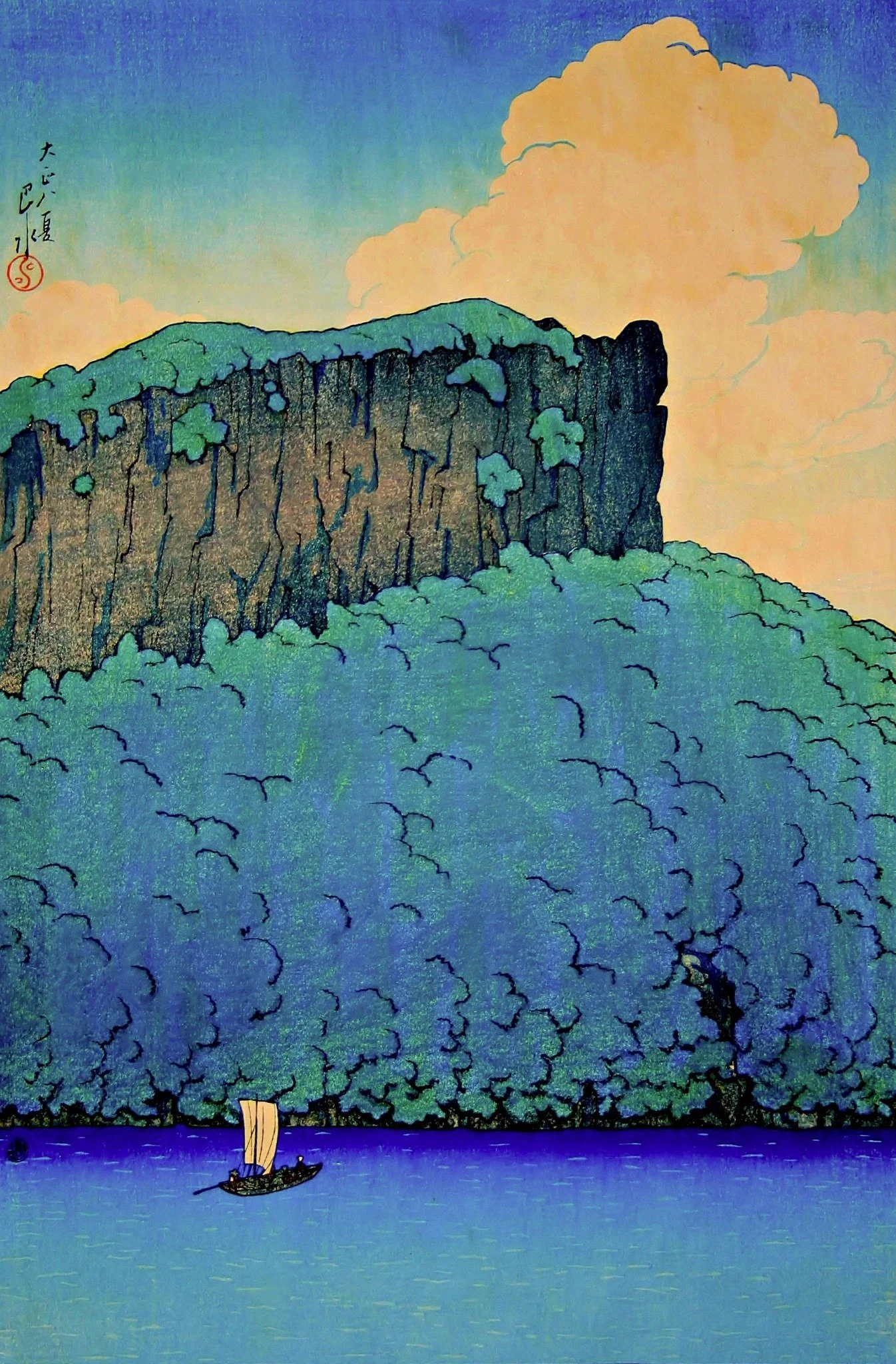
A tiny white sail crosses blue water beneath a wooded cliff and a great golden cloud in Kawase Hasui’s Senjomaku Cliff at Lake Towada. This portrait canvas reproduction brings the expansive landscape to a sturdy 1.5-inch wood stretcher.
Product details: Canvas reproduction over a sturdy 1.5-inch wood stretcher. Available in 16 × 24 in. ($259 CAD) and 24 × 36 in. ($299 CAD). No returns accepted.
More About the Art
A small white sail moves across the blue water at the foot of Senjomaku Cliff at Lake Towada. Above it, dense woodland rises toward a sheer wall of rock, while a large golden cloud fills the upper right. Kawase Hasui creates a striking relationship between the tiny boat and the immense surrounding landscape. The portrait format gives the cliff and trees a towering presence, yet the open water and luminous sky keep the composition spacious rather than enclosed or heavy.
The original woodblock design dates to 1919 and was published by Watanabe Shōzaburō as part of Souvenirs of Travels, First Collection. The National Museum of Asian Art records the title, artist, publisher, and year. This early design differs from Hasui's later 1933 view of the same cliffs. In the supplied image, no close foreground tree interrupts the lake. The viewer faces a clear sequence of water, wooded slope, exposed rock, and sky, each occupying a distinct part of the tall composition.
The boat establishes a human scale. Its dark narrow hull lies close to the lower edge, while the pale sail catches the light above it. A few compact figures and a projecting oar or pole give the craft enough detail to feel used. Around it, the lake spreads in broad blue and turquoise passages. Small horizontal marks suggest changes across the surface. These are quieter than the curved outlines of the foliage, allowing the water to remain an open interval beneath the densely wooded land.
The trees form an unusually continuous mass. Rounded crowns fit closely together, with fine dark contours distinguishing one group from another. Blue-green and brighter green passages shift across the slope, suggesting changes of light and depth without breaking its overall unity. Near the waterline, the vegetation becomes darker and more compressed. Farther upward, the crowns rise in large, irregular clusters. The repeated curves make the forest feel abundant, while the boat gives a measure of how extensive that growth must be.
The cliff introduces a different rhythm. Long vertical fissures cut through its brown-grey face, and darker passages gather toward the right. Small green forms cling near the top and interrupt the rock in scattered places. The upper ridge rises and falls gently before ending in a darker projecting shape. Against the softer woodland below, the exposed face feels especially steep. Its long lines direct the eye upward, connecting the lake's low horizontal calm with the much larger sky above the ridge.
The cloud gives the image its strongest warmth. Its rounded golden forms expand across the upper right, contrasting with the blue sky and cooler land. Smaller pale clouds appear closer to the ridge at the left. The large cloud's curves echo the rounded trees below, linking air and vegetation through a related visual rhythm. At the same time, the warm colour keeps the sky distinct. The picture holds cool water, green woodland, dark rock, and luminous cloud within a coherent arrangement of separate zones.
This canvas reproduction preserves the supplied image's complete vertical composition. Across a room, the blue lake, green slope, and golden cloud establish a vivid balance of colour. Closer attention finds the small boat, branching rock fissures, individual tree contours, and subtle marks on the water. The lasting impression comes from that exchange of scale: a brief human passage is held within a landscape whose great height, dense growth, and open sky remain clearly visible and quietly connected.
More About the Artist
Kawase Hasui (1883–1957) was one of the leading landscape designers of shin-hanga, the twentieth-century renewal of Japanese woodblock printing. His pictures explore how a place changes with weather, season, and the hour of day. Snow, rain, evening light, and moonlit water recur throughout his work. Human figures are often small, giving scale to a wider setting while keeping its atmosphere central. In Senjomaku Cliff at Lake Towada, a small white sail gives human scale to an immense wall of rock, dense green woodland, and a luminous bank of cloud.
Born in Tokyo with the given name Bunjiro, Hasui trained in both Western-style and Japanese painting. He studied with Okada Saburosuke and later entered the studio of Kaburaki Kiyokata. These experiences helped him combine clear drawing with an attentive use of colour and tonal depth. Buildings and trees in his prints have recognizable structures, yet their appearance is transformed by the surrounding light. A dark roof, a luminous reflection, or a pale area of sky can carry as much expressive weight as the main subject.
Hasui began his association with the publisher Watanabe Shōzaburō in the late 1910s. Watanabe's enterprise brought designers, carvers, and printers together to develop new woodblock images for a contemporary audience. This collaborative process retained established Japanese techniques while making room for fresh observations of daily life and landscape. Hasui's designs depended on that cooperation. Fine architectural lines, soft transitions in the sky, and complex patterns of foliage required different kinds of skill from the artisans who translated the image into a finished impression.
Travel and sketching supplied much of his subject matter. He depicted celebrated sites as well as quieter streets, villages, coastlines, and waterways across Japan. His landscapes frequently suggest the experience of arriving at a place under a particular set of conditions. A temple may be seen through rain, a village in deep snow, or a bridge at the fading end of day. The location remains identifiable, but season and light shape the emotional character of the view.
Senjomaku Cliff at Lake Towada dates to 1919, near the beginning of Hasui's career as a woodblock designer. Published by Watanabe as part of Souvenirs of Travels, First Collection, it shows an artist already able to organize a large landscape through a few decisive relationships. The cliff, rounded woodland, open water, and yellow cloud create distinct zones, while the little sail connects the immense setting with an imaginable human journey. Colour gives these separate forms a particularly vivid unity.
Hasui's art is especially rewarding when viewed at different distances. From across a room, the large relationships of light and dark establish a mood. Closer inspection reveals the details that sustain it: a cluster of blossoms, a line of roof tiles, a figure's gesture, or the changing shape of a reflection. These elements remain subordinate to the whole while giving the setting a convincing texture of life. His reputation rests on that balance between precise observation and a spacious, contemplative composition. A canvas reproduction offers a contemporary way to live with the image, while the original work belongs to the rich craft tradition of Japanese colour woodblock printing.
Premium quality canvas print of “Senjomaku Cliff at Lake Towada” by Kawase Hasui
A tiny white sail crosses blue water beneath a wooded cliff and a great golden cloud in Kawase Hasui’s Senjomaku Cliff at Lake Towada. This portrait canvas reproduction brings the expansive landscape to a sturdy 1.5-inch wood stretcher.
Product details: Canvas reproduction over a sturdy 1.5-inch wood stretcher. Available in 16 × 24 in. ($259 CAD) and 24 × 36 in. ($299 CAD). No returns accepted.
More About the Art
A small white sail moves across the blue water at the foot of Senjomaku Cliff at Lake Towada. Above it, dense woodland rises toward a sheer wall of rock, while a large golden cloud fills the upper right. Kawase Hasui creates a striking relationship between the tiny boat and the immense surrounding landscape. The portrait format gives the cliff and trees a towering presence, yet the open water and luminous sky keep the composition spacious rather than enclosed or heavy.
The original woodblock design dates to 1919 and was published by Watanabe Shōzaburō as part of Souvenirs of Travels, First Collection. The National Museum of Asian Art records the title, artist, publisher, and year. This early design differs from Hasui's later 1933 view of the same cliffs. In the supplied image, no close foreground tree interrupts the lake. The viewer faces a clear sequence of water, wooded slope, exposed rock, and sky, each occupying a distinct part of the tall composition.
The boat establishes a human scale. Its dark narrow hull lies close to the lower edge, while the pale sail catches the light above it. A few compact figures and a projecting oar or pole give the craft enough detail to feel used. Around it, the lake spreads in broad blue and turquoise passages. Small horizontal marks suggest changes across the surface. These are quieter than the curved outlines of the foliage, allowing the water to remain an open interval beneath the densely wooded land.
The trees form an unusually continuous mass. Rounded crowns fit closely together, with fine dark contours distinguishing one group from another. Blue-green and brighter green passages shift across the slope, suggesting changes of light and depth without breaking its overall unity. Near the waterline, the vegetation becomes darker and more compressed. Farther upward, the crowns rise in large, irregular clusters. The repeated curves make the forest feel abundant, while the boat gives a measure of how extensive that growth must be.
The cliff introduces a different rhythm. Long vertical fissures cut through its brown-grey face, and darker passages gather toward the right. Small green forms cling near the top and interrupt the rock in scattered places. The upper ridge rises and falls gently before ending in a darker projecting shape. Against the softer woodland below, the exposed face feels especially steep. Its long lines direct the eye upward, connecting the lake's low horizontal calm with the much larger sky above the ridge.
The cloud gives the image its strongest warmth. Its rounded golden forms expand across the upper right, contrasting with the blue sky and cooler land. Smaller pale clouds appear closer to the ridge at the left. The large cloud's curves echo the rounded trees below, linking air and vegetation through a related visual rhythm. At the same time, the warm colour keeps the sky distinct. The picture holds cool water, green woodland, dark rock, and luminous cloud within a coherent arrangement of separate zones.
This canvas reproduction preserves the supplied image's complete vertical composition. Across a room, the blue lake, green slope, and golden cloud establish a vivid balance of colour. Closer attention finds the small boat, branching rock fissures, individual tree contours, and subtle marks on the water. The lasting impression comes from that exchange of scale: a brief human passage is held within a landscape whose great height, dense growth, and open sky remain clearly visible and quietly connected.
More About the Artist
Kawase Hasui (1883–1957) was one of the leading landscape designers of shin-hanga, the twentieth-century renewal of Japanese woodblock printing. His pictures explore how a place changes with weather, season, and the hour of day. Snow, rain, evening light, and moonlit water recur throughout his work. Human figures are often small, giving scale to a wider setting while keeping its atmosphere central. In Senjomaku Cliff at Lake Towada, a small white sail gives human scale to an immense wall of rock, dense green woodland, and a luminous bank of cloud.
Born in Tokyo with the given name Bunjiro, Hasui trained in both Western-style and Japanese painting. He studied with Okada Saburosuke and later entered the studio of Kaburaki Kiyokata. These experiences helped him combine clear drawing with an attentive use of colour and tonal depth. Buildings and trees in his prints have recognizable structures, yet their appearance is transformed by the surrounding light. A dark roof, a luminous reflection, or a pale area of sky can carry as much expressive weight as the main subject.
Hasui began his association with the publisher Watanabe Shōzaburō in the late 1910s. Watanabe's enterprise brought designers, carvers, and printers together to develop new woodblock images for a contemporary audience. This collaborative process retained established Japanese techniques while making room for fresh observations of daily life and landscape. Hasui's designs depended on that cooperation. Fine architectural lines, soft transitions in the sky, and complex patterns of foliage required different kinds of skill from the artisans who translated the image into a finished impression.
Travel and sketching supplied much of his subject matter. He depicted celebrated sites as well as quieter streets, villages, coastlines, and waterways across Japan. His landscapes frequently suggest the experience of arriving at a place under a particular set of conditions. A temple may be seen through rain, a village in deep snow, or a bridge at the fading end of day. The location remains identifiable, but season and light shape the emotional character of the view.
Senjomaku Cliff at Lake Towada dates to 1919, near the beginning of Hasui's career as a woodblock designer. Published by Watanabe as part of Souvenirs of Travels, First Collection, it shows an artist already able to organize a large landscape through a few decisive relationships. The cliff, rounded woodland, open water, and yellow cloud create distinct zones, while the little sail connects the immense setting with an imaginable human journey. Colour gives these separate forms a particularly vivid unity.
Hasui's art is especially rewarding when viewed at different distances. From across a room, the large relationships of light and dark establish a mood. Closer inspection reveals the details that sustain it: a cluster of blossoms, a line of roof tiles, a figure's gesture, or the changing shape of a reflection. These elements remain subordinate to the whole while giving the setting a convincing texture of life. His reputation rests on that balance between precise observation and a spacious, contemplative composition. A canvas reproduction offers a contemporary way to live with the image, while the original work belongs to the rich craft tradition of Japanese colour woodblock printing.