
 Image 1 of 1
Saru Crag, Shiobara — Kawase Hasui (1949)
Premium quality canvas print of “Saru Crag, Shiobara” by Kawase Hasui
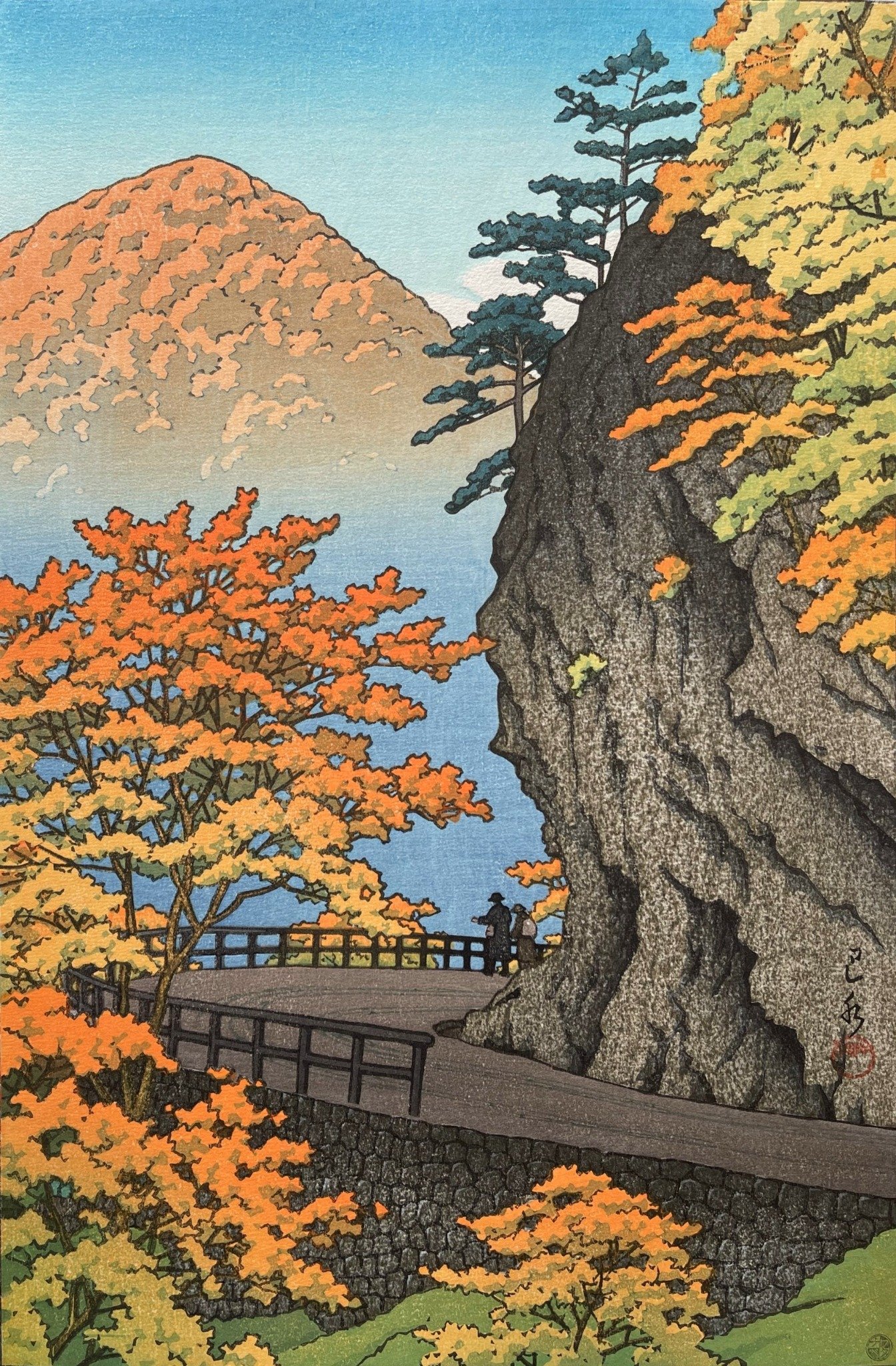
Autumn leaves glow in orange and gold around a towering dark crag, while two small travellers pause beside the open blue distance. Kawase Hasui’s Saru Crag, Shiobara brings the quiet grandeur of a mountain landscape into your home as a canvas reproduction over a 1.5-inch wood stretcher.
Product details: Canvas reproduction over a sturdy 1.5-inch wood stretcher. Available in 16 × 24 in. ($259 CAD) and 24 × 36 in. ($299 CAD). No returns accepted.
More About the Art
Saru Crag, Shiobara opens onto an autumn landscape of remarkable contrasts. A dark rock face rises through the right side of the image, while orange and golden leaves spread across the foreground and gather along its upper edge. Beyond these close, richly patterned surfaces, a broad blue distance gives the composition space to breathe. The scene feels both sheltered and expansive, as though the viewer has arrived at a quiet bend in a mountain path.
The crag supplies the image’s strongest vertical presence. Its uneven outline, deep creases, and mottled grey surface suggest weight and weathering. Dark recesses interrupt the lighter stone, while small patches of yellow foliage appear against its face. The rock remains visible from near the lower edge to the upper right, joining the different levels of the composition. Its rough texture contrasts with the comparatively smooth blue field behind it.
Autumn colour provides a lively counterpoint to this mass of stone. Branches at the left hold clusters of orange leaves, with pale yellow and green appearing nearer the bottom. More foliage descends from the upper right in irregular layers. These shapes are sharply outlined, yet their repeated colours create a flowing rhythm. The eye can move between the two sides of the scene by following the warm tones through the cooler surroundings.
A wooden walkway curves around the foot of the crag. Its broad brown surface crosses the foreground, then bends toward a small viewing area with a dark railing. The railing’s repeated uprights introduce an orderly pattern among the branching trees and fractured rock. This built structure makes the landscape accessible: it supplies a route into the picture and suggests the changing views a person might encounter while following it.
Two small figures stand near the far railing. One wears darker clothing and a broad hat; the other is lighter in tone. Their features are too small to identify, and the print leaves their relationship unexplained. They give the crag its impressive scale without turning the scene into a portrait. Their presence also creates a point of quiet attention, where the path, the rock, and the open distance meet.
A rounded mountain occupies the upper left. Its orange patches echo the foreground leaves, but its softer colouring separates it from the nearer trees. Below it, the pale blue tones deepen gradually. This movement from crisply described foreground to subdued distance gives the vertical format a spacious feeling. Dark pines between the mountain and the crag add another layer, their open branches standing clearly against the light.
The original colour woodblock design dates to 1949 and was published by the S. Watanabe Color Print Co. Museum collections identify it as Saru Crag, Shiobara, also known by its Japanese title Shiobara Saruiwa. It belongs to the later years of Kawase Hasui’s career, when he continued to explore landscape through the changing appearance of season, light, and atmosphere.
As a canvas reproduction, the composition offers warm autumn colour alongside the grounding presence of stone. From a distance, its orange foliage and generous blue spaces make a clear impression; closer viewing reveals the rails, branches, and tiny travellers. It invites an unhurried response, giving the room a place for the eye to rest and the imagination to follow the path.
More About the Artist
Kawase Hasui (1883–1957) was a Japanese landscape designer and a leading figure in shin-hanga, the movement that renewed colour woodblock printing in the twentieth century. His work ranges from city streets and temple grounds to coastlines, mountain paths, and remote settlements. Across these subjects, the appearance of a place changes with the weather, the season, and the hour. A familiar roof under snow, a road in rain, or a distant hill beyond autumn leaves becomes an opportunity to notice the landscape more carefully.
Born in Tokyo with the given name Bunjiro, Hasui initially faced the expectation that he would work in his family’s business. He received instruction in painting before pursuing art more fully as an adult. His training included Western-style art with Okada Saburosuke and, from 1910, study under the Japanese-style painter Kaburaki Kiyokata. Kiyokata gave him the name Hasui. This education brought him into contact with different approaches to composition, colour, and the description of space.
Hasui’s interest in single-sheet landscape prints was encouraged by the work of fellow pupil Ito Shinsui, particularly his Eight Views of Omi. Through Kiyokata he became known to the publisher Watanabe Shozaburo, who began publishing his landscape designs in 1918–1919. Their association became central to Hasui’s career. Early prints included views of Shiobara, the region that he would return to in later designs such as Saru Crag, Shiobara.
Shin-hanga depended on collaboration. Hasui supplied the design, while specialist carvers and printers worked with the publisher to bring it into print. The division of labour continued an established Japanese practice, while the results explored new palettes and ways of describing light and atmosphere. The finished image therefore reflects several kinds of skill. Hasui’s contribution was essential, but it should be understood alongside the craft and judgment of the people who translated his compositions into woodblock impressions.
Travel provided a continuing source of subjects. Hasui made extensive sketching journeys, gathering views that could later be developed into prints. His landscapes often centre on a modest path, a quiet building, or a small figure within a much larger setting. These choices allow ordinary places to hold the viewer’s attention. Seasonal colour and the changing surface of snow or water can become as prominent as an architectural landmark.
The Great Kanto Earthquake of 1923 interrupted this work severely. Fires destroyed Watanabe’s premises, woodblocks, and print stock, and Hasui lost his sketchbooks. He nevertheless continued designing prints in the years that followed. Works such as Zojo-ji Temple, Shiba from 1925 and Moon at Magome from 1930 show the breadth of his treatment of the Tokyo landscape: one built around a wintry temple setting, the other around the quiet appearance of the city after dark.
After the Second World War, Hasui and Watanabe resumed their collaboration as demand for Japanese prints grew, including among Americans stationed in Japan. Saru Crag, Shiobara dates to this later period. His reputation had also developed beyond Japan through collecting and exhibitions. In 1953, the making of Snow at Zojoji Temple was documented by Japan’s Cultural Properties Protection Committee, recognising the significance of the traditional printmaking process.
Over a career spanning roughly four decades, Hasui designed more than six hundred woodblock prints. His work is now held by institutions including the British Museum, the Art Institute of Chicago, and the Los Angeles County Museum of Art. Its continuing appeal is easy to understand in Saru Crag, Shiobara: small human presences coexist with a landscape that feels substantial and quietly alive. The scene leaves room for viewers to bring their own memories of travel, autumn, and moments spent looking outward.
Sources for the artwork and artist
Premium quality canvas print of “Saru Crag, Shiobara” by Kawase Hasui
Autumn leaves glow in orange and gold around a towering dark crag, while two small travellers pause beside the open blue distance. Kawase Hasui’s Saru Crag, Shiobara brings the quiet grandeur of a mountain landscape into your home as a canvas reproduction over a 1.5-inch wood stretcher.
Product details: Canvas reproduction over a sturdy 1.5-inch wood stretcher. Available in 16 × 24 in. ($259 CAD) and 24 × 36 in. ($299 CAD). No returns accepted.
More About the Art
Saru Crag, Shiobara opens onto an autumn landscape of remarkable contrasts. A dark rock face rises through the right side of the image, while orange and golden leaves spread across the foreground and gather along its upper edge. Beyond these close, richly patterned surfaces, a broad blue distance gives the composition space to breathe. The scene feels both sheltered and expansive, as though the viewer has arrived at a quiet bend in a mountain path.
The crag supplies the image’s strongest vertical presence. Its uneven outline, deep creases, and mottled grey surface suggest weight and weathering. Dark recesses interrupt the lighter stone, while small patches of yellow foliage appear against its face. The rock remains visible from near the lower edge to the upper right, joining the different levels of the composition. Its rough texture contrasts with the comparatively smooth blue field behind it.
Autumn colour provides a lively counterpoint to this mass of stone. Branches at the left hold clusters of orange leaves, with pale yellow and green appearing nearer the bottom. More foliage descends from the upper right in irregular layers. These shapes are sharply outlined, yet their repeated colours create a flowing rhythm. The eye can move between the two sides of the scene by following the warm tones through the cooler surroundings.
A wooden walkway curves around the foot of the crag. Its broad brown surface crosses the foreground, then bends toward a small viewing area with a dark railing. The railing’s repeated uprights introduce an orderly pattern among the branching trees and fractured rock. This built structure makes the landscape accessible: it supplies a route into the picture and suggests the changing views a person might encounter while following it.
Two small figures stand near the far railing. One wears darker clothing and a broad hat; the other is lighter in tone. Their features are too small to identify, and the print leaves their relationship unexplained. They give the crag its impressive scale without turning the scene into a portrait. Their presence also creates a point of quiet attention, where the path, the rock, and the open distance meet.
A rounded mountain occupies the upper left. Its orange patches echo the foreground leaves, but its softer colouring separates it from the nearer trees. Below it, the pale blue tones deepen gradually. This movement from crisply described foreground to subdued distance gives the vertical format a spacious feeling. Dark pines between the mountain and the crag add another layer, their open branches standing clearly against the light.
The original colour woodblock design dates to 1949 and was published by the S. Watanabe Color Print Co. Museum collections identify it as Saru Crag, Shiobara, also known by its Japanese title Shiobara Saruiwa. It belongs to the later years of Kawase Hasui’s career, when he continued to explore landscape through the changing appearance of season, light, and atmosphere.
As a canvas reproduction, the composition offers warm autumn colour alongside the grounding presence of stone. From a distance, its orange foliage and generous blue spaces make a clear impression; closer viewing reveals the rails, branches, and tiny travellers. It invites an unhurried response, giving the room a place for the eye to rest and the imagination to follow the path.
More About the Artist
Kawase Hasui (1883–1957) was a Japanese landscape designer and a leading figure in shin-hanga, the movement that renewed colour woodblock printing in the twentieth century. His work ranges from city streets and temple grounds to coastlines, mountain paths, and remote settlements. Across these subjects, the appearance of a place changes with the weather, the season, and the hour. A familiar roof under snow, a road in rain, or a distant hill beyond autumn leaves becomes an opportunity to notice the landscape more carefully.
Born in Tokyo with the given name Bunjiro, Hasui initially faced the expectation that he would work in his family’s business. He received instruction in painting before pursuing art more fully as an adult. His training included Western-style art with Okada Saburosuke and, from 1910, study under the Japanese-style painter Kaburaki Kiyokata. Kiyokata gave him the name Hasui. This education brought him into contact with different approaches to composition, colour, and the description of space.
Hasui’s interest in single-sheet landscape prints was encouraged by the work of fellow pupil Ito Shinsui, particularly his Eight Views of Omi. Through Kiyokata he became known to the publisher Watanabe Shozaburo, who began publishing his landscape designs in 1918–1919. Their association became central to Hasui’s career. Early prints included views of Shiobara, the region that he would return to in later designs such as Saru Crag, Shiobara.
Shin-hanga depended on collaboration. Hasui supplied the design, while specialist carvers and printers worked with the publisher to bring it into print. The division of labour continued an established Japanese practice, while the results explored new palettes and ways of describing light and atmosphere. The finished image therefore reflects several kinds of skill. Hasui’s contribution was essential, but it should be understood alongside the craft and judgment of the people who translated his compositions into woodblock impressions.
Travel provided a continuing source of subjects. Hasui made extensive sketching journeys, gathering views that could later be developed into prints. His landscapes often centre on a modest path, a quiet building, or a small figure within a much larger setting. These choices allow ordinary places to hold the viewer’s attention. Seasonal colour and the changing surface of snow or water can become as prominent as an architectural landmark.
The Great Kanto Earthquake of 1923 interrupted this work severely. Fires destroyed Watanabe’s premises, woodblocks, and print stock, and Hasui lost his sketchbooks. He nevertheless continued designing prints in the years that followed. Works such as Zojo-ji Temple, Shiba from 1925 and Moon at Magome from 1930 show the breadth of his treatment of the Tokyo landscape: one built around a wintry temple setting, the other around the quiet appearance of the city after dark.
After the Second World War, Hasui and Watanabe resumed their collaboration as demand for Japanese prints grew, including among Americans stationed in Japan. Saru Crag, Shiobara dates to this later period. His reputation had also developed beyond Japan through collecting and exhibitions. In 1953, the making of Snow at Zojoji Temple was documented by Japan’s Cultural Properties Protection Committee, recognising the significance of the traditional printmaking process.
Over a career spanning roughly four decades, Hasui designed more than six hundred woodblock prints. His work is now held by institutions including the British Museum, the Art Institute of Chicago, and the Los Angeles County Museum of Art. Its continuing appeal is easy to understand in Saru Crag, Shiobara: small human presences coexist with a landscape that feels substantial and quietly alive. The scene leaves room for viewers to bring their own memories of travel, autumn, and moments spent looking outward.