
 Image 1 of 1
Toshi Yoshida’s “Sangetsu-an, Hakone Museum” (1954)
Premium quality canvas print of Toshi Yoshida’s “Sangetsu-an, Hakone Museum”
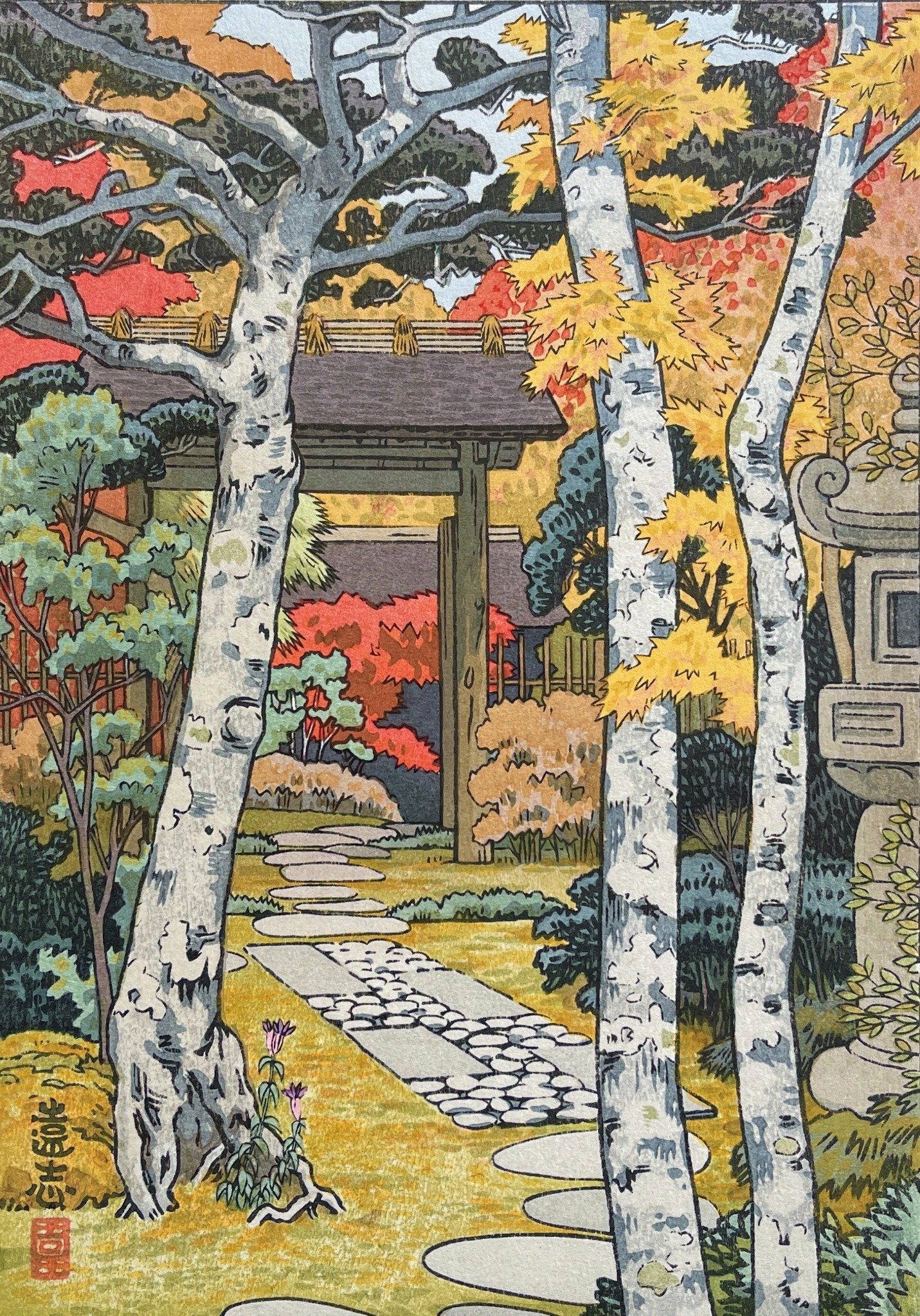
Bring the warmth of an autumn garden into your room. Toshi Yoshida’s Sangetsu-an, Hakone Museum follows a stone path between pale trunks, colourful foliage and a quiet wooden gate. Reproduced on canvas over a sturdy 1.5-inch wood stretcher, this richly detailed scene offers a welcoming sense of depth, with new shapes and colours to notice each time you look.
Product details: Canvas reproduction over a sturdy 1.5-inch wood stretcher. Available in 16 × 24 in. ($259 CAD) and 24 × 36 in. ($299 CAD). No returns accepted.
More About the Art
Sangetsu-an, Hakone Museum draws the viewer into a garden through the rhythm of a winding path. Broad, pale stepping stones enter from the lower edge, turn through the foreground and continue toward a wooden gate. A strip of smaller rounded stones introduces a different texture along the way. These changes in direction and scale give the scene an inviting depth, as though the garden is gradually opening ahead.
Three pale trunks provide the strongest vertical forms. One rises on the left, while two stand close together on the right. Their cool grey-blue shadows, dark markings and irregular edges make the bark visually distinct from the foliage around it. Branches reach across the upper picture, creating an intricate screen through which warmer colours appear. The trees frame the route while remaining substantial subjects in their own right.
Beyond them, a wooden gate holds the centre of the view. Its upright posts and broad, dark roof establish a quieter arrangement of lines within the branching garden. Through the opening, another roof and layers of planting suggest that the space continues farther. The gate is both a point of focus and a passage, drawing attention toward a partly revealed world beyond the immediate foreground.
Autumn colour fills that world with energy. Bright yellow leaves gather around the right-hand trees, while red and orange foliage appears behind the gate and across the upper scene. Dark green shrubs anchor these warm passages. The ground carries golden and olive tones, so that the seasonal colour extends below the canopy. Each area has its own shape and texture, yet the repeated hues keep the composition connected.
A large stone lantern is cropped by the right edge, its curved top and rectangular openings adding another distinctive form. Near the foot of the left tree, small purple flowers offer a gentler accent. These details reward close viewing without taking attention away from the path. With no people visible, the scene leaves room to imagine the quiet experience of moving through the garden at an unhurried pace.
Sangetsu-an is a tea house within Shinsenkyō, the garden and cultural setting of the Hakone Museum of Art. The museum records that Okada Mokichi conceived and developed Shinsenkyō between 1944 and 1953. This background connects Yoshida’s subject with a carefully formed landscape where planting, paths and architecture are encountered together. The view concentrates on an approach through the garden, allowing the setting to unfold through overlapping forms.
The National Museum of Modern Art, Tokyo, records this colour woodcut as a 1954 work, with the Japanese title 箱根神仙郷 山月庵. Its English catalogue places Sangetsu-an within The Garden of the Hakone Museum. This canvas reproduction presents that historical design in a contemporary format, retaining the composition’s relationship between closely observed garden features and a lively arrangement of colours, contours and patterned surfaces.
On a wall, the image offers both richness and order. The pale trunks give the eye clear resting points within the dense foliage, while the stepping stones lead it back into the picture. Red, gold, green and cool grey provide a varied palette that can bring warmth to a study or living space. The garden feels intimate and generous at once, with a familiar path inviting another look.
More About the Artist
Toshi Yoshida (1911–1995) was born in Tokyo into a family deeply involved in art. His parents, Hiroshi Yoshida and Fujio Yoshida, were both artists, and his early surroundings brought drawing, painting and printmaking into daily life. As a teenager, he learned from his father and from the skilled artisans in the family studio. This education gave him close contact with the practical demands of woodblock printing as well as the development of an image.
He also studied at the Taiheiyo-Gakai, or Pacific Painting Association, from 1932 to 1935. The British Museum records that he continued working in his father’s studio until Hiroshi’s death in 1950, when he took it over. His early prints developed within the family’s landscape tradition, while the studio supplied a setting in which artistic design and technical knowledge were closely connected. That experience remained part of the foundation for his later work.
Travel broadened his subjects from an early stage. In 1930, he accompanied his father on a sketching journey that included India, Burma and Malaya; they later travelled together in northeast China and Korea. Such journeys placed direct observation within his artistic education. His career would continue across national boundaries, combining the study of places with the exchange of printmaking knowledge and the presentation of his work to new audiences.
By 1952, he was also making abstract prints. Mount Holyoke College Art Museum’s study of the Yoshida family discusses Untitled, No. 9 from that year and traces his growing exploration of abstract form through later works such as Horizon, made in 1970. The museum identifies an early influence from his brother Hodaka, followed by the development of Toshi’s own approach. His command of woodblock technique supported a widening range of visual ideas.
Representational subjects remained part of that range. Sangetsu-an, Hakone Museum, dating from 1954, belongs to the same decade as those experiments and offers a recognizable garden filled with strong shapes. Looking at its trunks, leaves and stones, one can enjoy both the particular setting and the arrangement of forms across the surface. This is a useful way to appreciate Yoshida’s versatility: observation and a lively sense of design work together.
Sharing the medium was another substantial part of his career. With support from the Japan Society in New York, he gave lectures, demonstrated traditional woodblock techniques and exhibited in the United States in 1952, before travelling to Europe. In 1954, he returned to the United States with Hodaka for further lectures and exhibitions. These activities carried the studio knowledge he had acquired into settings where others could encounter the processes behind the finished image.
His teaching also took published form. In 1966, Toshi Yoshida and Rei Yuki coauthored Japanese Print-Making: A Handbook of Traditional and Modern Techniques, issued by Tuttle. The book brought the two approaches named in its title into a shared practical discussion. Alongside his demonstrations and exhibitions, this publication forms part of a career in which making images and communicating how they are made developed together.
Animals became an important focus of his later art. Fuchu Art Museum describes a sustained interest in observing wildlife, extending from drawings at the zoo to work informed by travel in Africa. He also used coloured pencils to create animal picture books. Between 1982 and 1993, seventeen volumes appeared in the series. These books extended his engagement with the natural world into a form that could be explored through successive pages and images.
That broad career helps place a garden scene such as Sangetsu-an within an artist’s continuing attention to the world around him. Its appeal is immediately accessible: pale bark against warm leaves, solid stones against softer ground, a gate seen through trees. Yet the longer one looks, the more the relationships between these elements become apparent. Yoshida gives the eye plenty to discover while keeping a clear and inviting route through the picture.
Sources
Premium quality canvas print of Toshi Yoshida’s “Sangetsu-an, Hakone Museum”
Bring the warmth of an autumn garden into your room. Toshi Yoshida’s Sangetsu-an, Hakone Museum follows a stone path between pale trunks, colourful foliage and a quiet wooden gate. Reproduced on canvas over a sturdy 1.5-inch wood stretcher, this richly detailed scene offers a welcoming sense of depth, with new shapes and colours to notice each time you look.
Product details: Canvas reproduction over a sturdy 1.5-inch wood stretcher. Available in 16 × 24 in. ($259 CAD) and 24 × 36 in. ($299 CAD). No returns accepted.
More About the Art
Sangetsu-an, Hakone Museum draws the viewer into a garden through the rhythm of a winding path. Broad, pale stepping stones enter from the lower edge, turn through the foreground and continue toward a wooden gate. A strip of smaller rounded stones introduces a different texture along the way. These changes in direction and scale give the scene an inviting depth, as though the garden is gradually opening ahead.
Three pale trunks provide the strongest vertical forms. One rises on the left, while two stand close together on the right. Their cool grey-blue shadows, dark markings and irregular edges make the bark visually distinct from the foliage around it. Branches reach across the upper picture, creating an intricate screen through which warmer colours appear. The trees frame the route while remaining substantial subjects in their own right.
Beyond them, a wooden gate holds the centre of the view. Its upright posts and broad, dark roof establish a quieter arrangement of lines within the branching garden. Through the opening, another roof and layers of planting suggest that the space continues farther. The gate is both a point of focus and a passage, drawing attention toward a partly revealed world beyond the immediate foreground.
Autumn colour fills that world with energy. Bright yellow leaves gather around the right-hand trees, while red and orange foliage appears behind the gate and across the upper scene. Dark green shrubs anchor these warm passages. The ground carries golden and olive tones, so that the seasonal colour extends below the canopy. Each area has its own shape and texture, yet the repeated hues keep the composition connected.
A large stone lantern is cropped by the right edge, its curved top and rectangular openings adding another distinctive form. Near the foot of the left tree, small purple flowers offer a gentler accent. These details reward close viewing without taking attention away from the path. With no people visible, the scene leaves room to imagine the quiet experience of moving through the garden at an unhurried pace.
Sangetsu-an is a tea house within Shinsenkyō, the garden and cultural setting of the Hakone Museum of Art. The museum records that Okada Mokichi conceived and developed Shinsenkyō between 1944 and 1953. This background connects Yoshida’s subject with a carefully formed landscape where planting, paths and architecture are encountered together. The view concentrates on an approach through the garden, allowing the setting to unfold through overlapping forms.
The National Museum of Modern Art, Tokyo, records this colour woodcut as a 1954 work, with the Japanese title 箱根神仙郷 山月庵. Its English catalogue places Sangetsu-an within The Garden of the Hakone Museum. This canvas reproduction presents that historical design in a contemporary format, retaining the composition’s relationship between closely observed garden features and a lively arrangement of colours, contours and patterned surfaces.
On a wall, the image offers both richness and order. The pale trunks give the eye clear resting points within the dense foliage, while the stepping stones lead it back into the picture. Red, gold, green and cool grey provide a varied palette that can bring warmth to a study or living space. The garden feels intimate and generous at once, with a familiar path inviting another look.
More About the Artist
Toshi Yoshida (1911–1995) was born in Tokyo into a family deeply involved in art. His parents, Hiroshi Yoshida and Fujio Yoshida, were both artists, and his early surroundings brought drawing, painting and printmaking into daily life. As a teenager, he learned from his father and from the skilled artisans in the family studio. This education gave him close contact with the practical demands of woodblock printing as well as the development of an image.
He also studied at the Taiheiyo-Gakai, or Pacific Painting Association, from 1932 to 1935. The British Museum records that he continued working in his father’s studio until Hiroshi’s death in 1950, when he took it over. His early prints developed within the family’s landscape tradition, while the studio supplied a setting in which artistic design and technical knowledge were closely connected. That experience remained part of the foundation for his later work.
Travel broadened his subjects from an early stage. In 1930, he accompanied his father on a sketching journey that included India, Burma and Malaya; they later travelled together in northeast China and Korea. Such journeys placed direct observation within his artistic education. His career would continue across national boundaries, combining the study of places with the exchange of printmaking knowledge and the presentation of his work to new audiences.
By 1952, he was also making abstract prints. Mount Holyoke College Art Museum’s study of the Yoshida family discusses Untitled, No. 9 from that year and traces his growing exploration of abstract form through later works such as Horizon, made in 1970. The museum identifies an early influence from his brother Hodaka, followed by the development of Toshi’s own approach. His command of woodblock technique supported a widening range of visual ideas.
Representational subjects remained part of that range. Sangetsu-an, Hakone Museum, dating from 1954, belongs to the same decade as those experiments and offers a recognizable garden filled with strong shapes. Looking at its trunks, leaves and stones, one can enjoy both the particular setting and the arrangement of forms across the surface. This is a useful way to appreciate Yoshida’s versatility: observation and a lively sense of design work together.
Sharing the medium was another substantial part of his career. With support from the Japan Society in New York, he gave lectures, demonstrated traditional woodblock techniques and exhibited in the United States in 1952, before travelling to Europe. In 1954, he returned to the United States with Hodaka for further lectures and exhibitions. These activities carried the studio knowledge he had acquired into settings where others could encounter the processes behind the finished image.
His teaching also took published form. In 1966, Toshi Yoshida and Rei Yuki coauthored Japanese Print-Making: A Handbook of Traditional and Modern Techniques, issued by Tuttle. The book brought the two approaches named in its title into a shared practical discussion. Alongside his demonstrations and exhibitions, this publication forms part of a career in which making images and communicating how they are made developed together.
Animals became an important focus of his later art. Fuchu Art Museum describes a sustained interest in observing wildlife, extending from drawings at the zoo to work informed by travel in Africa. He also used coloured pencils to create animal picture books. Between 1982 and 1993, seventeen volumes appeared in the series. These books extended his engagement with the natural world into a form that could be explored through successive pages and images.
That broad career helps place a garden scene such as Sangetsu-an within an artist’s continuing attention to the world around him. Its appeal is immediately accessible: pale bark against warm leaves, solid stones against softer ground, a gate seen through trees. Yet the longer one looks, the more the relationships between these elements become apparent. Yoshida gives the eye plenty to discover while keeping a clear and inviting route through the picture.