
 Image 1 of 1
Kawase Hasui’s “Rain at Ōmiya” (1930)
Premium quality canvas reproduction of Kawase Hasui’s “Rain at Ōmiya” (1930)
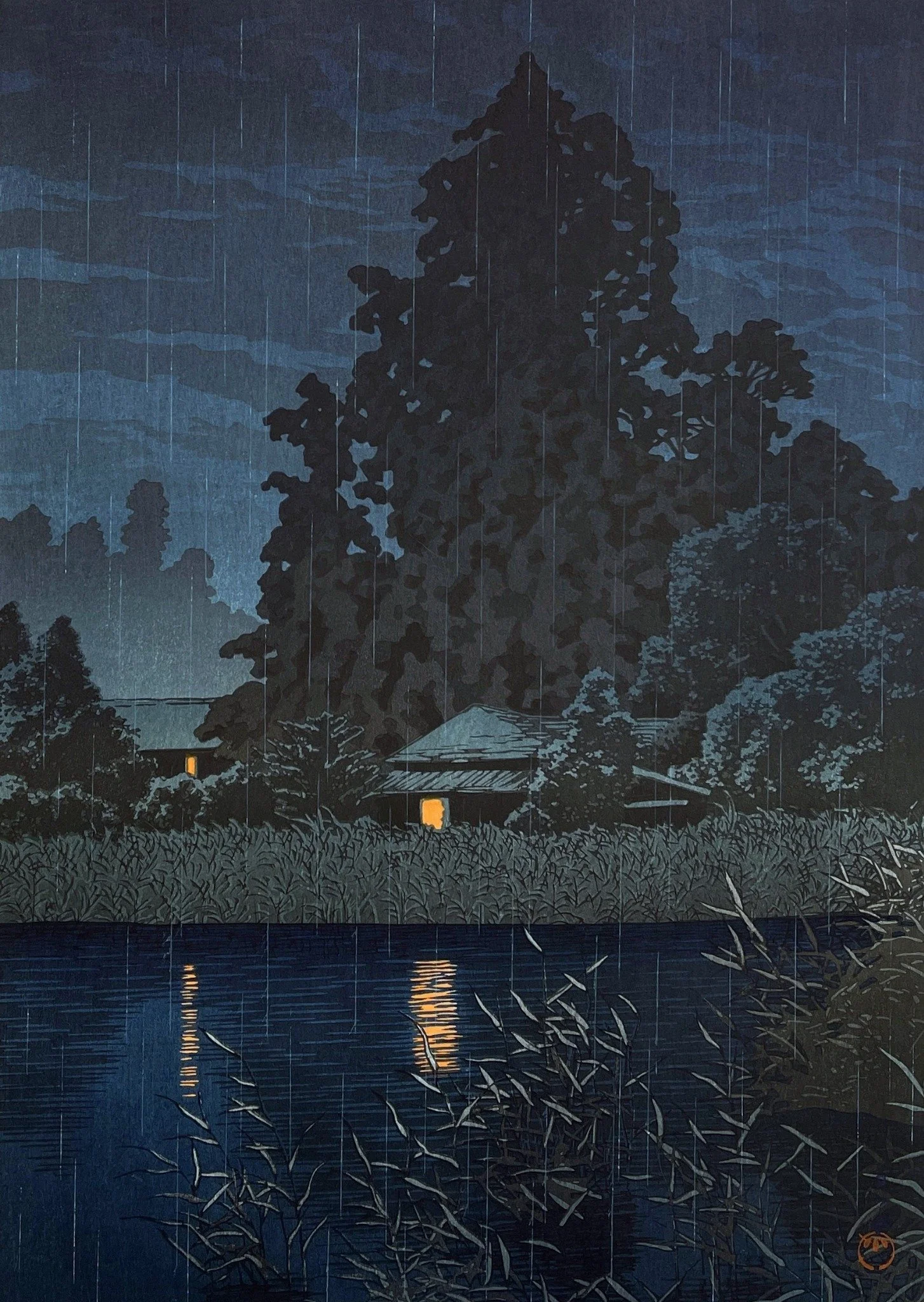
Bring the hush of an evening rain indoors. In Kawase Hasui’s Rain at Ōmiya, two amber windows glow beneath towering trees, their light trembling across dark water. Deep blues and fine rain lines give this canvas reproduction a quiet intensity, while a 1.5-inch wood stretcher adds depth and presence on your wall.
Product details: Canvas reproduction over a sturdy 1.5-inch wood stretcher. Available in 16 × 24 in. ($259 CAD) and 24 × 36 in. ($299 CAD). No returns accepted.
More About the Art:
Rain falls through the whole scene, from the blue clouds at the top to the dark water below. A group of tall trees rises above the rooftops, its uneven silhouette filling much of the sky. The trees feel substantial and close, yet the slender rain lines pass in front of them almost weightlessly. This meeting of solid forms and delicate marks gives Rain at Ōmiya its distinctive atmosphere.
Two small windows provide the brightest colour in the image. One shines from a low building near the centre; the other appears farther to the left, partly sheltered by vegetation. Their amber light finds an echo in the pond, where broken reflections stretch toward the foreground. No figure is clearly visible. The windows alone suggest human presence, bringing an intimate scale to a landscape dominated by trees and weather.
The surrounding colours make those lights feel warmer. Muted blue-green foliage sits between the near-black trees and the deep blue water. Across the sky, uneven bands of blue give the darkness depth without making the scene feel brightly illuminated. These closely related tones seem to share the same wet air, drawing the different parts of the view together. The golden windows remain small, precise points of contrast.
Look closely at the different directions within the composition. The rain falls in long, nearly vertical lines. Short horizontal strokes describe the surface of the pond, interrupting the reflections with small dark gaps. Slender leaves enter diagonally from the lower edge and right side. These repeated changes of direction keep the eye moving through an image that feels still at first glance.
The foreground vegetation is especially effective in establishing distance. Its thin stems and pale-edged leaves overlap the water, placing the viewer near the bank. Beyond them, the pond opens into a darker, quieter area before the opposite shore gathers into grasses, bushes and buildings. The space unfolds in layers, with each area offering a different density of detail.
The portrait format strengthens the impression of height. The houses occupy a narrow band beneath the trees, and their low rooflines help show how far the branches rise above them. At the same time, the reflections draw attention downward into the water. Your eye can travel from sky to tree, from window to reflection, then back through the rain to the sky again.
Hasui designed Rain at Ōmiya in 1930. The Smithsonian’s National Museum of Asian Art records an impression as a woodblock print in ink and colour on paper, published by Kawaguchi–Sakai. The date accompanying this reproduction refers to that original design. Its distinctive forms, rain lines and colour relationships are presented here on canvas, giving the composition a different physical presence.
On canvas, the image offers both a strong silhouette from across the room and finer details to discover up close. Its blue and charcoal tones can create a calm focal point in a reading corner, bedroom or living space. The small golden reflections keep the darkness welcoming: a glimpse of light and shelter, held within the steady fall of rain.
More About the Artist:
Kawase Hasui (1883–1957) was a Japanese artist best known for landscape prints that make weather and light central to the experience of a place. Born Kawase Bunjirō in Tokyo, he grew up in a family whose business dealt in silk braid. He received painting instruction while young, but could pursue art full time only after the family business passed to a relative in 1908. His early path combined artistic study with the practical obligations of family life.
His training crossed more than one approach to painting. He studied Western-style art under Okada Saburōsuke and, in 1910, became a pupil of Kaburaki Kiyokata, who gave him the name Hasui. This background brought him into contact with both Japanese pictorial traditions and Western methods of representing a landscape. His later prints make room for carefully described depth and light within the clear outlines and organised colour areas of a woodblock image.
Through Kiyokata, Hasui came to the attention of the publisher Watanabe Shōzaburō, who began publishing his landscape prints in 1918–19. Watanabe was a central supporter of shin-hanga, or “new prints,” a movement that renewed Japanese woodblock production for modern audiences. Their collaboration became a major part of Hasui’s career and helped bring his images to viewers beyond Japan. Travel scenes and views of Tokyo were important subjects within this work.
Making these prints required several kinds of expertise. Hasui supplied the design; specialist carvers translated it into woodblocks, and professional printers produced the finished impressions. The National Galleries of Scotland describes this division of work in its account of his Shin Ōhashi Bridge. Knowing that process adds another dimension to looking: a seemingly effortless passage of rain, shadow or reflected light emerged from an exchange between the artist’s image and the skills of other makers.
Travel was a continuing source of subjects. As the Sompo Museum of Art’s retrospective explains, Hasui depicted Japan through its changing seasons, including sun, clouds and rain, while looking toward places that carried a sense of an older landscape. His views invite attention to the particular conditions of an encounter: the way a roof appears beneath snow, how distant forms soften in the air, or how a small light changes a darkened setting.
His own remarks help explain how observation became an image. In a commentary accompanying a preparatory watercolour, the Cleveland Museum of Art records Hasui’s emphasis on working from reality, while allowing himself to simplify what he saw. He remembered the light and colour present when sketching and considered their eventual effect in a woodblock print as he developed the image. This was a process of selection and translation: the observed scene was shaped for the particular possibilities of another medium.
That attention to atmosphere connects Hasui with a wider development in modern Japanese prints. The Smithsonian’s account of this period describes an increasing interest in the character of light and the mood of a place, especially in night scenes. Rain at Ōmiya offers a vivid example to consider: dark masses establish the setting, while two small windows and their reflections give the scene its emotional focus. The effect is immediate even before its details are examined.
Hasui also worked with publishers besides Watanabe. The Smithsonian credits Kawaguchi–Sakai as publisher of its 1930 Rain at Ōmiya impression, placing this design within that broader professional network. Later in his career, the Cultural Properties Protection Committee documented the making of Snow at Zōjōji in 1953. That record drew attention to the craft behind the image as well as to the artist who designed it.
For a present-day viewer, Hasui’s landscapes offer a way to look more attentively at familiar experiences. Rain, trees, roofs and window light are ordinary subjects, yet their arrangement can make a scene feel newly noticed. In Rain at Ōmiya, the contrast between a vast dark canopy and a few warm reflections creates a view that feels both expansive and intimate. It is an image to live with slowly, returning to its details as the light in your own room changes.
Sources
Smithsonian National Museum of Asian Art — Rain at Omiya, S2003.8.740
Tokyo Fuji Art Museum — Kawase Hasui biography and documented printmaking process
National Galleries of Scotland — Shin Ōhashi Bridge and the collaborative woodblock process
Sompo Museum of Art — Kawase Hasui: Travel and nostalgic landscape
Cleveland Museum of Art — Snow at Zojoji Temple, preparatory watercolour and Hasui’s working method
Smithsonian National Museum of Asian Art — The Quality of Light
Premium quality canvas reproduction of Kawase Hasui’s “Rain at Ōmiya” (1930)
Bring the hush of an evening rain indoors. In Kawase Hasui’s Rain at Ōmiya, two amber windows glow beneath towering trees, their light trembling across dark water. Deep blues and fine rain lines give this canvas reproduction a quiet intensity, while a 1.5-inch wood stretcher adds depth and presence on your wall.
Product details: Canvas reproduction over a sturdy 1.5-inch wood stretcher. Available in 16 × 24 in. ($259 CAD) and 24 × 36 in. ($299 CAD). No returns accepted.
More About the Art:
Rain falls through the whole scene, from the blue clouds at the top to the dark water below. A group of tall trees rises above the rooftops, its uneven silhouette filling much of the sky. The trees feel substantial and close, yet the slender rain lines pass in front of them almost weightlessly. This meeting of solid forms and delicate marks gives Rain at Ōmiya its distinctive atmosphere.
Two small windows provide the brightest colour in the image. One shines from a low building near the centre; the other appears farther to the left, partly sheltered by vegetation. Their amber light finds an echo in the pond, where broken reflections stretch toward the foreground. No figure is clearly visible. The windows alone suggest human presence, bringing an intimate scale to a landscape dominated by trees and weather.
The surrounding colours make those lights feel warmer. Muted blue-green foliage sits between the near-black trees and the deep blue water. Across the sky, uneven bands of blue give the darkness depth without making the scene feel brightly illuminated. These closely related tones seem to share the same wet air, drawing the different parts of the view together. The golden windows remain small, precise points of contrast.
Look closely at the different directions within the composition. The rain falls in long, nearly vertical lines. Short horizontal strokes describe the surface of the pond, interrupting the reflections with small dark gaps. Slender leaves enter diagonally from the lower edge and right side. These repeated changes of direction keep the eye moving through an image that feels still at first glance.
The foreground vegetation is especially effective in establishing distance. Its thin stems and pale-edged leaves overlap the water, placing the viewer near the bank. Beyond them, the pond opens into a darker, quieter area before the opposite shore gathers into grasses, bushes and buildings. The space unfolds in layers, with each area offering a different density of detail.
The portrait format strengthens the impression of height. The houses occupy a narrow band beneath the trees, and their low rooflines help show how far the branches rise above them. At the same time, the reflections draw attention downward into the water. Your eye can travel from sky to tree, from window to reflection, then back through the rain to the sky again.
Hasui designed Rain at Ōmiya in 1930. The Smithsonian’s National Museum of Asian Art records an impression as a woodblock print in ink and colour on paper, published by Kawaguchi–Sakai. The date accompanying this reproduction refers to that original design. Its distinctive forms, rain lines and colour relationships are presented here on canvas, giving the composition a different physical presence.
On canvas, the image offers both a strong silhouette from across the room and finer details to discover up close. Its blue and charcoal tones can create a calm focal point in a reading corner, bedroom or living space. The small golden reflections keep the darkness welcoming: a glimpse of light and shelter, held within the steady fall of rain.
More About the Artist:
Kawase Hasui (1883–1957) was a Japanese artist best known for landscape prints that make weather and light central to the experience of a place. Born Kawase Bunjirō in Tokyo, he grew up in a family whose business dealt in silk braid. He received painting instruction while young, but could pursue art full time only after the family business passed to a relative in 1908. His early path combined artistic study with the practical obligations of family life.
His training crossed more than one approach to painting. He studied Western-style art under Okada Saburōsuke and, in 1910, became a pupil of Kaburaki Kiyokata, who gave him the name Hasui. This background brought him into contact with both Japanese pictorial traditions and Western methods of representing a landscape. His later prints make room for carefully described depth and light within the clear outlines and organised colour areas of a woodblock image.
Through Kiyokata, Hasui came to the attention of the publisher Watanabe Shōzaburō, who began publishing his landscape prints in 1918–19. Watanabe was a central supporter of shin-hanga, or “new prints,” a movement that renewed Japanese woodblock production for modern audiences. Their collaboration became a major part of Hasui’s career and helped bring his images to viewers beyond Japan. Travel scenes and views of Tokyo were important subjects within this work.
Making these prints required several kinds of expertise. Hasui supplied the design; specialist carvers translated it into woodblocks, and professional printers produced the finished impressions. The National Galleries of Scotland describes this division of work in its account of his Shin Ōhashi Bridge. Knowing that process adds another dimension to looking: a seemingly effortless passage of rain, shadow or reflected light emerged from an exchange between the artist’s image and the skills of other makers.
Travel was a continuing source of subjects. As the Sompo Museum of Art’s retrospective explains, Hasui depicted Japan through its changing seasons, including sun, clouds and rain, while looking toward places that carried a sense of an older landscape. His views invite attention to the particular conditions of an encounter: the way a roof appears beneath snow, how distant forms soften in the air, or how a small light changes a darkened setting.
His own remarks help explain how observation became an image. In a commentary accompanying a preparatory watercolour, the Cleveland Museum of Art records Hasui’s emphasis on working from reality, while allowing himself to simplify what he saw. He remembered the light and colour present when sketching and considered their eventual effect in a woodblock print as he developed the image. This was a process of selection and translation: the observed scene was shaped for the particular possibilities of another medium.
That attention to atmosphere connects Hasui with a wider development in modern Japanese prints. The Smithsonian’s account of this period describes an increasing interest in the character of light and the mood of a place, especially in night scenes. Rain at Ōmiya offers a vivid example to consider: dark masses establish the setting, while two small windows and their reflections give the scene its emotional focus. The effect is immediate even before its details are examined.
Hasui also worked with publishers besides Watanabe. The Smithsonian credits Kawaguchi–Sakai as publisher of its 1930 Rain at Ōmiya impression, placing this design within that broader professional network. Later in his career, the Cultural Properties Protection Committee documented the making of Snow at Zōjōji in 1953. That record drew attention to the craft behind the image as well as to the artist who designed it.
For a present-day viewer, Hasui’s landscapes offer a way to look more attentively at familiar experiences. Rain, trees, roofs and window light are ordinary subjects, yet their arrangement can make a scene feel newly noticed. In Rain at Ōmiya, the contrast between a vast dark canopy and a few warm reflections creates a view that feels both expansive and intimate. It is an image to live with slowly, returning to its details as the light in your own room changes.
Sources
Smithsonian National Museum of Asian Art — Rain at Omiya, S2003.8.740
Tokyo Fuji Art Museum — Kawase Hasui biography and documented printmaking process
National Galleries of Scotland — Shin Ōhashi Bridge and the collaborative woodblock process
Sompo Museum of Art — Kawase Hasui: Travel and nostalgic landscape
Cleveland Museum of Art — Snow at Zojoji Temple, preparatory watercolour and Hasui’s working method
Smithsonian National Museum of Asian Art — The Quality of Light