

 Image 1 of 1
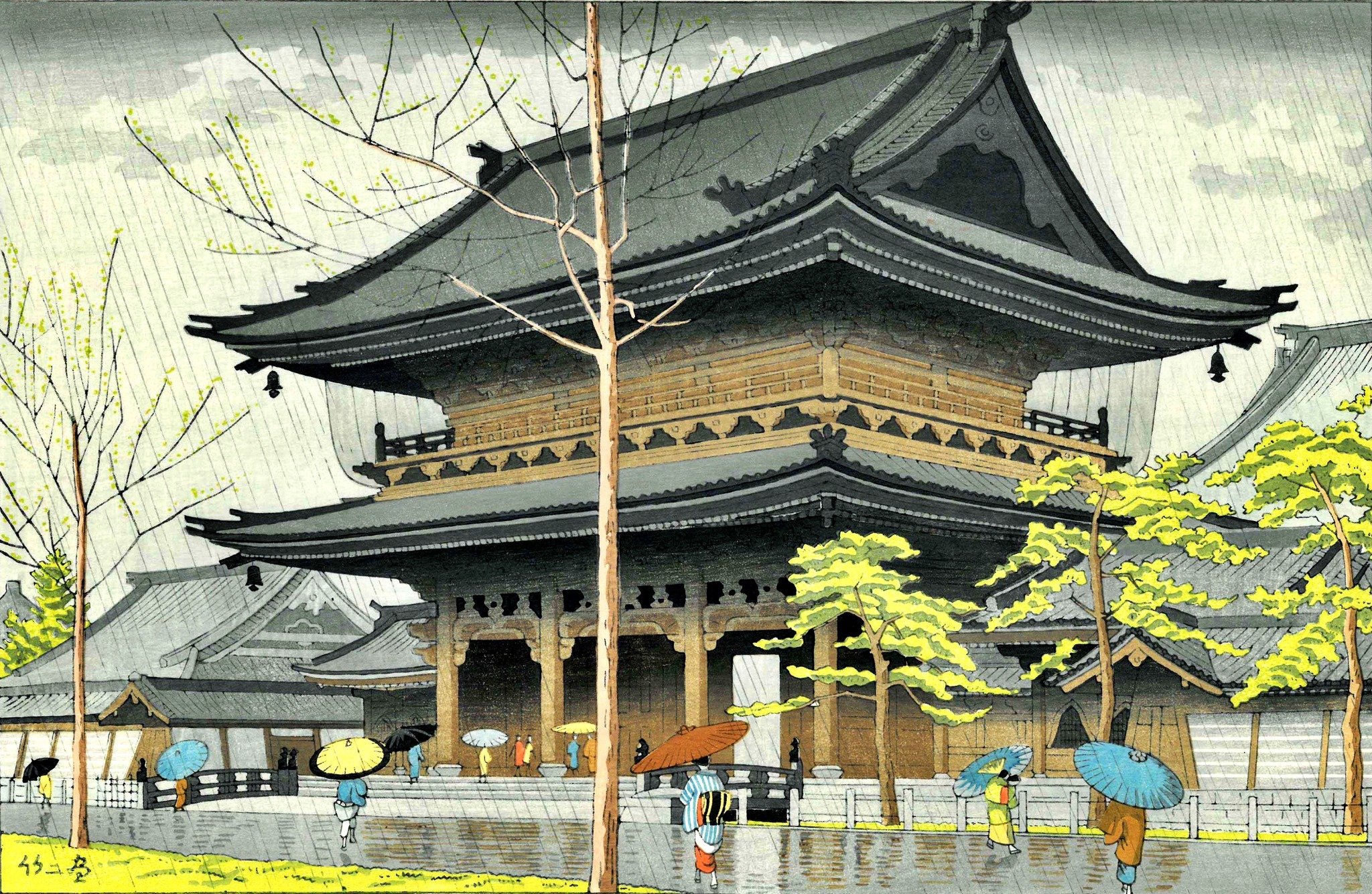
Rain at Higashi Honganji Temple — Takeji Asano (1953)
Premium quality canvas print of “Rain at Higashi Honganji Temple” by Takeji Asano
Bright umbrellas and fresh green foliage bring colour to a rainy day in Kyoto beneath the sweeping roofs of Higashi Honganji’s great gate. Takeji Asano’s atmospheric landscape creates a serene focal point for your home as a canvas reproduction over a sturdy 1.5-inch wood stretcher.
Product details: Canvas reproduction over a sturdy 1.5-inch wood stretcher. Available in 24 × 16 in. ($259 CAD) and 36 × 24 in. ($299 CAD). No returns accepted.
More About the Art
Rain at Higashi Honganji Temple sets the broad sweep of a monumental Kyoto gateway against the delicate movement of falling rain. Dark, layered roofs dominate the upper part of the image, their curved edges rising into a pale grey sky. Beneath them, warm timber, small figures, and colourful umbrellas enliven the temple approach. The scene balances the weight and permanence of architecture with a passing moment of weather.
The gateway is seen slightly from one side, allowing its projecting roofs and upper balcony to unfold across the landscape format. Fine rows of tiles follow the eaves, while dark brackets and pale wooden columns create a measured pattern below. The structure is the Goei-dō-mon, or Founder’s Hall Gate, the main entrance to the Higashi Honganji temple compound. Completed in 1911, its central section rises through two storeys, with lower structures extending to either side.
Trees bring a different rhythm to the foreground. A slender trunk stands close to the centre, and another rises near the left edge. Their sparse branches carry tiny yellow-green leaves that stand out against the grey sky. At the right, the broader crowns of pines form bright layers of foliage. These living shapes interrupt the building’s regular lines and soften its scale without hiding the complexity of the roof and timberwork.
Visitors move across the wet approach beneath umbrellas. Yellow and blue canopies punctuate the left side, while an orange umbrella near the centre shelters a figure in a blue-and-white striped garment. Two large blue umbrellas appear at the right. Farther back, smaller figures gather near the entrance. Their changing sizes establish distance and help the viewer appreciate the gateway’s height. Each umbrella supplies a brief note of colour within the shared grey atmosphere.
The rain crosses the entire view in long diagonal strokes. On the ground, its presence becomes a field of subdued reflections: columns, trunks, clothing, and umbrellas dissolve into broken marks on the paving. The foreground remains open enough for these echoes to register clearly. Bright vegetation along the lower edge gives the composition a fresh, luminous base, while the sombre roofs keep the light greens and warm colours in balance.
Takeji Asano designed this work for the Kyoto publisher Unsōdō, which records its first publication in 1953, or Shōwa 28. The Japanese title is Higashi Honganji ame, 東本願寺雨. The publisher also uses the English title Rain in Higashi-Honganji Temple, Kyoto. The image belongs to Asano’s extensive engagement with Japanese places and seasonal conditions, bringing careful architectural observation together with an accessible, gently animated sense of everyday life.
This landscape canvas reproduction preserves the supplied image composition, from the spreading roofs and slender foreground branches to the umbrellas and reflective paving. Across a room, the gate provides a strong architectural presence, relieved by the freshness of the foliage. Close viewing reveals details within the balcony, roof tiles, figures, and rain. The result is a spacious yet personal encounter with Kyoto, where a celebrated temple is experienced through the simple act of walking beneath an umbrella.
More About the Artist
Takeji Asano (1900–1998) was a Kyoto-born Japanese artist whose long career encompassed both descriptive landscape prints and more freely imagined compositions. His work reflects the variety of twentieth-century Japanese printmaking, moving between the careful depiction of familiar places and expressive designs made through an individual approach to the woodblock. Rain at Higashi Honganji Temple shows his ability to give a substantial architectural subject a fresh, approachable atmosphere through weather, foliage, and small human figures.
Asano first trained as a painter. He studied Japanese-style painting, or nihonga, at the Kyoto Municipal Special School of Painting, and also explored oil painting before returning to Japanese painting. He entered Tsuchida Bakusen’s Sannan-juku studio and exhibited with the Kokuga Sōsaku Kyōkai. This foundation supplied experience in drawing, composition, and colour before printmaking became a central part of his working life.
He began making woodblock prints around the age of thirty-one. The landscape prints of Kobayashi Kiyochika, particularly views of Tokyo, helped stimulate his interest in depicting places and events through print. Asano went on to produce scenes from Kyoto and other parts of Japan. These works could bring together recognizable buildings, seasonal vegetation, and figures engaged in ordinary activities, giving famous settings a sense of lived experience.
His relationship with Unsōdō became an important part of this landscape production in the early 1950s. Based in Kyoto, the publisher issued designs in the shin-hanga tradition, coordinating the specialist skills needed to turn an artist’s image into a colour woodblock print. Rain at Higashi Honganji Temple, first published in 1953, is one of those works. Its rain, complex timber architecture, and varied umbrellas demonstrate the range of elements that had to remain clear within a unified composition.
Alongside these published landscapes, Asano pursued the more independent practice associated with sōsaku-hanga, or creative prints. In that approach, the artist’s own drawing, carving, and printing became central to the work. Itami City Museum has described his determination to maintain this personal creative world. At fifty, he held his first solo exhibition of his freer prints, continuing to develop a distinctive vocabulary of simplified forms and expressive colour.
His imaginative work often included animals, birds, and people. Rather than describing every detail naturalistically, he could reshape a subject into bold, concise forms with an engaging sense of rhythm. Fuchu Art Museum has emphasized the liveliness and playfulness of these compositions, which developed alongside the brighter, more descriptive landscapes for which he was also known. The breadth of his work makes a single stylistic label insufficient to describe his career.
The National Museum of Modern Art, Kyoto preserves examples of this wider practice, including prints of people, animals, and urban subjects. Such works provide a useful context for looking at his temple landscapes. In both, the arrangement of large shapes matters as much as individual detail. A roof, tree, umbrella, or figure can establish a visual rhythm through its colour and position, helping the eye move comfortably across the image.
Rain at Higashi Honganji Temple rewards attention to that balance. The large gateway supplies structure, while the trees and umbrellas bring irregular movement into the view. Its subdued greys allow small passages of yellow, blue, and orange to feel especially vivid. Asano gives a monumental place a human scale, inviting the viewer to share a brief experience of weather and movement in front of one of Kyoto’s remarkable temple gates.
Sources for the artwork and artist
Premium quality canvas print of “Rain at Higashi Honganji Temple” by Takeji Asano
Bright umbrellas and fresh green foliage bring colour to a rainy day in Kyoto beneath the sweeping roofs of Higashi Honganji’s great gate. Takeji Asano’s atmospheric landscape creates a serene focal point for your home as a canvas reproduction over a sturdy 1.5-inch wood stretcher.
Product details: Canvas reproduction over a sturdy 1.5-inch wood stretcher. Available in 24 × 16 in. ($259 CAD) and 36 × 24 in. ($299 CAD). No returns accepted.
More About the Art
Rain at Higashi Honganji Temple sets the broad sweep of a monumental Kyoto gateway against the delicate movement of falling rain. Dark, layered roofs dominate the upper part of the image, their curved edges rising into a pale grey sky. Beneath them, warm timber, small figures, and colourful umbrellas enliven the temple approach. The scene balances the weight and permanence of architecture with a passing moment of weather.
The gateway is seen slightly from one side, allowing its projecting roofs and upper balcony to unfold across the landscape format. Fine rows of tiles follow the eaves, while dark brackets and pale wooden columns create a measured pattern below. The structure is the Goei-dō-mon, or Founder’s Hall Gate, the main entrance to the Higashi Honganji temple compound. Completed in 1911, its central section rises through two storeys, with lower structures extending to either side.
Trees bring a different rhythm to the foreground. A slender trunk stands close to the centre, and another rises near the left edge. Their sparse branches carry tiny yellow-green leaves that stand out against the grey sky. At the right, the broader crowns of pines form bright layers of foliage. These living shapes interrupt the building’s regular lines and soften its scale without hiding the complexity of the roof and timberwork.
Visitors move across the wet approach beneath umbrellas. Yellow and blue canopies punctuate the left side, while an orange umbrella near the centre shelters a figure in a blue-and-white striped garment. Two large blue umbrellas appear at the right. Farther back, smaller figures gather near the entrance. Their changing sizes establish distance and help the viewer appreciate the gateway’s height. Each umbrella supplies a brief note of colour within the shared grey atmosphere.
The rain crosses the entire view in long diagonal strokes. On the ground, its presence becomes a field of subdued reflections: columns, trunks, clothing, and umbrellas dissolve into broken marks on the paving. The foreground remains open enough for these echoes to register clearly. Bright vegetation along the lower edge gives the composition a fresh, luminous base, while the sombre roofs keep the light greens and warm colours in balance.
Takeji Asano designed this work for the Kyoto publisher Unsōdō, which records its first publication in 1953, or Shōwa 28. The Japanese title is Higashi Honganji ame, 東本願寺雨. The publisher also uses the English title Rain in Higashi-Honganji Temple, Kyoto. The image belongs to Asano’s extensive engagement with Japanese places and seasonal conditions, bringing careful architectural observation together with an accessible, gently animated sense of everyday life.
This landscape canvas reproduction preserves the supplied image composition, from the spreading roofs and slender foreground branches to the umbrellas and reflective paving. Across a room, the gate provides a strong architectural presence, relieved by the freshness of the foliage. Close viewing reveals details within the balcony, roof tiles, figures, and rain. The result is a spacious yet personal encounter with Kyoto, where a celebrated temple is experienced through the simple act of walking beneath an umbrella.
More About the Artist
Takeji Asano (1900–1998) was a Kyoto-born Japanese artist whose long career encompassed both descriptive landscape prints and more freely imagined compositions. His work reflects the variety of twentieth-century Japanese printmaking, moving between the careful depiction of familiar places and expressive designs made through an individual approach to the woodblock. Rain at Higashi Honganji Temple shows his ability to give a substantial architectural subject a fresh, approachable atmosphere through weather, foliage, and small human figures.
Asano first trained as a painter. He studied Japanese-style painting, or nihonga, at the Kyoto Municipal Special School of Painting, and also explored oil painting before returning to Japanese painting. He entered Tsuchida Bakusen’s Sannan-juku studio and exhibited with the Kokuga Sōsaku Kyōkai. This foundation supplied experience in drawing, composition, and colour before printmaking became a central part of his working life.
He began making woodblock prints around the age of thirty-one. The landscape prints of Kobayashi Kiyochika, particularly views of Tokyo, helped stimulate his interest in depicting places and events through print. Asano went on to produce scenes from Kyoto and other parts of Japan. These works could bring together recognizable buildings, seasonal vegetation, and figures engaged in ordinary activities, giving famous settings a sense of lived experience.
His relationship with Unsōdō became an important part of this landscape production in the early 1950s. Based in Kyoto, the publisher issued designs in the shin-hanga tradition, coordinating the specialist skills needed to turn an artist’s image into a colour woodblock print. Rain at Higashi Honganji Temple, first published in 1953, is one of those works. Its rain, complex timber architecture, and varied umbrellas demonstrate the range of elements that had to remain clear within a unified composition.
Alongside these published landscapes, Asano pursued the more independent practice associated with sōsaku-hanga, or creative prints. In that approach, the artist’s own drawing, carving, and printing became central to the work. Itami City Museum has described his determination to maintain this personal creative world. At fifty, he held his first solo exhibition of his freer prints, continuing to develop a distinctive vocabulary of simplified forms and expressive colour.
His imaginative work often included animals, birds, and people. Rather than describing every detail naturalistically, he could reshape a subject into bold, concise forms with an engaging sense of rhythm. Fuchu Art Museum has emphasized the liveliness and playfulness of these compositions, which developed alongside the brighter, more descriptive landscapes for which he was also known. The breadth of his work makes a single stylistic label insufficient to describe his career.
The National Museum of Modern Art, Kyoto preserves examples of this wider practice, including prints of people, animals, and urban subjects. Such works provide a useful context for looking at his temple landscapes. In both, the arrangement of large shapes matters as much as individual detail. A roof, tree, umbrella, or figure can establish a visual rhythm through its colour and position, helping the eye move comfortably across the image.
Rain at Higashi Honganji Temple rewards attention to that balance. The large gateway supplies structure, while the trees and umbrellas bring irregular movement into the view. Its subdued greys allow small passages of yellow, blue, and orange to feel especially vivid. Asano gives a monumental place a human scale, inviting the viewer to share a brief experience of weather and movement in front of one of Kyoto’s remarkable temple gates.
Sources for the artwork and artist