
 Image 1 of 1
Shiro Kasamatsu’s “Pine Trees at Yudanaka Hot Spring, Shinshu” (1950)
Premium quality canvas print of Shiro Kasamatsu’s “Pine Trees at Yudanaka Hot Spring, Shinshu”
Let a moonlit canopy bring depth and quiet colour to your room. Shiro Kasamatsu’s Pine Trees at Yudanaka Hot Spring, Shinshu places a small figure beneath immense pines, with warm buildings down the hillside. Reproduced on canvas over a sturdy 1.5-inch wood stretcher, its layered blues and greens create a calm, absorbing focal point.
Product details: Canvas reproduction over a sturdy 1.5-inch wood stretcher. Available in 16 × 24 in. ($259 CAD) and 24 × 36 in. ($299 CAD). No returns accepted.
More About the Art
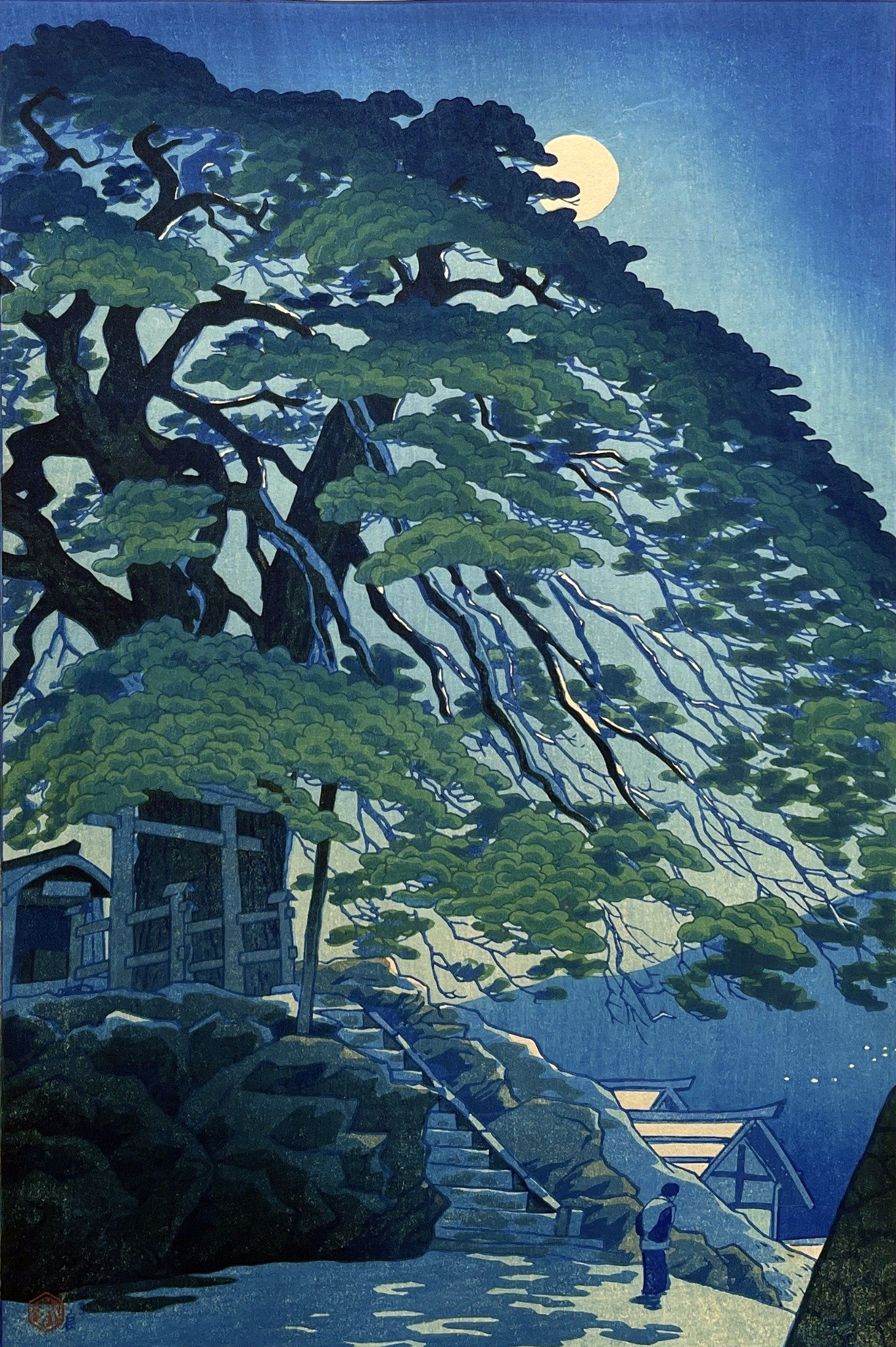
Pine Trees at Yudanaka Hot Spring, Shinshu makes a familiar tree into the defining presence of an entire landscape. The canopy spreads from the upper left across almost the whole picture, with thick trunks and branching limbs filling the space below. A pale moon appears beyond the foliage. Far beneath it, a small figure stands near the foot of a stone stairway, establishing the immense scale of the pines.
The trees are built from many distinct shapes. Rounded clusters of green needles overlap dark branches, while thin hanging limbs form a more delicate network against the light sky. Some branches turn abruptly; others travel diagonally through the picture for a considerable distance. This mixture of weight and fine detail gives the canopy its character. It feels both substantial and open enough for moonlight to pass through.
The moon provides a simple counterpoint to that complexity. Its warm, pale circle is partly interrupted by pine foliage, with the surrounding sky growing lighter nearby. Blue deepens toward the upper edge and returns in the spaces between branches. The restricted palette allows small differences to matter: olive green, dark navy and soft blue each describe a different part of the same night atmosphere.
Below the canopy, stone steps rise diagonally toward a fenced area and a small roofed structure on the left. Dark rocks border the ascent, with narrow highlights making their uneven edges legible. The figure near the bottom of the steps is described with only a few blue and pale shapes. Its small presence makes the scene feel inhabited without interrupting the trees’ dominance or explaining a particular story.
Buildings appear farther down the slope on the right, their sharp rooflines overlapping against the darker background. Warm strips of light beneath the roofs echo the colour of the moon. These distant accents bring another depth into the view, beyond the nearby stairway and tree trunks. They suggest an inhabited setting continuing outside the immediate foreground, while their partial concealment preserves the quiet, sheltered feeling of the scene.
Light also travels across the ground in irregular pale patches. Their edges answer the broken shapes of the foliage above, linking the upper canopy with the path below. The composition moves between these large and small relationships: tree and figure, moon and buildings, broad shadow and thin branch. The eye follows the branches outward, then returns along the stairs and stones to the lower part of the picture.
Yamanashi Prefectural Museum of Art records this composition as a 1950 woodblock design, with a title identifying the pine at Yudanaka Onsen in Shinshu. The date belongs to the historical design; the UnitedArts piece is a modern canvas reproduction. Seen in this format, the image retains its strong contrast between the sweeping natural forms and the measured lines of steps, fencing and buildings.
The tall arrangement is especially rewarding when there is room to follow it from the path up into the canopy. From farther away, the dark pines and glowing moon create a clear silhouette. Closer viewing reveals the interlaced branches, roof details and small pools of light. Together, they offer a scene that can feel restful at first glance while continuing to reveal new visual connections over time.
More About the Artist
Shiro Kasamatsu (1898–1991) was a Japanese painter and woodblock artist born in Tokyo’s Asakusa district. He entered the studio of the painter Kaburagi Kiyokata while still young, studying Japanese painting and receiving the artist name Shiro from his teacher. That training placed him within a community of artists working from established pictorial traditions while finding subjects in the surroundings and experiences of their own time.
In 1919, Kasamatsu’s first shin-hanga design, Seiran, was published by Watanabe Shōzaburō. Otaru Art Base places his entry into the movement after that of fellow Kiyokata pupils Itō Shinsui and Kawase Hasui. The term shin-hanga means “new prints”: contemporary designs brought into a form of woodblock production that depended on several specialised skills. Kasamatsu’s early participation connected his painting background with a different way of making and sharing images.
In that collaborative method, the designer’s image passed through the hands of carvers and printers, with a publisher coordinating its production. The Metropolitan Museum of Art describes how separate blocks carried the different colours and how registration guides aligned successive impressions. This process could bring together precise outlines, broad colour and subtle changes of tone. Those qualities help explain the range of visual effects possible within the historical woodblock medium.
Kasamatsu’s subjects extended from Tokyo to scenic places elsewhere in Japan. Yamanashi Prefectural Museum of Art describes early views that included the modern character of the city, atmospheric hot-spring towns and familiar Japanese settings. Such a range allowed buildings, paths, trees and changing conditions to become recurring points of interest. A landscape could be identified as a particular place while also offering an experience of light, distance or enclosure.
After the war, his publishing relationships widened. Unsōdō’s official account records a substantial group of Kasamatsu prints issued from 1952 to 1959. This later activity continued his involvement in landscape printmaking beyond its pre-war period. The connection also shows how a career in the medium could extend through different publishing arrangements, with each finished image emerging from the practical work of translating a design into a printed composition.
From 1955, Kasamatsu also began making works that he drew, carved and printed himself. Yamanashi’s account describes a later interest in birds, plants, fish and other familiar living subjects, alongside a continued search for new expression in woodblock printing. Taking responsibility for the stages of production offered another form of engagement with the medium. This part of his career should be understood alongside his publisher-issued designs, without assuming the same production method for every work.
Ōta Memorial Museum of Art’s 2021 retrospective brought together approximately 130 works from across his shin-hanga career. Its presentation included early prints as well as designs produced through later publishing relationships. Bringing these works into one exhibition makes it possible to see the continuity of his activity across several decades. It also provides a setting in which the individual character of his landscapes can be appreciated through comparison.
In the Yudanaka scene, that character is immediately approachable through the arrangement of forms. The canopy supplies both an intricate surface and a broad sheltering shape. The small figure gives the trees scale, while the moon and warm buildings make different kinds of light visible within one blue night. These are direct visual relationships, offering a way into the work before any knowledge of its history is required.
Kasamatsu’s art rewards attention to those relationships. A viewer can begin with the subject, then follow the movements created by colour and line: along a branch, through a gap in the needles, down a stone stairway and toward a distant roof. The scene remains recognisable throughout that movement. Its quiet appeal comes from holding many observations together within a composition that feels clear, spacious and whole.
Sources
Yamanashi Prefectural Museum of Art — Pine at Yudanaka Onsen, 1950
Yamanashi Prefectural Museum of Art — Kasamatsu’s career and collection
Ōta Memorial Museum of Art — Shiro Kasamatsu retrospective, 2021
Unsōdō — Shiro Kasamatsu exhibition catalogue and career overview
The Metropolitan Museum of Art — Woodblock Prints in the Ukiyo-e Style
Premium quality canvas print of Shiro Kasamatsu’s “Pine Trees at Yudanaka Hot Spring, Shinshu”
Let a moonlit canopy bring depth and quiet colour to your room. Shiro Kasamatsu’s Pine Trees at Yudanaka Hot Spring, Shinshu places a small figure beneath immense pines, with warm buildings down the hillside. Reproduced on canvas over a sturdy 1.5-inch wood stretcher, its layered blues and greens create a calm, absorbing focal point.
Product details: Canvas reproduction over a sturdy 1.5-inch wood stretcher. Available in 16 × 24 in. ($259 CAD) and 24 × 36 in. ($299 CAD). No returns accepted.
More About the Art
Pine Trees at Yudanaka Hot Spring, Shinshu makes a familiar tree into the defining presence of an entire landscape. The canopy spreads from the upper left across almost the whole picture, with thick trunks and branching limbs filling the space below. A pale moon appears beyond the foliage. Far beneath it, a small figure stands near the foot of a stone stairway, establishing the immense scale of the pines.
The trees are built from many distinct shapes. Rounded clusters of green needles overlap dark branches, while thin hanging limbs form a more delicate network against the light sky. Some branches turn abruptly; others travel diagonally through the picture for a considerable distance. This mixture of weight and fine detail gives the canopy its character. It feels both substantial and open enough for moonlight to pass through.
The moon provides a simple counterpoint to that complexity. Its warm, pale circle is partly interrupted by pine foliage, with the surrounding sky growing lighter nearby. Blue deepens toward the upper edge and returns in the spaces between branches. The restricted palette allows small differences to matter: olive green, dark navy and soft blue each describe a different part of the same night atmosphere.
Below the canopy, stone steps rise diagonally toward a fenced area and a small roofed structure on the left. Dark rocks border the ascent, with narrow highlights making their uneven edges legible. The figure near the bottom of the steps is described with only a few blue and pale shapes. Its small presence makes the scene feel inhabited without interrupting the trees’ dominance or explaining a particular story.
Buildings appear farther down the slope on the right, their sharp rooflines overlapping against the darker background. Warm strips of light beneath the roofs echo the colour of the moon. These distant accents bring another depth into the view, beyond the nearby stairway and tree trunks. They suggest an inhabited setting continuing outside the immediate foreground, while their partial concealment preserves the quiet, sheltered feeling of the scene.
Light also travels across the ground in irregular pale patches. Their edges answer the broken shapes of the foliage above, linking the upper canopy with the path below. The composition moves between these large and small relationships: tree and figure, moon and buildings, broad shadow and thin branch. The eye follows the branches outward, then returns along the stairs and stones to the lower part of the picture.
Yamanashi Prefectural Museum of Art records this composition as a 1950 woodblock design, with a title identifying the pine at Yudanaka Onsen in Shinshu. The date belongs to the historical design; the UnitedArts piece is a modern canvas reproduction. Seen in this format, the image retains its strong contrast between the sweeping natural forms and the measured lines of steps, fencing and buildings.
The tall arrangement is especially rewarding when there is room to follow it from the path up into the canopy. From farther away, the dark pines and glowing moon create a clear silhouette. Closer viewing reveals the interlaced branches, roof details and small pools of light. Together, they offer a scene that can feel restful at first glance while continuing to reveal new visual connections over time.
More About the Artist
Shiro Kasamatsu (1898–1991) was a Japanese painter and woodblock artist born in Tokyo’s Asakusa district. He entered the studio of the painter Kaburagi Kiyokata while still young, studying Japanese painting and receiving the artist name Shiro from his teacher. That training placed him within a community of artists working from established pictorial traditions while finding subjects in the surroundings and experiences of their own time.
In 1919, Kasamatsu’s first shin-hanga design, Seiran, was published by Watanabe Shōzaburō. Otaru Art Base places his entry into the movement after that of fellow Kiyokata pupils Itō Shinsui and Kawase Hasui. The term shin-hanga means “new prints”: contemporary designs brought into a form of woodblock production that depended on several specialised skills. Kasamatsu’s early participation connected his painting background with a different way of making and sharing images.
In that collaborative method, the designer’s image passed through the hands of carvers and printers, with a publisher coordinating its production. The Metropolitan Museum of Art describes how separate blocks carried the different colours and how registration guides aligned successive impressions. This process could bring together precise outlines, broad colour and subtle changes of tone. Those qualities help explain the range of visual effects possible within the historical woodblock medium.
Kasamatsu’s subjects extended from Tokyo to scenic places elsewhere in Japan. Yamanashi Prefectural Museum of Art describes early views that included the modern character of the city, atmospheric hot-spring towns and familiar Japanese settings. Such a range allowed buildings, paths, trees and changing conditions to become recurring points of interest. A landscape could be identified as a particular place while also offering an experience of light, distance or enclosure.
After the war, his publishing relationships widened. Unsōdō’s official account records a substantial group of Kasamatsu prints issued from 1952 to 1959. This later activity continued his involvement in landscape printmaking beyond its pre-war period. The connection also shows how a career in the medium could extend through different publishing arrangements, with each finished image emerging from the practical work of translating a design into a printed composition.
From 1955, Kasamatsu also began making works that he drew, carved and printed himself. Yamanashi’s account describes a later interest in birds, plants, fish and other familiar living subjects, alongside a continued search for new expression in woodblock printing. Taking responsibility for the stages of production offered another form of engagement with the medium. This part of his career should be understood alongside his publisher-issued designs, without assuming the same production method for every work.
Ōta Memorial Museum of Art’s 2021 retrospective brought together approximately 130 works from across his shin-hanga career. Its presentation included early prints as well as designs produced through later publishing relationships. Bringing these works into one exhibition makes it possible to see the continuity of his activity across several decades. It also provides a setting in which the individual character of his landscapes can be appreciated through comparison.
In the Yudanaka scene, that character is immediately approachable through the arrangement of forms. The canopy supplies both an intricate surface and a broad sheltering shape. The small figure gives the trees scale, while the moon and warm buildings make different kinds of light visible within one blue night. These are direct visual relationships, offering a way into the work before any knowledge of its history is required.
Kasamatsu’s art rewards attention to those relationships. A viewer can begin with the subject, then follow the movements created by colour and line: along a branch, through a gap in the needles, down a stone stairway and toward a distant roof. The scene remains recognisable throughout that movement. Its quiet appeal comes from holding many observations together within a composition that feels clear, spacious and whole.
Sources
Yamanashi Prefectural Museum of Art — Pine at Yudanaka Onsen, 1950
Yamanashi Prefectural Museum of Art — Kasamatsu’s career and collection
Ōta Memorial Museum of Art — Shiro Kasamatsu retrospective, 2021
Unsōdō — Shiro Kasamatsu exhibition catalogue and career overview
The Metropolitan Museum of Art — Woodblock Prints in the Ukiyo-e Style