

 Image 1 of 1
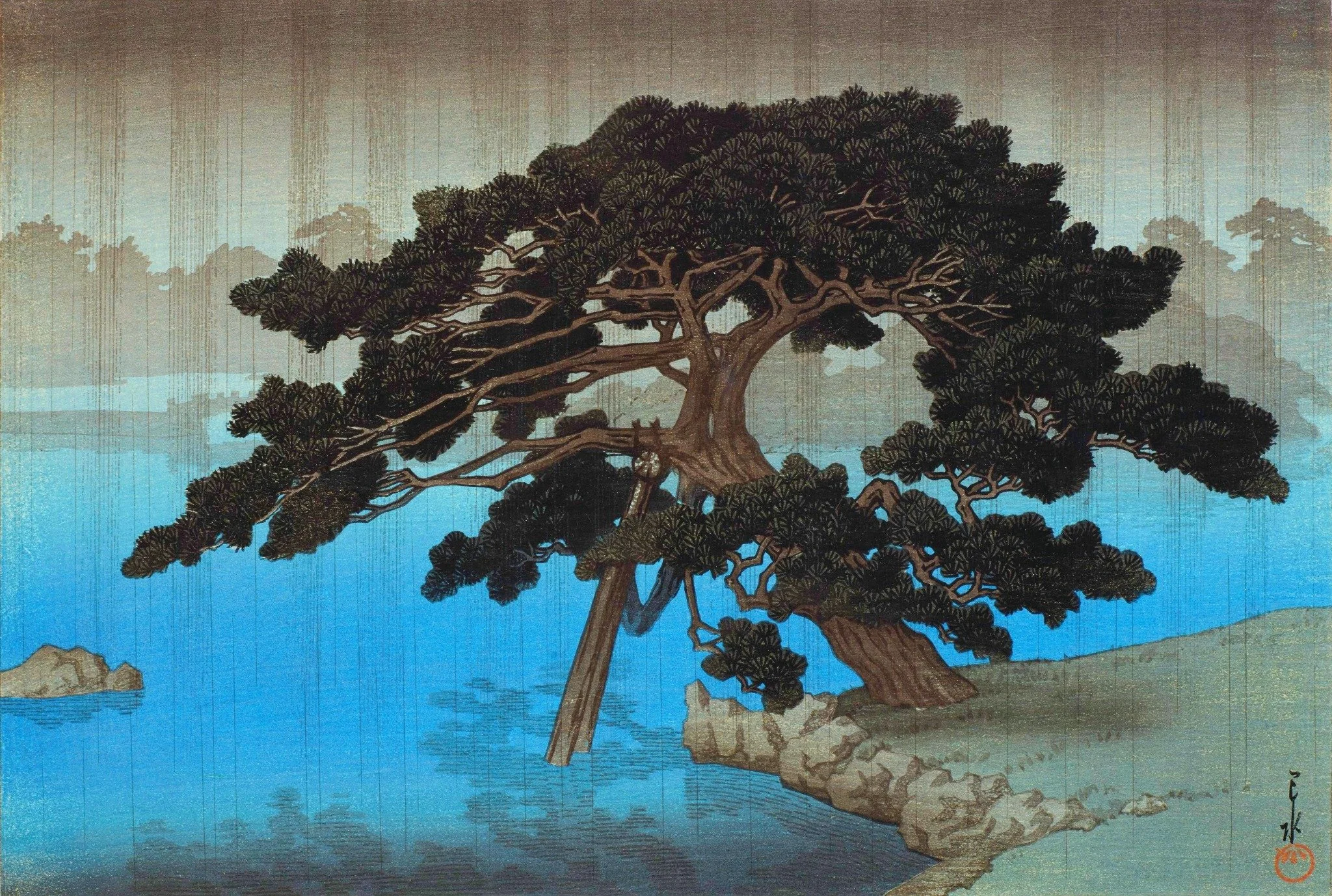
Onshi Park, Shiba — Kawase Hasui (1937)
Premium quality canvas print of “Onshi Park, Shiba” by Kawase Hasui
Fine rain falls across a spreading pine and a luminous blue pond in a quiet Tokyo garden. Kawase Hasui’s Onshi Park, Shiba brings the stillness and sculptural beauty of this waterside retreat into your home, reproduced on canvas over a sturdy 1.5-inch wood stretcher.
Product details: Canvas reproduction over a sturdy 1.5-inch wood stretcher. Available in 24 × 16 in. ($259 CAD) and 36 × 24 in. ($299 CAD). No returns accepted.
More About the Art
Onshi Park, Shiba centres on a spreading pine beside blue water, its dark canopy held beneath a curtain of rain. The tree grows from a low, stone-edged bank at the right and reaches almost across the composition. Beyond it, distant trees dissolve into a pale, misty shore. The scene feels enclosed yet spacious: the pine is close enough for individual needles and branches to become visible, while the water opens a broad field of colour around it.
The pine provides the image’s strongest structure. Its trunk bends, divides, and sends long limbs outward in several directions. Clusters of needles form rounded masses, separated by openings through which the blue water and light background remain visible. Brown edges pick out the branches against the foliage. This intricate framework gives the tree a particular character, as though its shape has been formed gradually through years of growth and careful tending.
A timber support stands beneath one of the spreading limbs. It is a small but telling detail within the composition, connecting the tree’s natural form with the care of a cultivated garden. The stone edge below reinforces that relationship. Rather than an untouched wilderness, this is a place where water, rocks, planting, and human attention have been brought together. The absence of figures allows those quieter signs of care to become more noticeable.
Rain changes the appearance of every surface. Fine vertical lines pass across sky, foliage, water, and bank, giving the separate elements a shared atmosphere. In the distance, land and trees lose their sharp edges. The foreground pine remains dark and distinct, while its reflection gathers in soft, broken shapes beneath it. The blue of the pond feels especially luminous against the muted grey-green ground and the warm brown of the trunk.
Hasui balances a rich centre with passages of openness. A small group of rocks interrupts the water at left, answering the larger stone edge at right. Between them lies an expanse of blue. Above, the distant shore becomes a pale horizontal band behind the pine. These simple relationships give the view its calm, allowing the eye to move between fine detail and broad areas of colour.
Kawase Hasui designed the original colour woodblock print in December 1937. Its Japanese title is Shiba Onshi kōen, written 芝恩賜公園, and the publisher was Watanabe Shōzaburō. Minato City’s history museum identifies the setting as the garden now known as Kyū-Shiba-rikyū. Formerly the grounds of the Shiba Detached Palace, it was given to Tokyo in 1924 and opened to the public after restoration.
That history deepens the scene’s sense of a tended retreat within the city. The garden’s pond and rock formations provide the setting, but weather gives this particular view its mood. Presented as a canvas reproduction, Onshi Park, Shiba brings the pine’s sculptural shape and the pond’s clear blue into a contemporary interior. From across the room, the broad canopy establishes a strong, tranquil presence; closer viewing reveals the branching limbs, supporting timber, fine rain, and reflections. It offers a place for the eye to rest and return.
More About the Artist
Kawase Hasui (1883–1957) was a Japanese landscape artist whose woodblock designs made the changing appearance of familiar places a subject of lasting interest. Rain, snow, dusk, and moonlight shape the experience of his scenes as much as their buildings, trees, or geography. His work includes distant mountains and coasts as well as the parks, temple grounds, and waterways of Tokyo. Onshi Park, Shiba belongs to this attentive vision of the city’s quieter spaces.
Hasui was born in Tokyo with the given name Bunjiro. His artistic education included Western-style painting with Okada Saburosuke and Japanese-style painting under Kaburaki Kiyokata, whose studio he joined in 1910. Kiyokata gave him the name Hasui. Experience across these approaches helped him develop a visual language that could combine the clarity of a strong outline with a sensitive treatment of depth, shading, and atmosphere.
The landscape prints of Itō Shinsui, a fellow pupil in Kiyokata’s circle, encouraged his interest in woodblock design. In 1918 he began working with the publisher Watanabe Shōzaburō, and their long association became central to the shin-hanga movement. Meaning “new prints,” shin-hanga renewed traditional Japanese woodblock production through close collaboration among artists, carvers, printers, and publishers. It made room for modern effects of light and colour within a continuing craft tradition.
A finished print therefore depended on several kinds of expertise. Hasui’s drawing had to be translated into carved blocks, while printers controlled colour, pressure, and the relationships between successive impressions. Onshi Park, Shiba makes this shared precision easy to appreciate. The fine rain crosses a complicated network of branches, the foliage contains numerous small marks, and the water changes tone without losing its broad, unified presence. All these effects contribute to the atmosphere of the whole.
Travel supplied Hasui with many of his subjects. He filled sketchbooks with observations gathered across Japan, returning to landscape through changing seasons and conditions. His home city offered an equally rich field of discovery. A garden pond, a neighbourhood bridge, or a temple approach could become as absorbing as a celebrated landmark. These choices allow viewers to enter his images through recognisable experiences: pausing beside water, walking through snow, or looking at a tree in rain.
His career also involved the loss of essential working materials. The Great Kantō Earthquake of 1923 destroyed Watanabe’s premises, woodblocks, and print stock, while Hasui’s house and sketchbooks were lost. He continued travelling and designing afterward. The decades that followed produced a substantial body of work, with weather and place remaining closely connected throughout. His prints could suggest continuity and intimacy even when the world around their subjects was changing.
Hasui continued working after the Second World War and remained active into the 1950s. In 1953, the production process of Snow at Zōjōji Temple was documented by Japan’s Cultural Properties Protection Committee, preserving a record of collaborative printmaking. His career ultimately encompassed more than six hundred designs. Museum collections now hold these landscapes alongside material that helps explain their preparation and production, sustaining interest in both their imagery and their craft.
Onshi Park, Shiba offers an especially focused introduction to his art. A single tree becomes the centre of a complete atmosphere, supported by the relationships between rain, water, stone, and distance. The image does not require a dramatic event to hold attention. Its strength comes from the care with which ordinary elements are brought together, making a moment in a Tokyo garden feel spacious, particular, and quietly enduring.
Sources
LACMA — Onshi Park, Shiba; colour woodblock print, December 1937
Smithsonian National Museum of Asian Art — Onshi Park, Shiba; December 1937 and Watanabe publisher
Minato City History Museum — Hasui’s Onshi Park, Shiba; identification as Kyū-Shiba-rikyū Gardens
Tokyo Metropolitan Park Association — Kyū-Shiba-rikyū Gardens history and pond landscape
Christie’s — Shiba Onshi koen; Watanabe Shōzaburō and horizontal woodblock format
Kawase Hasui Catalogue — Onshi Park at Shiba; Japanese title and publication details
Japan Museum SieboldHuis — Kawase Hasui: Capturing the Soul of Japan
Tokyo Fuji Art Museum — Kawase Hasui biography and 1953 print-production documentation
Premium quality canvas print of “Onshi Park, Shiba” by Kawase Hasui
Fine rain falls across a spreading pine and a luminous blue pond in a quiet Tokyo garden. Kawase Hasui’s Onshi Park, Shiba brings the stillness and sculptural beauty of this waterside retreat into your home, reproduced on canvas over a sturdy 1.5-inch wood stretcher.
Product details: Canvas reproduction over a sturdy 1.5-inch wood stretcher. Available in 24 × 16 in. ($259 CAD) and 36 × 24 in. ($299 CAD). No returns accepted.
More About the Art
Onshi Park, Shiba centres on a spreading pine beside blue water, its dark canopy held beneath a curtain of rain. The tree grows from a low, stone-edged bank at the right and reaches almost across the composition. Beyond it, distant trees dissolve into a pale, misty shore. The scene feels enclosed yet spacious: the pine is close enough for individual needles and branches to become visible, while the water opens a broad field of colour around it.
The pine provides the image’s strongest structure. Its trunk bends, divides, and sends long limbs outward in several directions. Clusters of needles form rounded masses, separated by openings through which the blue water and light background remain visible. Brown edges pick out the branches against the foliage. This intricate framework gives the tree a particular character, as though its shape has been formed gradually through years of growth and careful tending.
A timber support stands beneath one of the spreading limbs. It is a small but telling detail within the composition, connecting the tree’s natural form with the care of a cultivated garden. The stone edge below reinforces that relationship. Rather than an untouched wilderness, this is a place where water, rocks, planting, and human attention have been brought together. The absence of figures allows those quieter signs of care to become more noticeable.
Rain changes the appearance of every surface. Fine vertical lines pass across sky, foliage, water, and bank, giving the separate elements a shared atmosphere. In the distance, land and trees lose their sharp edges. The foreground pine remains dark and distinct, while its reflection gathers in soft, broken shapes beneath it. The blue of the pond feels especially luminous against the muted grey-green ground and the warm brown of the trunk.
Hasui balances a rich centre with passages of openness. A small group of rocks interrupts the water at left, answering the larger stone edge at right. Between them lies an expanse of blue. Above, the distant shore becomes a pale horizontal band behind the pine. These simple relationships give the view its calm, allowing the eye to move between fine detail and broad areas of colour.
Kawase Hasui designed the original colour woodblock print in December 1937. Its Japanese title is Shiba Onshi kōen, written 芝恩賜公園, and the publisher was Watanabe Shōzaburō. Minato City’s history museum identifies the setting as the garden now known as Kyū-Shiba-rikyū. Formerly the grounds of the Shiba Detached Palace, it was given to Tokyo in 1924 and opened to the public after restoration.
That history deepens the scene’s sense of a tended retreat within the city. The garden’s pond and rock formations provide the setting, but weather gives this particular view its mood. Presented as a canvas reproduction, Onshi Park, Shiba brings the pine’s sculptural shape and the pond’s clear blue into a contemporary interior. From across the room, the broad canopy establishes a strong, tranquil presence; closer viewing reveals the branching limbs, supporting timber, fine rain, and reflections. It offers a place for the eye to rest and return.
More About the Artist
Kawase Hasui (1883–1957) was a Japanese landscape artist whose woodblock designs made the changing appearance of familiar places a subject of lasting interest. Rain, snow, dusk, and moonlight shape the experience of his scenes as much as their buildings, trees, or geography. His work includes distant mountains and coasts as well as the parks, temple grounds, and waterways of Tokyo. Onshi Park, Shiba belongs to this attentive vision of the city’s quieter spaces.
Hasui was born in Tokyo with the given name Bunjiro. His artistic education included Western-style painting with Okada Saburosuke and Japanese-style painting under Kaburaki Kiyokata, whose studio he joined in 1910. Kiyokata gave him the name Hasui. Experience across these approaches helped him develop a visual language that could combine the clarity of a strong outline with a sensitive treatment of depth, shading, and atmosphere.
The landscape prints of Itō Shinsui, a fellow pupil in Kiyokata’s circle, encouraged his interest in woodblock design. In 1918 he began working with the publisher Watanabe Shōzaburō, and their long association became central to the shin-hanga movement. Meaning “new prints,” shin-hanga renewed traditional Japanese woodblock production through close collaboration among artists, carvers, printers, and publishers. It made room for modern effects of light and colour within a continuing craft tradition.
A finished print therefore depended on several kinds of expertise. Hasui’s drawing had to be translated into carved blocks, while printers controlled colour, pressure, and the relationships between successive impressions. Onshi Park, Shiba makes this shared precision easy to appreciate. The fine rain crosses a complicated network of branches, the foliage contains numerous small marks, and the water changes tone without losing its broad, unified presence. All these effects contribute to the atmosphere of the whole.
Travel supplied Hasui with many of his subjects. He filled sketchbooks with observations gathered across Japan, returning to landscape through changing seasons and conditions. His home city offered an equally rich field of discovery. A garden pond, a neighbourhood bridge, or a temple approach could become as absorbing as a celebrated landmark. These choices allow viewers to enter his images through recognisable experiences: pausing beside water, walking through snow, or looking at a tree in rain.
His career also involved the loss of essential working materials. The Great Kantō Earthquake of 1923 destroyed Watanabe’s premises, woodblocks, and print stock, while Hasui’s house and sketchbooks were lost. He continued travelling and designing afterward. The decades that followed produced a substantial body of work, with weather and place remaining closely connected throughout. His prints could suggest continuity and intimacy even when the world around their subjects was changing.
Hasui continued working after the Second World War and remained active into the 1950s. In 1953, the production process of Snow at Zōjōji Temple was documented by Japan’s Cultural Properties Protection Committee, preserving a record of collaborative printmaking. His career ultimately encompassed more than six hundred designs. Museum collections now hold these landscapes alongside material that helps explain their preparation and production, sustaining interest in both their imagery and their craft.
Onshi Park, Shiba offers an especially focused introduction to his art. A single tree becomes the centre of a complete atmosphere, supported by the relationships between rain, water, stone, and distance. The image does not require a dramatic event to hold attention. Its strength comes from the care with which ordinary elements are brought together, making a moment in a Tokyo garden feel spacious, particular, and quietly enduring.
Sources
LACMA — Onshi Park, Shiba; colour woodblock print, December 1937
Smithsonian National Museum of Asian Art — Onshi Park, Shiba; December 1937 and Watanabe publisher
Minato City History Museum — Hasui’s Onshi Park, Shiba; identification as Kyū-Shiba-rikyū Gardens
Tokyo Metropolitan Park Association — Kyū-Shiba-rikyū Gardens history and pond landscape
Christie’s — Shiba Onshi koen; Watanabe Shōzaburō and horizontal woodblock format
Kawase Hasui Catalogue — Onshi Park at Shiba; Japanese title and publication details
Japan Museum SieboldHuis — Kawase Hasui: Capturing the Soul of Japan
Tokyo Fuji Art Museum — Kawase Hasui biography and 1953 print-production documentation