

 Image 1 of 1
Nojiri — Katsuyuki Nishijima (c. 2000)
Premium quality canvas print of “Nojiri” by Katsuyuki Nishijima
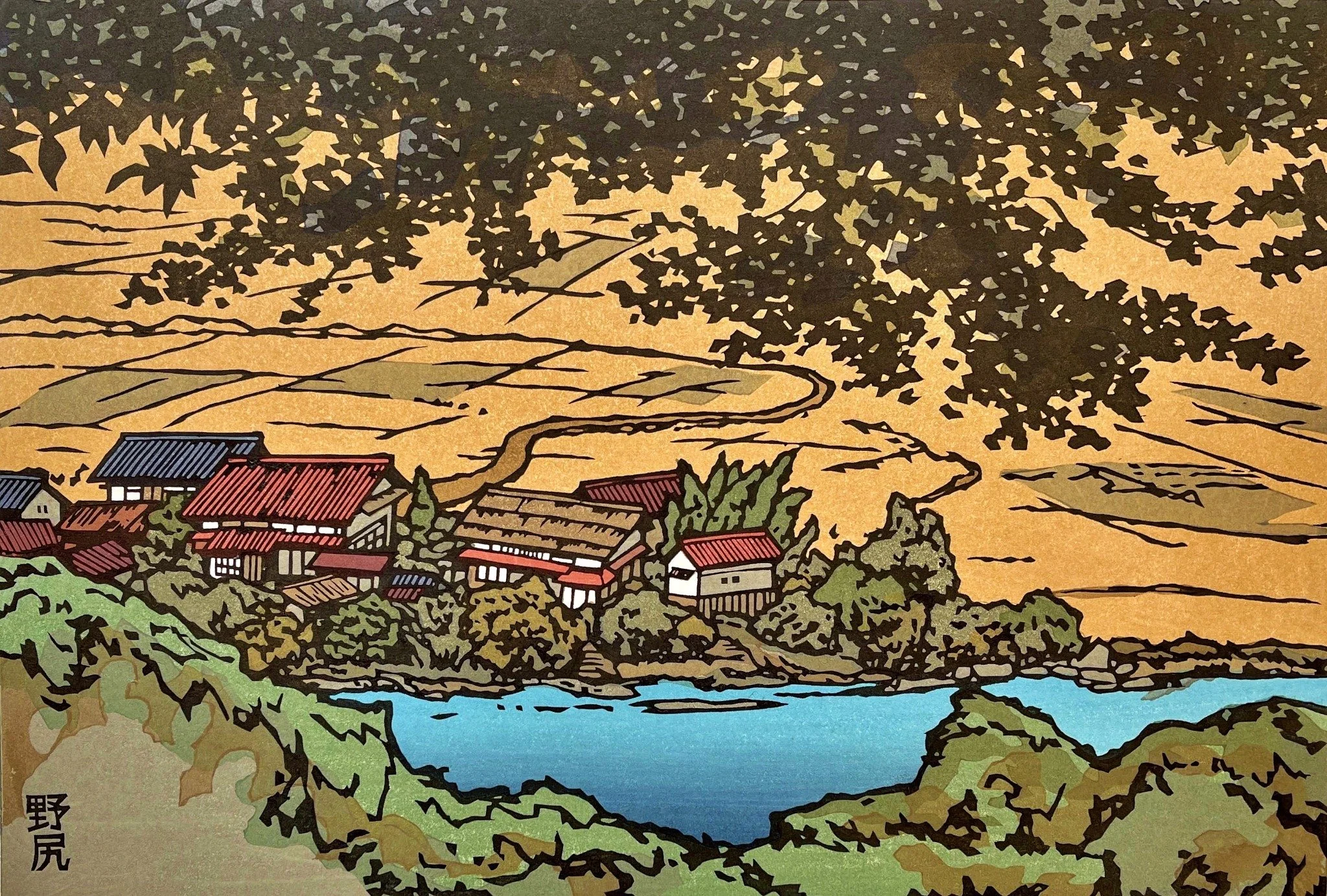
Warm golden light surrounds a riverside settlement beneath a canopy of dark leaves. Katsuyuki Nishijima’s Nojiri balances vivid blue water, clustered rooftops, and bold natural shapes in a landscape canvas reproduction over a sturdy 1.5-inch wood stretcher.
Product details: Canvas reproduction over a sturdy 1.5-inch wood stretcher. Available in 24 × 16 in. ($259 CAD) and 36 × 24 in. ($299 CAD). No returns accepted.
More About the Art
Dark foliage hangs over a small settlement in Nojiri, where red and grey roofs gather beside a vivid blue stretch of water. Warm gold fills much of the background, carrying long, wavering dark lines that contrast with the closely fitted buildings below. Large rocks and patches of green occupy the foreground. The scene has a clear sense of place, yet its immediate impact comes from the way these strong colours and irregular shapes fit together.
Ronin Gallery identifies Katsuyuki Nishijima's Nojiri as a woodblock print from his Kisokaidō series and dates its catalogued impression to about 2000. The series places the work within his continuing interest in traditional settlements and roads. This image looks toward a compact group of buildings rather than presenting a broad street. Their overlapping roofs and varied walls become the centre of a landscape shaped by water, foliage, and warm surrounding light.
The overhead leaves establish the nearest layer. They form a dense dark canopy across the top of the picture, interrupted by many small openings. A few branches reach downward into the gold, leading the eye toward the rooftops. This partial screen makes the village feel encountered from a particular position. It also creates a visual connection between the top edge and the darker rocks below, giving the bright central area a firm surrounding structure.
Within the settlement, individual buildings remain distinct. Some roofs are red, others blue-grey or brown, and their slopes point in different directions. Pale walls and small rectangular openings appear beneath them. Closely spaced strokes describe tiles, timber, and roof edges without requiring every surface to be equally detailed. The architecture feels compact and varied, with enough small differences to suggest a place that has developed through many separate structures.
The water introduces a cooler interval below the buildings. Its bright blue shape winds through the lower part of the view, bordered by rocks and vegetation. Dark marks on the surface suggest gentle movement, while the uneven banks keep its outline active. The water's colour makes the red roofs and golden background seem warmer, creating a relationship that can be appreciated before the viewer begins to identify the smaller architectural details.
Foreground stones bring a different rhythm. Their broad, angular surfaces are marked with olive, grey, and dark brown. Some nearly meet the lower edge, emphasizing their closeness. From these substantial forms, the eye can move across the water to the houses and then upward into the patterned gold. The scene gains depth through these successive layers, even though its bold outlines also keep attention on the flat, decorative organization of the picture.
This landscape canvas reproduction preserves the supplied image's broad proportions and full arrangement of foliage, buildings, water, and stone. From a distance, its blue and gold establish a warm, clear presence. Nearby, roof patterns, small windows, and the edges of the leaves offer a more detailed experience. Nojiri brings those scales of looking together, allowing an intimate settlement to occupy a richly structured landscape whose colours remain fresh and distinctive with repeated viewing.
More About the Artist
Katsuyuki Nishijima, born in Yamaguchi Prefecture in 1945, is a Japanese woodblock printmaker whose work brings close attention to traditional buildings and the landscapes around them. His subjects include shopfronts, tiled roofs, thatched farmhouses, waterways, and quiet stretches of town. Strong outlines and broad areas of colour give these familiar places an immediate presence. Small variations within roofs, walls, foliage, and sky then invite a slower kind of looking, revealing how much visual interest can be held within an apparently modest scene.
Nishijima trained at the Mikumo publishing house in Kyoto between 1964 and 1968. This period gave him sustained experience of woodblock printmaking and its practical demands. A print develops through the relationship between a design, the carved surfaces that carry it, and the colours transferred to paper. Learning that relationship requires attention to both the whole composition and the smallest marks. His later images show a particularly clear understanding of how large colour shapes and fine linear details can support one another.
During the second half of the 1960s, he exhibited with the Kyoto Independents. He also explored stencil dyeing and printing, especially between 1969 and 1972. From 1972, traditional architecture became a central subject in his limited edition woodblocks. His series include views associated with the Sixty-Nine Stations of the Kisokaidō and scenes of Kyoto streets. These projects place everyday buildings within a continuing Japanese tradition of looking closely at roads, settlements, and the distinctive appearance of particular places.
Nishijima's practice is associated with sōsaku-hanga, often translated as creative prints. This approach places the artist at the centre of designing, carving, and printing. The Philbrook Museum of Art describes the individual command of these stages as an essential quality of his work. His pictures therefore belong to a tradition in which the marks of the image emerge through an artist's sustained engagement with the material process, from the decisions of the initial design to the pressure and colour of the printed impression.
Traditional architecture offers him a remarkably varied visual language. Roof tiles can become closely repeated dark strokes; a plaster wall can provide a broad interval of light; wooden frames can divide a facade into strong geometric shapes. A street or bank may lead the eye into depth, while an overhanging tree closes part of the view. These are qualities visible across his work, and they help explain why a building or quiet landscape can carry a composition without relying on a dramatic event.
Human presence is often suggested through inhabited structures and traces of use. A doorway, a roofline, or a boat can give a setting a sense of ordinary life even when no figure occupies the scene. Nishijima's landscapes can be enjoyed both as recognizable places and as arrangements of colour and line. The two experiences reinforce each other: close looking makes the construction of the picture clearer, while also making the setting feel more particular. His woodblocks are represented in museum collections in Japan and abroad, including American institutions identified by the Philbrook Museum.
Premium quality canvas print of “Nojiri” by Katsuyuki Nishijima
Warm golden light surrounds a riverside settlement beneath a canopy of dark leaves. Katsuyuki Nishijima’s Nojiri balances vivid blue water, clustered rooftops, and bold natural shapes in a landscape canvas reproduction over a sturdy 1.5-inch wood stretcher.
Product details: Canvas reproduction over a sturdy 1.5-inch wood stretcher. Available in 24 × 16 in. ($259 CAD) and 36 × 24 in. ($299 CAD). No returns accepted.
More About the Art
Dark foliage hangs over a small settlement in Nojiri, where red and grey roofs gather beside a vivid blue stretch of water. Warm gold fills much of the background, carrying long, wavering dark lines that contrast with the closely fitted buildings below. Large rocks and patches of green occupy the foreground. The scene has a clear sense of place, yet its immediate impact comes from the way these strong colours and irregular shapes fit together.
Ronin Gallery identifies Katsuyuki Nishijima's Nojiri as a woodblock print from his Kisokaidō series and dates its catalogued impression to about 2000. The series places the work within his continuing interest in traditional settlements and roads. This image looks toward a compact group of buildings rather than presenting a broad street. Their overlapping roofs and varied walls become the centre of a landscape shaped by water, foliage, and warm surrounding light.
The overhead leaves establish the nearest layer. They form a dense dark canopy across the top of the picture, interrupted by many small openings. A few branches reach downward into the gold, leading the eye toward the rooftops. This partial screen makes the village feel encountered from a particular position. It also creates a visual connection between the top edge and the darker rocks below, giving the bright central area a firm surrounding structure.
Within the settlement, individual buildings remain distinct. Some roofs are red, others blue-grey or brown, and their slopes point in different directions. Pale walls and small rectangular openings appear beneath them. Closely spaced strokes describe tiles, timber, and roof edges without requiring every surface to be equally detailed. The architecture feels compact and varied, with enough small differences to suggest a place that has developed through many separate structures.
The water introduces a cooler interval below the buildings. Its bright blue shape winds through the lower part of the view, bordered by rocks and vegetation. Dark marks on the surface suggest gentle movement, while the uneven banks keep its outline active. The water's colour makes the red roofs and golden background seem warmer, creating a relationship that can be appreciated before the viewer begins to identify the smaller architectural details.
Foreground stones bring a different rhythm. Their broad, angular surfaces are marked with olive, grey, and dark brown. Some nearly meet the lower edge, emphasizing their closeness. From these substantial forms, the eye can move across the water to the houses and then upward into the patterned gold. The scene gains depth through these successive layers, even though its bold outlines also keep attention on the flat, decorative organization of the picture.
This landscape canvas reproduction preserves the supplied image's broad proportions and full arrangement of foliage, buildings, water, and stone. From a distance, its blue and gold establish a warm, clear presence. Nearby, roof patterns, small windows, and the edges of the leaves offer a more detailed experience. Nojiri brings those scales of looking together, allowing an intimate settlement to occupy a richly structured landscape whose colours remain fresh and distinctive with repeated viewing.
More About the Artist
Katsuyuki Nishijima, born in Yamaguchi Prefecture in 1945, is a Japanese woodblock printmaker whose work brings close attention to traditional buildings and the landscapes around them. His subjects include shopfronts, tiled roofs, thatched farmhouses, waterways, and quiet stretches of town. Strong outlines and broad areas of colour give these familiar places an immediate presence. Small variations within roofs, walls, foliage, and sky then invite a slower kind of looking, revealing how much visual interest can be held within an apparently modest scene.
Nishijima trained at the Mikumo publishing house in Kyoto between 1964 and 1968. This period gave him sustained experience of woodblock printmaking and its practical demands. A print develops through the relationship between a design, the carved surfaces that carry it, and the colours transferred to paper. Learning that relationship requires attention to both the whole composition and the smallest marks. His later images show a particularly clear understanding of how large colour shapes and fine linear details can support one another.
During the second half of the 1960s, he exhibited with the Kyoto Independents. He also explored stencil dyeing and printing, especially between 1969 and 1972. From 1972, traditional architecture became a central subject in his limited edition woodblocks. His series include views associated with the Sixty-Nine Stations of the Kisokaidō and scenes of Kyoto streets. These projects place everyday buildings within a continuing Japanese tradition of looking closely at roads, settlements, and the distinctive appearance of particular places.
Nishijima's practice is associated with sōsaku-hanga, often translated as creative prints. This approach places the artist at the centre of designing, carving, and printing. The Philbrook Museum of Art describes the individual command of these stages as an essential quality of his work. His pictures therefore belong to a tradition in which the marks of the image emerge through an artist's sustained engagement with the material process, from the decisions of the initial design to the pressure and colour of the printed impression.
Traditional architecture offers him a remarkably varied visual language. Roof tiles can become closely repeated dark strokes; a plaster wall can provide a broad interval of light; wooden frames can divide a facade into strong geometric shapes. A street or bank may lead the eye into depth, while an overhanging tree closes part of the view. These are qualities visible across his work, and they help explain why a building or quiet landscape can carry a composition without relying on a dramatic event.
Human presence is often suggested through inhabited structures and traces of use. A doorway, a roofline, or a boat can give a setting a sense of ordinary life even when no figure occupies the scene. Nishijima's landscapes can be enjoyed both as recognizable places and as arrangements of colour and line. The two experiences reinforce each other: close looking makes the construction of the picture clearer, while also making the setting feel more particular. His woodblocks are represented in museum collections in Japan and abroad, including American institutions identified by the Philbrook Museum.