

 Image 1 of 1
Nikkō Road — Kawase Hasui (1930)
Premium quality canvas print of “Nikkō Road” by Kawase Hasui
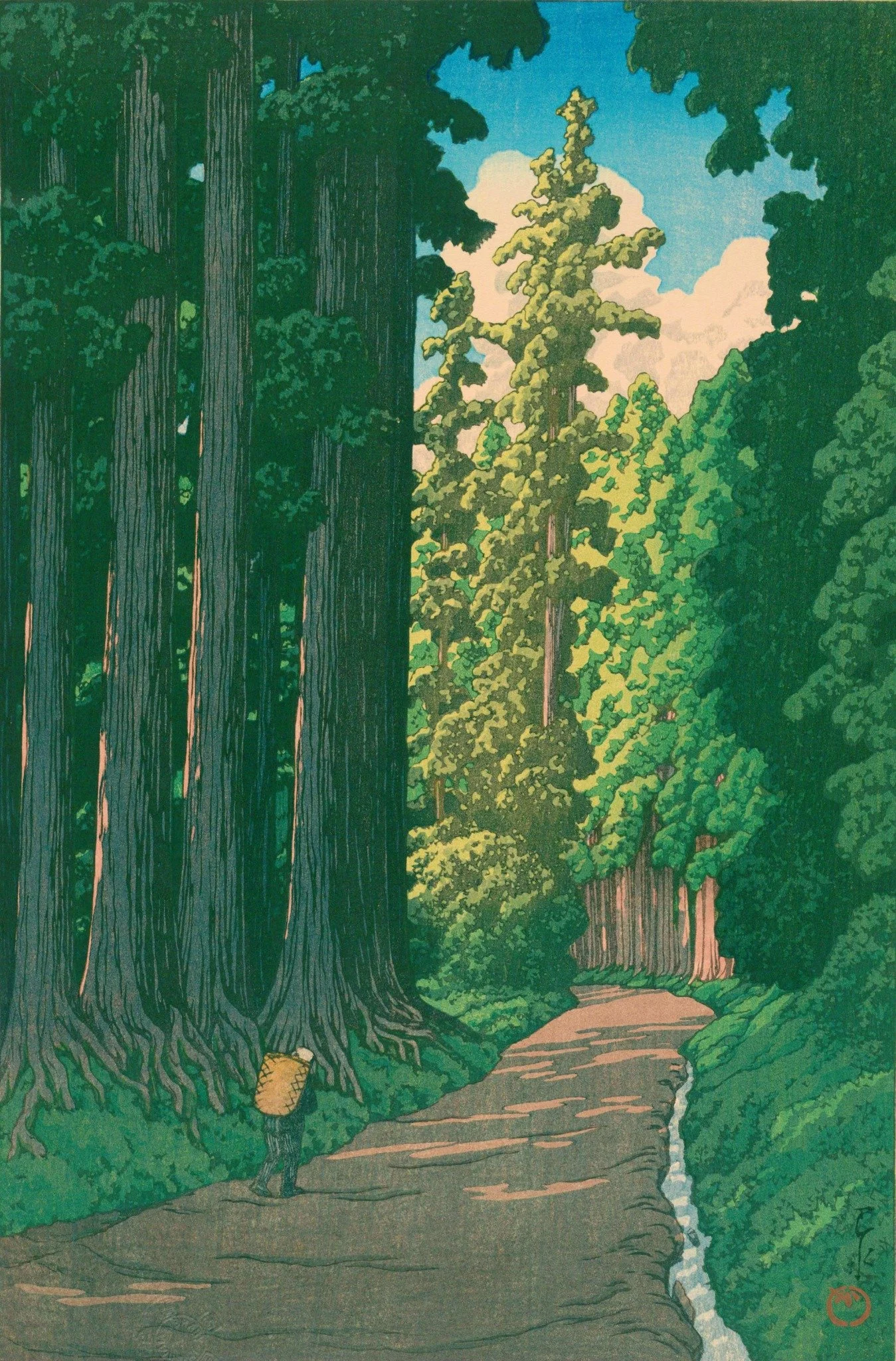
Towering cedars shelter a winding road as sunlight brightens the trees ahead and a lone walker passes beneath the canopy. Kawase Hasui’s Nikkō Road brings the grandeur and quiet invitation of this historic avenue into your home, reproduced on canvas over a sturdy 1.5-inch wood stretcher.
Product details: Canvas reproduction over a sturdy 1.5-inch wood stretcher. Available in 16 × 24 in. ($259 CAD) and 24 × 36 in. ($299 CAD). No returns accepted.
More About the Art
Nikkō Road leads the eye into a corridor of towering trees, where sunlight reaches the path in warm, irregular patches. Massive trunks rise along the left side, their exposed roots spreading into the green bank. Farther ahead, the road curves between brighter trees and disappears into the woodland. A small figure carrying a woven basket walks beneath this immense canopy. Above, an opening reveals blue sky and pale clouds, giving the enclosed forest a sense of light and air.
The nearest trees establish the scale of the scene. Their trunks extend beyond the upper edge, so their full height can only be imagined. Fine vertical lines describe the bark, while lighter brown passages separate individual trees from the surrounding shade. At their bases, roots divide and spread across the ground. These strong forms make the forest feel substantial and closely encountered, rather than viewed from a distant overlook.
The road introduces a gentler movement. Broad in the foreground, it narrows as it bends toward the centre of the image. Warm peach and brown tones distinguish its surface from the green banks. Shadows cross it in long, uneven shapes, suggesting the branches and foliage overhead. The path provides a clear route through the composition, inviting the eye to follow its curve while leaving the next part of the journey just out of sight.
Light changes the appearance of the trees ahead. Their foliage becomes yellow-green and gold against the deep green of the near woodland. Small shapes overlap to suggest branches catching the sun at different angles. Behind them, pale clouds gather within a blue opening. Hasui gives these brighter passages enough space to feel luminous, while the darker edges of the composition preserve the sheltering character of the avenue.
The basket-carrying figure supplies a human measure. The person occupies only a small part of the road, near the enormous roots at left. Clothing and posture are simply indicated, while the warm basket stands out clearly. This modest presence allows the scale of the trees to become more tangible. The avenue is both a monumental landscape and a place through which someone is making an ordinary journey.
Kawase Hasui designed the original colour woodblock print in 1930. Its Japanese title is Nikkō kaidō, written 日光街道; museum catalogues also call it The Nikkō Highway or The Road to Nikkō. Watanabe Shōzaburō published the design. The setting belongs to the historic route connecting Edo, now Tokyo, with Nikkō, and the wooded stretch represented here is in Tochigi Prefecture.
The region’s celebrated sugi, or Japanese cedar, avenues grew from a planting project begun by Matsudaira Masatsuna in 1625. That history gives the trees a cultural presence as well as a natural one. Presented as a canvas reproduction, Nikkō Road brings their scale and varied greens into a contemporary interior. From across the room, the towering trunks and sunlit curve establish its character; closer viewing reveals bark, roots, patterned shadows, and the small figure beneath the canopy. It offers a landscape that feels both inviting and quietly magnificent.
More About the Artist
Kawase Hasui (1883–1957) was a Japanese landscape artist whose colour woodblock designs make the experience of a place feel immediate. His subjects range from mountain villages and coastlines to city streets, temple precincts, and wooded roads. Light, weather, and season shape each scene, giving familiar elements a particular atmosphere. Nikkō Road shows how he could make sunlight and shade as compelling as a recognisable building or distant landmark.
Hasui was born in Tokyo with the given name Bunjiro. He studied Western-style painting with Okada Saburosuke and became a pupil of Kaburaki Kiyokata in 1910. Kiyokata gave him the artist’s name Hasui. This education brought together different approaches to image-making, helping him combine the clarity of carefully arranged forms with an interest in perspective, tonal variation, and the observed character of the natural world.
His interest in landscape prints was encouraged by Itō Shinsui, another artist associated with Kiyokata’s studio. In 1918, Hasui began his long collaboration with the publisher Watanabe Shōzaburō. Their work became central to shin-hanga, meaning “new prints,” the twentieth-century renewal of traditional Japanese woodblock production. The movement brought artists, specialist carvers, printers, and publishers together, maintaining a shared workshop process while developing new effects of colour and atmosphere.
In this setting, a design depended on more than the artist’s initial drawing. Carved lines and colour blocks had to be coordinated through the skill of the printer. Subtle changes of tone could suggest a widening sky, wet ground, or the gradual movement from shade into sunlight. Nikkō Road offers a clear example: the dense trunks, intricate foliage, warm path, and pale clouds require distinct treatments, yet they remain connected within a single convincing space.
Travel and sketching provided Hasui with a continuing store of subjects. He journeyed widely in Japan, recording scenes that later became woodblock designs. His attention often fell on places encountered at an ordinary pace: a road curving between trees, a house beside water, or a temple seen from a sheltered angle. A small figure might give scale to the setting, allowing the viewer to imagine the landscape as somewhere to enter and experience.
His working life included severe disruption. The Great Kantō Earthquake of 1923 destroyed Watanabe’s premises, woodblocks, and print stock, while Hasui lost his house and sketchbooks. He continued travelling and designing afterward. Through the later 1920s and following decades, his prints explored a broad range of places and conditions. The Nikkō design of 1930 belongs to this sustained period of landscape work, bringing a historic avenue into a vivid experience of light and distance.
Hasui continued creating prints after the Second World War and remained active into the 1950s. In 1953, the production of Snow at Zōjōji Temple was documented by Japan’s Cultural Properties Protection Committee, preserving a record of the collaborative craft behind his art. His career ultimately encompassed more than six hundred designs. Museum collections now hold these landscapes alongside evidence that helps explain their preparation, production, and place within modern Japanese printmaking.
His enduring appeal lies in the relationships he establishes within a scene. A small walker gives measure to great trees; a patch of sunlight makes nearby shade feel deeper; a bending path creates distance and anticipation. These are simple visual experiences, brought together with exceptional care. Nikkō Road offers a particularly welcoming introduction to this aspect of his art, combining the grandeur of an old avenue with the intimacy of a journey made on foot.
Sources
Smithsonian National Museum of Asian Art — Nikkō Highway; 1930 and Watanabe publisher
National Museum of Modern Art, Tokyo — The Nikkō Highway; Japanese title 日光街道 and 1930 date
Kawase Hasui Catalogue — Nikkō Highway; title and publication details
Nikkō City Tourism Association — Origins of the Nikkō Sugi Cedar Avenue
Tochigi Prefecture — Cedar Avenue of Nikkō; planting begun in 1625
Japan Museum SieboldHuis — Kawase Hasui: Capturing the Soul of Japan
Tokyo Fuji Art Museum — Kawase Hasui biography and 1953 print-production documentation
Premium quality canvas print of “Nikkō Road” by Kawase Hasui
Towering cedars shelter a winding road as sunlight brightens the trees ahead and a lone walker passes beneath the canopy. Kawase Hasui’s Nikkō Road brings the grandeur and quiet invitation of this historic avenue into your home, reproduced on canvas over a sturdy 1.5-inch wood stretcher.
Product details: Canvas reproduction over a sturdy 1.5-inch wood stretcher. Available in 16 × 24 in. ($259 CAD) and 24 × 36 in. ($299 CAD). No returns accepted.
More About the Art
Nikkō Road leads the eye into a corridor of towering trees, where sunlight reaches the path in warm, irregular patches. Massive trunks rise along the left side, their exposed roots spreading into the green bank. Farther ahead, the road curves between brighter trees and disappears into the woodland. A small figure carrying a woven basket walks beneath this immense canopy. Above, an opening reveals blue sky and pale clouds, giving the enclosed forest a sense of light and air.
The nearest trees establish the scale of the scene. Their trunks extend beyond the upper edge, so their full height can only be imagined. Fine vertical lines describe the bark, while lighter brown passages separate individual trees from the surrounding shade. At their bases, roots divide and spread across the ground. These strong forms make the forest feel substantial and closely encountered, rather than viewed from a distant overlook.
The road introduces a gentler movement. Broad in the foreground, it narrows as it bends toward the centre of the image. Warm peach and brown tones distinguish its surface from the green banks. Shadows cross it in long, uneven shapes, suggesting the branches and foliage overhead. The path provides a clear route through the composition, inviting the eye to follow its curve while leaving the next part of the journey just out of sight.
Light changes the appearance of the trees ahead. Their foliage becomes yellow-green and gold against the deep green of the near woodland. Small shapes overlap to suggest branches catching the sun at different angles. Behind them, pale clouds gather within a blue opening. Hasui gives these brighter passages enough space to feel luminous, while the darker edges of the composition preserve the sheltering character of the avenue.
The basket-carrying figure supplies a human measure. The person occupies only a small part of the road, near the enormous roots at left. Clothing and posture are simply indicated, while the warm basket stands out clearly. This modest presence allows the scale of the trees to become more tangible. The avenue is both a monumental landscape and a place through which someone is making an ordinary journey.
Kawase Hasui designed the original colour woodblock print in 1930. Its Japanese title is Nikkō kaidō, written 日光街道; museum catalogues also call it The Nikkō Highway or The Road to Nikkō. Watanabe Shōzaburō published the design. The setting belongs to the historic route connecting Edo, now Tokyo, with Nikkō, and the wooded stretch represented here is in Tochigi Prefecture.
The region’s celebrated sugi, or Japanese cedar, avenues grew from a planting project begun by Matsudaira Masatsuna in 1625. That history gives the trees a cultural presence as well as a natural one. Presented as a canvas reproduction, Nikkō Road brings their scale and varied greens into a contemporary interior. From across the room, the towering trunks and sunlit curve establish its character; closer viewing reveals bark, roots, patterned shadows, and the small figure beneath the canopy. It offers a landscape that feels both inviting and quietly magnificent.
More About the Artist
Kawase Hasui (1883–1957) was a Japanese landscape artist whose colour woodblock designs make the experience of a place feel immediate. His subjects range from mountain villages and coastlines to city streets, temple precincts, and wooded roads. Light, weather, and season shape each scene, giving familiar elements a particular atmosphere. Nikkō Road shows how he could make sunlight and shade as compelling as a recognisable building or distant landmark.
Hasui was born in Tokyo with the given name Bunjiro. He studied Western-style painting with Okada Saburosuke and became a pupil of Kaburaki Kiyokata in 1910. Kiyokata gave him the artist’s name Hasui. This education brought together different approaches to image-making, helping him combine the clarity of carefully arranged forms with an interest in perspective, tonal variation, and the observed character of the natural world.
His interest in landscape prints was encouraged by Itō Shinsui, another artist associated with Kiyokata’s studio. In 1918, Hasui began his long collaboration with the publisher Watanabe Shōzaburō. Their work became central to shin-hanga, meaning “new prints,” the twentieth-century renewal of traditional Japanese woodblock production. The movement brought artists, specialist carvers, printers, and publishers together, maintaining a shared workshop process while developing new effects of colour and atmosphere.
In this setting, a design depended on more than the artist’s initial drawing. Carved lines and colour blocks had to be coordinated through the skill of the printer. Subtle changes of tone could suggest a widening sky, wet ground, or the gradual movement from shade into sunlight. Nikkō Road offers a clear example: the dense trunks, intricate foliage, warm path, and pale clouds require distinct treatments, yet they remain connected within a single convincing space.
Travel and sketching provided Hasui with a continuing store of subjects. He journeyed widely in Japan, recording scenes that later became woodblock designs. His attention often fell on places encountered at an ordinary pace: a road curving between trees, a house beside water, or a temple seen from a sheltered angle. A small figure might give scale to the setting, allowing the viewer to imagine the landscape as somewhere to enter and experience.
His working life included severe disruption. The Great Kantō Earthquake of 1923 destroyed Watanabe’s premises, woodblocks, and print stock, while Hasui lost his house and sketchbooks. He continued travelling and designing afterward. Through the later 1920s and following decades, his prints explored a broad range of places and conditions. The Nikkō design of 1930 belongs to this sustained period of landscape work, bringing a historic avenue into a vivid experience of light and distance.
Hasui continued creating prints after the Second World War and remained active into the 1950s. In 1953, the production of Snow at Zōjōji Temple was documented by Japan’s Cultural Properties Protection Committee, preserving a record of the collaborative craft behind his art. His career ultimately encompassed more than six hundred designs. Museum collections now hold these landscapes alongside evidence that helps explain their preparation, production, and place within modern Japanese printmaking.
His enduring appeal lies in the relationships he establishes within a scene. A small walker gives measure to great trees; a patch of sunlight makes nearby shade feel deeper; a bending path creates distance and anticipation. These are simple visual experiences, brought together with exceptional care. Nikkō Road offers a particularly welcoming introduction to this aspect of his art, combining the grandeur of an old avenue with the intimacy of a journey made on foot.
Sources
Smithsonian National Museum of Asian Art — Nikkō Highway; 1930 and Watanabe publisher
National Museum of Modern Art, Tokyo — The Nikkō Highway; Japanese title 日光街道 and 1930 date
Kawase Hasui Catalogue — Nikkō Highway; title and publication details
Nikkō City Tourism Association — Origins of the Nikkō Sugi Cedar Avenue
Tochigi Prefecture — Cedar Avenue of Nikkō; planting begun in 1625
Japan Museum SieboldHuis — Kawase Hasui: Capturing the Soul of Japan
Tokyo Fuji Art Museum — Kawase Hasui biography and 1953 print-production documentation