

 Image 1 of 1
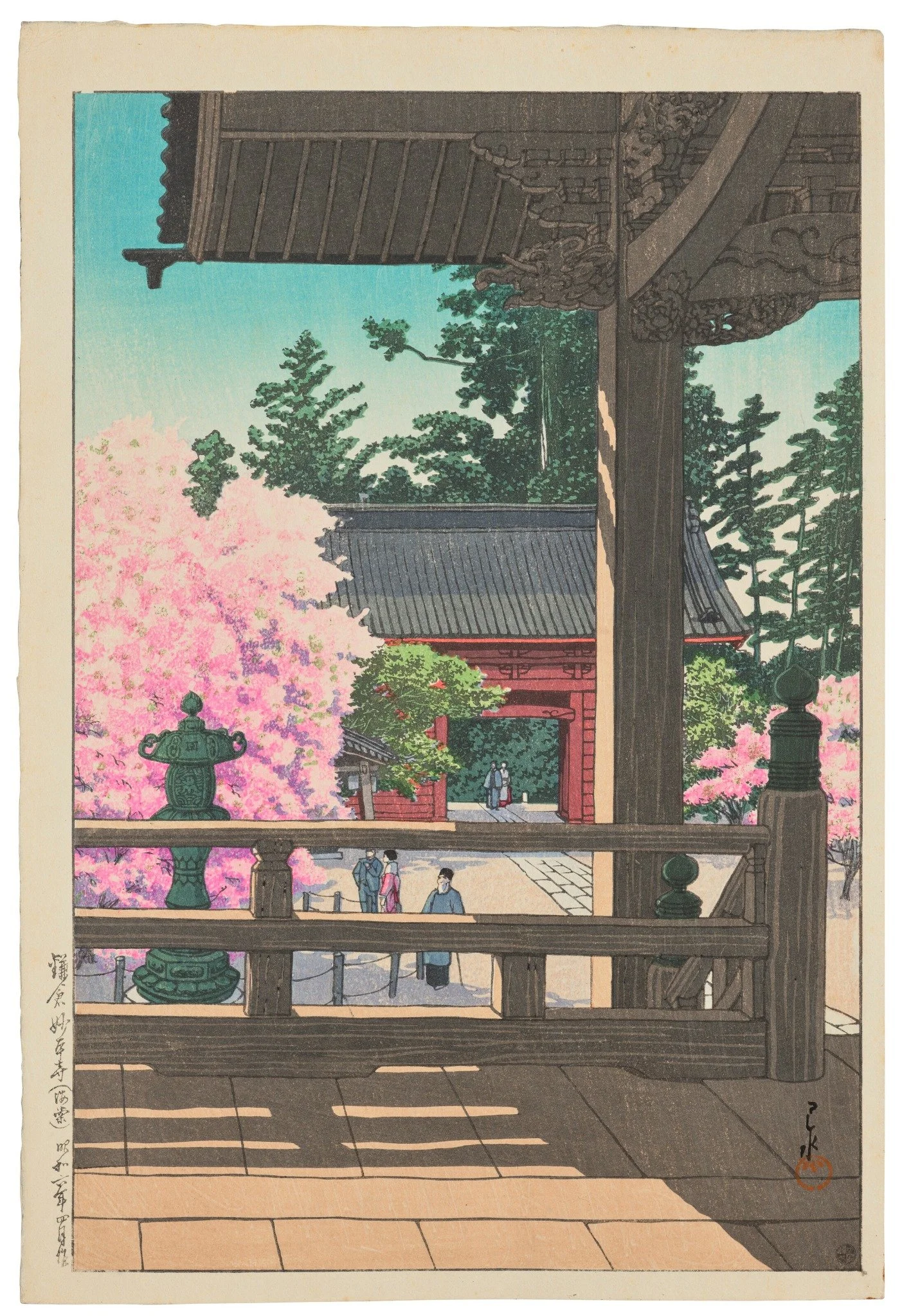
Myōhon Temple, Kamakura — Kawase Hasui (1931)
Premium quality canvas print of “Myōhon Temple, Kamakura” by Kawase Hasui
Pink crabapple blossoms brighten a sunlit temple courtyard, framed by carved wooden eaves and a shaded veranda. Kawase Hasui’s Myōhon Temple, Kamakura brings the grace and freshness of a Japanese spring day into your home, reproduced on canvas over a sturdy 1.5-inch wood stretcher.
Product details: Canvas reproduction over a sturdy 1.5-inch wood stretcher. Available in 16 × 24 in. ($259 CAD) and 24 × 36 in. ($299 CAD). No returns accepted.
More About the Art
Myōhon Temple, Kamakura opens from the shelter of a temple veranda onto a courtyard filled with spring colour. Dark wooden eaves stretch across the upper composition, while a substantial pillar rises at the right and a railing crosses the foreground. Beyond them, pink blossoms gather beside a vermilion gate. Visitors move through the grounds beneath green trees and a clear turquoise sky. The image makes the experience of looking outward feel as important as the view itself.
The foreground architecture establishes a strong sense of place. Closely spaced boards, carved details, and heavy beams give the shaded structure weight and texture. Horizontal rails divide the lower view into separate openings, through which the courtyard and its figures remain visible. On the floor, long patches of sunlight describe the spaces between the rails. These alternating bands of light and shadow bring the viewer close to the building’s surfaces.
Beyond this frame, the blossoms appear especially delicate. Their pale pink and deeper rose tones gather in irregular clusters, with small glimpses of branches and greenery between them. The flowering trees create a luminous middle distance against the dark woodland. They are identified in the work’s Japanese title as kaidō, or flowering crabapple. This seasonal detail gives the design a particular connection to Myōhon-ji’s spring landscape.
The vermilion gate adds another kind of warmth. Its tiled roof forms a broad, cool grey shape above the red posts and walls. The open passage creates a smaller frame within the larger composition, drawing attention to figures standing beyond it. The arrangement makes distance easy to follow: from the shaded veranda, across the sunlit ground, through the gate, and into the trees. Architecture guides the eye without making the scene feel rigid.
The people give the temple a quiet, everyday life. Some appear close to the veranda, others farther away near the gateway. Their modest scale allows the buildings and blossoms to remain prominent, while their presence makes the grounds feel inhabited and welcoming. A decorative lantern at the left and rounded railing ornaments at the right add further detail, connecting the large structural shapes with smaller objects encountered at walking pace.
Kawase Hasui designed the original colour woodblock print in April 1931, and it was published by Watanabe Shōzaburō. Its Japanese title is Kamakura Myōhonji (kaidō), written 鎌倉妙本寺(海棠). The setting is Myōhon-ji, a Nichiren Buddhist temple in Kamakura, Kanagawa Prefecture. The temple stands on land associated with the Hiki clan, giving the spring view a setting within the city’s long religious and historical landscape.
Hasui’s composition brings that history close through a carefully chosen viewpoint. The near timber, soft flowers, bright gate, and small figures belong to one coherent experience of space. Presented as a canvas reproduction, Myōhon Temple, Kamakura offers both rich colour and architectural depth. From across the room, the pink blossoms and dark wooden frame establish its character; closer viewing reveals carved details, sunlight on the floor, and the unhurried movement of visitors. It invites a moment of still attention within the freshness of spring.
More About the Artist
Kawase Hasui (1883–1957) was a Japanese artist celebrated for woodblock landscapes that make the atmosphere of a place feel immediate. His scenes include temple precincts, city waterways, country settlements, mountains, and coasts. Light and weather give each setting its own character: snow quietens a street, rain connects trees and water, or spring sunshine reaches a shaded building. Myōhon Temple, Kamakura shows how he could combine architecture, seasonal bloom, and ordinary human activity within a single absorbing view.
Hasui was born in Tokyo with the given name Bunjiro. His training included Western-style painting under Okada Saburosuke and Japanese-style painting under Kaburaki Kiyokata, whose studio he joined in 1910. Kiyokata gave him his artist’s name. These different approaches helped prepare him to work with strong compositional forms while remaining attentive to perspective, changes of tone, and the particular appearance of a place at a particular moment.
His interest in landscape prints was encouraged by the work of Itō Shinsui, another pupil in Kiyokata’s circle. In 1918, Hasui began collaborating with the publisher Watanabe Shōzaburō. Their partnership became central to shin-hanga, or “new prints,” the twentieth-century renewal of Japanese woodblock production. The movement retained a division of work among artist, carver, printer, and publisher, while exploring new possibilities for colour, light, and atmospheric expression.
This shared process is essential to understanding his art. The artist’s design had to become a carefully coordinated sequence of carved and printed forms. Small details needed to remain legible within larger areas of colour. In Myōhon Temple, Kamakura, the dark carved timber, delicate flowering branches, repeated roof tiles, and patches of sunlight each require a different visual treatment. Their successful combination allows the completed image to feel clear and spacious despite its richness of detail.
Travel and sketching supplied Hasui with a continuing store of subjects. He journeyed widely across Japan, recording scenes that could later be developed into woodblock designs. He often chose views that encourage an intimate response: a lane beneath trees, a temple seen from a sheltered corner, or a shore encountered at dusk. Such settings invite viewers to imagine being present, rather than simply recognising a famous landmark from a distance.
His working life also involved major disruption. The Great Kantō Earthquake of 1923 destroyed Watanabe’s premises, woodblocks, and print stock, while Hasui’s house and sketchbooks were lost. He continued travelling and designing afterward, building a substantial body of landscapes through the following decades. The Myōhon-ji design belongs to the productive years of the early 1930s, when his work explored a wide range of seasonal settings and carefully chosen viewpoints.
Hasui remained active after the Second World War and continued creating prints into the 1950s. In 1953, the production of Snow at Zōjōji Temple was documented by Japan’s Cultural Properties Protection Committee, preserving a record of the collaborative craft behind a finished print. By the end of his career, he had designed more than six hundred woodblock prints. Museum collections now preserve this extensive record of Japan’s landscapes, buildings, weather, and everyday spaces.
His enduring appeal comes partly from the way separate elements answer one another. A small figure gives scale to a temple gate; a flowering branch softens a strong architectural line; sunlight joins foreground and distance. Myōhon Temple, Kamakura makes these relationships particularly vivid. The viewer is offered a sheltered place from which to look, and the longer the view is considered, the more carefully connected its details become. It is an invitation to notice the richness of a familiar, passing moment.
Sources
National Museum of Modern Art, Tokyo — Myōhon-ji Temple, Kamakura (kaidō); 1931 and Japanese title
Kawase Hasui Catalogue — Myōhon Temple, Kamakura; Japanese title and publication details
Ronin Gallery — Myōhon Temple, Kamakura; Watanabe Shōzaburō and 1931 design
Kamakura City Tourist Association — Myōhon-ji and its connection to the Hiki clan
Japan Museum SieboldHuis — Kawase Hasui: Capturing the Soul of Japan
Tokyo Fuji Art Museum — Kawase Hasui biography and 1953 print-production documentation
Premium quality canvas print of “Myōhon Temple, Kamakura” by Kawase Hasui
Pink crabapple blossoms brighten a sunlit temple courtyard, framed by carved wooden eaves and a shaded veranda. Kawase Hasui’s Myōhon Temple, Kamakura brings the grace and freshness of a Japanese spring day into your home, reproduced on canvas over a sturdy 1.5-inch wood stretcher.
Product details: Canvas reproduction over a sturdy 1.5-inch wood stretcher. Available in 16 × 24 in. ($259 CAD) and 24 × 36 in. ($299 CAD). No returns accepted.
More About the Art
Myōhon Temple, Kamakura opens from the shelter of a temple veranda onto a courtyard filled with spring colour. Dark wooden eaves stretch across the upper composition, while a substantial pillar rises at the right and a railing crosses the foreground. Beyond them, pink blossoms gather beside a vermilion gate. Visitors move through the grounds beneath green trees and a clear turquoise sky. The image makes the experience of looking outward feel as important as the view itself.
The foreground architecture establishes a strong sense of place. Closely spaced boards, carved details, and heavy beams give the shaded structure weight and texture. Horizontal rails divide the lower view into separate openings, through which the courtyard and its figures remain visible. On the floor, long patches of sunlight describe the spaces between the rails. These alternating bands of light and shadow bring the viewer close to the building’s surfaces.
Beyond this frame, the blossoms appear especially delicate. Their pale pink and deeper rose tones gather in irregular clusters, with small glimpses of branches and greenery between them. The flowering trees create a luminous middle distance against the dark woodland. They are identified in the work’s Japanese title as kaidō, or flowering crabapple. This seasonal detail gives the design a particular connection to Myōhon-ji’s spring landscape.
The vermilion gate adds another kind of warmth. Its tiled roof forms a broad, cool grey shape above the red posts and walls. The open passage creates a smaller frame within the larger composition, drawing attention to figures standing beyond it. The arrangement makes distance easy to follow: from the shaded veranda, across the sunlit ground, through the gate, and into the trees. Architecture guides the eye without making the scene feel rigid.
The people give the temple a quiet, everyday life. Some appear close to the veranda, others farther away near the gateway. Their modest scale allows the buildings and blossoms to remain prominent, while their presence makes the grounds feel inhabited and welcoming. A decorative lantern at the left and rounded railing ornaments at the right add further detail, connecting the large structural shapes with smaller objects encountered at walking pace.
Kawase Hasui designed the original colour woodblock print in April 1931, and it was published by Watanabe Shōzaburō. Its Japanese title is Kamakura Myōhonji (kaidō), written 鎌倉妙本寺(海棠). The setting is Myōhon-ji, a Nichiren Buddhist temple in Kamakura, Kanagawa Prefecture. The temple stands on land associated with the Hiki clan, giving the spring view a setting within the city’s long religious and historical landscape.
Hasui’s composition brings that history close through a carefully chosen viewpoint. The near timber, soft flowers, bright gate, and small figures belong to one coherent experience of space. Presented as a canvas reproduction, Myōhon Temple, Kamakura offers both rich colour and architectural depth. From across the room, the pink blossoms and dark wooden frame establish its character; closer viewing reveals carved details, sunlight on the floor, and the unhurried movement of visitors. It invites a moment of still attention within the freshness of spring.
More About the Artist
Kawase Hasui (1883–1957) was a Japanese artist celebrated for woodblock landscapes that make the atmosphere of a place feel immediate. His scenes include temple precincts, city waterways, country settlements, mountains, and coasts. Light and weather give each setting its own character: snow quietens a street, rain connects trees and water, or spring sunshine reaches a shaded building. Myōhon Temple, Kamakura shows how he could combine architecture, seasonal bloom, and ordinary human activity within a single absorbing view.
Hasui was born in Tokyo with the given name Bunjiro. His training included Western-style painting under Okada Saburosuke and Japanese-style painting under Kaburaki Kiyokata, whose studio he joined in 1910. Kiyokata gave him his artist’s name. These different approaches helped prepare him to work with strong compositional forms while remaining attentive to perspective, changes of tone, and the particular appearance of a place at a particular moment.
His interest in landscape prints was encouraged by the work of Itō Shinsui, another pupil in Kiyokata’s circle. In 1918, Hasui began collaborating with the publisher Watanabe Shōzaburō. Their partnership became central to shin-hanga, or “new prints,” the twentieth-century renewal of Japanese woodblock production. The movement retained a division of work among artist, carver, printer, and publisher, while exploring new possibilities for colour, light, and atmospheric expression.
This shared process is essential to understanding his art. The artist’s design had to become a carefully coordinated sequence of carved and printed forms. Small details needed to remain legible within larger areas of colour. In Myōhon Temple, Kamakura, the dark carved timber, delicate flowering branches, repeated roof tiles, and patches of sunlight each require a different visual treatment. Their successful combination allows the completed image to feel clear and spacious despite its richness of detail.
Travel and sketching supplied Hasui with a continuing store of subjects. He journeyed widely across Japan, recording scenes that could later be developed into woodblock designs. He often chose views that encourage an intimate response: a lane beneath trees, a temple seen from a sheltered corner, or a shore encountered at dusk. Such settings invite viewers to imagine being present, rather than simply recognising a famous landmark from a distance.
His working life also involved major disruption. The Great Kantō Earthquake of 1923 destroyed Watanabe’s premises, woodblocks, and print stock, while Hasui’s house and sketchbooks were lost. He continued travelling and designing afterward, building a substantial body of landscapes through the following decades. The Myōhon-ji design belongs to the productive years of the early 1930s, when his work explored a wide range of seasonal settings and carefully chosen viewpoints.
Hasui remained active after the Second World War and continued creating prints into the 1950s. In 1953, the production of Snow at Zōjōji Temple was documented by Japan’s Cultural Properties Protection Committee, preserving a record of the collaborative craft behind a finished print. By the end of his career, he had designed more than six hundred woodblock prints. Museum collections now preserve this extensive record of Japan’s landscapes, buildings, weather, and everyday spaces.
His enduring appeal comes partly from the way separate elements answer one another. A small figure gives scale to a temple gate; a flowering branch softens a strong architectural line; sunlight joins foreground and distance. Myōhon Temple, Kamakura makes these relationships particularly vivid. The viewer is offered a sheltered place from which to look, and the longer the view is considered, the more carefully connected its details become. It is an invitation to notice the richness of a familiar, passing moment.
Sources
National Museum of Modern Art, Tokyo — Myōhon-ji Temple, Kamakura (kaidō); 1931 and Japanese title
Kawase Hasui Catalogue — Myōhon Temple, Kamakura; Japanese title and publication details
Ronin Gallery — Myōhon Temple, Kamakura; Watanabe Shōzaburō and 1931 design
Kamakura City Tourist Association — Myōhon-ji and its connection to the Hiki clan
Japan Museum SieboldHuis — Kawase Hasui: Capturing the Soul of Japan
Tokyo Fuji Art Museum — Kawase Hasui biography and 1953 print-production documentation