

 Image 1 of 1
Moonlight at Yasaka Pagoda — Takeji Asano (1951)
Premium quality canvas print of “Moonlight at Yasaka Pagoda” by Takeji Asano
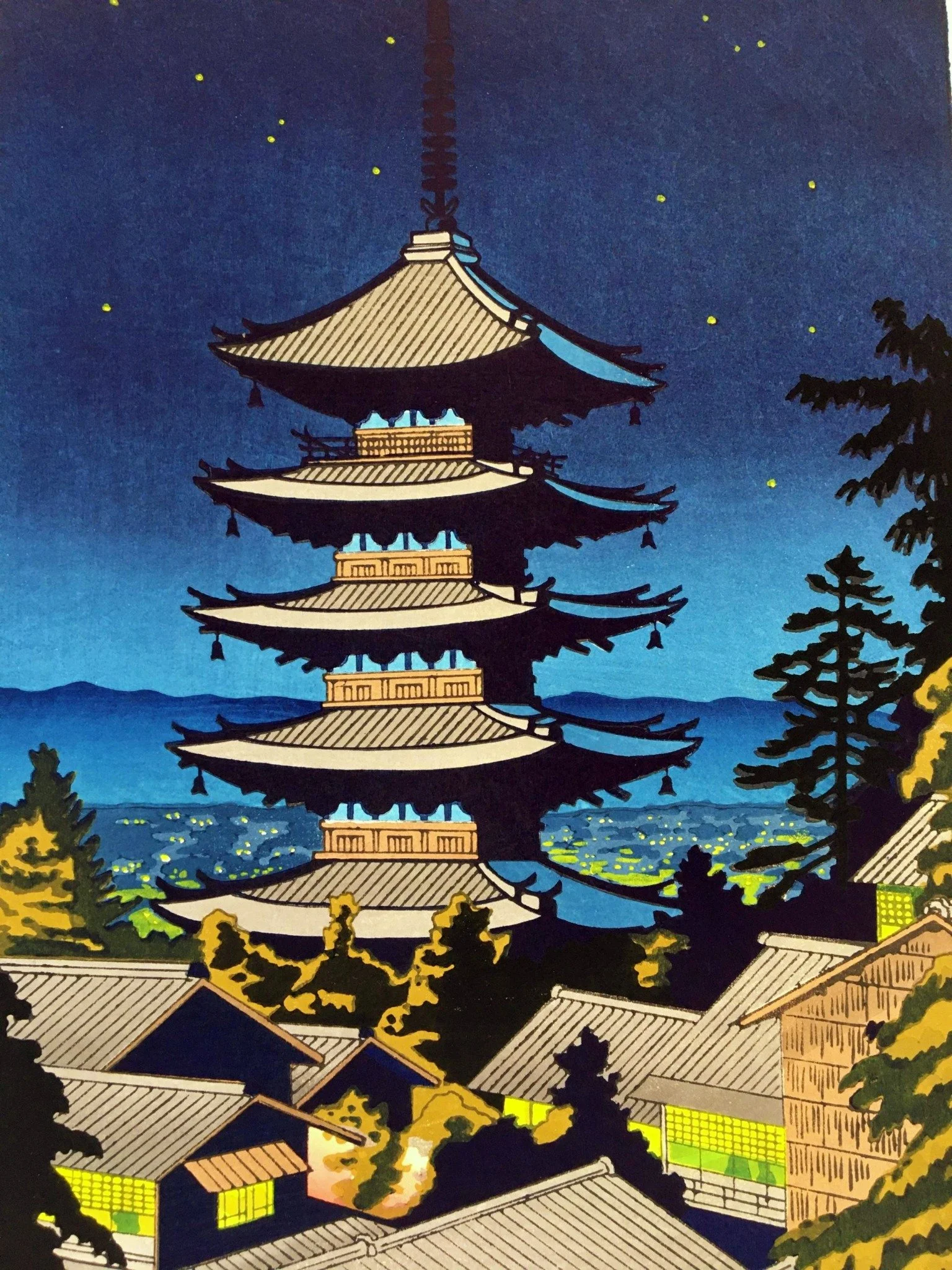
A luminous pagoda rises above Kyoto’s rooftops beneath a deep blue, star-filled sky. Takeji Asano’s Moonlight at Yasaka Pagoda balances pale architecture, glowing windows, and warm yellow accents in a portrait canvas reproduction over a sturdy 1.5-inch wood stretcher.
Product details: Canvas reproduction over a sturdy 1.5-inch wood stretcher. Available in 16 × 24 in. ($259 CAD) and 24 × 36 in. ($299 CAD). No returns accepted.
More About the Art
Moonlight at Yasaka Pagoda presents Kyoto as a city of deep blue air, pale roofs, and small points of light. The five-storey tower rises above a close arrangement of houses and trees, its repeating eaves spreading into the night. Yellow-green stars are scattered across the sky, while illuminated windows and distant lights create a gentle answer below. The image feels spacious above the rooftops and warmly inhabited close to the ground.
The pagoda holds the composition together. Its tiers climb in a clear vertical sequence, narrowing toward the finial that reaches beyond the upper edge of the supplied image. Each roof is formed from a light surface and a dark underside, with upturned corners that give the structure a graceful rhythm. Fine parallel lines indicate the roof covering. Small hanging elements and the wooden galleries between storeys add detail without disturbing the strong overall silhouette.
Asano makes the building appear luminous through contrast. Cream and pale gold roof planes stand against indigo shadows; touches of bright blue catch along the right-hand edges. The surrounding sky changes from darker violet-blue above to a clearer turquoise near the hills. No moon disc is visible in this supplied image. Instead, the title’s moonlight is suggested by the pale architecture and the cool colours that bind the tower, sky, and distant landscape together.
Nearer the viewer, the city becomes a series of intersecting rooflines. Grey and cream surfaces slope in different directions, crossing the lower image in broad diagonals. Warm timber walls appear between them. Several windows glow in yellow and green, creating small, vivid rectangles amid the blue shadows. These domestic details balance the height of the pagoda, allowing a monumental building and the quieter scale of nearby homes to coexist within one view.
Trees provide a third rhythm. Dark pines rise along the right side, their irregular branches breaking into the sky. Smaller golden trees gather around the base of the tower, while dense silhouettes interrupt the foreground roofs. Their organic forms soften the repeated architectural lines. Beyond, the city lights extend toward low hills, enlarging the space and connecting the close neighbourhood with a much broader Kyoto night.
The landmark is the Yasaka Pagoda of Hōkan-ji Temple in Kyoto’s Higashiyama area. Kyoto’s official travel guide places it among the old neighbourhoods between Kiyomizu-dera and Yasaka Shrine. Unsōdō, the publisher of Asano’s woodblock design, lists it as Moonlight at Yasaka Pagoda, 八坂の塔 月夜, catalogue number TA4, and gives 1951 as the year of its first printing. That date belongs to the design’s publishing history; this offering is a contemporary canvas reproduction of the supplied image.
The portrait format allows the tower to dominate without losing the surrounding life of the city. Stars, distant lights, glowing windows, and pale roofs repeat the idea of illumination at several scales. Reproduced over a sturdy wood stretcher, the image offers a striking combination of nocturnal blues and warm yellow accents. Its immediate appeal lies in the luminous pagoda, while closer looking reveals the many small shapes that give the evening scene its depth and quiet character.
More About the Artist
Takeji Asano (1900–1998) brought a distinctive warmth and clarity to twentieth-century Japanese woodblock prints. Born in Kyoto, he developed a long career that included paintings, views of famous places, and freely imaginative creative prints. Moonlight at Yasaka Pagoda shows his ability to make a well-known landmark feel both monumental and close to ordinary life. The tower rises with unmistakable authority, yet surrounding houses, lit windows, and trees remain essential to the atmosphere of the scene.
He first trained as a painter, graduating from the Kyoto School of Arts and Crafts in 1919 and the Kyoto Municipal School of Painting in 1923. Japanese-style painting was central to his education, and he also experimented with oil painting. He entered Tsuchida Bakusen’s school in 1927. This varied experience preceded his turn toward printmaking around 1930, giving him a foundation in both observation and the deliberate arrangement of a picture’s surfaces.
The work of Kobayashi Kiyochika encouraged Asano’s interest in depicting recognizable places. He made landscapes of Kyoto, Osaka, Tokyo, and other parts of Japan, finding subjects among streets, temples, rivers, and familiar landmarks. Kyoto Seika University has described how sketches made in different places underlay his softly shaped, technically assured multicolour prints. That approach gave individual locations a clear identity while leaving room for season, light, and the quieter feelings a place could suggest.
Asano’s publishing relationship with Unsōdō placed some of these landscapes within the collaborative tradition associated with shin-hanga. The Kyoto publisher began issuing his designs in the early 1950s and continues to catalogue many of them. Moonlight at Yasaka Pagoda is one such design, first printed in 1951 according to Unsōdō’s own record. Its fine roof lines and carefully separated colour areas reflect the disciplined design required for an image that takes shape through multiple woodblock impressions.
Alongside publisher-issued landscapes, Asano explored sōsaku-hanga, the creative-print approach that emphasizes the artist’s involvement in designing, carving, and printing. This became a field for increasingly personal invention. Birds, insects, animals, musicians, and human figures appeared in simplified, expressive forms. The warmth of these works does not require a detailed account of a place or event; it can emerge through a few bold shapes, an unusual relationship of colours, or an unexpectedly humorous gesture.
Fuchū Art Museum has highlighted the freedom and gentle vitality of this later work. In 1960, the American artist Ben Shahn visited Asano’s studio, beginning a friendship that became part of his artistic life. Asano continued exhibiting over many decades. His career therefore reaches beyond the serene temple views for which many viewers first recognize his name, embracing both close observation and an imaginative freedom that remained active well into his later years.
His work is preserved in major Japanese collections, and his family donated approximately 1,500 works to Kyoto Seika University after his death. These holdings make it possible to see connections across the many kinds of images he created. Moonlight at Yasaka Pagoda offers a particularly clear introduction: the architecture is precisely organized, the palette is bold, and the atmosphere remains inviting. A familiar skyline becomes an absorbing pattern of light, shadow, and human habitation.
Sources for the artwork and artist
Premium quality canvas print of “Moonlight at Yasaka Pagoda” by Takeji Asano
A luminous pagoda rises above Kyoto’s rooftops beneath a deep blue, star-filled sky. Takeji Asano’s Moonlight at Yasaka Pagoda balances pale architecture, glowing windows, and warm yellow accents in a portrait canvas reproduction over a sturdy 1.5-inch wood stretcher.
Product details: Canvas reproduction over a sturdy 1.5-inch wood stretcher. Available in 16 × 24 in. ($259 CAD) and 24 × 36 in. ($299 CAD). No returns accepted.
More About the Art
Moonlight at Yasaka Pagoda presents Kyoto as a city of deep blue air, pale roofs, and small points of light. The five-storey tower rises above a close arrangement of houses and trees, its repeating eaves spreading into the night. Yellow-green stars are scattered across the sky, while illuminated windows and distant lights create a gentle answer below. The image feels spacious above the rooftops and warmly inhabited close to the ground.
The pagoda holds the composition together. Its tiers climb in a clear vertical sequence, narrowing toward the finial that reaches beyond the upper edge of the supplied image. Each roof is formed from a light surface and a dark underside, with upturned corners that give the structure a graceful rhythm. Fine parallel lines indicate the roof covering. Small hanging elements and the wooden galleries between storeys add detail without disturbing the strong overall silhouette.
Asano makes the building appear luminous through contrast. Cream and pale gold roof planes stand against indigo shadows; touches of bright blue catch along the right-hand edges. The surrounding sky changes from darker violet-blue above to a clearer turquoise near the hills. No moon disc is visible in this supplied image. Instead, the title’s moonlight is suggested by the pale architecture and the cool colours that bind the tower, sky, and distant landscape together.
Nearer the viewer, the city becomes a series of intersecting rooflines. Grey and cream surfaces slope in different directions, crossing the lower image in broad diagonals. Warm timber walls appear between them. Several windows glow in yellow and green, creating small, vivid rectangles amid the blue shadows. These domestic details balance the height of the pagoda, allowing a monumental building and the quieter scale of nearby homes to coexist within one view.
Trees provide a third rhythm. Dark pines rise along the right side, their irregular branches breaking into the sky. Smaller golden trees gather around the base of the tower, while dense silhouettes interrupt the foreground roofs. Their organic forms soften the repeated architectural lines. Beyond, the city lights extend toward low hills, enlarging the space and connecting the close neighbourhood with a much broader Kyoto night.
The landmark is the Yasaka Pagoda of Hōkan-ji Temple in Kyoto’s Higashiyama area. Kyoto’s official travel guide places it among the old neighbourhoods between Kiyomizu-dera and Yasaka Shrine. Unsōdō, the publisher of Asano’s woodblock design, lists it as Moonlight at Yasaka Pagoda, 八坂の塔 月夜, catalogue number TA4, and gives 1951 as the year of its first printing. That date belongs to the design’s publishing history; this offering is a contemporary canvas reproduction of the supplied image.
The portrait format allows the tower to dominate without losing the surrounding life of the city. Stars, distant lights, glowing windows, and pale roofs repeat the idea of illumination at several scales. Reproduced over a sturdy wood stretcher, the image offers a striking combination of nocturnal blues and warm yellow accents. Its immediate appeal lies in the luminous pagoda, while closer looking reveals the many small shapes that give the evening scene its depth and quiet character.
More About the Artist
Takeji Asano (1900–1998) brought a distinctive warmth and clarity to twentieth-century Japanese woodblock prints. Born in Kyoto, he developed a long career that included paintings, views of famous places, and freely imaginative creative prints. Moonlight at Yasaka Pagoda shows his ability to make a well-known landmark feel both monumental and close to ordinary life. The tower rises with unmistakable authority, yet surrounding houses, lit windows, and trees remain essential to the atmosphere of the scene.
He first trained as a painter, graduating from the Kyoto School of Arts and Crafts in 1919 and the Kyoto Municipal School of Painting in 1923. Japanese-style painting was central to his education, and he also experimented with oil painting. He entered Tsuchida Bakusen’s school in 1927. This varied experience preceded his turn toward printmaking around 1930, giving him a foundation in both observation and the deliberate arrangement of a picture’s surfaces.
The work of Kobayashi Kiyochika encouraged Asano’s interest in depicting recognizable places. He made landscapes of Kyoto, Osaka, Tokyo, and other parts of Japan, finding subjects among streets, temples, rivers, and familiar landmarks. Kyoto Seika University has described how sketches made in different places underlay his softly shaped, technically assured multicolour prints. That approach gave individual locations a clear identity while leaving room for season, light, and the quieter feelings a place could suggest.
Asano’s publishing relationship with Unsōdō placed some of these landscapes within the collaborative tradition associated with shin-hanga. The Kyoto publisher began issuing his designs in the early 1950s and continues to catalogue many of them. Moonlight at Yasaka Pagoda is one such design, first printed in 1951 according to Unsōdō’s own record. Its fine roof lines and carefully separated colour areas reflect the disciplined design required for an image that takes shape through multiple woodblock impressions.
Alongside publisher-issued landscapes, Asano explored sōsaku-hanga, the creative-print approach that emphasizes the artist’s involvement in designing, carving, and printing. This became a field for increasingly personal invention. Birds, insects, animals, musicians, and human figures appeared in simplified, expressive forms. The warmth of these works does not require a detailed account of a place or event; it can emerge through a few bold shapes, an unusual relationship of colours, or an unexpectedly humorous gesture.
Fuchū Art Museum has highlighted the freedom and gentle vitality of this later work. In 1960, the American artist Ben Shahn visited Asano’s studio, beginning a friendship that became part of his artistic life. Asano continued exhibiting over many decades. His career therefore reaches beyond the serene temple views for which many viewers first recognize his name, embracing both close observation and an imaginative freedom that remained active well into his later years.
His work is preserved in major Japanese collections, and his family donated approximately 1,500 works to Kyoto Seika University after his death. These holdings make it possible to see connections across the many kinds of images he created. Moonlight at Yasaka Pagoda offers a particularly clear introduction: the architecture is precisely organized, the palette is bold, and the atmosphere remains inviting. A familiar skyline becomes an absorbing pattern of light, shadow, and human habitation.
Sources for the artwork and artist