

 Image 1 of 1
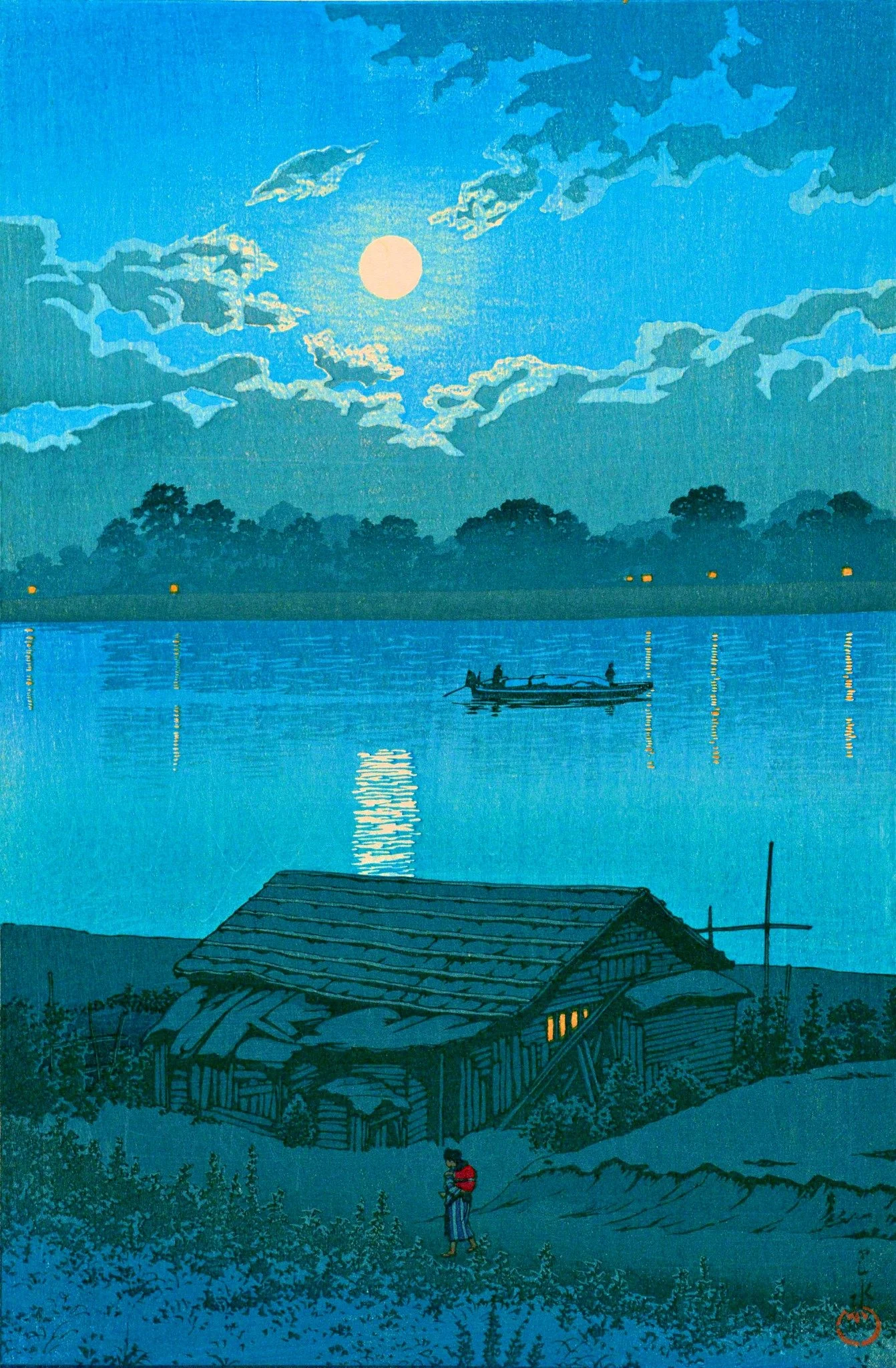
Moon on the Arakawa River at Akabane — Kawase Hasui (1929)
Premium quality canvas print of “Moon on the Arakawa River at Akabane” by Kawase Hasui
A pale moon and warm riverside lights shimmer across luminous blue water. Kawase Hasui’s Moon on the Arakawa River at Akabane brings the intimacy and spaciousness of a quiet Tokyo night into your home as a portrait canvas reproduction over a sturdy 1.5-inch wood stretcher.
Product details: Canvas reproduction over a sturdy 1.5-inch wood stretcher. Available in 16 × 24 in. ($259 CAD) and 24 × 36 in. ($299 CAD). No returns accepted.
More About the Art
Moon on the Arakawa River at Akabane opens a luminous night above a quiet stretch of water. A full moon hangs among irregular clouds, its pale circle surrounded by the blues and blue-greens that fill the sky. Below, a low line of trees marks the opposite bank. Small amber lights punctuate that dark shore, connecting the distant landscape with the signs of everyday life close at hand.
The sky occupies a generous part of the portrait composition. Hasui gives the clouds layered, shifting edges, allowing lighter passages to gather around the moon while deeper shapes cross the upper right. Their varied outlines keep the open sky active without disturbing its spaciousness. The moon itself remains a simple, clear form, a quiet centre of attention within the surrounding movement of colour and cloud.
Across the middle of the image, the river carries a narrow boat with two silhouetted figures. Its long horizontal shape rests between fine ripples and darker reflections. The boat feels small within the broad expanse of water, yet its distinct outline gives the scene a human rhythm. Hasui leaves its occupants unnamed, allowing their presence to suggest the ordinary activity of the river rather than a fixed story.
Light creates an intimate connection between sky and water. Beneath the moon, a broken column of pale yellow marks the rippled surface, while the more distant shore lights send slender reflections downward. These separated strokes make brightness feel mobile and delicate. Their warmth also prepares the eye for the glowing windows of the low wooden building that anchors the foreground, bringing a domestic note into the cool night.
The building is described through dark, assured lines: overlapping roof sections, horizontal boards, projecting eaves, and narrow openings. Plants gather around its walls and spread across the sloping bank. A small figure in striped clothing, touched with a vivid red accent, stands nearby. Together, the house, vegetation, and figure offer a close, textured counterpart to the open river and expansive sky beyond them.
Kawase Hasui designed this colour woodblock print in 1929, during the Shōwa era. Its Japanese title is Arakawa no tsuki (Akabane), 荒川の月(赤羽), and it belongs to Twenty Views of Tokyo, Tōkyō nijūkei. Published by Watanabe Shōzaburō, the design presents Tokyo through a riverside nocturne. The National Museum of Modern Art, Tokyo, and the Museum of Fine Arts, Boston, identify the work within that series, while the Los Angeles County Museum of Art holds another impression.
This portrait canvas reproduction preserves the supplied image composition, including the cloud-filled sky, moonlit water, boat, wooden house, and foreground figure. Its vivid turquoise and deeper blue passages give the scene a fresh, enveloping presence, balanced by small points of amber and red. The generous vertical format allows the eye to move between earth, water, and sky without interruption. Viewed slowly, the image offers a succession of quiet discoveries: a roofline, a ripple, a distant light, a figure on the bank. Each returns the eye to the calm relationship between human shelter and the wide night.
More About the Artist
Kawase Hasui (1883–1957) made changing light and weather central to the art of the Japanese landscape print. A leading designer of the shin-hanga movement, he worked within a tradition of carved woodblocks while giving familiar places a personal, atmospheric character. Moon on the Arakawa River at Akabane shows that gift through a river, a modest house, and a luminous sky: ordinary elements brought into a carefully balanced night scene.
Hasui was born in Tokyo with the given name Bunjiro. His education included Western-style painting under Okada Saburosuke and, from 1910, study with the Japanese-style painter Kaburaki Kiyokata. These experiences gave him access to different ways of organizing a picture. The firm outlines and carefully placed silhouettes of his prints coexist with a sensitivity to depth, colour relationships, and the gradual transitions through which light changes a landscape.
His move into landscape woodblock printing took shape through his connection with Kiyokata and the publisher Watanabe Shōzaburō. Watanabe issued his first landscape prints in 1918–19, beginning a collaboration that became central to Hasui’s career. The publisher supported shin-hanga, or “new prints,” through images that brought contemporary feeling to established craft. In Hasui’s work, that renewal often emerged through quiet subjects and the particular atmosphere of a passing hour.
A shin-hanga print depended on several kinds of expertise. The designer established the image, while skilled carvers and printers translated it into blocks, lines, and successive layers of colour under a publisher’s direction. The Akabane scene makes the demands of that process easy to appreciate. Fine plants and roof details share the image with broad blue passages, distinct clouds, and small reflections, each requiring a different balance of precision and softness.
Travel and observation sustained Hasui’s practice. He made extensive sketching journeys across Japan, finding subjects in temple precincts, villages, urban waterways, coastlines, and mountain settings. He was drawn both to recognizable places and to less celebrated views. His Twenty Views of Tokyo series includes the Arakawa image, presenting the city through a quiet riverbank. The intimate viewpoint encourages attention to daily surroundings, even within a landscape dominated by sky and water.
His career continued through major upheavals. The Great Kantō Earthquake of 1923 destroyed Watanabe’s premises, stock, and woodblocks, and Hasui lost sketchbooks. He nevertheless continued to design new landscapes. Work resumed again after the Second World War, and his complete output eventually exceeded six hundred print designs. Alongside these landscapes, his illustrations for magazines, menus, posters, and postcards reveal the wider range of his activity as an image maker.
In 1953, Japan’s Cultural Properties Protection Committee documented the production of Snow at Zōjōji Temple. This attention to the making of a woodblock print helps place Hasui’s achievement within its collaborative craft. His images preserve the decisions of a designer alongside the accomplished work of other hands. Their atmospheric effects grew from that coordinated effort, giving apparently fleeting conditions an enduring visual form.
In the Akabane nocturne, Hasui’s sensitivity can be felt in the relation between small human details and surrounding space. The boat gives the river scale, the windows suggest shelter, and the distant lights carry the eye across the bank. Above them, the moon remains clear and still. His landscape invites patient looking, allowing an everyday riverside view to become a place of lasting quiet.
Sources for the artwork and artist
Premium quality canvas print of “Moon on the Arakawa River at Akabane” by Kawase Hasui
A pale moon and warm riverside lights shimmer across luminous blue water. Kawase Hasui’s Moon on the Arakawa River at Akabane brings the intimacy and spaciousness of a quiet Tokyo night into your home as a portrait canvas reproduction over a sturdy 1.5-inch wood stretcher.
Product details: Canvas reproduction over a sturdy 1.5-inch wood stretcher. Available in 16 × 24 in. ($259 CAD) and 24 × 36 in. ($299 CAD). No returns accepted.
More About the Art
Moon on the Arakawa River at Akabane opens a luminous night above a quiet stretch of water. A full moon hangs among irregular clouds, its pale circle surrounded by the blues and blue-greens that fill the sky. Below, a low line of trees marks the opposite bank. Small amber lights punctuate that dark shore, connecting the distant landscape with the signs of everyday life close at hand.
The sky occupies a generous part of the portrait composition. Hasui gives the clouds layered, shifting edges, allowing lighter passages to gather around the moon while deeper shapes cross the upper right. Their varied outlines keep the open sky active without disturbing its spaciousness. The moon itself remains a simple, clear form, a quiet centre of attention within the surrounding movement of colour and cloud.
Across the middle of the image, the river carries a narrow boat with two silhouetted figures. Its long horizontal shape rests between fine ripples and darker reflections. The boat feels small within the broad expanse of water, yet its distinct outline gives the scene a human rhythm. Hasui leaves its occupants unnamed, allowing their presence to suggest the ordinary activity of the river rather than a fixed story.
Light creates an intimate connection between sky and water. Beneath the moon, a broken column of pale yellow marks the rippled surface, while the more distant shore lights send slender reflections downward. These separated strokes make brightness feel mobile and delicate. Their warmth also prepares the eye for the glowing windows of the low wooden building that anchors the foreground, bringing a domestic note into the cool night.
The building is described through dark, assured lines: overlapping roof sections, horizontal boards, projecting eaves, and narrow openings. Plants gather around its walls and spread across the sloping bank. A small figure in striped clothing, touched with a vivid red accent, stands nearby. Together, the house, vegetation, and figure offer a close, textured counterpart to the open river and expansive sky beyond them.
Kawase Hasui designed this colour woodblock print in 1929, during the Shōwa era. Its Japanese title is Arakawa no tsuki (Akabane), 荒川の月(赤羽), and it belongs to Twenty Views of Tokyo, Tōkyō nijūkei. Published by Watanabe Shōzaburō, the design presents Tokyo through a riverside nocturne. The National Museum of Modern Art, Tokyo, and the Museum of Fine Arts, Boston, identify the work within that series, while the Los Angeles County Museum of Art holds another impression.
This portrait canvas reproduction preserves the supplied image composition, including the cloud-filled sky, moonlit water, boat, wooden house, and foreground figure. Its vivid turquoise and deeper blue passages give the scene a fresh, enveloping presence, balanced by small points of amber and red. The generous vertical format allows the eye to move between earth, water, and sky without interruption. Viewed slowly, the image offers a succession of quiet discoveries: a roofline, a ripple, a distant light, a figure on the bank. Each returns the eye to the calm relationship between human shelter and the wide night.
More About the Artist
Kawase Hasui (1883–1957) made changing light and weather central to the art of the Japanese landscape print. A leading designer of the shin-hanga movement, he worked within a tradition of carved woodblocks while giving familiar places a personal, atmospheric character. Moon on the Arakawa River at Akabane shows that gift through a river, a modest house, and a luminous sky: ordinary elements brought into a carefully balanced night scene.
Hasui was born in Tokyo with the given name Bunjiro. His education included Western-style painting under Okada Saburosuke and, from 1910, study with the Japanese-style painter Kaburaki Kiyokata. These experiences gave him access to different ways of organizing a picture. The firm outlines and carefully placed silhouettes of his prints coexist with a sensitivity to depth, colour relationships, and the gradual transitions through which light changes a landscape.
His move into landscape woodblock printing took shape through his connection with Kiyokata and the publisher Watanabe Shōzaburō. Watanabe issued his first landscape prints in 1918–19, beginning a collaboration that became central to Hasui’s career. The publisher supported shin-hanga, or “new prints,” through images that brought contemporary feeling to established craft. In Hasui’s work, that renewal often emerged through quiet subjects and the particular atmosphere of a passing hour.
A shin-hanga print depended on several kinds of expertise. The designer established the image, while skilled carvers and printers translated it into blocks, lines, and successive layers of colour under a publisher’s direction. The Akabane scene makes the demands of that process easy to appreciate. Fine plants and roof details share the image with broad blue passages, distinct clouds, and small reflections, each requiring a different balance of precision and softness.
Travel and observation sustained Hasui’s practice. He made extensive sketching journeys across Japan, finding subjects in temple precincts, villages, urban waterways, coastlines, and mountain settings. He was drawn both to recognizable places and to less celebrated views. His Twenty Views of Tokyo series includes the Arakawa image, presenting the city through a quiet riverbank. The intimate viewpoint encourages attention to daily surroundings, even within a landscape dominated by sky and water.
His career continued through major upheavals. The Great Kantō Earthquake of 1923 destroyed Watanabe’s premises, stock, and woodblocks, and Hasui lost sketchbooks. He nevertheless continued to design new landscapes. Work resumed again after the Second World War, and his complete output eventually exceeded six hundred print designs. Alongside these landscapes, his illustrations for magazines, menus, posters, and postcards reveal the wider range of his activity as an image maker.
In 1953, Japan’s Cultural Properties Protection Committee documented the production of Snow at Zōjōji Temple. This attention to the making of a woodblock print helps place Hasui’s achievement within its collaborative craft. His images preserve the decisions of a designer alongside the accomplished work of other hands. Their atmospheric effects grew from that coordinated effort, giving apparently fleeting conditions an enduring visual form.
In the Akabane nocturne, Hasui’s sensitivity can be felt in the relation between small human details and surrounding space. The boat gives the river scale, the windows suggest shelter, and the distant lights carry the eye across the bank. Above them, the moon remains clear and still. His landscape invites patient looking, allowing an everyday riverside view to become a place of lasting quiet.
Sources for the artwork and artist