

 Image 1 of 1
Misty Evening at Shinobazu Pond — Shiro Kasamatsu (1932)
Premium quality canvas print of “Misty Evening at Shinobazu Pond” by Shiro Kasamatsu
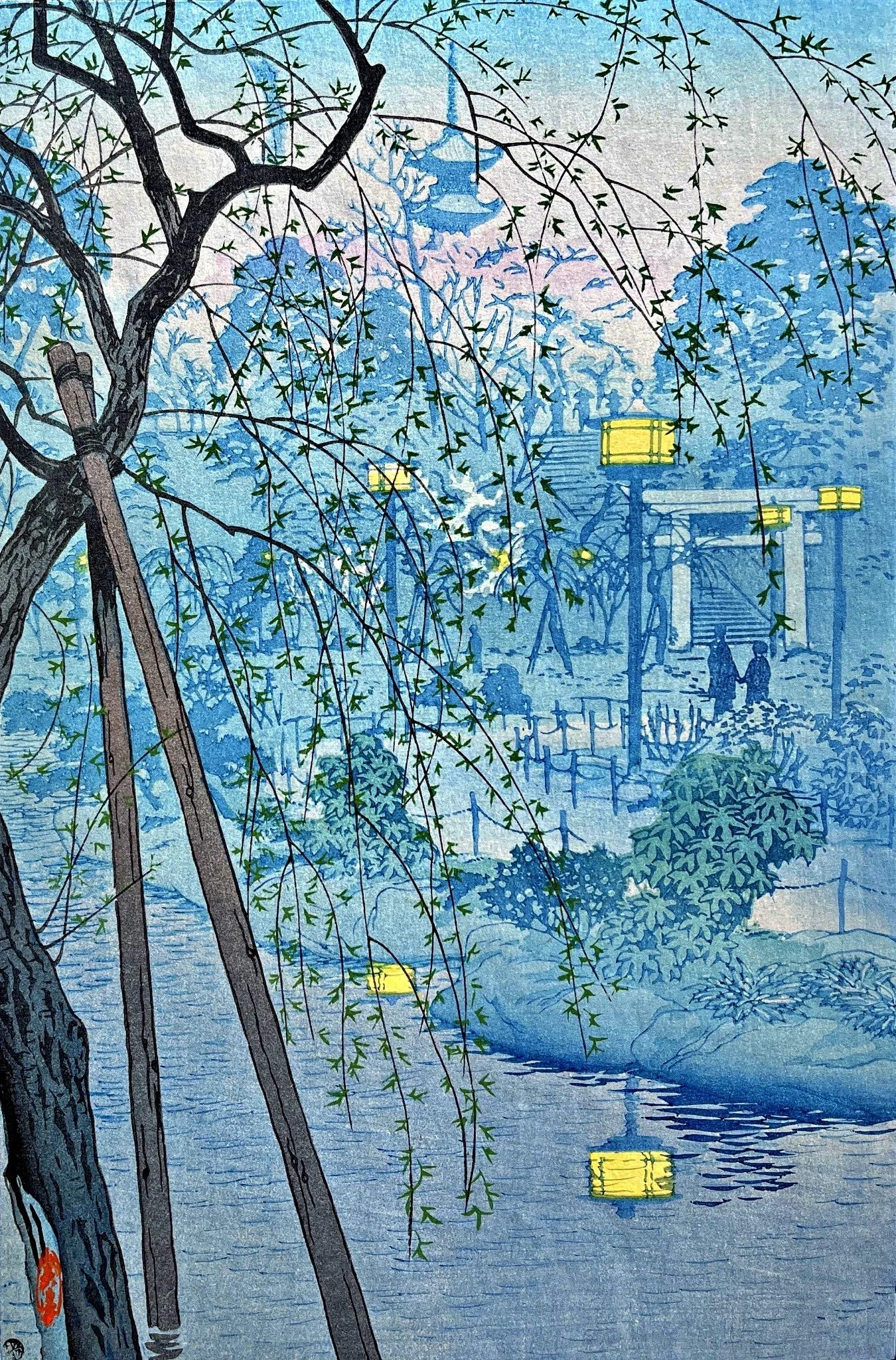
Willow branches frame pale temple buildings, cherry blossoms and glowing yellow lanterns beside blue water in Shiro Kasamatsu’s Misty Evening at Shinobazu Pond. This portrait canvas reproduction is stretched over a sturdy 1.5-inch wood stretcher.
Product details: Canvas reproduction over a sturdy 1.5-inch wood stretcher. Available in 16 × 24 in. ($259 CAD) and 24 × 36 in. ($299 CAD). No returns accepted.
More About the Art
A willow tree fills the left foreground of Misty Evening at Shinobazu Pond. Its dark trunk divides into curved branches, while thin stems descend across a pale blue view of temple buildings, flowering trees, stone lanterns, and water. Small green leaves punctuate the hanging lines. Yellow lights appear among the cooler forms, with one especially bright reflection near the lower right. Shiro Kasamatsu creates a closely layered scene in which the viewer looks through vegetation toward an inhabited landscape softened by evening mist.
The original woodblock design dates to 1932. Otaru Art Base's collection database identifies the title, artist, and date, while the Ōta Memorial Museum's Kasamatsu exhibition list records it among his early works for Watanabe Shōzaburō. The supplied image corresponds to this design. Its setting is made distinctive through atmosphere as much as architecture: the willow remains sharply defined, while more distant trees and buildings appear in lighter, closely related tones that suggest changing visibility across the pond.
The foreground trunk is carefully articulated. Dark outlines separate its irregular bark from the paler supporting poles that lean against it. The props introduce straighter lines beside the natural curves, giving the tree a sense of being tended within a public place. Above, its branches spread across almost the entire width of the image. Their hanging stems establish many small openings, allowing the distant scene to appear in fragments rather than as a single unrestricted view.
The leaves provide a delicate rhythm. Some stems carry only a few pointed shapes, while others gather into denser clusters. Their green introduces a restrained contrast with the many blues behind them. Because the leaves remain small, the branches do not become a solid curtain. The eye can pass through them repeatedly, discovering a lantern, a figure, a roofline, or another patch of reflected light. This exchange between near detail and distant form gives the image a particularly patient pace.
Across the pond, steps and low railings connect the lanterns with a temple structure partly concealed by trees. A roof and finial rise above the paler foliage. Small figures appear along the path, their darker shapes providing points of scale within the mist. Pink blossom gathers behind and beside the building, introducing a quiet warmth. These colours remain subdued enough for the yellow lamps to hold their distinct brightness, while the architecture supplies a clear framework beneath the surrounding growth.
The water opens a quieter area in the lower half. Pale blue passages are interrupted by dark, irregular reflections and small horizontal marks. The brightest yellow reflection is compact but especially noticeable, repeating the light above in a less stable form. Hanging stems cross this surface, linking the foreground tree with the water without eliminating the sense of distance between them. The lower scene becomes another layered arrangement, where direct forms and reflections can be followed separately and then understood together.
This portrait canvas reproduction preserves the supplied image's complete composition. Its broad blue atmosphere gives the work a unified presence, while the willow, lanterns, figures, and blossoms reward closer attention. Looking slowly reveals how the sharpest foreground lines coexist with the softened distance. The image offers a familiar kind of evening experience: a well-used place becomes quieter as visibility changes, and a few small lights guide the eye through the surrounding colour, vegetation, architecture, and moving reflections.
More About the Artist
Shiro Kasamatsu (1898–1991) was a Japanese painter and print designer whose long career connected the early development of shin-hanga with its continued practice after the Second World War. Born in Tokyo, he became known for landscapes, city scenes, temple grounds, and hot spring towns. His images often make a place memorable through a particular condition of light or season. In Misty Evening at Shinobazu Pond, a willow, distant temple, and glowing lanterns become inseparable from the blue atmosphere and the changing reflections on the water.
As a young artist, Kasamatsu studied Japanese painting under Kaburaki Kiyokata. This training placed him within a studio associated with several important modern print designers, including Kawase Hasui and Itō Shinsui. Although his teacher was especially celebrated for pictures of women, Kasamatsu developed a sustained interest in landscape. Buildings, trees, bridges, and the spaces between them supplied subjects in which he could explore both the identity of a place and the atmosphere surrounding it.
His first prints for the publisher Watanabe Shōzaburō appeared in 1919. Watanabe was a central organizer of shin-hanga, the renewed Japanese woodblock tradition that brought artists together with specialist carvers and printers. The resulting images depended on shared skills. A designer established the composition, while the carved blocks and carefully handled layers of pigment gave it material form. Kasamatsu's career began during the movement's formative years, when publishers and artists were developing new ways to present contemporary Japanese life through established printmaking methods.
The Ōta Memorial Museum of Art emphasizes his sensitive use of pale colour in views of Tokyo and hot spring areas. That restraint can be understood as a way of allowing architecture and weather to occupy the same image without one overwhelming the other. A street, roof, or distant hillside remains legible, while the surrounding air changes its appearance. His pictures reward attention to intervals as much as objects: an opening between branches, a stretch of water, or a softly coloured area of sky can become crucial to the composition.
Misty Evening at Shinobazu Pond was published by Watanabe in 1932. Its lanterns, hanging willow leaves, and pale architecture show how carefully Kasamatsu could organize a scene around changing visibility. After the war, he also worked with the Kyoto publisher Unsōdō. The Ōta Memorial Museum dates this important phase of his shin-hanga production to 1952–1959. His career therefore connects distinct periods in the continuing development of modern Japanese woodblock landscape, while maintaining a recognizably patient attention to atmosphere and place.
Kasamatsu also explored sōsaku-hanga, producing work through his own designing, carving, and printing. His career thus encompassed both the collaborative publishing tradition and a more individually controlled printmaking practice. This breadth helps place him within the changing history of twentieth-century Japanese prints. The Ōta Memorial Museum devoted a major exhibition to his shin-hanga in 2021, bringing together early and postwar works. Looking at his images today, the enduring attraction is their patient observation: ordinary paths, buildings, trees, and waterways become places where colour, craft, and quiet human experience meet. Each scene offers a different invitation to look closely and remain for a moment.
Premium quality canvas print of “Misty Evening at Shinobazu Pond” by Shiro Kasamatsu
Willow branches frame pale temple buildings, cherry blossoms and glowing yellow lanterns beside blue water in Shiro Kasamatsu’s Misty Evening at Shinobazu Pond. This portrait canvas reproduction is stretched over a sturdy 1.5-inch wood stretcher.
Product details: Canvas reproduction over a sturdy 1.5-inch wood stretcher. Available in 16 × 24 in. ($259 CAD) and 24 × 36 in. ($299 CAD). No returns accepted.
More About the Art
A willow tree fills the left foreground of Misty Evening at Shinobazu Pond. Its dark trunk divides into curved branches, while thin stems descend across a pale blue view of temple buildings, flowering trees, stone lanterns, and water. Small green leaves punctuate the hanging lines. Yellow lights appear among the cooler forms, with one especially bright reflection near the lower right. Shiro Kasamatsu creates a closely layered scene in which the viewer looks through vegetation toward an inhabited landscape softened by evening mist.
The original woodblock design dates to 1932. Otaru Art Base's collection database identifies the title, artist, and date, while the Ōta Memorial Museum's Kasamatsu exhibition list records it among his early works for Watanabe Shōzaburō. The supplied image corresponds to this design. Its setting is made distinctive through atmosphere as much as architecture: the willow remains sharply defined, while more distant trees and buildings appear in lighter, closely related tones that suggest changing visibility across the pond.
The foreground trunk is carefully articulated. Dark outlines separate its irregular bark from the paler supporting poles that lean against it. The props introduce straighter lines beside the natural curves, giving the tree a sense of being tended within a public place. Above, its branches spread across almost the entire width of the image. Their hanging stems establish many small openings, allowing the distant scene to appear in fragments rather than as a single unrestricted view.
The leaves provide a delicate rhythm. Some stems carry only a few pointed shapes, while others gather into denser clusters. Their green introduces a restrained contrast with the many blues behind them. Because the leaves remain small, the branches do not become a solid curtain. The eye can pass through them repeatedly, discovering a lantern, a figure, a roofline, or another patch of reflected light. This exchange between near detail and distant form gives the image a particularly patient pace.
Across the pond, steps and low railings connect the lanterns with a temple structure partly concealed by trees. A roof and finial rise above the paler foliage. Small figures appear along the path, their darker shapes providing points of scale within the mist. Pink blossom gathers behind and beside the building, introducing a quiet warmth. These colours remain subdued enough for the yellow lamps to hold their distinct brightness, while the architecture supplies a clear framework beneath the surrounding growth.
The water opens a quieter area in the lower half. Pale blue passages are interrupted by dark, irregular reflections and small horizontal marks. The brightest yellow reflection is compact but especially noticeable, repeating the light above in a less stable form. Hanging stems cross this surface, linking the foreground tree with the water without eliminating the sense of distance between them. The lower scene becomes another layered arrangement, where direct forms and reflections can be followed separately and then understood together.
This portrait canvas reproduction preserves the supplied image's complete composition. Its broad blue atmosphere gives the work a unified presence, while the willow, lanterns, figures, and blossoms reward closer attention. Looking slowly reveals how the sharpest foreground lines coexist with the softened distance. The image offers a familiar kind of evening experience: a well-used place becomes quieter as visibility changes, and a few small lights guide the eye through the surrounding colour, vegetation, architecture, and moving reflections.
More About the Artist
Shiro Kasamatsu (1898–1991) was a Japanese painter and print designer whose long career connected the early development of shin-hanga with its continued practice after the Second World War. Born in Tokyo, he became known for landscapes, city scenes, temple grounds, and hot spring towns. His images often make a place memorable through a particular condition of light or season. In Misty Evening at Shinobazu Pond, a willow, distant temple, and glowing lanterns become inseparable from the blue atmosphere and the changing reflections on the water.
As a young artist, Kasamatsu studied Japanese painting under Kaburaki Kiyokata. This training placed him within a studio associated with several important modern print designers, including Kawase Hasui and Itō Shinsui. Although his teacher was especially celebrated for pictures of women, Kasamatsu developed a sustained interest in landscape. Buildings, trees, bridges, and the spaces between them supplied subjects in which he could explore both the identity of a place and the atmosphere surrounding it.
His first prints for the publisher Watanabe Shōzaburō appeared in 1919. Watanabe was a central organizer of shin-hanga, the renewed Japanese woodblock tradition that brought artists together with specialist carvers and printers. The resulting images depended on shared skills. A designer established the composition, while the carved blocks and carefully handled layers of pigment gave it material form. Kasamatsu's career began during the movement's formative years, when publishers and artists were developing new ways to present contemporary Japanese life through established printmaking methods.
The Ōta Memorial Museum of Art emphasizes his sensitive use of pale colour in views of Tokyo and hot spring areas. That restraint can be understood as a way of allowing architecture and weather to occupy the same image without one overwhelming the other. A street, roof, or distant hillside remains legible, while the surrounding air changes its appearance. His pictures reward attention to intervals as much as objects: an opening between branches, a stretch of water, or a softly coloured area of sky can become crucial to the composition.
Misty Evening at Shinobazu Pond was published by Watanabe in 1932. Its lanterns, hanging willow leaves, and pale architecture show how carefully Kasamatsu could organize a scene around changing visibility. After the war, he also worked with the Kyoto publisher Unsōdō. The Ōta Memorial Museum dates this important phase of his shin-hanga production to 1952–1959. His career therefore connects distinct periods in the continuing development of modern Japanese woodblock landscape, while maintaining a recognizably patient attention to atmosphere and place.
Kasamatsu also explored sōsaku-hanga, producing work through his own designing, carving, and printing. His career thus encompassed both the collaborative publishing tradition and a more individually controlled printmaking practice. This breadth helps place him within the changing history of twentieth-century Japanese prints. The Ōta Memorial Museum devoted a major exhibition to his shin-hanga in 2021, bringing together early and postwar works. Looking at his images today, the enduring attraction is their patient observation: ordinary paths, buildings, trees, and waterways become places where colour, craft, and quiet human experience meet. Each scene offers a different invitation to look closely and remain for a moment.