

 Image 1 of 1
A Midnight Scene at Atami — Tsuchiya Koitsu (1939)
Premium quality canvas print of “A Midnight Scene at Atami” by Tsuchiya Koitsu
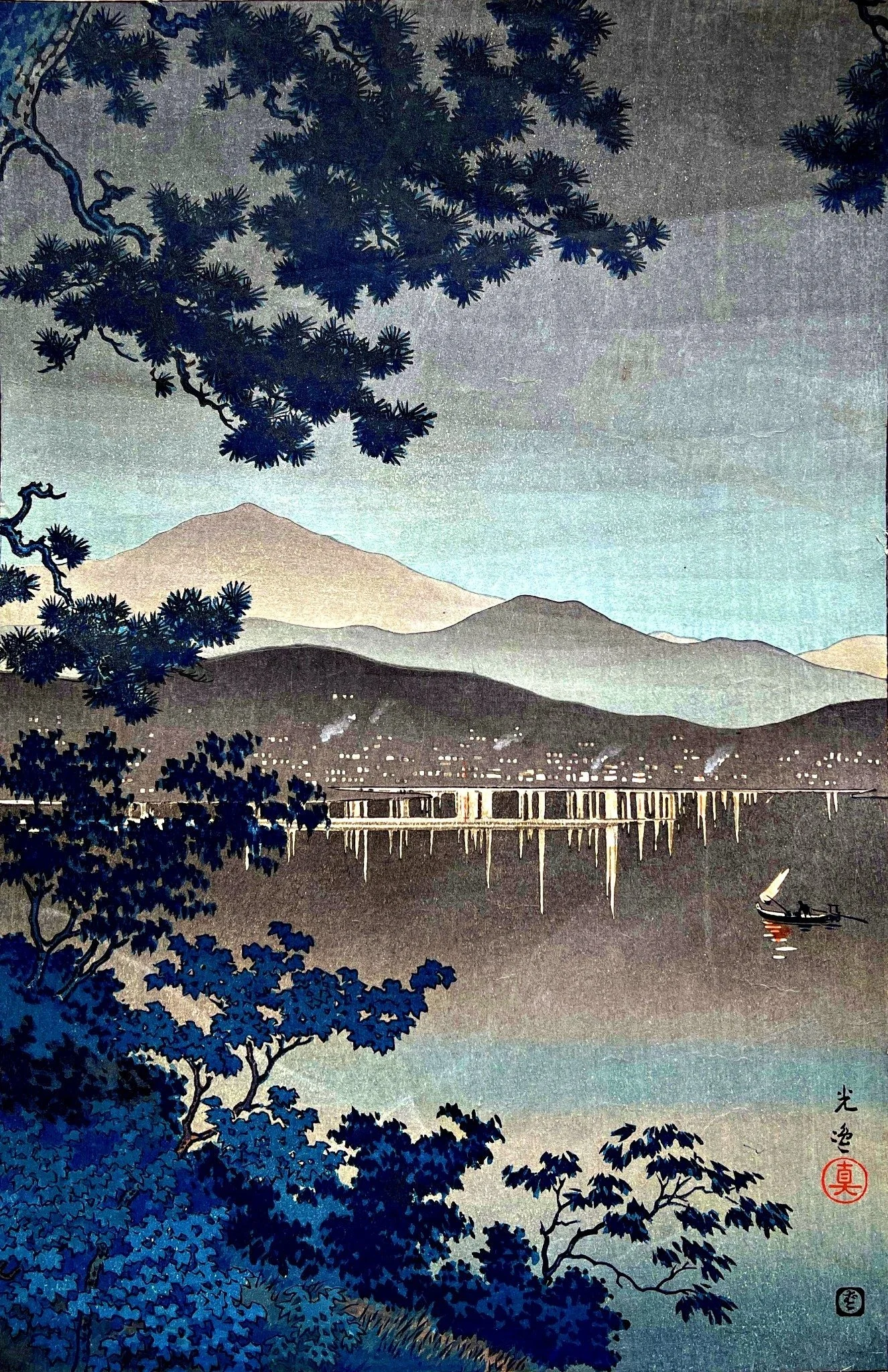
Dark pine branches frame a quiet bay, layered mountains, harbour lights and a small boat in Tsuchiya Koitsu’s A Midnight Scene at Atami. This portrait canvas reproduction is stretched over a sturdy 1.5-inch wood stretcher.
Product details: Canvas reproduction over a sturdy 1.5-inch wood stretcher. Available in 16 × 24 in. ($259 CAD) and 24 × 36 in. ($299 CAD). No returns accepted.
More About the Art
Dark pine branches extend across the upper edge of A Midnight Scene at Atami, sheltering a view of still water and a distant shoreline. Mountains rise behind the town in softly overlapping layers. A narrow boat occupies the open water to the right, while scattered lights and pale reflections mark the far bank. Tsuchiya Koitsu uses a portrait composition to connect these different distances, holding the broad bay within an intimate frame of close foliage and finely divided needles.
The original design was issued in October 1939 by the publisher Baba Nobuhiko, according to the specialist Koitsu catalogue maintained by Ross Walker. Its fuller English title identifies Atami as a famous spa. The image itself places the bay and its evening light at the centre of attention. The town is present through low buildings, a pale waterfront structure, and small points of brightness, leaving the wide surface of the water to carry much of the scene's quiet atmosphere.
The upper pine is the strongest dark form. Its branching limbs cross the lighter sky, carrying clusters of needles whose irregular edges remain clearly visible. Some branches extend from beyond the frame, suggesting a larger tree surrounding the viewer's position. This near layer establishes scale before the eye reaches the mountains. Its detailed silhouette makes the distant contours appear softer and simpler, creating depth through a deliberate contrast between close, articulated growth and broad forms farther away.
Along the left and lower edges, additional foliage closes part of the view. Deep blue leaves overlap in varied shapes, with small openings allowing the water and shore to appear between them. Their density gives the foreground weight without enclosing the bay completely. The open area remains large enough for the boat and its reflection to be read clearly. Looking through the foliage becomes part of the experience, making the landscape feel discovered from a quiet, particular position beside the shore.
The mountains provide a sequence of gentle changes in tone. A pale upper ridge is followed by darker slopes, each separated by a clear contour. Their surfaces contain relatively little detail. This restraint allows them to suggest distance and scale without competing with the pine needles or the town's small lights. The sky above changes gradually in colour, creating an interval of air between the highest peak and the dark branches that cross the top of the image.
On the water, reflections appear as slender vertical passages and small broken marks. The brighter waterfront forms are repeated below in a less regular way, making the surface feel still but responsive to light. The boat supplies a different accent: its compact dark shape and pale sail-like form occupy a generous opening. Its small size preserves the breadth of the bay, while its presence gives the scene a human measure without turning the image into a dramatic narrative.
This canvas reproduction preserves the supplied image's complete portrait arrangement. Dark foliage provides a strong surrounding framework, while the bay, lights, and mountain layers create a quieter centre. At a distance, the composition offers a cohesive evening mood. Closer inspection reveals fine needles, changing leaf shapes, narrow reflections, and the small craft on the water. The lasting interest lies in that relationship between detail and openness, through which a broad coastal setting becomes a sheltered and contemplative view.
More About the Artist
Tsuchiya Koitsu (1870–1949) was a Japanese painter and print designer whose landscapes are especially associated with the shin-hanga movement of the 1930s. His images often bring a place into focus through a striking condition of light. Distant lamps, reflected windows, rain-darkened streets, and pale evening skies can transform recognizable architecture into an atmosphere. A Midnight Scene at Atami, Famous Spa presents that sensitivity through a broad bay seen beneath dark pine branches, where scattered lights and their reflections make the distant shore feel inhabited.
Born in the Hamamatsu area of Shizuoka Prefecture, Koitsu moved to Tokyo as a young man. He entered the circle of Kobayashi Kiyochika, an important designer of Meiji-period prints, and became his pupil. This relationship connected him with a tradition that paid close attention to the visual effects of artificial light and changing urban life. The two artists belonged to different generations, but the expressive relationship between darkness and illumination remained important to Koitsu's later landscape work.
His early career extended beyond the landscapes for which he is now best known. He produced commercial images, including prints connected with the Sino-Japanese War of 1894–1895, and worked in lithography and painting. The Lavenberg Collection's biographical account, based on research by Ross Walker and Toshikazu Doi, documents this wider activity. His mature shin-hanga designs grew from a substantial working life in image making rather than from a sudden beginning in an unfamiliar medium. Drawing remained a foundation across these different kinds of production.
Koitsu's landscape career developed particularly strongly after meeting the publisher Watanabe Shōzaburō in 1931 at a memorial exhibition for Kiyochika. Watanabe issued his Evening at Gion design in 1932. Koitsu subsequently worked with several publishers, including Doi Hangaten and Baba Nobuhiko. The Atami image belongs to the group associated with Baba. These publishing relationships placed his designs within a collaborative craft involving specialist carving and printing, whose control of fine lines, colour layers, and gradations was essential to the finished woodblock image.
His compositions reward attention to the way they frame a view. A close tree can establish the viewer's position, while a stretch of water or an opening between buildings creates distance. The darkest passages give smaller lights unusual force. In the Atami scene, foreground pine needles and the low contours of the far shore establish different scales of detail. A narrow boat offers another point of human presence. These relationships make the picture feel spacious without leaving its atmosphere vague or its structure uncertain.
Koitsu continued painting in his later years and died in 1949. His landscape designs remain represented in public collections and specialist studies of modern Japanese prints. Their appeal rests in the sustained relationship between clear drawing and atmospheric colour. Looking first from across a room reveals the broad balance of dark foliage, pale sky, and still water. Closer attention then discovers the small forms that give the setting its particular character. A canvas reproduction presents those visual relationships in a contemporary display format, while the original design belongs to Japan's rich woodblock tradition.
Premium quality canvas print of “A Midnight Scene at Atami” by Tsuchiya Koitsu
Dark pine branches frame a quiet bay, layered mountains, harbour lights and a small boat in Tsuchiya Koitsu’s A Midnight Scene at Atami. This portrait canvas reproduction is stretched over a sturdy 1.5-inch wood stretcher.
Product details: Canvas reproduction over a sturdy 1.5-inch wood stretcher. Available in 16 × 24 in. ($259 CAD) and 24 × 36 in. ($299 CAD). No returns accepted.
More About the Art
Dark pine branches extend across the upper edge of A Midnight Scene at Atami, sheltering a view of still water and a distant shoreline. Mountains rise behind the town in softly overlapping layers. A narrow boat occupies the open water to the right, while scattered lights and pale reflections mark the far bank. Tsuchiya Koitsu uses a portrait composition to connect these different distances, holding the broad bay within an intimate frame of close foliage and finely divided needles.
The original design was issued in October 1939 by the publisher Baba Nobuhiko, according to the specialist Koitsu catalogue maintained by Ross Walker. Its fuller English title identifies Atami as a famous spa. The image itself places the bay and its evening light at the centre of attention. The town is present through low buildings, a pale waterfront structure, and small points of brightness, leaving the wide surface of the water to carry much of the scene's quiet atmosphere.
The upper pine is the strongest dark form. Its branching limbs cross the lighter sky, carrying clusters of needles whose irregular edges remain clearly visible. Some branches extend from beyond the frame, suggesting a larger tree surrounding the viewer's position. This near layer establishes scale before the eye reaches the mountains. Its detailed silhouette makes the distant contours appear softer and simpler, creating depth through a deliberate contrast between close, articulated growth and broad forms farther away.
Along the left and lower edges, additional foliage closes part of the view. Deep blue leaves overlap in varied shapes, with small openings allowing the water and shore to appear between them. Their density gives the foreground weight without enclosing the bay completely. The open area remains large enough for the boat and its reflection to be read clearly. Looking through the foliage becomes part of the experience, making the landscape feel discovered from a quiet, particular position beside the shore.
The mountains provide a sequence of gentle changes in tone. A pale upper ridge is followed by darker slopes, each separated by a clear contour. Their surfaces contain relatively little detail. This restraint allows them to suggest distance and scale without competing with the pine needles or the town's small lights. The sky above changes gradually in colour, creating an interval of air between the highest peak and the dark branches that cross the top of the image.
On the water, reflections appear as slender vertical passages and small broken marks. The brighter waterfront forms are repeated below in a less regular way, making the surface feel still but responsive to light. The boat supplies a different accent: its compact dark shape and pale sail-like form occupy a generous opening. Its small size preserves the breadth of the bay, while its presence gives the scene a human measure without turning the image into a dramatic narrative.
This canvas reproduction preserves the supplied image's complete portrait arrangement. Dark foliage provides a strong surrounding framework, while the bay, lights, and mountain layers create a quieter centre. At a distance, the composition offers a cohesive evening mood. Closer inspection reveals fine needles, changing leaf shapes, narrow reflections, and the small craft on the water. The lasting interest lies in that relationship between detail and openness, through which a broad coastal setting becomes a sheltered and contemplative view.
More About the Artist
Tsuchiya Koitsu (1870–1949) was a Japanese painter and print designer whose landscapes are especially associated with the shin-hanga movement of the 1930s. His images often bring a place into focus through a striking condition of light. Distant lamps, reflected windows, rain-darkened streets, and pale evening skies can transform recognizable architecture into an atmosphere. A Midnight Scene at Atami, Famous Spa presents that sensitivity through a broad bay seen beneath dark pine branches, where scattered lights and their reflections make the distant shore feel inhabited.
Born in the Hamamatsu area of Shizuoka Prefecture, Koitsu moved to Tokyo as a young man. He entered the circle of Kobayashi Kiyochika, an important designer of Meiji-period prints, and became his pupil. This relationship connected him with a tradition that paid close attention to the visual effects of artificial light and changing urban life. The two artists belonged to different generations, but the expressive relationship between darkness and illumination remained important to Koitsu's later landscape work.
His early career extended beyond the landscapes for which he is now best known. He produced commercial images, including prints connected with the Sino-Japanese War of 1894–1895, and worked in lithography and painting. The Lavenberg Collection's biographical account, based on research by Ross Walker and Toshikazu Doi, documents this wider activity. His mature shin-hanga designs grew from a substantial working life in image making rather than from a sudden beginning in an unfamiliar medium. Drawing remained a foundation across these different kinds of production.
Koitsu's landscape career developed particularly strongly after meeting the publisher Watanabe Shōzaburō in 1931 at a memorial exhibition for Kiyochika. Watanabe issued his Evening at Gion design in 1932. Koitsu subsequently worked with several publishers, including Doi Hangaten and Baba Nobuhiko. The Atami image belongs to the group associated with Baba. These publishing relationships placed his designs within a collaborative craft involving specialist carving and printing, whose control of fine lines, colour layers, and gradations was essential to the finished woodblock image.
His compositions reward attention to the way they frame a view. A close tree can establish the viewer's position, while a stretch of water or an opening between buildings creates distance. The darkest passages give smaller lights unusual force. In the Atami scene, foreground pine needles and the low contours of the far shore establish different scales of detail. A narrow boat offers another point of human presence. These relationships make the picture feel spacious without leaving its atmosphere vague or its structure uncertain.
Koitsu continued painting in his later years and died in 1949. His landscape designs remain represented in public collections and specialist studies of modern Japanese prints. Their appeal rests in the sustained relationship between clear drawing and atmospheric colour. Looking first from across a room reveals the broad balance of dark foliage, pale sky, and still water. Closer attention then discovers the small forms that give the setting its particular character. A canvas reproduction presents those visual relationships in a contemporary display format, while the original design belongs to Japan's rich woodblock tradition.