

 Image 1 of 1
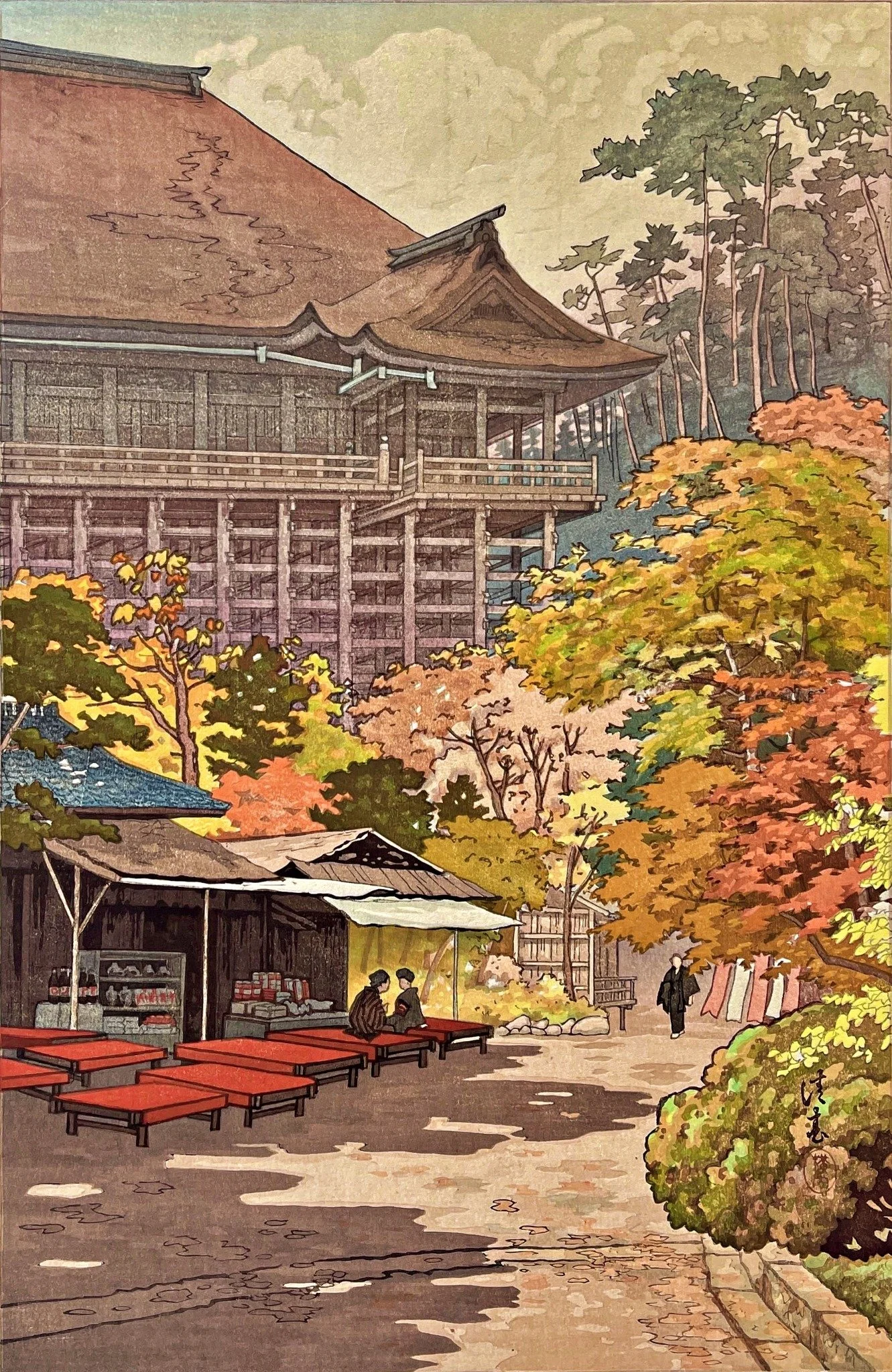
Maple Leaves at Kiyomizu Temple — Yokouchi Kiyoharu (1936)
Premium quality canvas print of “Maple Leaves at Kiyomizu Temple” by Yokouchi Kiyoharu
Golden maples, red benches, and the great wooden stage of Kiyomizu-dera fill this Kyoto view with the warmth of autumn. Yokouchi Kiyoharu’s Maple Leaves at Kiyomizu Temple brings a welcoming, contemplative atmosphere to your home as a portrait canvas reproduction over a sturdy 1.5-inch wood stretcher.
Product details: Canvas reproduction over a sturdy 1.5-inch wood stretcher. Available in 16 × 24 in. ($259 CAD) and 24 × 36 in. ($299 CAD). No returns accepted.
More About the Art
Maple Leaves at Kiyomizu Temple presents autumn in Kyoto as a meeting of monumental architecture and everyday leisure. The temple’s great wooden hall rises across the upper left, its broad brown roof and elevated platform set against a pale, softly clouded sky. Below, a small refreshment stall and rows of red benches invite the eye into a more intimate space. Between them, foliage gathers in warm layers of yellow, orange, pink, and red.
The hall’s structure gives the upper part of the image a strong sense of order. Railings run along the platform, while substantial posts and crossed timbers support it above the sloping ground. The roof’s wide sweep is interrupted by a smaller projecting gable, adding a second, more intricate rhythm within its large silhouette. Tall pines at the right rise beyond the autumn trees, their narrow trunks and green crowns extending the view upward.
In the foreground, the scale becomes comfortably human. Low benches, covered in vivid red, spread outward from the refreshments stall. Beneath its awning, two seated figures face one another. Shelves and small containers suggest the practical life of the establishment without overwhelming the scene with detail. The benches’ rectangular shapes echo the temple’s railings above, connecting this resting place with the larger architecture behind it.
A broad path begins at the lower edge and leads toward the right. Patches of light alternate with irregular shadows across its surface, and scattered leaves give the ground a gentle seasonal texture. Farther along, a solitary figure walks beside hanging lengths of coloured cloth. This small presence helps establish distance and suggests that the temple grounds continue beyond the visible scene. The path offers the viewer an imagined way through the landscape.
The autumn colour is varied rather than uniform. A golden canopy near the temple is answered by softer pink trees in the middle distance and deeper orange foliage at the right. Dark green shrubs keep these warm passages distinct. The broad reddish roof and scarlet benches repeat the seasonal palette at different heights. Against them, the pale sky and quiet brown ground provide space for the eye to rest.
The Museum of Fine Arts, Boston identifies the design as Maple Leaves at Kiyomizu Temple in Kyoto, by Yokouchi Kiyoharu, and dates it to July 1936, or Shōwa 11. The Japanese title is Kyōto Kiyomizu-dera kōyō, 京都清水寺紅葉. It is catalogued as a self-published colour woodblock print. Kiyomizu-dera’s Main Hall and projecting wooden stage are among the temple’s defining structures; the present hall was reconstructed in 1633.
This portrait canvas reproduction preserves the supplied image composition, including the temple platform, autumn trees, refreshment stall, red benches, and long foreground path. The scene offers both a clear architectural focus and many smaller discoveries. Viewed across a room, its warm colours create a welcoming presence. Up close, the timberwork, changing leaves, seated visitors, and patterned shadows reward patient attention and invite repeated looking. The quiet arrangement invites the viewer to imagine pausing beneath the maples before continuing through the temple grounds.
More About the Artist
Yokouchi Kiyoharu was a Japanese artist whose surviving woodblock prints reveal an attentive approach to landscape, architecture, and seasonal atmosphere. Maple Leaves at Kiyomizu Temple, published in 1936, brings those interests together in a view that combines the scale of a celebrated building with the modest activity of visitors below it. Its warm colour and carefully organized spaces provide a direct introduction to his approach to landscape.
His recorded subjects range from Kyoto temple grounds to Tokyo’s cherry blossoms and Asakusa Kannon in the rain. These themes belong to a long tradition of Japanese landscape imagery in which a recognizable place gains character through a particular season or condition of light. They also offer different ways of bringing architecture into relation with trees, open space, and the modest scale of visitors.
Specialist research has associated Kiyoharu with watercolour landscape painting as well as printmaking. That connection is useful when considering the soft transitions and gently layered forms visible in the Kiyomizu design. The pale sky, muted browns, and varied autumn colours create a spacious atmosphere even where the image contains considerable detail. The result combines firm architectural drawing with a more fluid treatment of foliage, light, and distance.
His work is represented in several museum collections. The Museum of Fine Arts, Boston preserves Maple Leaves at Kiyomizu Temple in Kyoto. The Los Angeles County Museum of Art holds a colour woodblock print titled Cherry Blossoms at Night in Rainy Weather, Tokyo, while Honolulu Museum of Art records Asakusa Kannon Temple in Rain. Together, these subjects indicate an interest in temple settings and the changing appearance of familiar places under different seasonal and atmospheric conditions.
The MFA describes the Kiyomizu work as self-published. Colour woodblock production brings drawing, carving, and printing into a close relationship, with separately prepared blocks contributing different parts of the finished image. Precise alignment allows these impressions to combine on a single sheet. The process can accommodate both fine architectural lines and broad passages of colour, qualities that work together throughout this richly varied temple landscape.
Within the Kiyomizu scene, Kiyoharu’s ability to organize different kinds of detail becomes especially apparent. The elevated platform is described through repeated upright posts and horizontal railings. The trees interrupt those regular forms with loose, overlapping masses. At the lower left, the benches introduce another clear pattern, this time on the scale of people at rest. These relationships make a densely populated composition feel readable and inviting.
His treatment of the figures is equally measured. The seated pair and the walker remain small, yet they shape the way the landscape is experienced. They suggest resting, conversation, and movement through the grounds without demanding a specific narrative. Their presence connects the temple’s impressive structure with ordinary time. The viewer encounters the place through these accessible human activities as well as through the brilliance of the autumn leaves.
Kiyoharu’s contribution can be appreciated through the care visible in such decisions. A famous landmark becomes a setting for an unhurried encounter with colour, weathered timber, filtered light, and open space. The image remains rich in detail while allowing its larger shapes to hold together. Its enduring appeal rests in that balance, offering a landscape that can be enjoyed immediately and explored gradually through repeated looking.
Sources for the artwork and artist
Premium quality canvas print of “Maple Leaves at Kiyomizu Temple” by Yokouchi Kiyoharu
Golden maples, red benches, and the great wooden stage of Kiyomizu-dera fill this Kyoto view with the warmth of autumn. Yokouchi Kiyoharu’s Maple Leaves at Kiyomizu Temple brings a welcoming, contemplative atmosphere to your home as a portrait canvas reproduction over a sturdy 1.5-inch wood stretcher.
Product details: Canvas reproduction over a sturdy 1.5-inch wood stretcher. Available in 16 × 24 in. ($259 CAD) and 24 × 36 in. ($299 CAD). No returns accepted.
More About the Art
Maple Leaves at Kiyomizu Temple presents autumn in Kyoto as a meeting of monumental architecture and everyday leisure. The temple’s great wooden hall rises across the upper left, its broad brown roof and elevated platform set against a pale, softly clouded sky. Below, a small refreshment stall and rows of red benches invite the eye into a more intimate space. Between them, foliage gathers in warm layers of yellow, orange, pink, and red.
The hall’s structure gives the upper part of the image a strong sense of order. Railings run along the platform, while substantial posts and crossed timbers support it above the sloping ground. The roof’s wide sweep is interrupted by a smaller projecting gable, adding a second, more intricate rhythm within its large silhouette. Tall pines at the right rise beyond the autumn trees, their narrow trunks and green crowns extending the view upward.
In the foreground, the scale becomes comfortably human. Low benches, covered in vivid red, spread outward from the refreshments stall. Beneath its awning, two seated figures face one another. Shelves and small containers suggest the practical life of the establishment without overwhelming the scene with detail. The benches’ rectangular shapes echo the temple’s railings above, connecting this resting place with the larger architecture behind it.
A broad path begins at the lower edge and leads toward the right. Patches of light alternate with irregular shadows across its surface, and scattered leaves give the ground a gentle seasonal texture. Farther along, a solitary figure walks beside hanging lengths of coloured cloth. This small presence helps establish distance and suggests that the temple grounds continue beyond the visible scene. The path offers the viewer an imagined way through the landscape.
The autumn colour is varied rather than uniform. A golden canopy near the temple is answered by softer pink trees in the middle distance and deeper orange foliage at the right. Dark green shrubs keep these warm passages distinct. The broad reddish roof and scarlet benches repeat the seasonal palette at different heights. Against them, the pale sky and quiet brown ground provide space for the eye to rest.
The Museum of Fine Arts, Boston identifies the design as Maple Leaves at Kiyomizu Temple in Kyoto, by Yokouchi Kiyoharu, and dates it to July 1936, or Shōwa 11. The Japanese title is Kyōto Kiyomizu-dera kōyō, 京都清水寺紅葉. It is catalogued as a self-published colour woodblock print. Kiyomizu-dera’s Main Hall and projecting wooden stage are among the temple’s defining structures; the present hall was reconstructed in 1633.
This portrait canvas reproduction preserves the supplied image composition, including the temple platform, autumn trees, refreshment stall, red benches, and long foreground path. The scene offers both a clear architectural focus and many smaller discoveries. Viewed across a room, its warm colours create a welcoming presence. Up close, the timberwork, changing leaves, seated visitors, and patterned shadows reward patient attention and invite repeated looking. The quiet arrangement invites the viewer to imagine pausing beneath the maples before continuing through the temple grounds.
More About the Artist
Yokouchi Kiyoharu was a Japanese artist whose surviving woodblock prints reveal an attentive approach to landscape, architecture, and seasonal atmosphere. Maple Leaves at Kiyomizu Temple, published in 1936, brings those interests together in a view that combines the scale of a celebrated building with the modest activity of visitors below it. Its warm colour and carefully organized spaces provide a direct introduction to his approach to landscape.
His recorded subjects range from Kyoto temple grounds to Tokyo’s cherry blossoms and Asakusa Kannon in the rain. These themes belong to a long tradition of Japanese landscape imagery in which a recognizable place gains character through a particular season or condition of light. They also offer different ways of bringing architecture into relation with trees, open space, and the modest scale of visitors.
Specialist research has associated Kiyoharu with watercolour landscape painting as well as printmaking. That connection is useful when considering the soft transitions and gently layered forms visible in the Kiyomizu design. The pale sky, muted browns, and varied autumn colours create a spacious atmosphere even where the image contains considerable detail. The result combines firm architectural drawing with a more fluid treatment of foliage, light, and distance.
His work is represented in several museum collections. The Museum of Fine Arts, Boston preserves Maple Leaves at Kiyomizu Temple in Kyoto. The Los Angeles County Museum of Art holds a colour woodblock print titled Cherry Blossoms at Night in Rainy Weather, Tokyo, while Honolulu Museum of Art records Asakusa Kannon Temple in Rain. Together, these subjects indicate an interest in temple settings and the changing appearance of familiar places under different seasonal and atmospheric conditions.
The MFA describes the Kiyomizu work as self-published. Colour woodblock production brings drawing, carving, and printing into a close relationship, with separately prepared blocks contributing different parts of the finished image. Precise alignment allows these impressions to combine on a single sheet. The process can accommodate both fine architectural lines and broad passages of colour, qualities that work together throughout this richly varied temple landscape.
Within the Kiyomizu scene, Kiyoharu’s ability to organize different kinds of detail becomes especially apparent. The elevated platform is described through repeated upright posts and horizontal railings. The trees interrupt those regular forms with loose, overlapping masses. At the lower left, the benches introduce another clear pattern, this time on the scale of people at rest. These relationships make a densely populated composition feel readable and inviting.
His treatment of the figures is equally measured. The seated pair and the walker remain small, yet they shape the way the landscape is experienced. They suggest resting, conversation, and movement through the grounds without demanding a specific narrative. Their presence connects the temple’s impressive structure with ordinary time. The viewer encounters the place through these accessible human activities as well as through the brilliance of the autumn leaves.
Kiyoharu’s contribution can be appreciated through the care visible in such decisions. A famous landmark becomes a setting for an unhurried encounter with colour, weathered timber, filtered light, and open space. The image remains rich in detail while allowing its larger shapes to hold together. Its enduring appeal rests in that balance, offering a landscape that can be enjoyed immediately and explored gradually through repeated looking.
Sources for the artwork and artist