

 Image 1 of 1
Lake Chūzenji at Nikkō — Kawase Hasui (1930)
Premium quality canvas print of “Lake Chūzenji at Nikkō” by Kawase Hasui
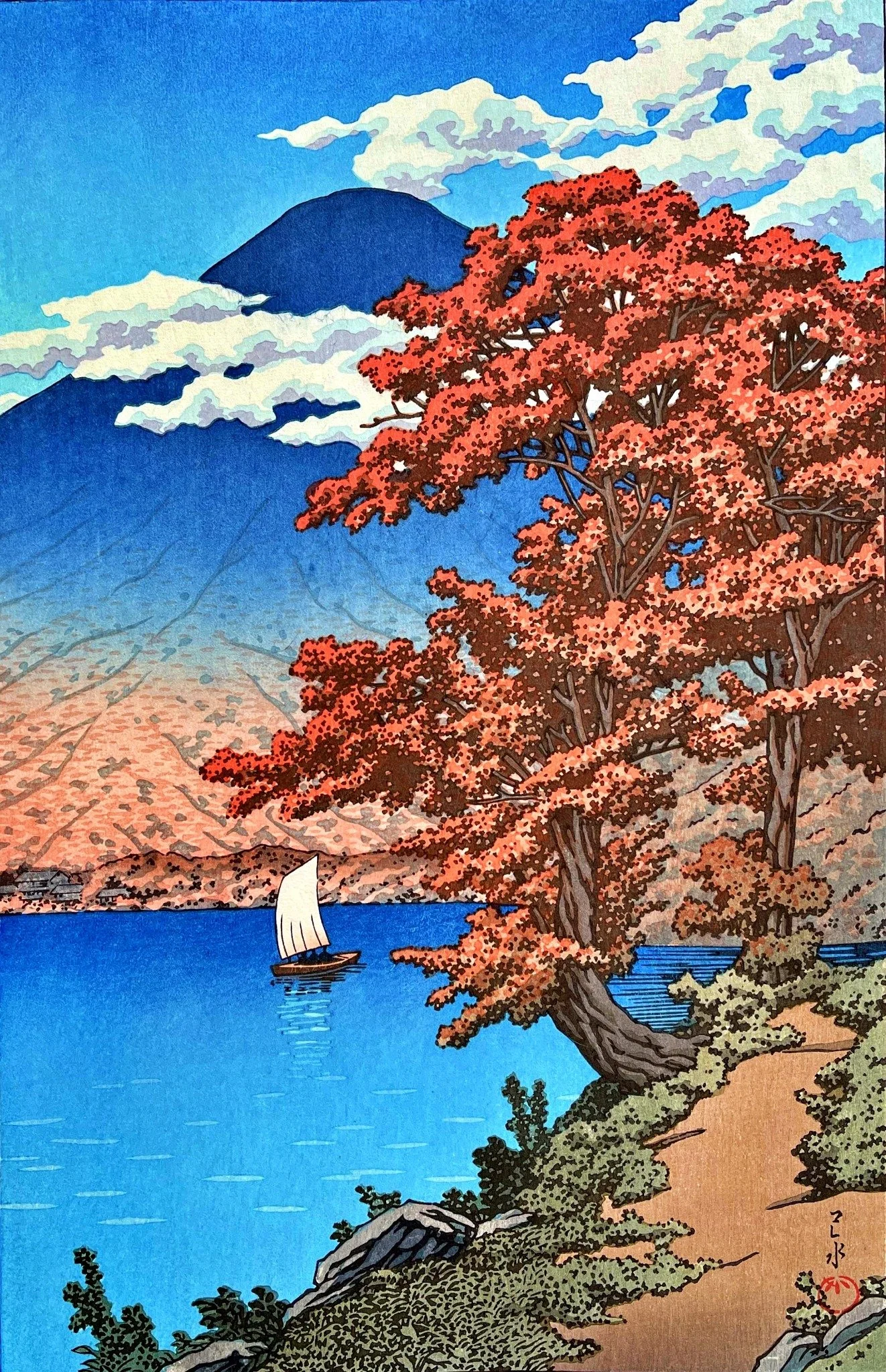
Brilliant autumn leaves frame a white sail and luminous blue water beneath a towering mountain. Kawase Hasui’s Lake Chūzenji at Nikkō brings the freshness and colour of a quiet lakeside day into your home as a portrait canvas reproduction over a sturdy 1.5-inch wood stretcher.
Product details: Canvas reproduction over a sturdy 1.5-inch wood stretcher. Available in 16 × 24 in. ($259 CAD) and 24 × 36 in. ($299 CAD). No returns accepted.
More About the Art
Lake Chūzenji at Nikkō brings the brilliance of autumn into a landscape of expansive blue. A large tree rises along the right shore, its twisting trunks supporting masses of red and coral foliage. Beyond it, a mountain fills the distance, with pale clouds crossing its slopes and drifting through the sky above. Between these substantial forms, a single white sail rests against the open water, a small, luminous point within the wider view.
The shoreline gives the viewer a place to stand. An ochre path curves through the lower right corner, bordered by green groundcover, dark plants, and angular rocks. The nearest tree bends outward over the lake before rising into its canopy. Its exposed roots and branching limbs make the foreground feel tangible, drawing attention to the difference between the solid bank and the broad, clear space of the water.
The autumn foliage forms an intricate pattern without becoming a continuous screen. Small dark marks gather within the reds, while openings reveal slender branches and glimpses of blue beyond. The canopy spreads across the mountain, connecting the nearest shore with the distant landscape. Warm colour also appears along the opposite bank, where low hills and a few small buildings establish a quieter horizontal edge just above the water.
Blue creates the scene’s spaciousness. The lake moves from deeper colour near the far shore toward lighter passages in the foreground. Short horizontal strokes suggest ripples, allowing the water to remain calm while catching the light. Above it, the mountain changes gradually from dark blue near its summit to softer tones farther down. Delicate lines and scattered shapes suggest features on its slopes without competing with the nearer leaves.
The clouds have a character of their own. Their irregular, layered edges cross the mountain in pale cream, light green, and lavender-grey. Against the deep upper sky, these shapes make the air feel bright and open. The sail repeats their light colour on a much smaller scale. Its curved outline, fine vertical divisions, brown hull, and broken reflection provide an intimate detail that balances the great height of the mountain.
Designed by Kawase Hasui in 1930, this colour woodblock landscape is known in Japanese as Nikkō Chūzenji-ko, 日光中禅寺湖. The Minneapolis Institute of Art records Kawaguchi Jirō as publisher, Maeda Kentarō as carver, and Komatsu Wasankichi as printer. Lake Chūzenji lies in the mountains near Nikkō, a setting celebrated for its autumn colours. Hasui’s arrangement makes that seasonal richness immediately visible while preserving a feeling of unhurried distance.
This portrait canvas reproduction preserves the supplied image composition, from the high clouds and mountain summit to the sailboat, curling tree, and foreground path. At a distance, the meeting of coral reds and clear blues gives the work a vibrant presence. Closer viewing reveals the many small shapes that sustain its calm: leaves, ripples, branches, rocks, and the scattered forms along the far bank. It invites the eye to travel slowly between the shore at hand and the landscape beyond, holding the colour of autumn within an enduring sense of space.
More About the Artist
Kawase Hasui (1883–1957) was one of the leading landscape designers of the shin-hanga movement, the renewal of Japanese woodblock printing in the early twentieth century. His images combine a strong sense of place with close attention to season, weather, and light. In Lake Chūzenji at Nikkō, that sensitivity takes a particularly colourful form: red foliage stands against blue water and a monumental mountain, while a small white sail gives the broad landscape a gentle human scale.
Born in Tokyo with the given name Bunjiro, Hasui developed his skills through several kinds of artistic training. He studied Western-style painting under Okada Saburosuke and entered the studio of the Japanese-style painter Kaburaki Kiyokata in 1910. This background brought together an interest in observed space and tonal relationships with an appreciation of clear line and carefully arranged forms. His early work also included illustration and commercial design, activities that broadened his experience of making images for reproduction.
His decisive engagement with woodblock landscape printing came through the work of Itō Shinsui, another artist associated with Kiyokata’s studio. Shinsui’s landscape prints encouraged Hasui to show his own sketches to Watanabe Shōzaburō, who published his first landscapes in 1918. Their long collaboration helped establish Hasui’s reputation. Watanabe played a central role in shin-hanga, supporting the specialized skills needed to produce prints with subtle colour, detailed carving, and expressive effects of atmosphere.
Hasui’s career also extended to other publishers. Lake Chūzenji at Nikkō was issued by Kawaguchi Jirō, and the museum record identifies the carver and printer alongside the designer. These credits reveal the shared craft behind the finished image. Hasui established the arrangement, while the translation into carved blocks and layered colour demanded other forms of expertise. The contrast between slender branches, dense leaves, smooth blue passages, and sharply shaped clouds makes that coordination especially apparent here.
Travel supplied much of his subject matter. Hasui journeyed across Japan with his sketchbooks, studying both well-known places and quieter settings that might otherwise escape attention. His landscapes include temple precincts, city canals, fishing villages, rural roads, and mountain lakes. He often chose viewpoints that gave familiar scenery a personal character. In this Nikkō view, the curving shoreline places the viewer close to the earth before opening a much larger world across the water.
His working life unfolded through periods of severe disruption. The Great Kantō Earthquake of 1923 destroyed Watanabe’s premises, print stock, and woodblocks, and Hasui also lost sketchbooks. He continued creating new landscapes, and his career remained active after the Second World War. His output eventually exceeded six hundred print designs. Alongside those works, illustrations for magazines, posters, menus, and postcards show the range of contexts in which his art reached an audience.
In 1953, the production of Snow at Zōjōji Temple was documented by Japan’s Cultural Properties Protection Committee. That record recognized the importance of the coordinated skills through which traditional woodblock images were made. Hasui’s achievement can be understood within this wider craft: careful design and close collaboration gave changing natural conditions a lasting, tangible form.
Lake Chūzenji at Nikkō brings these qualities together with unusual brightness. Its autumn tree rewards attention to small details, while the mountain and lake allow the eye to rest in broader colour. The scene feels both carefully composed and easy to enter. Hasui gives a particular Japanese landscape an emotional openness that continues to invite quiet, attentive looking.
Sources for the artwork and artist
Premium quality canvas print of “Lake Chūzenji at Nikkō” by Kawase Hasui
Brilliant autumn leaves frame a white sail and luminous blue water beneath a towering mountain. Kawase Hasui’s Lake Chūzenji at Nikkō brings the freshness and colour of a quiet lakeside day into your home as a portrait canvas reproduction over a sturdy 1.5-inch wood stretcher.
Product details: Canvas reproduction over a sturdy 1.5-inch wood stretcher. Available in 16 × 24 in. ($259 CAD) and 24 × 36 in. ($299 CAD). No returns accepted.
More About the Art
Lake Chūzenji at Nikkō brings the brilliance of autumn into a landscape of expansive blue. A large tree rises along the right shore, its twisting trunks supporting masses of red and coral foliage. Beyond it, a mountain fills the distance, with pale clouds crossing its slopes and drifting through the sky above. Between these substantial forms, a single white sail rests against the open water, a small, luminous point within the wider view.
The shoreline gives the viewer a place to stand. An ochre path curves through the lower right corner, bordered by green groundcover, dark plants, and angular rocks. The nearest tree bends outward over the lake before rising into its canopy. Its exposed roots and branching limbs make the foreground feel tangible, drawing attention to the difference between the solid bank and the broad, clear space of the water.
The autumn foliage forms an intricate pattern without becoming a continuous screen. Small dark marks gather within the reds, while openings reveal slender branches and glimpses of blue beyond. The canopy spreads across the mountain, connecting the nearest shore with the distant landscape. Warm colour also appears along the opposite bank, where low hills and a few small buildings establish a quieter horizontal edge just above the water.
Blue creates the scene’s spaciousness. The lake moves from deeper colour near the far shore toward lighter passages in the foreground. Short horizontal strokes suggest ripples, allowing the water to remain calm while catching the light. Above it, the mountain changes gradually from dark blue near its summit to softer tones farther down. Delicate lines and scattered shapes suggest features on its slopes without competing with the nearer leaves.
The clouds have a character of their own. Their irregular, layered edges cross the mountain in pale cream, light green, and lavender-grey. Against the deep upper sky, these shapes make the air feel bright and open. The sail repeats their light colour on a much smaller scale. Its curved outline, fine vertical divisions, brown hull, and broken reflection provide an intimate detail that balances the great height of the mountain.
Designed by Kawase Hasui in 1930, this colour woodblock landscape is known in Japanese as Nikkō Chūzenji-ko, 日光中禅寺湖. The Minneapolis Institute of Art records Kawaguchi Jirō as publisher, Maeda Kentarō as carver, and Komatsu Wasankichi as printer. Lake Chūzenji lies in the mountains near Nikkō, a setting celebrated for its autumn colours. Hasui’s arrangement makes that seasonal richness immediately visible while preserving a feeling of unhurried distance.
This portrait canvas reproduction preserves the supplied image composition, from the high clouds and mountain summit to the sailboat, curling tree, and foreground path. At a distance, the meeting of coral reds and clear blues gives the work a vibrant presence. Closer viewing reveals the many small shapes that sustain its calm: leaves, ripples, branches, rocks, and the scattered forms along the far bank. It invites the eye to travel slowly between the shore at hand and the landscape beyond, holding the colour of autumn within an enduring sense of space.
More About the Artist
Kawase Hasui (1883–1957) was one of the leading landscape designers of the shin-hanga movement, the renewal of Japanese woodblock printing in the early twentieth century. His images combine a strong sense of place with close attention to season, weather, and light. In Lake Chūzenji at Nikkō, that sensitivity takes a particularly colourful form: red foliage stands against blue water and a monumental mountain, while a small white sail gives the broad landscape a gentle human scale.
Born in Tokyo with the given name Bunjiro, Hasui developed his skills through several kinds of artistic training. He studied Western-style painting under Okada Saburosuke and entered the studio of the Japanese-style painter Kaburaki Kiyokata in 1910. This background brought together an interest in observed space and tonal relationships with an appreciation of clear line and carefully arranged forms. His early work also included illustration and commercial design, activities that broadened his experience of making images for reproduction.
His decisive engagement with woodblock landscape printing came through the work of Itō Shinsui, another artist associated with Kiyokata’s studio. Shinsui’s landscape prints encouraged Hasui to show his own sketches to Watanabe Shōzaburō, who published his first landscapes in 1918. Their long collaboration helped establish Hasui’s reputation. Watanabe played a central role in shin-hanga, supporting the specialized skills needed to produce prints with subtle colour, detailed carving, and expressive effects of atmosphere.
Hasui’s career also extended to other publishers. Lake Chūzenji at Nikkō was issued by Kawaguchi Jirō, and the museum record identifies the carver and printer alongside the designer. These credits reveal the shared craft behind the finished image. Hasui established the arrangement, while the translation into carved blocks and layered colour demanded other forms of expertise. The contrast between slender branches, dense leaves, smooth blue passages, and sharply shaped clouds makes that coordination especially apparent here.
Travel supplied much of his subject matter. Hasui journeyed across Japan with his sketchbooks, studying both well-known places and quieter settings that might otherwise escape attention. His landscapes include temple precincts, city canals, fishing villages, rural roads, and mountain lakes. He often chose viewpoints that gave familiar scenery a personal character. In this Nikkō view, the curving shoreline places the viewer close to the earth before opening a much larger world across the water.
His working life unfolded through periods of severe disruption. The Great Kantō Earthquake of 1923 destroyed Watanabe’s premises, print stock, and woodblocks, and Hasui also lost sketchbooks. He continued creating new landscapes, and his career remained active after the Second World War. His output eventually exceeded six hundred print designs. Alongside those works, illustrations for magazines, posters, menus, and postcards show the range of contexts in which his art reached an audience.
In 1953, the production of Snow at Zōjōji Temple was documented by Japan’s Cultural Properties Protection Committee. That record recognized the importance of the coordinated skills through which traditional woodblock images were made. Hasui’s achievement can be understood within this wider craft: careful design and close collaboration gave changing natural conditions a lasting, tangible form.
Lake Chūzenji at Nikkō brings these qualities together with unusual brightness. Its autumn tree rewards attention to small details, while the mountain and lake allow the eye to rest in broader colour. The scene feels both carefully composed and easy to enter. Hasui gives a particular Japanese landscape an emotional openness that continues to invite quiet, attentive looking.
Sources for the artwork and artist