
 Image 1 of 4
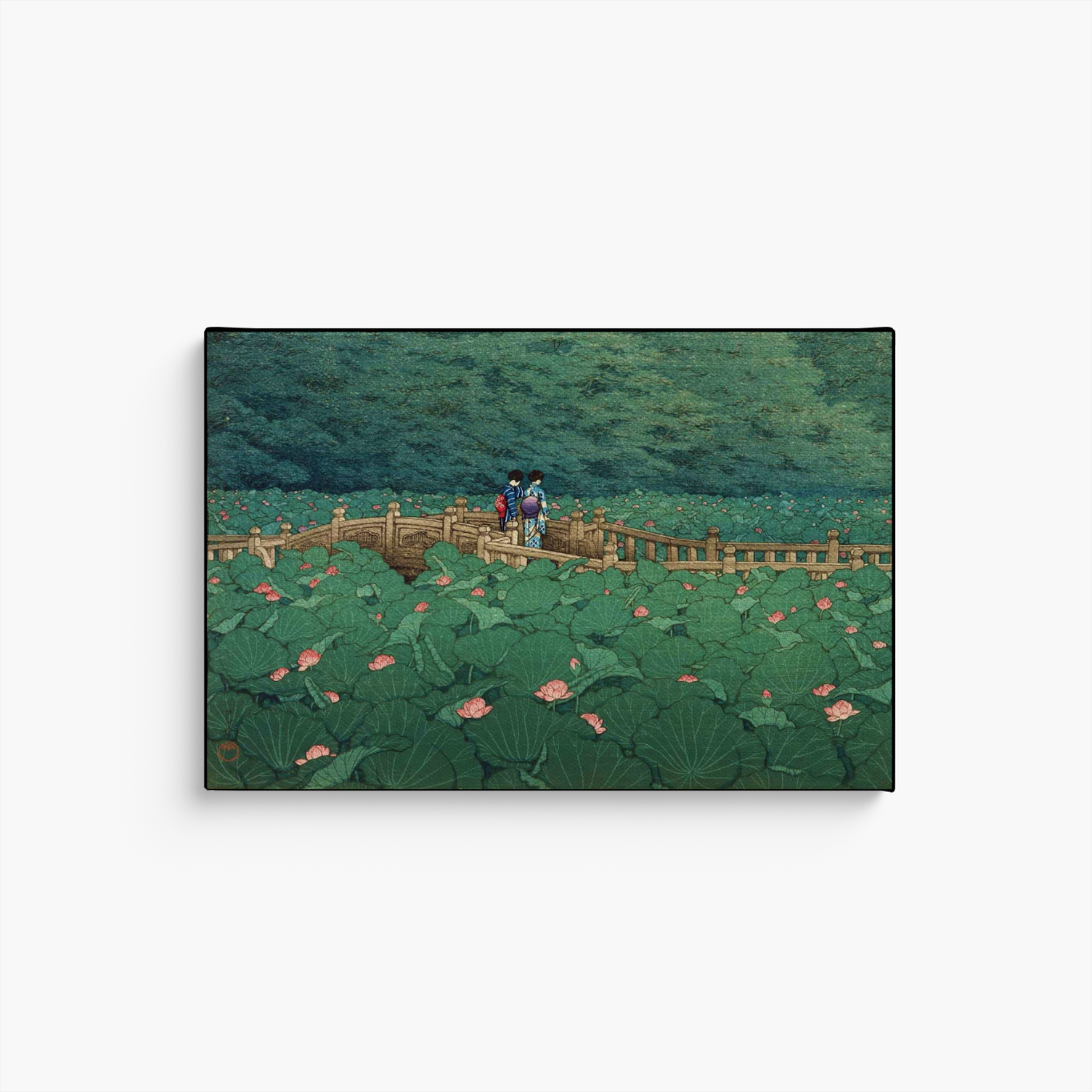 Image 2 of 4
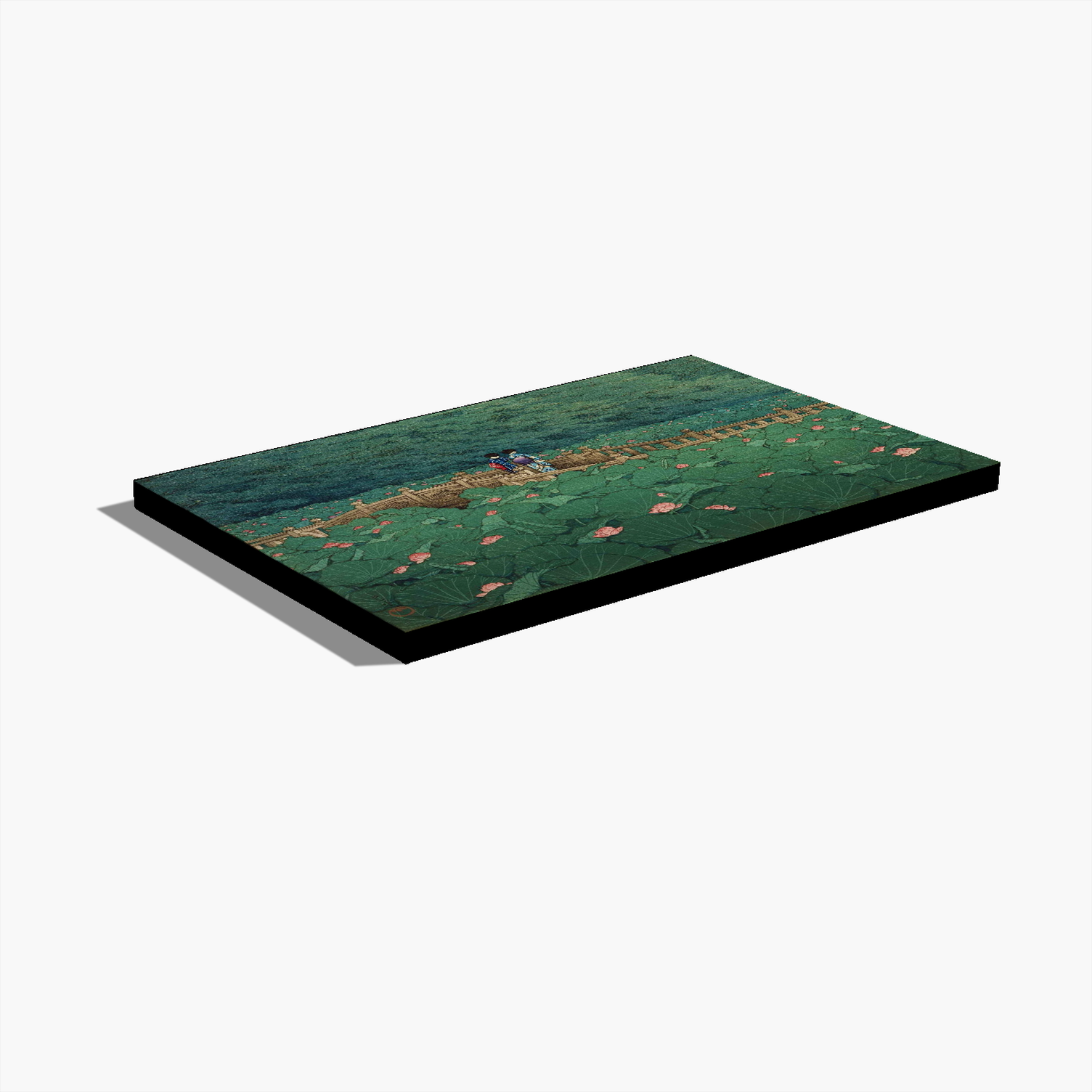 Image 3 of 4
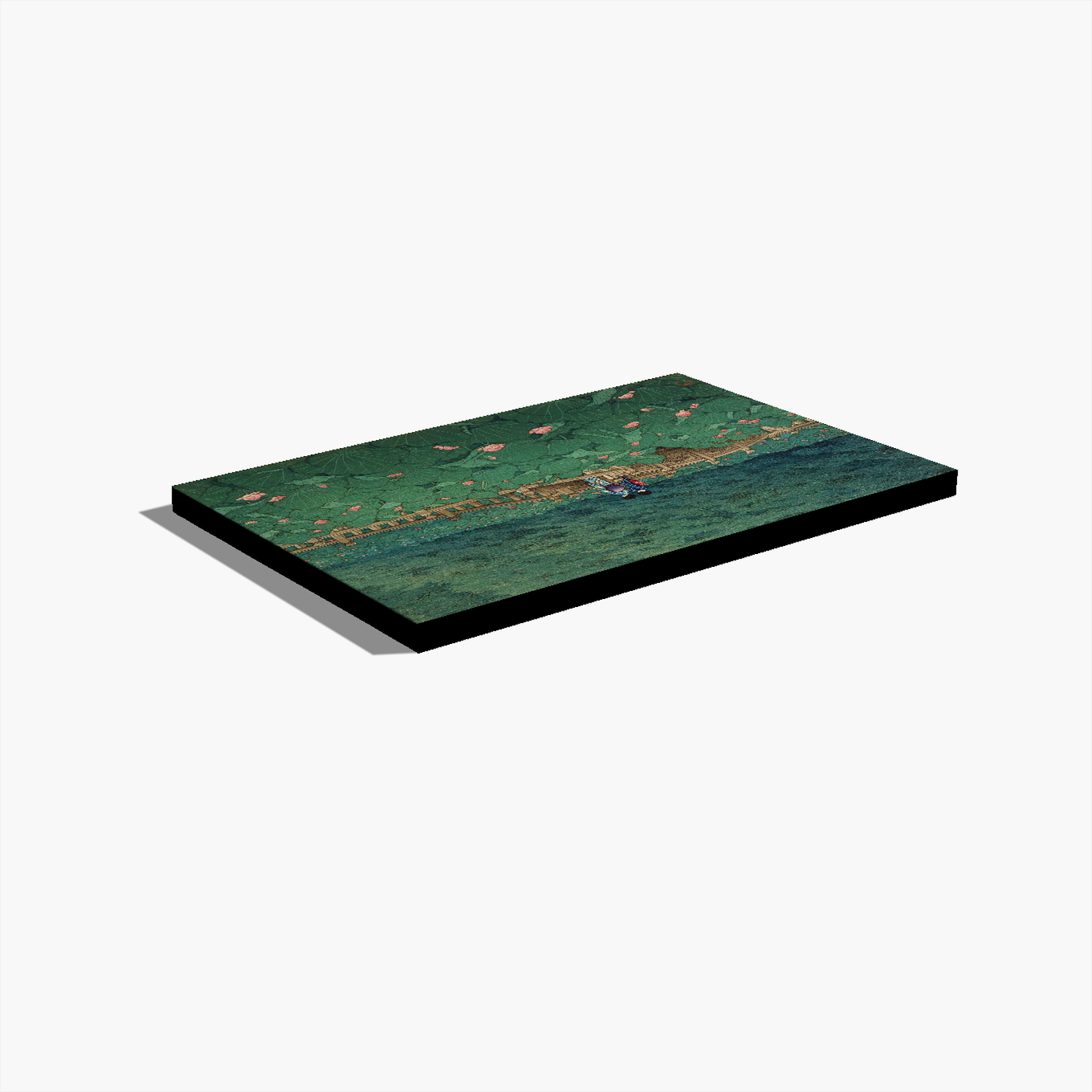 Image 4 of 4
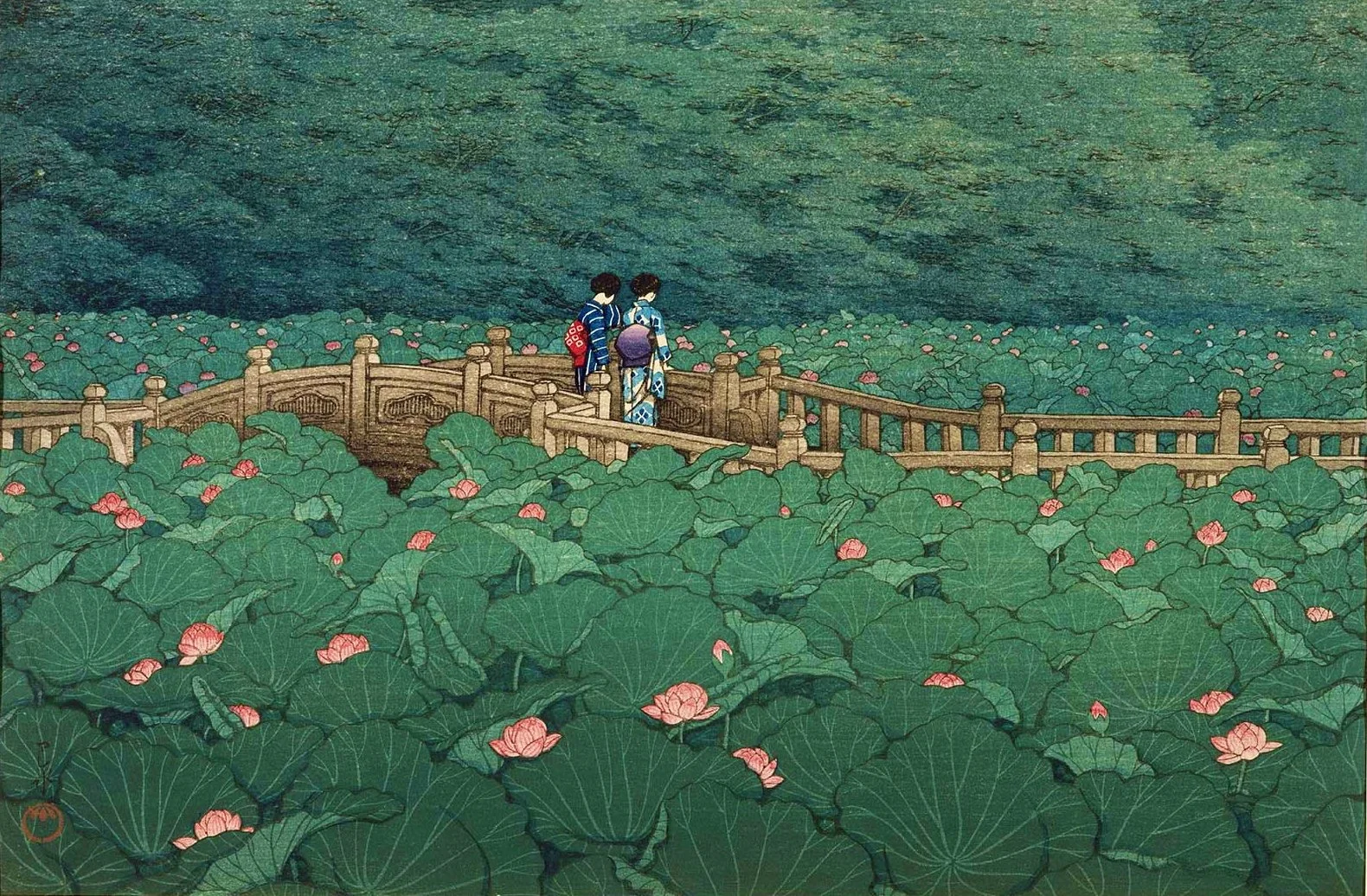
Kawase Hasui's "The Pond at Benten Shrine in Shiba" (1932)
Premium quality canvas print of Kawase Hasui’s “The Pond at Benten Shrine in Shiba” woodblock painting
Transform your living space into a peaceful haven with art that speaks to the soul. This canvas reprint evokes the tranquil beauty of a summer pond in old Tokyo, filling your home with an atmosphere of stillness, natural abundance, and quiet elegance. Built on a sturdy 1.5" wood frame, it offers a substantial gallery-style presence while preserving the delicate refinement of Hasui’s original woodblock design.
More About the Art:
Kawase Hasui’s “The Pond at Benten Shrine in Shiba,” also known by its Japanese title Shiba Benten Ike, is a graceful meditation on water, flowers, shade, and human contemplation. Created in August 1929, the work is a colour woodblock print in the horizontal ōban format. Museum records identify the original publisher as the joint firm of Sakai and Kawaguchi, while later impressions were produced from the surviving blocks by subsequent publishers. (Art Institute of Chicago)
The scene presents a lush pond covered with lotus leaves and blossoms. Two women in kimono stand quietly at the water’s edge, their figures small and restrained within the surrounding landscape. Rather than dominating the composition, they become part of its contemplative rhythm. Their stillness encourages the viewer to share their experience: to pause before the flowers, notice the cool shadows beneath the trees, and enter the calm world Hasui has created.
The composition is remarkable for its sense of depth. Broad lotus leaves spread across the foreground and middle distance, forming a rich, patterned surface over the water. Beyond them, dense trees rise in shadow, enclosing the pond and giving the scene the feeling of a secluded garden hidden within the city. The figures provide both scale and emotional focus, yet Hasui leaves their thoughts unspoken. They may be admiring the blossoms, conversing softly, or simply resting in the coolness of the shade.
This quiet ambiguity is central to the print’s beauty. Hasui does not construct a dramatic narrative. Instead, he captures an ordinary moment and allows atmosphere to give it meaning. The summer heat is suggested through the heavy vegetation and abundant lotus growth, while the shaded water offers a sense of relief and stillness. Japanese descriptions of the work similarly emphasize the countless lotuses covering the pond, the modestly rendered women, and the dense trees that evoke a brief moment in the height of summer. (Shin Hanga)
The historical setting adds another layer of resonance. The pond once occupied the southwestern corner of the grounds of Zōjō-ji Temple in Shiba, Tokyo. It was known as Benten Pond because Benzaiten—also called Benten—was enshrined on a small island within it. Benzaiten is traditionally associated with music, eloquence, learning, beauty, and water, making the pond an especially fitting subject for an image shaped by harmony and reflection. After the Second World War, much of the pond was filled in and reduced to a smaller artificial body of water, although a remnant remains near Hōshū-in in present-day Shiba Park. (JMApps)
Hasui’s print therefore preserves more than a picturesque garden. It records a landscape that has since been substantially altered, allowing the viewer to encounter a quieter and greener vision of Tokyo before the city’s postwar transformation. Yet the image never feels merely documentary. Hasui softens the specific location into something universal: a place where water, flowers, shade, and human presence exist in perfect balance.
The lotus itself carries deep symbolic significance in Japanese Buddhist culture. Rooted in mud yet rising above the water to bloom with remarkable purity, it has long been associated with spiritual awakening, resilience, and the possibility of beauty emerging from imperfection. In Hasui’s composition, the lotus leaves create a living tapestry across the pond. Their repetition gives the scene rhythm, while the blossoms introduce moments of brightness among the deeper greens and shadows.
What makes “The Pond at Benten Shrine in Shiba” especially compelling is the balance between abundance and restraint. The pond is richly filled with vegetation, yet the composition never feels crowded. The women are elegantly dressed, yet they do not become decorative spectacles. The setting has religious and historical importance, yet Hasui approaches it without grandeur. Everything is held together by quiet observation.
This sensitivity is one of the defining qualities of Shin Hanga landscape art. Rather than simply reviving the imagery of classical ukiyo-e, artists such as Hasui explored modern effects of natural light, atmospheric depth, seasonal change, and personal emotion. In this print, traditional subject matter is joined with a modern awareness of space and mood. The result feels timeless: recognizably Japanese, yet emotionally accessible to viewers far beyond its original place and period.
As a canvas reprint, “The Pond at Benten Shrine in Shiba” brings a soothing and refined presence into the contemporary home. Its horizontal composition is particularly well suited to placement above a sofa, bed, console, or dining area. The broad expanse of lotus-covered water creates visual calm, while the shaded trees and softly observed figures add depth and intimacy.
This work is ideal for interiors that seek elegance without excess. It complements spaces inspired by nature, Japanese design, quiet luxury, meditation, or traditional craftsmanship. Its mood is gentle rather than dramatic, making it a piece that can be lived with over time. It does not overwhelm a room; it deepens it.
Hasui transforms a summer pond into a meditation on stillness. The lotus leaves become a pattern of life and renewal. The women become witnesses to beauty. The shaded garden becomes a refuge from the noise of the outside world. “The Pond at Benten Shrine in Shiba” is not merely an image of old Tokyo—it is an invitation to pause, observe, and rediscover the restorative power of quiet places.
More About the Artist:
Kawase Hasui was one of the most important Japanese landscape printmakers of the twentieth century and a central figure in the Shin Hanga movement. Born Bunjiro Kawase in Tokyo in 1883, he became celebrated for his poetic depictions of temples, villages, coastlines, city streets, mountains, and seasonal landscapes. His prints are distinguished by their sensitive treatment of rain, snow, twilight, moonlight, reflection, and silence.
Hasui’s path to becoming an artist was not immediate. His family expected him to enter the family’s rope and thread business, and for a time his artistic ambitions were delayed by commercial responsibilities. After the business failed when he was in his twenties, he was able to pursue art more seriously. He studied Western-style painting under Okada Saburōsuke before being accepted as a pupil of Kaburaki Kiyokata, an influential master of modern Japanese painting. Kiyokata gave him the art name Hasui. (Wikipedia)
Hasui’s early training in both Western and Japanese painting helped shape the distinctive character of his later woodblock designs. From Western art, he absorbed an interest in perspective, naturalistic light, and spatial atmosphere. From Japanese painting and ukiyo-e, he inherited an appreciation for seasonal subjects, simplified forms, expressive line, and the emotional power of carefully balanced composition.
A decisive moment came when Hasui saw Itō Shinsui’s series Eight Views of Lake Biwa. Inspired by Shinsui’s modern approach to traditional woodblock printing, Hasui became interested in producing landscape prints through the collaborative publisher-led system. He began working with Watanabe Shōzaburō, the publisher most closely associated with the development of Shin Hanga, and his first experimental landscape prints appeared in 1918. (Wikipedia)
The Shin Hanga movement sought to renew Japanese woodblock printing while preserving its traditional division of labour. The artist created the design, but skilled carvers cut the blocks, printers applied the pigments, and a publisher coordinated and distributed the finished work. This collaboration allowed for extraordinary technical refinement, including subtle colour gradations, layered shadows, reflected light, and delicate atmospheric effects.
Hasui proved exceptionally suited to this process. His designs gave carvers and printers opportunities to reproduce the finest details of weather and light: snow settling on temple roofs, rain darkening a road, the glow of a distant window, moonlight moving across water, or summer foliage gathering around a quiet pond. He understood that landscape could convey emotion without relying on dramatic human action.
Travel was essential to Hasui’s artistic practice. He journeyed throughout Japan, sketching villages, temples, mountains, coastlines, and urban neighbourhoods. Many of his prints originated in drawings and watercolours made directly before the landscape. Yet he did not treat these sketches as strict documentary records. When developing them into print designs, he often simplified, rearranged, or intensified elements to strengthen the emotional atmosphere.
This approach earned Hasui a reputation as a poet of travel and landscape. His Japan is not defined by crowds, industry, or rapid modernization, even though he lived through an era of profound national change. Instead, he sought places where older rhythms remained visible: a shrine under rain, a road disappearing into snow, a fishing village at dusk, a quiet bridge, or a pond filled with lotus blossoms.
“The Pond at Benten Shrine in Shiba” is especially meaningful because Shiba was part of Hasui’s native Tokyo. The print shows his ability to find lyrical beauty within the modern city by focusing on a surviving pocket of nature, religious tradition, and quiet human experience. Rather than portraying Tokyo as a metropolis of traffic and construction, he reveals it as a city of hidden gardens, temple grounds, seasonal flowers, and contemplative spaces.
Hasui’s career was deeply affected by the Great Kantō Earthquake of 1923. The disaster destroyed Watanabe’s workshop, along with completed woodblocks and many of Hasui’s sketches. Although this represented an enormous artistic loss, Hasui resumed his travels and printmaking. His later work often became richer in colour and increasingly assured in its atmospheric effects. (Wikipedia)
Over the course of a career lasting nearly four decades, Hasui designed hundreds of woodblock prints. He worked primarily with Watanabe, though certain works, including “The Pond at Benten Shrine in Shiba,” were first issued by other publishers. His prints became especially admired outside Japan, where collectors responded to their combination of traditional craftsmanship, modern atmosphere, and accessible emotional beauty.
Hasui has often been called the “Hiroshige of the Shōwa era,” a comparison that recognizes his importance as an interpreter of Japanese landscape. Like Utagawa Hiroshige before him, Hasui found poetry in weather, travel, changing seasons, and ordinary places. Yet his work possesses a distinctly twentieth-century sensibility. His scenes often feel more solitary, immersive, and quietly psychological.
The human figures in Hasui’s prints are usually small. They rarely appear as individual portraits and seldom command the scene. Instead, they serve as emotional guides, helping the viewer imagine the experience of walking through rain, crossing a snowy bridge, standing before a temple, or contemplating a lotus pond. Their scale reinforces the relationship between humanity and the larger natural world.
This is beautifully demonstrated in “The Pond at Benten Shrine in Shiba.” The two women are essential to the image, yet their importance comes from their attentiveness rather than their prominence. They are not performing for the viewer. They are simply present before the pond, absorbed in the summer landscape. Through them, Hasui turns looking itself into the subject of the print.
Toward the end of his life, Hasui’s contribution to traditional woodblock craftsmanship received significant official recognition. The production process for one of his later works was formally documented as part of efforts to preserve the techniques of Japanese printmaking. His art is now represented in major museum collections around the world, and his reputation has continued to grow among scholars, collectors, and admirers of Japanese design. (Wikipedia)
Kawase Hasui died in Tokyo in 1957, leaving behind an extraordinary visual record of Japan during a period of transformation. His prints preserve places that have changed or disappeared, but their importance reaches beyond historical documentation. They preserve feelings: the silence after snowfall, the coolness of evening rain, the loneliness of a distant light, and the peaceful abundance of a lotus pond in summer.
Today, Hasui’s art feels remarkably suited to contemporary interiors. His compositions are elegant and balanced, while his emotional language remains quiet and universal. They offer relief from visual noise and constant movement. To live with a Hasui landscape is to live with an image that encourages attention, reflection, and calm.
“The Pond at Benten Shrine in Shiba” embodies the finest qualities of his work. It is intimate yet spacious, richly observed yet restrained, historically specific yet timeless. Through lotus blossoms, shaded water, and two silent figures, Hasui reveals a world in which beauty is found not in spectacle, but in the simple and profound act of pausing before nature.
Please note: This premium canvas reprint is built on a sturdy 1.5" wood frame for a substantial gallery-style presence. Please review all artwork, size, and product details carefully before ordering, as returns are not accepted for this item.
Premium quality canvas print of Kawase Hasui’s “The Pond at Benten Shrine in Shiba” woodblock painting
Transform your living space into a peaceful haven with art that speaks to the soul. This canvas reprint evokes the tranquil beauty of a summer pond in old Tokyo, filling your home with an atmosphere of stillness, natural abundance, and quiet elegance. Built on a sturdy 1.5" wood frame, it offers a substantial gallery-style presence while preserving the delicate refinement of Hasui’s original woodblock design.
More About the Art:
Kawase Hasui’s “The Pond at Benten Shrine in Shiba,” also known by its Japanese title Shiba Benten Ike, is a graceful meditation on water, flowers, shade, and human contemplation. Created in August 1929, the work is a colour woodblock print in the horizontal ōban format. Museum records identify the original publisher as the joint firm of Sakai and Kawaguchi, while later impressions were produced from the surviving blocks by subsequent publishers. (Art Institute of Chicago)
The scene presents a lush pond covered with lotus leaves and blossoms. Two women in kimono stand quietly at the water’s edge, their figures small and restrained within the surrounding landscape. Rather than dominating the composition, they become part of its contemplative rhythm. Their stillness encourages the viewer to share their experience: to pause before the flowers, notice the cool shadows beneath the trees, and enter the calm world Hasui has created.
The composition is remarkable for its sense of depth. Broad lotus leaves spread across the foreground and middle distance, forming a rich, patterned surface over the water. Beyond them, dense trees rise in shadow, enclosing the pond and giving the scene the feeling of a secluded garden hidden within the city. The figures provide both scale and emotional focus, yet Hasui leaves their thoughts unspoken. They may be admiring the blossoms, conversing softly, or simply resting in the coolness of the shade.
This quiet ambiguity is central to the print’s beauty. Hasui does not construct a dramatic narrative. Instead, he captures an ordinary moment and allows atmosphere to give it meaning. The summer heat is suggested through the heavy vegetation and abundant lotus growth, while the shaded water offers a sense of relief and stillness. Japanese descriptions of the work similarly emphasize the countless lotuses covering the pond, the modestly rendered women, and the dense trees that evoke a brief moment in the height of summer. (Shin Hanga)
The historical setting adds another layer of resonance. The pond once occupied the southwestern corner of the grounds of Zōjō-ji Temple in Shiba, Tokyo. It was known as Benten Pond because Benzaiten—also called Benten—was enshrined on a small island within it. Benzaiten is traditionally associated with music, eloquence, learning, beauty, and water, making the pond an especially fitting subject for an image shaped by harmony and reflection. After the Second World War, much of the pond was filled in and reduced to a smaller artificial body of water, although a remnant remains near Hōshū-in in present-day Shiba Park. (JMApps)
Hasui’s print therefore preserves more than a picturesque garden. It records a landscape that has since been substantially altered, allowing the viewer to encounter a quieter and greener vision of Tokyo before the city’s postwar transformation. Yet the image never feels merely documentary. Hasui softens the specific location into something universal: a place where water, flowers, shade, and human presence exist in perfect balance.
The lotus itself carries deep symbolic significance in Japanese Buddhist culture. Rooted in mud yet rising above the water to bloom with remarkable purity, it has long been associated with spiritual awakening, resilience, and the possibility of beauty emerging from imperfection. In Hasui’s composition, the lotus leaves create a living tapestry across the pond. Their repetition gives the scene rhythm, while the blossoms introduce moments of brightness among the deeper greens and shadows.
What makes “The Pond at Benten Shrine in Shiba” especially compelling is the balance between abundance and restraint. The pond is richly filled with vegetation, yet the composition never feels crowded. The women are elegantly dressed, yet they do not become decorative spectacles. The setting has religious and historical importance, yet Hasui approaches it without grandeur. Everything is held together by quiet observation.
This sensitivity is one of the defining qualities of Shin Hanga landscape art. Rather than simply reviving the imagery of classical ukiyo-e, artists such as Hasui explored modern effects of natural light, atmospheric depth, seasonal change, and personal emotion. In this print, traditional subject matter is joined with a modern awareness of space and mood. The result feels timeless: recognizably Japanese, yet emotionally accessible to viewers far beyond its original place and period.
As a canvas reprint, “The Pond at Benten Shrine in Shiba” brings a soothing and refined presence into the contemporary home. Its horizontal composition is particularly well suited to placement above a sofa, bed, console, or dining area. The broad expanse of lotus-covered water creates visual calm, while the shaded trees and softly observed figures add depth and intimacy.
This work is ideal for interiors that seek elegance without excess. It complements spaces inspired by nature, Japanese design, quiet luxury, meditation, or traditional craftsmanship. Its mood is gentle rather than dramatic, making it a piece that can be lived with over time. It does not overwhelm a room; it deepens it.
Hasui transforms a summer pond into a meditation on stillness. The lotus leaves become a pattern of life and renewal. The women become witnesses to beauty. The shaded garden becomes a refuge from the noise of the outside world. “The Pond at Benten Shrine in Shiba” is not merely an image of old Tokyo—it is an invitation to pause, observe, and rediscover the restorative power of quiet places.
More About the Artist:
Kawase Hasui was one of the most important Japanese landscape printmakers of the twentieth century and a central figure in the Shin Hanga movement. Born Bunjiro Kawase in Tokyo in 1883, he became celebrated for his poetic depictions of temples, villages, coastlines, city streets, mountains, and seasonal landscapes. His prints are distinguished by their sensitive treatment of rain, snow, twilight, moonlight, reflection, and silence.
Hasui’s path to becoming an artist was not immediate. His family expected him to enter the family’s rope and thread business, and for a time his artistic ambitions were delayed by commercial responsibilities. After the business failed when he was in his twenties, he was able to pursue art more seriously. He studied Western-style painting under Okada Saburōsuke before being accepted as a pupil of Kaburaki Kiyokata, an influential master of modern Japanese painting. Kiyokata gave him the art name Hasui. (Wikipedia)
Hasui’s early training in both Western and Japanese painting helped shape the distinctive character of his later woodblock designs. From Western art, he absorbed an interest in perspective, naturalistic light, and spatial atmosphere. From Japanese painting and ukiyo-e, he inherited an appreciation for seasonal subjects, simplified forms, expressive line, and the emotional power of carefully balanced composition.
A decisive moment came when Hasui saw Itō Shinsui’s series Eight Views of Lake Biwa. Inspired by Shinsui’s modern approach to traditional woodblock printing, Hasui became interested in producing landscape prints through the collaborative publisher-led system. He began working with Watanabe Shōzaburō, the publisher most closely associated with the development of Shin Hanga, and his first experimental landscape prints appeared in 1918. (Wikipedia)
The Shin Hanga movement sought to renew Japanese woodblock printing while preserving its traditional division of labour. The artist created the design, but skilled carvers cut the blocks, printers applied the pigments, and a publisher coordinated and distributed the finished work. This collaboration allowed for extraordinary technical refinement, including subtle colour gradations, layered shadows, reflected light, and delicate atmospheric effects.
Hasui proved exceptionally suited to this process. His designs gave carvers and printers opportunities to reproduce the finest details of weather and light: snow settling on temple roofs, rain darkening a road, the glow of a distant window, moonlight moving across water, or summer foliage gathering around a quiet pond. He understood that landscape could convey emotion without relying on dramatic human action.
Travel was essential to Hasui’s artistic practice. He journeyed throughout Japan, sketching villages, temples, mountains, coastlines, and urban neighbourhoods. Many of his prints originated in drawings and watercolours made directly before the landscape. Yet he did not treat these sketches as strict documentary records. When developing them into print designs, he often simplified, rearranged, or intensified elements to strengthen the emotional atmosphere.
This approach earned Hasui a reputation as a poet of travel and landscape. His Japan is not defined by crowds, industry, or rapid modernization, even though he lived through an era of profound national change. Instead, he sought places where older rhythms remained visible: a shrine under rain, a road disappearing into snow, a fishing village at dusk, a quiet bridge, or a pond filled with lotus blossoms.
“The Pond at Benten Shrine in Shiba” is especially meaningful because Shiba was part of Hasui’s native Tokyo. The print shows his ability to find lyrical beauty within the modern city by focusing on a surviving pocket of nature, religious tradition, and quiet human experience. Rather than portraying Tokyo as a metropolis of traffic and construction, he reveals it as a city of hidden gardens, temple grounds, seasonal flowers, and contemplative spaces.
Hasui’s career was deeply affected by the Great Kantō Earthquake of 1923. The disaster destroyed Watanabe’s workshop, along with completed woodblocks and many of Hasui’s sketches. Although this represented an enormous artistic loss, Hasui resumed his travels and printmaking. His later work often became richer in colour and increasingly assured in its atmospheric effects. (Wikipedia)
Over the course of a career lasting nearly four decades, Hasui designed hundreds of woodblock prints. He worked primarily with Watanabe, though certain works, including “The Pond at Benten Shrine in Shiba,” were first issued by other publishers. His prints became especially admired outside Japan, where collectors responded to their combination of traditional craftsmanship, modern atmosphere, and accessible emotional beauty.
Hasui has often been called the “Hiroshige of the Shōwa era,” a comparison that recognizes his importance as an interpreter of Japanese landscape. Like Utagawa Hiroshige before him, Hasui found poetry in weather, travel, changing seasons, and ordinary places. Yet his work possesses a distinctly twentieth-century sensibility. His scenes often feel more solitary, immersive, and quietly psychological.
The human figures in Hasui’s prints are usually small. They rarely appear as individual portraits and seldom command the scene. Instead, they serve as emotional guides, helping the viewer imagine the experience of walking through rain, crossing a snowy bridge, standing before a temple, or contemplating a lotus pond. Their scale reinforces the relationship between humanity and the larger natural world.
This is beautifully demonstrated in “The Pond at Benten Shrine in Shiba.” The two women are essential to the image, yet their importance comes from their attentiveness rather than their prominence. They are not performing for the viewer. They are simply present before the pond, absorbed in the summer landscape. Through them, Hasui turns looking itself into the subject of the print.
Toward the end of his life, Hasui’s contribution to traditional woodblock craftsmanship received significant official recognition. The production process for one of his later works was formally documented as part of efforts to preserve the techniques of Japanese printmaking. His art is now represented in major museum collections around the world, and his reputation has continued to grow among scholars, collectors, and admirers of Japanese design. (Wikipedia)
Kawase Hasui died in Tokyo in 1957, leaving behind an extraordinary visual record of Japan during a period of transformation. His prints preserve places that have changed or disappeared, but their importance reaches beyond historical documentation. They preserve feelings: the silence after snowfall, the coolness of evening rain, the loneliness of a distant light, and the peaceful abundance of a lotus pond in summer.
Today, Hasui’s art feels remarkably suited to contemporary interiors. His compositions are elegant and balanced, while his emotional language remains quiet and universal. They offer relief from visual noise and constant movement. To live with a Hasui landscape is to live with an image that encourages attention, reflection, and calm.
“The Pond at Benten Shrine in Shiba” embodies the finest qualities of his work. It is intimate yet spacious, richly observed yet restrained, historically specific yet timeless. Through lotus blossoms, shaded water, and two silent figures, Hasui reveals a world in which beauty is found not in spectacle, but in the simple and profound act of pausing before nature.
Please note: This premium canvas reprint is built on a sturdy 1.5" wood frame for a substantial gallery-style presence. Please review all artwork, size, and product details carefully before ordering, as returns are not accepted for this item.