
 Image 1 of 1
The Hamlet of Hataori in Shiobara — Kawase Hasui (1946)
Premium quality canvas print of “The Hamlet of Hataori in Shiobara” by Kawase Hasui
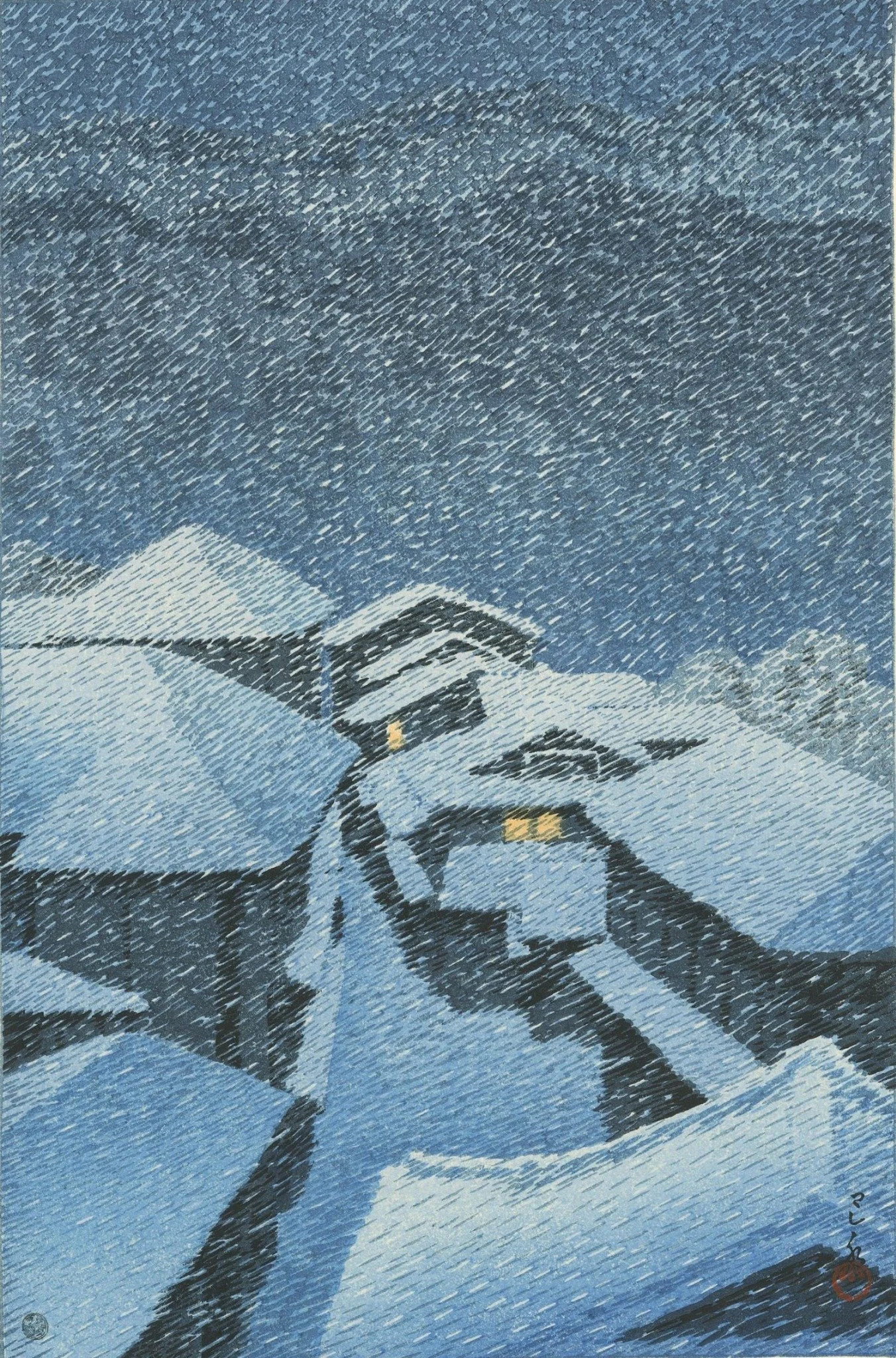
Through a curtain of falling snow, golden windows glow among the deep blue roofs of a quiet mountain hamlet. Kawase Hasui’s The Hamlet of Hataori in Shiobara brings the feeling of winter shelter and warm light into your home, reproduced on canvas over a 1.5-inch wood stretcher.
Product details: Canvas reproduction over a sturdy 1.5-inch wood stretcher. Available in 16 × 24 in. ($259 CAD) and 24 × 36 in. ($299 CAD). No returns accepted.
More About the Art
In The Hamlet of Hataori in Shiobara, winter weather becomes the main presence in the landscape. Pale diagonal marks cover a deep blue sky and sweep across a cluster of houses below. Snow lies thickly on the roofs, softening their outlines into broad, sloping shapes. Among the dark walls, small yellow windows glow. These few warm accents are enough to suggest shelter within a scene otherwise dominated by cold colour and restless movement.
The sky occupies much of the upper half of the vertical composition. Rather than appearing empty, it is filled with layers of short, closely spaced strokes. Their varying brightness and density give the snowfall depth: some marks stand out clearly, while others seem to disappear into the blue. The repetition builds a powerful visual rhythm that continues over the buildings, joining the atmosphere and the village in one continuous surface.
Below, the houses are closely grouped. Roofs overlap from the foreground into the middle distance, with dark bands beneath the eaves helping separate one structure from another. Large areas of pale blue suggest snow that has gathered on the slopes. The roofs remain recognisable despite the dense pattern crossing them, so the viewer can alternate between reading the village as a place and experiencing the storm as an all-enclosing texture.
A narrow dark passage draws the eye upward from the lower part of the image. Its irregular course threads between the houses toward the more distant roofs. The contrast between this dark opening and the snow-covered surfaces creates an impression of depth without a distant horizon. It also gives the scene a human route: a way through the village, although no person is clearly visible along it.
The lighted windows offer the strongest change of temperature within the palette. A small yellow opening appears on a house farther back, while a broader patch of golden light glows nearer the centre. The surrounding walls are almost black. Because the interiors remain unseen, the windows invite the viewer to imagine warmth without supplying a particular story. Their modest size makes them feel especially precious within the expansive field of blue.
The original colour woodblock design dates to 1946, or Shōwa 21, and was published by Watanabe Shōzaburō. Museum records use the shorter titles Hataori in Shiobara and Hataori, Shiobara; the fuller English title describes the same snowy hamlet. Sotheby’s notes that the design exists in blue-dominated and black-and-purple variants. The image reproduced here presents the blue palette, with golden windows providing its concentrated warm accents.
Shiobara had a long association with Kawase Hasui. The British Museum records his childhood stays at the hot-spring resort, and he later returned to its scenery in his prints. That background gives the subject a personal geographic connection, but the image does not require a biographical explanation to communicate. Its immediate strength lies in the relationships between wind-driven snow, overlapping roofs, and the small signs of light within them.
Reproduced on canvas, this scene brings rich blue colour and an enveloping winter atmosphere to a room. Seen from across the space, the roof shapes and warm windows establish a clear composition. Closer viewing reveals the many small marks that give the storm its energy. The picture offers both movement and stillness: snow continuing to fall around buildings that appear settled, inhabited, and quietly enduring.
More About the Artist
Kawase Hasui (1883–1957) was a Japanese landscape designer whose woodblock prints give weather and light a central role in the experience of place. His subjects include temple grounds, urban streets, coastlines, rural houses, and mountain scenery. A landscape’s identity emerges through the season and the hour as much as through its buildings or geography. In his winter views, snow can transform a familiar setting into an arrangement of pale surfaces, deep shadows, and small traces of human life.
Born in Tokyo with the given name Bunjiro, Hasui spent time during childhood at Shiobara, a hot-spring resort where his aunt lived. The British Museum connects these stays with the development of his interest in Japanese landscape. The region remained part of his artistic world long afterward. Hataori in Shiobara therefore belongs to a continuing engagement with a place he knew, rather than an isolated choice of subject.
Hasui’s artistic education brought together different approaches to painting. He studied Western-style art with Okada Saburosuke and entered the studio of Japanese-style painter Kaburaki Kiyokata in 1910. Kiyokata gave him the name Hasui. Before landscape printmaking became his principal activity, he earned income through illustration and other design work, gaining experience in composing images for publication.
The landscape prints of fellow pupil Ito Shinsui, particularly Eight Views of Omi, encouraged his interest in single-sheet woodblock pictures. Through Kiyokata he became known to Watanabe Shōzaburō, who began publishing his landscape designs in 1918–1919. The association developed into an enduring partnership. Watanabe was a leading advocate of shin-hanga, or “new prints,” which renewed traditional woodblock production for audiences in Japan and abroad.
This production depended on the work of several specialists. Hasui developed the image, a carver prepared the blocks, and a printer transferred their lines and colours to paper, with the publisher coordinating the work. The finished print brought these contributions together. New palettes and expressive effects developed within an established craft process. Recognising that collaboration helps explain how a scene such as Hataori could combine sharply structured roofs with an intricate, seemingly continuous veil of snow.
Travel and sketching supplied Hasui with subjects throughout his career. He explored places across Japan during a period when towns and landscapes were changing rapidly. His prints often give a quiet street or an ordinary dwelling as much visual attention as a famous landmark. Small figures sometimes establish the scale of a larger setting; in other compositions, an illuminated window or a simple path is enough to make human presence felt.
The Great Kanto Earthquake of 1923 caused serious losses. Watanabe’s premises, woodblocks, and print stock were destroyed, and Hasui lost his sketchbooks. He continued making landscape designs in the years that followed. His work again found an international audience, and after the Second World War he and Watanabe resumed their collaboration amid renewed demand for Japanese prints. The 1946 Hataori design belongs to this later phase of his career.
Hasui remained active until the end of his life in 1957. In 1953, the making of Snow at Zojoji Temple was documented by Japan’s Cultural Properties Protection Committee, providing a record of the traditional printmaking process. Across roughly four decades he designed more than six hundred woodblock prints. These works are preserved in major collections, including the British Museum, the Minneapolis Institute of Art, and the Los Angeles County Museum of Art.
His continuing appeal rests partly on how directly these images invite sustained looking. In Hataori, a limited palette holds an extraordinary range of textures and depths: snow in the air, snow on roofs, blue shadows, and golden light. The scene feels intimate even though the houses remain closed to us. It allows viewers to encounter the landscape through a simple but powerful relationship between the weather outside and the promise of shelter within.
Sources
Minneapolis Institute of Art — Hataori in Shiobara, 1946; publisher record
Birmingham Museum of Art — Hataori, Shiobara; Shōwa 21 inscription
Sotheby’s — The Hamlet of Hataori in Shiobara; title and colour variants
Japan Museum SieboldHuis — Kawase Hasui. Capturing the Soul of Japan
Tokyo Fuji Art Museum — Kawase Hasui biography and 1953 process record
Premium quality canvas print of “The Hamlet of Hataori in Shiobara” by Kawase Hasui
Through a curtain of falling snow, golden windows glow among the deep blue roofs of a quiet mountain hamlet. Kawase Hasui’s The Hamlet of Hataori in Shiobara brings the feeling of winter shelter and warm light into your home, reproduced on canvas over a 1.5-inch wood stretcher.
Product details: Canvas reproduction over a sturdy 1.5-inch wood stretcher. Available in 16 × 24 in. ($259 CAD) and 24 × 36 in. ($299 CAD). No returns accepted.
More About the Art
In The Hamlet of Hataori in Shiobara, winter weather becomes the main presence in the landscape. Pale diagonal marks cover a deep blue sky and sweep across a cluster of houses below. Snow lies thickly on the roofs, softening their outlines into broad, sloping shapes. Among the dark walls, small yellow windows glow. These few warm accents are enough to suggest shelter within a scene otherwise dominated by cold colour and restless movement.
The sky occupies much of the upper half of the vertical composition. Rather than appearing empty, it is filled with layers of short, closely spaced strokes. Their varying brightness and density give the snowfall depth: some marks stand out clearly, while others seem to disappear into the blue. The repetition builds a powerful visual rhythm that continues over the buildings, joining the atmosphere and the village in one continuous surface.
Below, the houses are closely grouped. Roofs overlap from the foreground into the middle distance, with dark bands beneath the eaves helping separate one structure from another. Large areas of pale blue suggest snow that has gathered on the slopes. The roofs remain recognisable despite the dense pattern crossing them, so the viewer can alternate between reading the village as a place and experiencing the storm as an all-enclosing texture.
A narrow dark passage draws the eye upward from the lower part of the image. Its irregular course threads between the houses toward the more distant roofs. The contrast between this dark opening and the snow-covered surfaces creates an impression of depth without a distant horizon. It also gives the scene a human route: a way through the village, although no person is clearly visible along it.
The lighted windows offer the strongest change of temperature within the palette. A small yellow opening appears on a house farther back, while a broader patch of golden light glows nearer the centre. The surrounding walls are almost black. Because the interiors remain unseen, the windows invite the viewer to imagine warmth without supplying a particular story. Their modest size makes them feel especially precious within the expansive field of blue.
The original colour woodblock design dates to 1946, or Shōwa 21, and was published by Watanabe Shōzaburō. Museum records use the shorter titles Hataori in Shiobara and Hataori, Shiobara; the fuller English title describes the same snowy hamlet. Sotheby’s notes that the design exists in blue-dominated and black-and-purple variants. The image reproduced here presents the blue palette, with golden windows providing its concentrated warm accents.
Shiobara had a long association with Kawase Hasui. The British Museum records his childhood stays at the hot-spring resort, and he later returned to its scenery in his prints. That background gives the subject a personal geographic connection, but the image does not require a biographical explanation to communicate. Its immediate strength lies in the relationships between wind-driven snow, overlapping roofs, and the small signs of light within them.
Reproduced on canvas, this scene brings rich blue colour and an enveloping winter atmosphere to a room. Seen from across the space, the roof shapes and warm windows establish a clear composition. Closer viewing reveals the many small marks that give the storm its energy. The picture offers both movement and stillness: snow continuing to fall around buildings that appear settled, inhabited, and quietly enduring.
More About the Artist
Kawase Hasui (1883–1957) was a Japanese landscape designer whose woodblock prints give weather and light a central role in the experience of place. His subjects include temple grounds, urban streets, coastlines, rural houses, and mountain scenery. A landscape’s identity emerges through the season and the hour as much as through its buildings or geography. In his winter views, snow can transform a familiar setting into an arrangement of pale surfaces, deep shadows, and small traces of human life.
Born in Tokyo with the given name Bunjiro, Hasui spent time during childhood at Shiobara, a hot-spring resort where his aunt lived. The British Museum connects these stays with the development of his interest in Japanese landscape. The region remained part of his artistic world long afterward. Hataori in Shiobara therefore belongs to a continuing engagement with a place he knew, rather than an isolated choice of subject.
Hasui’s artistic education brought together different approaches to painting. He studied Western-style art with Okada Saburosuke and entered the studio of Japanese-style painter Kaburaki Kiyokata in 1910. Kiyokata gave him the name Hasui. Before landscape printmaking became his principal activity, he earned income through illustration and other design work, gaining experience in composing images for publication.
The landscape prints of fellow pupil Ito Shinsui, particularly Eight Views of Omi, encouraged his interest in single-sheet woodblock pictures. Through Kiyokata he became known to Watanabe Shōzaburō, who began publishing his landscape designs in 1918–1919. The association developed into an enduring partnership. Watanabe was a leading advocate of shin-hanga, or “new prints,” which renewed traditional woodblock production for audiences in Japan and abroad.
This production depended on the work of several specialists. Hasui developed the image, a carver prepared the blocks, and a printer transferred their lines and colours to paper, with the publisher coordinating the work. The finished print brought these contributions together. New palettes and expressive effects developed within an established craft process. Recognising that collaboration helps explain how a scene such as Hataori could combine sharply structured roofs with an intricate, seemingly continuous veil of snow.
Travel and sketching supplied Hasui with subjects throughout his career. He explored places across Japan during a period when towns and landscapes were changing rapidly. His prints often give a quiet street or an ordinary dwelling as much visual attention as a famous landmark. Small figures sometimes establish the scale of a larger setting; in other compositions, an illuminated window or a simple path is enough to make human presence felt.
The Great Kanto Earthquake of 1923 caused serious losses. Watanabe’s premises, woodblocks, and print stock were destroyed, and Hasui lost his sketchbooks. He continued making landscape designs in the years that followed. His work again found an international audience, and after the Second World War he and Watanabe resumed their collaboration amid renewed demand for Japanese prints. The 1946 Hataori design belongs to this later phase of his career.
Hasui remained active until the end of his life in 1957. In 1953, the making of Snow at Zojoji Temple was documented by Japan’s Cultural Properties Protection Committee, providing a record of the traditional printmaking process. Across roughly four decades he designed more than six hundred woodblock prints. These works are preserved in major collections, including the British Museum, the Minneapolis Institute of Art, and the Los Angeles County Museum of Art.
His continuing appeal rests partly on how directly these images invite sustained looking. In Hataori, a limited palette holds an extraordinary range of textures and depths: snow in the air, snow on roofs, blue shadows, and golden light. The scene feels intimate even though the houses remain closed to us. It allows viewers to encounter the landscape through a simple but powerful relationship between the weather outside and the promise of shelter within.
Sources
Minneapolis Institute of Art — Hataori in Shiobara, 1946; publisher record
Birmingham Museum of Art — Hataori, Shiobara; Shōwa 21 inscription
Sotheby’s — The Hamlet of Hataori in Shiobara; title and colour variants
Japan Museum SieboldHuis — Kawase Hasui. Capturing the Soul of Japan
Tokyo Fuji Art Museum — Kawase Hasui biography and 1953 process record