

 Image 1 of 1
Hall of Golden Hue, Hiraizumi — Kawase Hasui (1957)
Premium quality canvas print of “Hall of Golden Hue, Hiraizumi” by Kawase Hasui
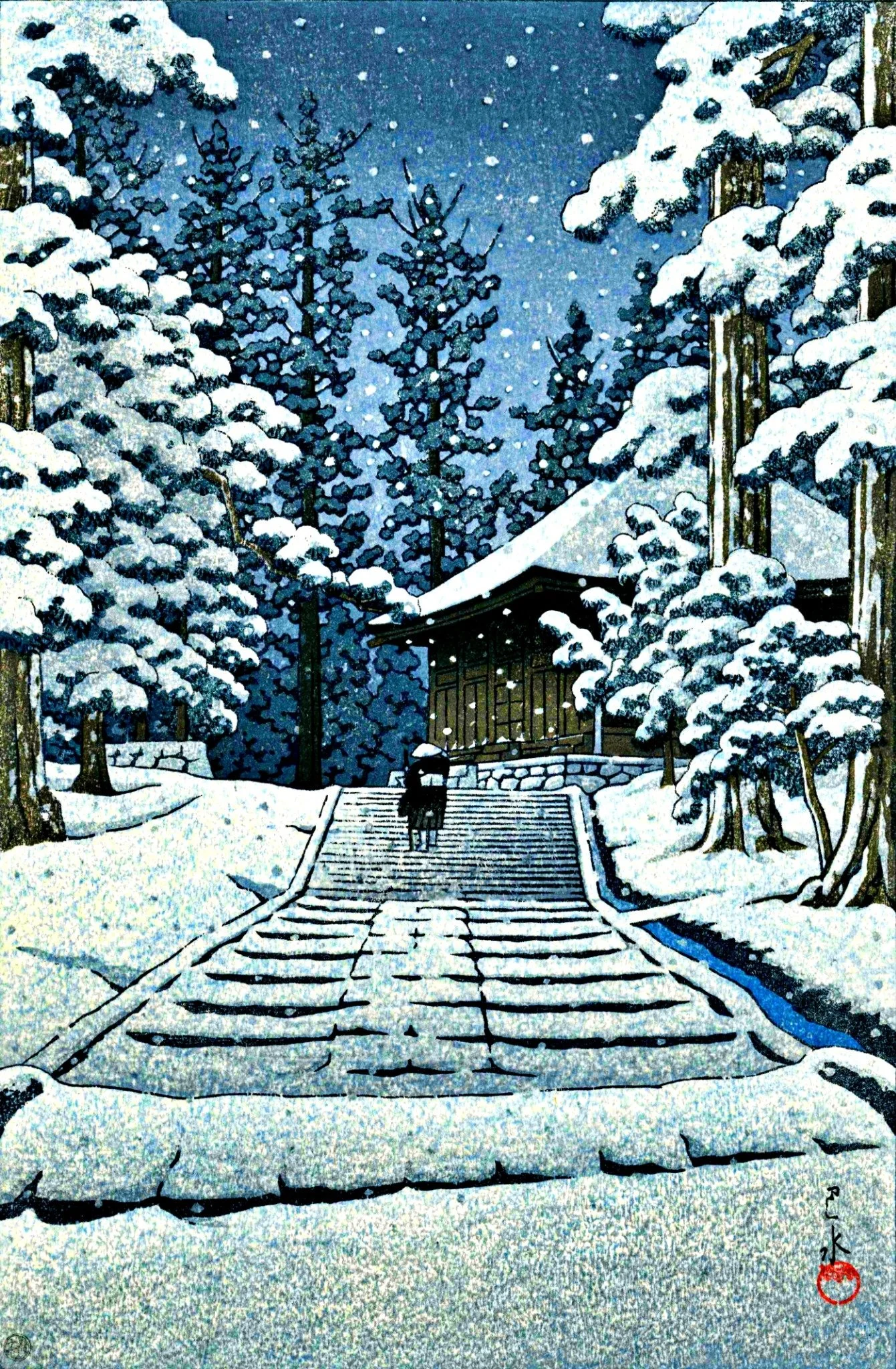
A lone traveler climbs snowy steps through tall, white-laden trees toward the shelter of a temple hall. Kawase Hasui’s Hall of Golden Hue, Hiraizumi brings the luminous stillness of winter into your home as a portrait canvas reproduction over a sturdy 1.5-inch wood stretcher.
Product details: Canvas reproduction over a sturdy 1.5-inch wood stretcher. Available in 16 × 24 in. ($259 CAD) and 24 × 36 in. ($299 CAD). No returns accepted.
More About the Art
Snow settles across the approach to Chūson-ji, turning stone steps, roofs, and branches into a continuous landscape of white. In Hall of Golden Hue, Hiraizumi, Kawase Hasui places the viewer at the foot of a long stairway, looking upward through tall trees toward a sheltered building. A solitary traveler makes the ascent. Around that small, dark figure, falling flakes drift against a blue sky and gather upon the surrounding evergreens.
The stairs give the composition its direction. Broad near the viewer, they narrow as they climb, their dark edges appearing beneath uneven layers of snow. Repeated horizontal lines establish a measured rhythm, leading the eye toward the traveler and the building beyond. The pale banks on either side soften the architecture of the approach, while a slender passage of blue along the right edge adds depth to the foreground.
Trees frame the ascent with a different kind of movement. Large trunks rise near the edges, their brown and dark green surfaces standing against the snow. Rounded white masses rest on the branches, while narrower trees farther away create an intricate pattern of silhouettes. Between them, the blue background gives the forest room to recede. Hasui allows the nearest branches to feel substantial without closing the view toward the upper steps.
The building appears above a low stone foundation, partly screened by trees. Its dark wooden panels and projecting eaves contrast with the thick snow along the roof. That combination gives the structure a reassuring presence within the winter scene. The traveler, seen from behind beneath a broad hat and dark cloak, introduces a human scale. The figure’s destination is clear, while personal identity remains open, encouraging the viewer to follow the same quiet path imaginatively.
The title refers to the celebrated Konjikidō at Chūson-ji in Hiraizumi, Iwate Prefecture. Completed in 1124, the small hall is dedicated to Amida Nyorai and is renowned for its gold-leaf decoration. The temple’s official history distinguishes that precious inner building from the protective outer hall that sheltered it against the weather. Hasui presents the snowy approach and sheltering exterior, preserving a sense of the sacred destination without revealing its gilded interior.
This colour woodblock design dates to 1957, Shōwa 32. Its Japanese title is Hiraizumi Konjiki-dō, 平泉金色堂, and the publisher was Watanabe Shōzaburō. Aichi Prefectural Museum of Art records the work under that date, and an official Takasaki exhibition checklist identifies both year and publisher. Within the image, the rich blue air and many shapes of white make snow feel active as well as settled: individual flakes pass before trees, roof, and traveler, joining every part of the scene.
This portrait canvas reproduction preserves the supplied composition, from the falling snow and highest branches to the broad steps in the foreground. Its quiet contrasts reward both distant and close viewing. White establishes the scene’s luminous presence; blue carries the surrounding air; dark lines reveal the path, trees, and shelter. The result is an invitation to pause at the threshold of a winter landscape, where human movement continues gently within the stillness of the forest.
More About the Artist
Kawase Hasui (1883–1957) gave Japanese landscape printmaking an enduring language of season, atmosphere, and quiet human presence. As a leading designer of shin-hanga, he worked with traditional woodblock techniques while exploring the changing appearance of familiar places. His landscapes range from urban canals and temple grounds to fishing villages and mountain roads. Hall of Golden Hue, Hiraizumi brings those interests together through a snowy ascent, a sheltering building, and a single traveler.
Born in Tokyo with the given name Bunjiro, Hasui studied Western-style painting under Okada Saburosuke before entering the studio of Kaburaki Kiyokata in 1910. This education brought different artistic approaches into conversation. His prints can combine clear outlines and strong decorative arrangements with subtle depth and carefully judged tonal relationships. In the Hiraizumi scene, the stairway establishes distance while the snow-laden branches create an intricate pattern across the vertical format.
Hasui’s association with the publisher Watanabe Shōzaburō was decisive. Watanabe issued his first landscape prints in 1918–19, beginning a collaboration that helped shape the shin-hanga movement. The term means “new prints,” reflecting an effort to renew Japanese woodblock printing for a contemporary audience. Hasui found a particularly expressive role within that renewal by attending to the feeling of a place under specific conditions of light, weather, and season.
The finished images depended on collaboration. A designer’s arrangement had to be translated into carved blocks and successive layers of printed colour, bringing the expertise of carvers and printers together with that of the publisher. The winter forest here shows the range such coordination could achieve: slender branches, heavy snow, fine architectural lines, and a broad blue atmosphere remain distinct while belonging to the same view. Their relationship gives the scene both clarity and softness.
Observation and travel supplied much of Hasui’s subject matter. He journeyed across Japan, sketching settings that included celebrated landmarks and quieter, less familiar places. His attention often rested on modest signs of daily life within a larger landscape. A person walking through snow, a small boat, or an illuminated window could give an expansive scene a human measure. The lone traveler at Hiraizumi serves that role without overwhelming the surrounding trees and falling flakes.
Hasui continued working through severe disruptions. The Great Kantō Earthquake of 1923 destroyed Watanabe’s premises, print stock, and woodblocks, while Hasui also lost sketchbooks. New designs followed, and his career continued after the Second World War. His output eventually exceeded six hundred print designs. Illustrations for magazines, menus, posters, and postcards further demonstrate the range of his work and the many ways his images reached viewers beyond the exhibition room.
In 1953, the production of Snow at Zōjōji Temple was documented by Japan’s Cultural Properties Protection Committee. That attention to the making of a woodblock image recognized the importance of its coordinated skills. Hall of Golden Hue, Hiraizumi dates to 1957, the year Hasui died, and belongs to the closing period of his career. It carries forward his sustained interest in the meeting of built places, natural conditions, and individual experience.
The image’s emotional presence emerges from that measured attention. The snowy stairway offers a direction, the traveler makes the distance tangible, and the building promises shelter beneath its white roof. Hasui leaves space for the viewer’s own response. His landscape remains rooted in a particular temple setting while opening into a broader experience of patience, solitude, and the quiet persistence of a journey.
Sources for the artwork and artist
Premium quality canvas print of “Hall of Golden Hue, Hiraizumi” by Kawase Hasui
A lone traveler climbs snowy steps through tall, white-laden trees toward the shelter of a temple hall. Kawase Hasui’s Hall of Golden Hue, Hiraizumi brings the luminous stillness of winter into your home as a portrait canvas reproduction over a sturdy 1.5-inch wood stretcher.
Product details: Canvas reproduction over a sturdy 1.5-inch wood stretcher. Available in 16 × 24 in. ($259 CAD) and 24 × 36 in. ($299 CAD). No returns accepted.
More About the Art
Snow settles across the approach to Chūson-ji, turning stone steps, roofs, and branches into a continuous landscape of white. In Hall of Golden Hue, Hiraizumi, Kawase Hasui places the viewer at the foot of a long stairway, looking upward through tall trees toward a sheltered building. A solitary traveler makes the ascent. Around that small, dark figure, falling flakes drift against a blue sky and gather upon the surrounding evergreens.
The stairs give the composition its direction. Broad near the viewer, they narrow as they climb, their dark edges appearing beneath uneven layers of snow. Repeated horizontal lines establish a measured rhythm, leading the eye toward the traveler and the building beyond. The pale banks on either side soften the architecture of the approach, while a slender passage of blue along the right edge adds depth to the foreground.
Trees frame the ascent with a different kind of movement. Large trunks rise near the edges, their brown and dark green surfaces standing against the snow. Rounded white masses rest on the branches, while narrower trees farther away create an intricate pattern of silhouettes. Between them, the blue background gives the forest room to recede. Hasui allows the nearest branches to feel substantial without closing the view toward the upper steps.
The building appears above a low stone foundation, partly screened by trees. Its dark wooden panels and projecting eaves contrast with the thick snow along the roof. That combination gives the structure a reassuring presence within the winter scene. The traveler, seen from behind beneath a broad hat and dark cloak, introduces a human scale. The figure’s destination is clear, while personal identity remains open, encouraging the viewer to follow the same quiet path imaginatively.
The title refers to the celebrated Konjikidō at Chūson-ji in Hiraizumi, Iwate Prefecture. Completed in 1124, the small hall is dedicated to Amida Nyorai and is renowned for its gold-leaf decoration. The temple’s official history distinguishes that precious inner building from the protective outer hall that sheltered it against the weather. Hasui presents the snowy approach and sheltering exterior, preserving a sense of the sacred destination without revealing its gilded interior.
This colour woodblock design dates to 1957, Shōwa 32. Its Japanese title is Hiraizumi Konjiki-dō, 平泉金色堂, and the publisher was Watanabe Shōzaburō. Aichi Prefectural Museum of Art records the work under that date, and an official Takasaki exhibition checklist identifies both year and publisher. Within the image, the rich blue air and many shapes of white make snow feel active as well as settled: individual flakes pass before trees, roof, and traveler, joining every part of the scene.
This portrait canvas reproduction preserves the supplied composition, from the falling snow and highest branches to the broad steps in the foreground. Its quiet contrasts reward both distant and close viewing. White establishes the scene’s luminous presence; blue carries the surrounding air; dark lines reveal the path, trees, and shelter. The result is an invitation to pause at the threshold of a winter landscape, where human movement continues gently within the stillness of the forest.
More About the Artist
Kawase Hasui (1883–1957) gave Japanese landscape printmaking an enduring language of season, atmosphere, and quiet human presence. As a leading designer of shin-hanga, he worked with traditional woodblock techniques while exploring the changing appearance of familiar places. His landscapes range from urban canals and temple grounds to fishing villages and mountain roads. Hall of Golden Hue, Hiraizumi brings those interests together through a snowy ascent, a sheltering building, and a single traveler.
Born in Tokyo with the given name Bunjiro, Hasui studied Western-style painting under Okada Saburosuke before entering the studio of Kaburaki Kiyokata in 1910. This education brought different artistic approaches into conversation. His prints can combine clear outlines and strong decorative arrangements with subtle depth and carefully judged tonal relationships. In the Hiraizumi scene, the stairway establishes distance while the snow-laden branches create an intricate pattern across the vertical format.
Hasui’s association with the publisher Watanabe Shōzaburō was decisive. Watanabe issued his first landscape prints in 1918–19, beginning a collaboration that helped shape the shin-hanga movement. The term means “new prints,” reflecting an effort to renew Japanese woodblock printing for a contemporary audience. Hasui found a particularly expressive role within that renewal by attending to the feeling of a place under specific conditions of light, weather, and season.
The finished images depended on collaboration. A designer’s arrangement had to be translated into carved blocks and successive layers of printed colour, bringing the expertise of carvers and printers together with that of the publisher. The winter forest here shows the range such coordination could achieve: slender branches, heavy snow, fine architectural lines, and a broad blue atmosphere remain distinct while belonging to the same view. Their relationship gives the scene both clarity and softness.
Observation and travel supplied much of Hasui’s subject matter. He journeyed across Japan, sketching settings that included celebrated landmarks and quieter, less familiar places. His attention often rested on modest signs of daily life within a larger landscape. A person walking through snow, a small boat, or an illuminated window could give an expansive scene a human measure. The lone traveler at Hiraizumi serves that role without overwhelming the surrounding trees and falling flakes.
Hasui continued working through severe disruptions. The Great Kantō Earthquake of 1923 destroyed Watanabe’s premises, print stock, and woodblocks, while Hasui also lost sketchbooks. New designs followed, and his career continued after the Second World War. His output eventually exceeded six hundred print designs. Illustrations for magazines, menus, posters, and postcards further demonstrate the range of his work and the many ways his images reached viewers beyond the exhibition room.
In 1953, the production of Snow at Zōjōji Temple was documented by Japan’s Cultural Properties Protection Committee. That attention to the making of a woodblock image recognized the importance of its coordinated skills. Hall of Golden Hue, Hiraizumi dates to 1957, the year Hasui died, and belongs to the closing period of his career. It carries forward his sustained interest in the meeting of built places, natural conditions, and individual experience.
The image’s emotional presence emerges from that measured attention. The snowy stairway offers a direction, the traveler makes the distance tangible, and the building promises shelter beneath its white roof. Hasui leaves space for the viewer’s own response. His landscape remains rooted in a particular temple setting while opening into a broader experience of patience, solitude, and the quiet persistence of a journey.
Sources for the artwork and artist