
 Image 1 of 4
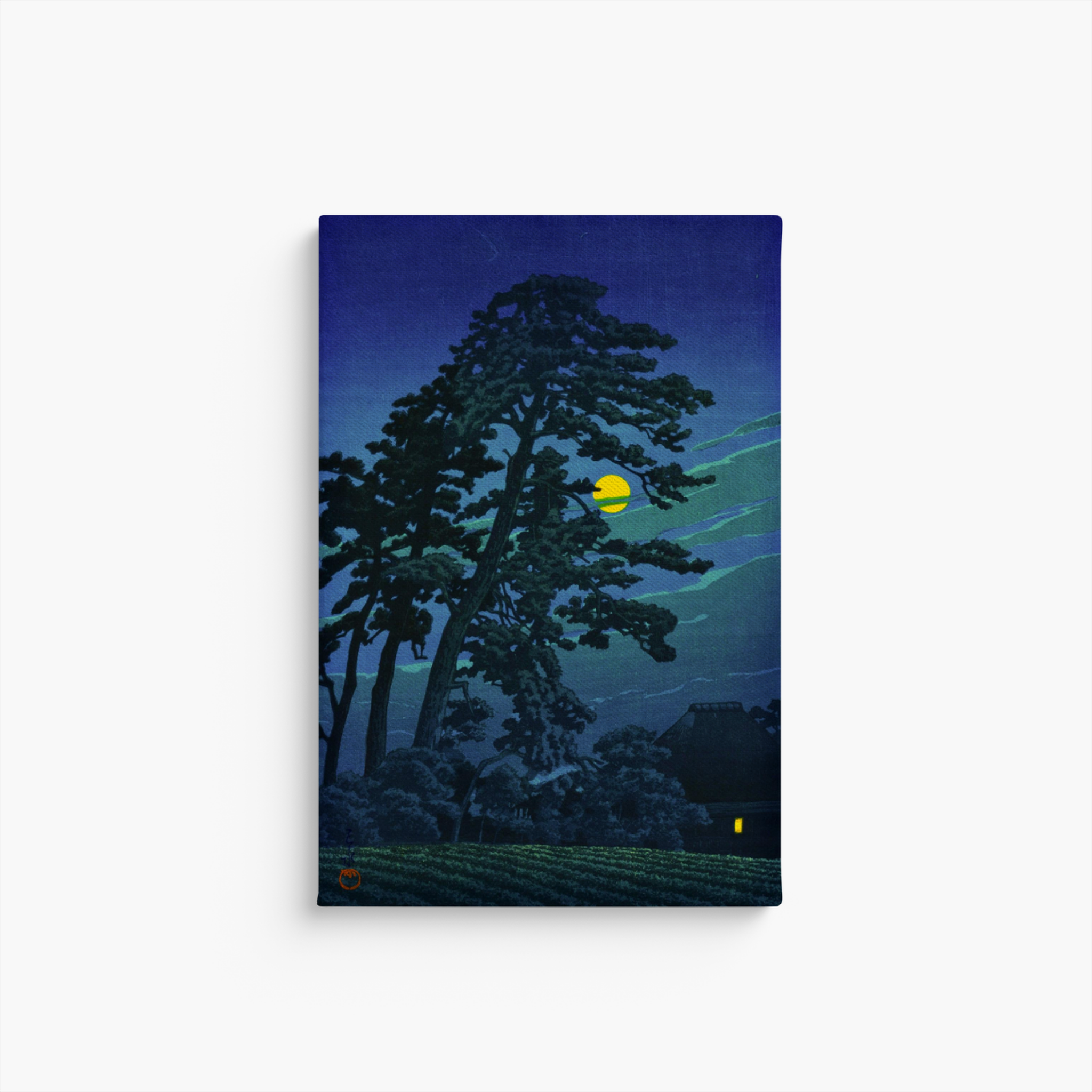 Image 2 of 4
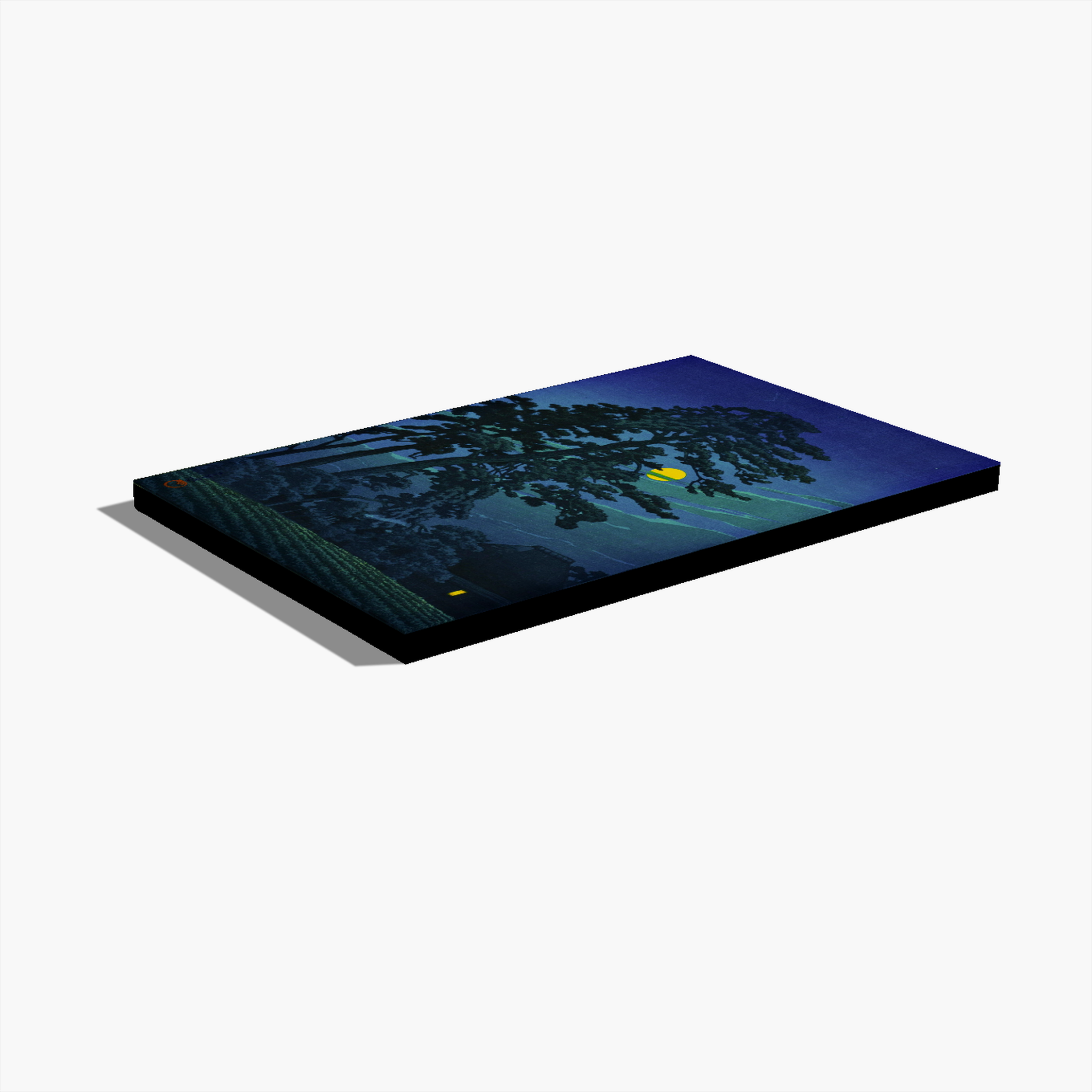 Image 3 of 4
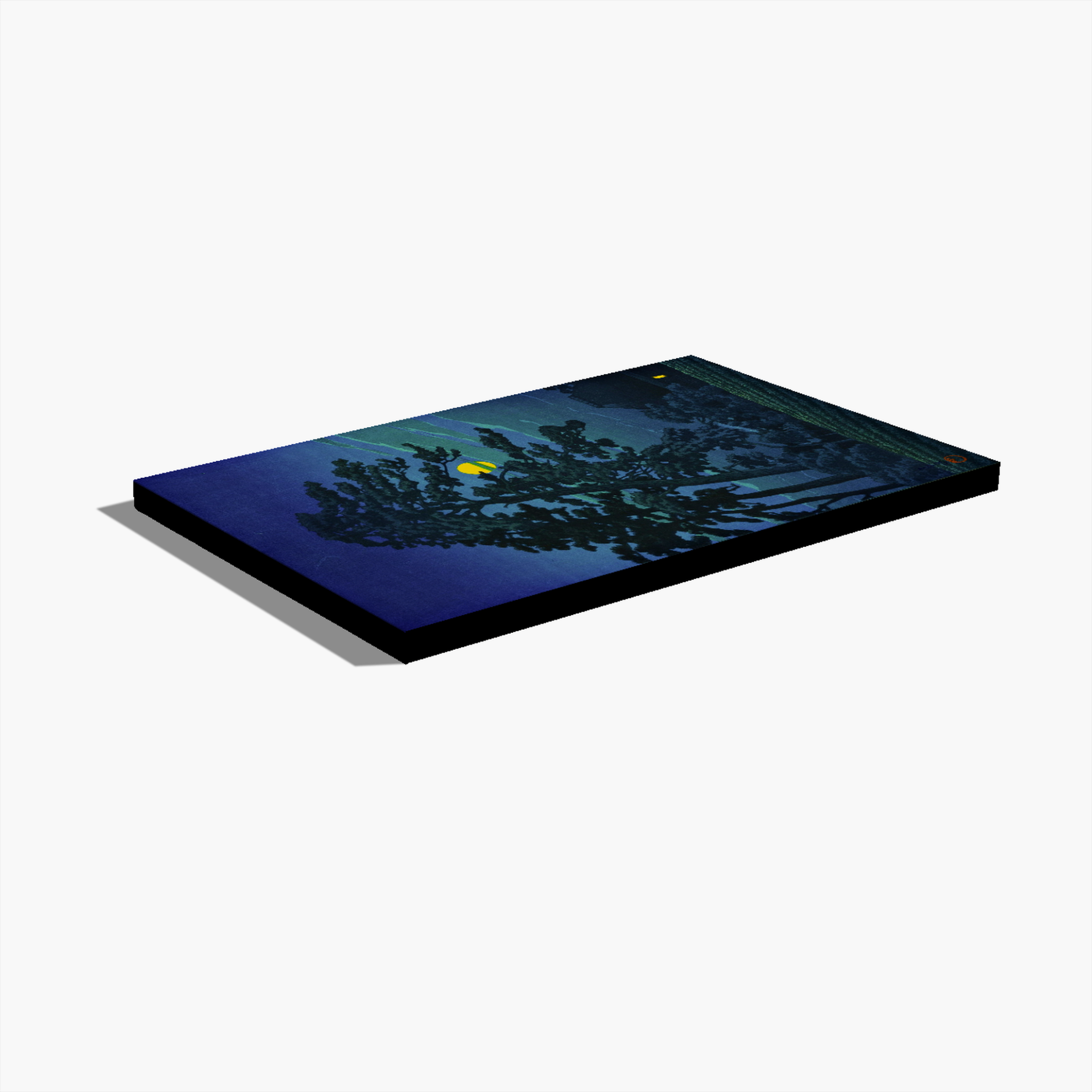 Image 4 of 4
Kawase Hasui’s “Full Moon at Magome” (1930)
Premium quality canvas reproduction of Kawase Hasui’s “Full Moon at Magome” (1930)
Bring the quiet of a moonlit landscape into your room. In Kawase Hasui’s Full Moon at Magome, a golden moon shines between spreading pine branches, while a small illuminated window answers it below. Reproduced on canvas over a sturdy 1.5-inch wood stretcher, this richly coloured night scene gives a space depth and a warm point of light.
Product details: Canvas reproduction over a sturdy 1.5-inch wood stretcher. Available in 16 × 24 in. ($259 CAD) and 24 × 36 in. ($299 CAD). No returns accepted.
More About the Art:
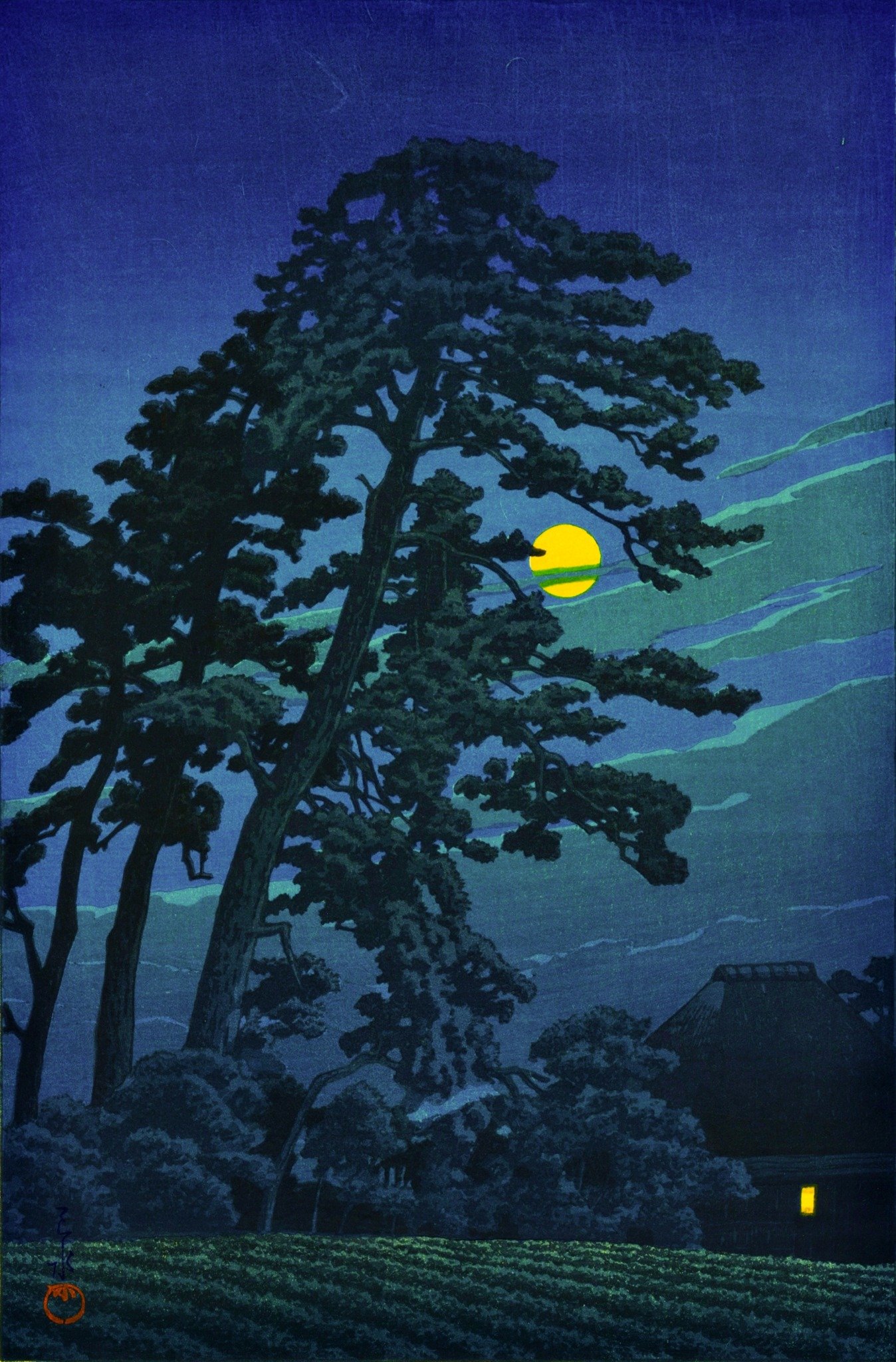
Full Moon at Magome is built around the imposing shape of a pine tree. Its trunk rises through the centre-left of the picture, leaning slightly as it divides into long, irregular branches. Dense clusters of needles spread across the sky, with narrow openings revealing blue between them. Smaller trunks and branches gather beside it, turning the trees into a layered foreground that feels both substantial and intricate.
The sky deepens from a lighter blue near the trees into a rich, almost violet blue above them. Across its lower part, pale green-grey cloud bands stretch toward the right edge. Their long, flowing shapes pass behind the branches and cross the face of the moon. These strips of lighter colour introduce a horizontal rhythm within a composition otherwise dominated by rising trunks and the height of the trees.
The moon is a brilliant yellow disc to the right of the main trunk. One branch touches its edge, and a cloud cuts across its lower portion, making the circle appear suspended among several overlapping forms. Its strong, simple colour gives the eye an immediate place to rest. From there, the smaller details of the foliage become easier to notice against the surrounding blue.
Near the bottom right, a farmhouse emerges from the darkness. Its steep roof has a broad, weighty silhouette, while the walls beneath it are barely separated from the shrubs. A single narrow window glows yellow. The relationship between that small rectangle and the moon gives the view much of its warmth: two lights at very different scales connect the open sky with a sheltered domestic space.
The lower edge of the image is filled with a textured green field. Repeated bands and small marks create a surface that contrasts with the broad areas of sky. Above it, rounded shrubs and low branches overlap in several shades of blue-green. These quieter details keep the darker portion of the picture active, encouraging a closer look after the bright moon has first attracted attention.
The portrait format allows the scene to unfold gradually from ground to sky. Looking upward, the field leads into tangled foliage, then along the pine’s trunk and outward through its spreading crown. Looking down from the moon, the clouds guide attention toward the farmhouse. Both routes reveal a composition with a clear overall shape and smaller relationships that become apparent with time.
The original woodblock design dates to 1930 and belongs to Hasui’s Twenty Views of Tokyo, also known as Tokyo Nijūkei. Museum records identify the work as Moon at Magome, or Magome no tsuki, and name Watanabe Shōzaburō as its publisher. UnitedArts presents the image here as a canvas reproduction; the historical design date does not describe when this new canvas was made.
On a wall, the broad blues and dark greens can create a calm focal point, while the yellow accents keep the image lively. The tall proportions suit a space where the upward movement of the trees can be appreciated. Canvas over a 1.5-inch wood stretcher gives the scene physical depth, inviting both an across-the-room view and a closer examination of its branches, cloud bands and field.
More About the Artist:
Kawase Hasui (1883–1957) was a Japanese artist best known for landscape prints that make weather and light central to the experience of a place. Born Kawase Bunjirō in Tokyo, he grew up in a family whose business dealt in silk braid. He received painting instruction while young, but could pursue art full time only after the family business passed to a relative in 1908. His early path combined artistic study with the practical obligations of family life.
His training crossed more than one approach to painting. He studied Western-style art under Okada Saburōsuke and, in 1910, became a pupil of Kaburaki Kiyokata, who gave him the name Hasui. This background brought him into contact with both Japanese pictorial traditions and Western methods of representing a landscape. His later prints make room for carefully described depth and light within the clear outlines and organised colour areas of a woodblock image.
Through Kiyokata, Hasui came to the attention of the publisher Watanabe Shōzaburō, who began publishing his landscape prints in 1918–19. Watanabe was a central supporter of shin-hanga, or “new prints,” a movement that renewed Japanese woodblock production for modern audiences. Their collaboration became a major part of Hasui’s career and helped bring his images to viewers beyond Japan. Travel scenes and views of Tokyo were important subjects within this work.
Making these prints required several kinds of expertise. Hasui supplied the design; specialist carvers translated it into woodblocks, and professional printers produced the finished impressions. The National Galleries of Scotland describes this division of work in its account of his Shin Ōhashi Bridge. Knowing that process adds another dimension to looking: a seemingly effortless passage of rain, shadow or reflected light emerged from an exchange between the artist’s image and the skills of other makers.
Travel was a continuing source of subjects. As the Sompo Museum of Art’s retrospective explains, Hasui depicted Japan through its changing seasons, including sun, clouds and rain, while looking toward places that carried a sense of an older landscape. His views invite attention to the particular conditions of an encounter: the way a roof appears beneath snow, how distant forms soften in the air, or how a small light changes a darkened setting.
His own remarks help explain how observation became an image. In a commentary accompanying a preparatory watercolour, the Cleveland Museum of Art records Hasui’s emphasis on working from reality, while allowing himself to simplify what he saw. He remembered the light and colour present when sketching and considered their eventual effect in a woodblock print as he developed the image. This was a process of selection and translation: the observed scene was shaped for the particular possibilities of another medium.
That attention to atmosphere connects Hasui with a wider development in modern Japanese prints. The Smithsonian’s account of this period describes an increasing interest in the character of light and the mood of a place, especially in night scenes. Full Moon at Magome offers a clear example to consider: its pines establish a strong dark structure, while a yellow moon and a much smaller window light change the feeling of the entire view.
This landscape also connects a widely travelling artist with a place he knew as home. Tokyo Fuji Art Museum notes that Hasui moved to Magome in 1930, the year of the design, and identifies the three pines as a familiar local landmark. Within Twenty Views of Tokyo, the scene draws attention to trees, a field and a farmhouse. Its subject offers an intimate way to encounter a place through ordinary features of its surroundings.
For a present-day viewer, Hasui’s landscapes offer a way to notice light more attentively. The same tree can feel different against a bright sky or at night; a small window can change our sense of the building around it. In Full Moon at Magome, the space between branches, the shape of a passing cloud and the two yellow lights invite that kind of looking. It is a view whose broad stillness leaves room for many small discoveries.
Sources
Spencer Museum of Art — Moon at Magome, 1930, Twenty Views of Tokyo
Carnegie Museum of Art — Moon at Magome, publisher and medium record
Tokyo Fuji Art Museum — Moon at Magome, artist biography and local context
National Galleries of Scotland — Shin Ōhashi Bridge and the collaborative woodblock process
Sompo Museum of Art — Kawase Hasui: Travel and nostalgic landscape
Cleveland Museum of Art — Snow at Zojoji Temple, preparatory watercolour and Hasui’s working method
Smithsonian National Museum of Asian Art — The Quality of Light
Premium quality canvas reproduction of Kawase Hasui’s “Full Moon at Magome” (1930)
Bring the quiet of a moonlit landscape into your room. In Kawase Hasui’s Full Moon at Magome, a golden moon shines between spreading pine branches, while a small illuminated window answers it below. Reproduced on canvas over a sturdy 1.5-inch wood stretcher, this richly coloured night scene gives a space depth and a warm point of light.
Product details: Canvas reproduction over a sturdy 1.5-inch wood stretcher. Available in 16 × 24 in. ($259 CAD) and 24 × 36 in. ($299 CAD). No returns accepted.
More About the Art:
Full Moon at Magome is built around the imposing shape of a pine tree. Its trunk rises through the centre-left of the picture, leaning slightly as it divides into long, irregular branches. Dense clusters of needles spread across the sky, with narrow openings revealing blue between them. Smaller trunks and branches gather beside it, turning the trees into a layered foreground that feels both substantial and intricate.
The sky deepens from a lighter blue near the trees into a rich, almost violet blue above them. Across its lower part, pale green-grey cloud bands stretch toward the right edge. Their long, flowing shapes pass behind the branches and cross the face of the moon. These strips of lighter colour introduce a horizontal rhythm within a composition otherwise dominated by rising trunks and the height of the trees.
The moon is a brilliant yellow disc to the right of the main trunk. One branch touches its edge, and a cloud cuts across its lower portion, making the circle appear suspended among several overlapping forms. Its strong, simple colour gives the eye an immediate place to rest. From there, the smaller details of the foliage become easier to notice against the surrounding blue.
Near the bottom right, a farmhouse emerges from the darkness. Its steep roof has a broad, weighty silhouette, while the walls beneath it are barely separated from the shrubs. A single narrow window glows yellow. The relationship between that small rectangle and the moon gives the view much of its warmth: two lights at very different scales connect the open sky with a sheltered domestic space.
The lower edge of the image is filled with a textured green field. Repeated bands and small marks create a surface that contrasts with the broad areas of sky. Above it, rounded shrubs and low branches overlap in several shades of blue-green. These quieter details keep the darker portion of the picture active, encouraging a closer look after the bright moon has first attracted attention.
The portrait format allows the scene to unfold gradually from ground to sky. Looking upward, the field leads into tangled foliage, then along the pine’s trunk and outward through its spreading crown. Looking down from the moon, the clouds guide attention toward the farmhouse. Both routes reveal a composition with a clear overall shape and smaller relationships that become apparent with time.
The original woodblock design dates to 1930 and belongs to Hasui’s Twenty Views of Tokyo, also known as Tokyo Nijūkei. Museum records identify the work as Moon at Magome, or Magome no tsuki, and name Watanabe Shōzaburō as its publisher. UnitedArts presents the image here as a canvas reproduction; the historical design date does not describe when this new canvas was made.
On a wall, the broad blues and dark greens can create a calm focal point, while the yellow accents keep the image lively. The tall proportions suit a space where the upward movement of the trees can be appreciated. Canvas over a 1.5-inch wood stretcher gives the scene physical depth, inviting both an across-the-room view and a closer examination of its branches, cloud bands and field.
More About the Artist:
Kawase Hasui (1883–1957) was a Japanese artist best known for landscape prints that make weather and light central to the experience of a place. Born Kawase Bunjirō in Tokyo, he grew up in a family whose business dealt in silk braid. He received painting instruction while young, but could pursue art full time only after the family business passed to a relative in 1908. His early path combined artistic study with the practical obligations of family life.
His training crossed more than one approach to painting. He studied Western-style art under Okada Saburōsuke and, in 1910, became a pupil of Kaburaki Kiyokata, who gave him the name Hasui. This background brought him into contact with both Japanese pictorial traditions and Western methods of representing a landscape. His later prints make room for carefully described depth and light within the clear outlines and organised colour areas of a woodblock image.
Through Kiyokata, Hasui came to the attention of the publisher Watanabe Shōzaburō, who began publishing his landscape prints in 1918–19. Watanabe was a central supporter of shin-hanga, or “new prints,” a movement that renewed Japanese woodblock production for modern audiences. Their collaboration became a major part of Hasui’s career and helped bring his images to viewers beyond Japan. Travel scenes and views of Tokyo were important subjects within this work.
Making these prints required several kinds of expertise. Hasui supplied the design; specialist carvers translated it into woodblocks, and professional printers produced the finished impressions. The National Galleries of Scotland describes this division of work in its account of his Shin Ōhashi Bridge. Knowing that process adds another dimension to looking: a seemingly effortless passage of rain, shadow or reflected light emerged from an exchange between the artist’s image and the skills of other makers.
Travel was a continuing source of subjects. As the Sompo Museum of Art’s retrospective explains, Hasui depicted Japan through its changing seasons, including sun, clouds and rain, while looking toward places that carried a sense of an older landscape. His views invite attention to the particular conditions of an encounter: the way a roof appears beneath snow, how distant forms soften in the air, or how a small light changes a darkened setting.
His own remarks help explain how observation became an image. In a commentary accompanying a preparatory watercolour, the Cleveland Museum of Art records Hasui’s emphasis on working from reality, while allowing himself to simplify what he saw. He remembered the light and colour present when sketching and considered their eventual effect in a woodblock print as he developed the image. This was a process of selection and translation: the observed scene was shaped for the particular possibilities of another medium.
That attention to atmosphere connects Hasui with a wider development in modern Japanese prints. The Smithsonian’s account of this period describes an increasing interest in the character of light and the mood of a place, especially in night scenes. Full Moon at Magome offers a clear example to consider: its pines establish a strong dark structure, while a yellow moon and a much smaller window light change the feeling of the entire view.
This landscape also connects a widely travelling artist with a place he knew as home. Tokyo Fuji Art Museum notes that Hasui moved to Magome in 1930, the year of the design, and identifies the three pines as a familiar local landmark. Within Twenty Views of Tokyo, the scene draws attention to trees, a field and a farmhouse. Its subject offers an intimate way to encounter a place through ordinary features of its surroundings.
For a present-day viewer, Hasui’s landscapes offer a way to notice light more attentively. The same tree can feel different against a bright sky or at night; a small window can change our sense of the building around it. In Full Moon at Magome, the space between branches, the shape of a passing cloud and the two yellow lights invite that kind of looking. It is a view whose broad stillness leaves room for many small discoveries.
Sources
Spencer Museum of Art — Moon at Magome, 1930, Twenty Views of Tokyo
Carnegie Museum of Art — Moon at Magome, publisher and medium record
Tokyo Fuji Art Museum — Moon at Magome, artist biography and local context
National Galleries of Scotland — Shin Ōhashi Bridge and the collaborative woodblock process
Sompo Museum of Art — Kawase Hasui: Travel and nostalgic landscape
Cleveland Museum of Art — Snow at Zojoji Temple, preparatory watercolour and Hasui’s working method
Smithsonian National Museum of Asian Art — The Quality of Light