

 Image 1 of 1
First Wind — Katsuyuki Nishijima (1986)
Premium quality canvas print of “First Wind” by Katsuyuki Nishijima
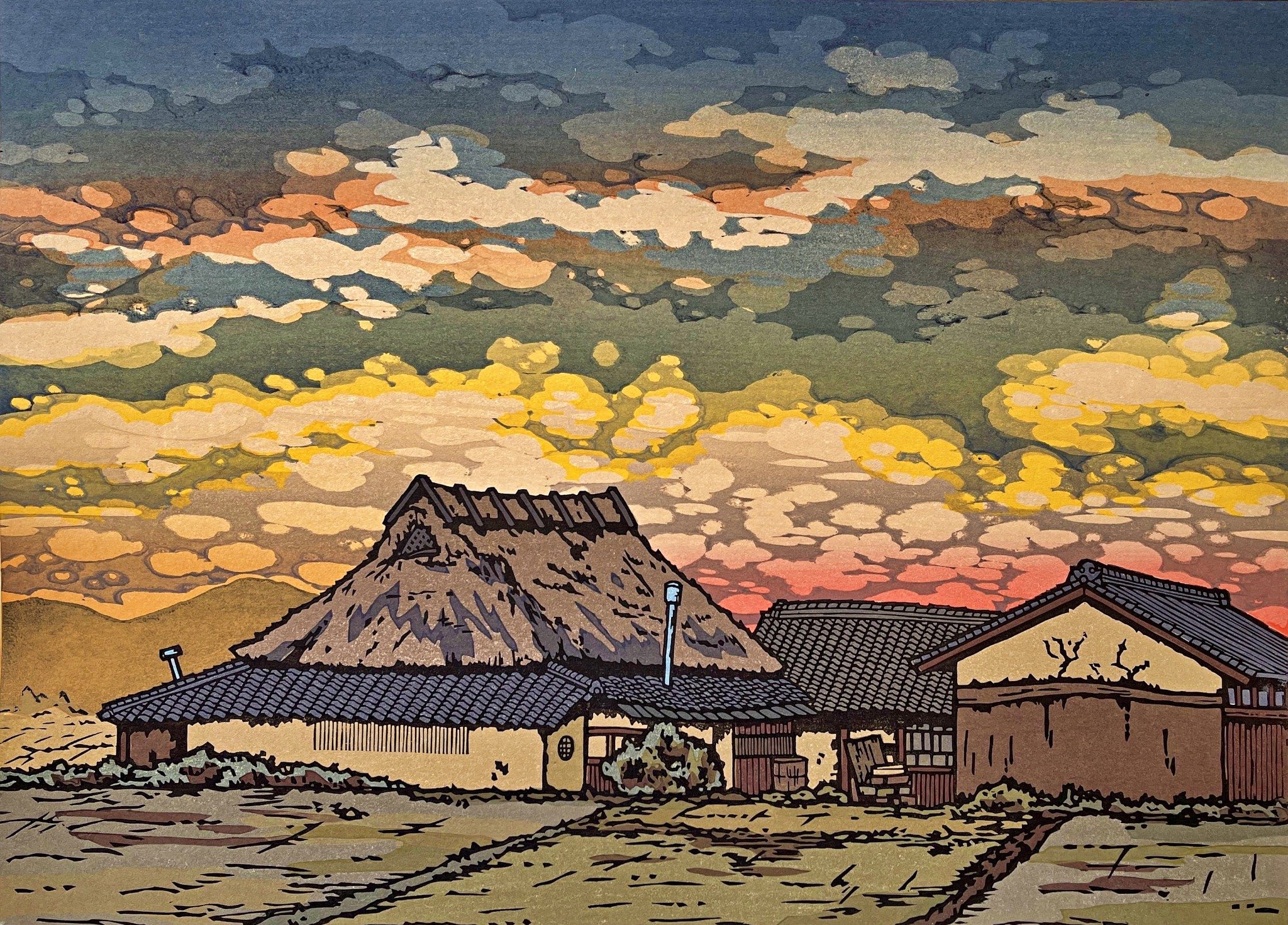
Layered clouds in gold, coral, and blue-grey sweep above traditional tiled roofs and a thatched farmhouse. Katsuyuki Nishijima’s First Wind brings an expressive evening sky to a landscape canvas reproduction over a sturdy 1.5-inch wood stretcher.
Product details: Canvas reproduction over a sturdy 1.5-inch wood stretcher. Available in 24 × 16 in. ($259 CAD) and 36 × 24 in. ($299 CAD). No returns accepted.
More About the Art
A great expanse of cloud rises above traditional buildings in First Wind. Gold, pale cream, coral, muted green, and blue-grey spread across the sky in overlapping shapes. Beneath them, a thatched farmhouse stands among lower tiled roofs and pale walls. The foreground remains open, marked by dark lines and small patches of vegetation. The image makes the sky unusually prominent while keeping the settlement firmly grounded along the lower part of the composition.
The design is attributed to Katsuyuki Nishijima and is also known by its Japanese title Hatsukaze. An Artelino record reproduced by Ukiyo-e Search dates it to 1986 and connects its title with a strong wind moving through evening clouds. That description provides a useful setting for what is visible here: an unsettled sky above buildings that remain substantial and still. The contrast is conveyed through shape and colour rather than through bending trees or human figures.
The central farmhouse has a broad thatched roof with a steep upper profile. Short dark strokes describe its surface, while heavier outlines define the eaves. In front, a lower tiled roof introduces a tighter, more regular pattern. These different textures help distinguish neighbouring structures that might otherwise merge. A narrow chimney and small openings provide further points of detail, giving the buildings a convincing sense of construction and use.
To the right, a pale gable and tiled roof form a second strong architectural shape. Dark framing divides its surfaces, while irregular marks suggest an aged exterior. Between the buildings, a small passage and clustered objects create a pocket of depth. The picture does not need a clearly marked road or a visible occupant to imply an inhabited place. Its doors, walls, and rooflines provide enough evidence of ordinary life continuing beneath the expansive sky.
The cloud shapes are much less regular. Some are outlined firmly, while others merge through neighbouring colours. Warm bands gather near the roofline and toward the middle of the sky; cooler tones deepen above them. The repeated, rounded forms suggest continual movement. Looking from one cloud to another carries the eye across almost the full width of the image, making the sky feel larger than the group of buildings below.
The lower ground offers a quieter pattern. Dark lines and broad patches of muted colour break its surface, while low plants gather against the walls. This comparatively open foreground gives the architecture room and prevents the densely patterned sky from overwhelming the whole picture. Its horizontal spread also echoes the long rooflines, establishing a steady base beneath the changing cloud shapes.
This landscape canvas reproduction preserves the supplied composition, including the generous sky and the entire cluster of traditional buildings. The warm colours give the work an inviting presence, while the cooler cloud layers retain the complexity of an unsettled evening. At closer range, the thatch, roof tiles, and wall details offer a second scale of interest. First Wind brings those experiences together: a moment of atmospheric change is held above the enduring shapes of a familiar rural setting.
More About the Artist
Katsuyuki Nishijima, born in Yamaguchi Prefecture in 1945, is a Japanese woodblock printmaker whose work brings close attention to traditional buildings and the landscapes around them. His subjects include shopfronts, tiled roofs, thatched farmhouses, waterways, and quiet stretches of town. Strong outlines and broad areas of colour give these familiar places an immediate presence. Small variations within roofs, walls, foliage, and sky then invite a slower kind of looking, revealing how much visual interest can be held within an apparently modest scene.
Nishijima trained at the Mikumo publishing house in Kyoto between 1964 and 1968. This period gave him sustained experience of woodblock printmaking and its practical demands. A print develops through the relationship between a design, the carved surfaces that carry it, and the colours transferred to paper. Learning that relationship requires attention to both the whole composition and the smallest marks. His later images show a particularly clear understanding of how large colour shapes and fine linear details can support one another.
During the second half of the 1960s, he exhibited with the Kyoto Independents. He also explored stencil dyeing and printing, especially between 1969 and 1972. From 1972, traditional architecture became a central subject in his limited edition woodblocks. His series include views associated with the Sixty-Nine Stations of the Kisokaidō and scenes of Kyoto streets. These projects place everyday buildings within a continuing Japanese tradition of looking closely at roads, settlements, and the distinctive appearance of particular places.
Nishijima's practice is associated with sōsaku-hanga, often translated as creative prints. This approach places the artist at the centre of designing, carving, and printing. The Philbrook Museum of Art describes the individual command of these stages as an essential quality of his work. His pictures therefore belong to a tradition in which the marks of the image emerge through an artist's sustained engagement with the material process, from the decisions of the initial design to the pressure and colour of the printed impression.
Traditional architecture offers him a remarkably varied visual language. Roof tiles can become closely repeated dark strokes; a plaster wall can provide a broad interval of light; wooden frames can divide a facade into strong geometric shapes. A street or bank may lead the eye into depth, while an overhanging tree closes part of the view. These are qualities visible across his work, and they help explain why a building or quiet landscape can carry a composition without relying on a dramatic event.
Human presence is often suggested through inhabited structures and traces of use. A doorway, a roofline, or a boat can give a setting a sense of ordinary life even when no figure occupies the scene. Nishijima's landscapes can be enjoyed both as recognizable places and as arrangements of colour and line. The two experiences reinforce each other: close looking makes the construction of the picture clearer, while also making the setting feel more particular. His woodblocks are represented in museum collections in Japan and abroad, including American institutions identified by the Philbrook Museum.
Premium quality canvas print of “First Wind” by Katsuyuki Nishijima
Layered clouds in gold, coral, and blue-grey sweep above traditional tiled roofs and a thatched farmhouse. Katsuyuki Nishijima’s First Wind brings an expressive evening sky to a landscape canvas reproduction over a sturdy 1.5-inch wood stretcher.
Product details: Canvas reproduction over a sturdy 1.5-inch wood stretcher. Available in 24 × 16 in. ($259 CAD) and 36 × 24 in. ($299 CAD). No returns accepted.
More About the Art
A great expanse of cloud rises above traditional buildings in First Wind. Gold, pale cream, coral, muted green, and blue-grey spread across the sky in overlapping shapes. Beneath them, a thatched farmhouse stands among lower tiled roofs and pale walls. The foreground remains open, marked by dark lines and small patches of vegetation. The image makes the sky unusually prominent while keeping the settlement firmly grounded along the lower part of the composition.
The design is attributed to Katsuyuki Nishijima and is also known by its Japanese title Hatsukaze. An Artelino record reproduced by Ukiyo-e Search dates it to 1986 and connects its title with a strong wind moving through evening clouds. That description provides a useful setting for what is visible here: an unsettled sky above buildings that remain substantial and still. The contrast is conveyed through shape and colour rather than through bending trees or human figures.
The central farmhouse has a broad thatched roof with a steep upper profile. Short dark strokes describe its surface, while heavier outlines define the eaves. In front, a lower tiled roof introduces a tighter, more regular pattern. These different textures help distinguish neighbouring structures that might otherwise merge. A narrow chimney and small openings provide further points of detail, giving the buildings a convincing sense of construction and use.
To the right, a pale gable and tiled roof form a second strong architectural shape. Dark framing divides its surfaces, while irregular marks suggest an aged exterior. Between the buildings, a small passage and clustered objects create a pocket of depth. The picture does not need a clearly marked road or a visible occupant to imply an inhabited place. Its doors, walls, and rooflines provide enough evidence of ordinary life continuing beneath the expansive sky.
The cloud shapes are much less regular. Some are outlined firmly, while others merge through neighbouring colours. Warm bands gather near the roofline and toward the middle of the sky; cooler tones deepen above them. The repeated, rounded forms suggest continual movement. Looking from one cloud to another carries the eye across almost the full width of the image, making the sky feel larger than the group of buildings below.
The lower ground offers a quieter pattern. Dark lines and broad patches of muted colour break its surface, while low plants gather against the walls. This comparatively open foreground gives the architecture room and prevents the densely patterned sky from overwhelming the whole picture. Its horizontal spread also echoes the long rooflines, establishing a steady base beneath the changing cloud shapes.
This landscape canvas reproduction preserves the supplied composition, including the generous sky and the entire cluster of traditional buildings. The warm colours give the work an inviting presence, while the cooler cloud layers retain the complexity of an unsettled evening. At closer range, the thatch, roof tiles, and wall details offer a second scale of interest. First Wind brings those experiences together: a moment of atmospheric change is held above the enduring shapes of a familiar rural setting.
More About the Artist
Katsuyuki Nishijima, born in Yamaguchi Prefecture in 1945, is a Japanese woodblock printmaker whose work brings close attention to traditional buildings and the landscapes around them. His subjects include shopfronts, tiled roofs, thatched farmhouses, waterways, and quiet stretches of town. Strong outlines and broad areas of colour give these familiar places an immediate presence. Small variations within roofs, walls, foliage, and sky then invite a slower kind of looking, revealing how much visual interest can be held within an apparently modest scene.
Nishijima trained at the Mikumo publishing house in Kyoto between 1964 and 1968. This period gave him sustained experience of woodblock printmaking and its practical demands. A print develops through the relationship between a design, the carved surfaces that carry it, and the colours transferred to paper. Learning that relationship requires attention to both the whole composition and the smallest marks. His later images show a particularly clear understanding of how large colour shapes and fine linear details can support one another.
During the second half of the 1960s, he exhibited with the Kyoto Independents. He also explored stencil dyeing and printing, especially between 1969 and 1972. From 1972, traditional architecture became a central subject in his limited edition woodblocks. His series include views associated with the Sixty-Nine Stations of the Kisokaidō and scenes of Kyoto streets. These projects place everyday buildings within a continuing Japanese tradition of looking closely at roads, settlements, and the distinctive appearance of particular places.
Nishijima's practice is associated with sōsaku-hanga, often translated as creative prints. This approach places the artist at the centre of designing, carving, and printing. The Philbrook Museum of Art describes the individual command of these stages as an essential quality of his work. His pictures therefore belong to a tradition in which the marks of the image emerge through an artist's sustained engagement with the material process, from the decisions of the initial design to the pressure and colour of the printed impression.
Traditional architecture offers him a remarkably varied visual language. Roof tiles can become closely repeated dark strokes; a plaster wall can provide a broad interval of light; wooden frames can divide a facade into strong geometric shapes. A street or bank may lead the eye into depth, while an overhanging tree closes part of the view. These are qualities visible across his work, and they help explain why a building or quiet landscape can carry a composition without relying on a dramatic event.
Human presence is often suggested through inhabited structures and traces of use. A doorway, a roofline, or a boat can give a setting a sense of ordinary life even when no figure occupies the scene. Nishijima's landscapes can be enjoyed both as recognizable places and as arrangements of colour and line. The two experiences reinforce each other: close looking makes the construction of the picture clearer, while also making the setting feel more particular. His woodblocks are represented in museum collections in Japan and abroad, including American institutions identified by the Philbrook Museum.