

 Image 1 of 1
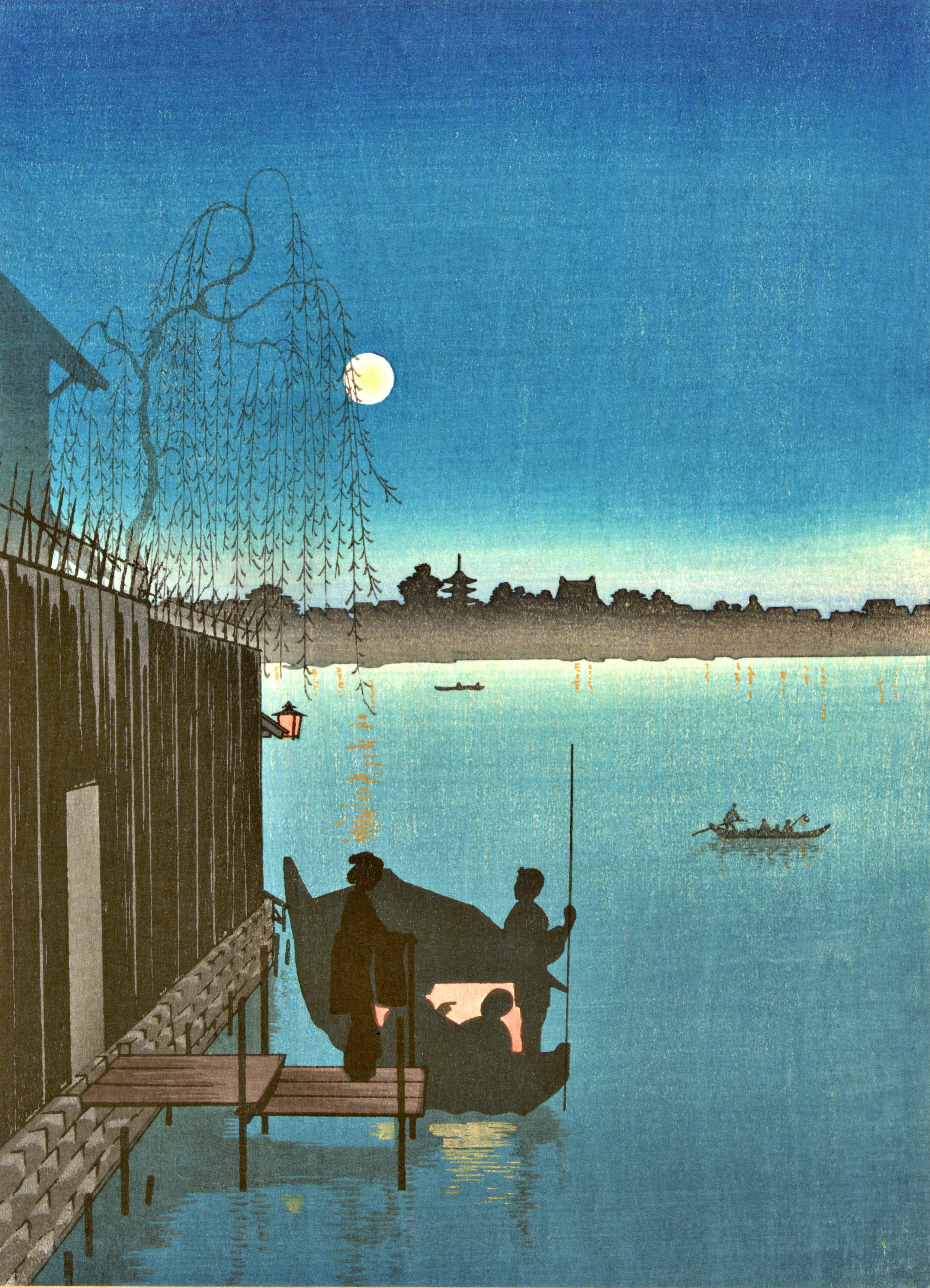
Evening Cool at Sumida — Eijirō Kobayashi (c. 1900–1920)
Premium quality canvas print of “Evening Cool at Sumida” by Eijirō Kobayashi
A pale moon shines through trailing willow branches as warm lantern light gathers around a boat on the Sumida River. Eijirō Kobayashi’s Evening Cool at Sumida brings this quiet Tokyo night into your home as a portrait canvas reproduction over a sturdy 1.5-inch wood stretcher.
Product details: Canvas reproduction over a sturdy 1.5-inch wood stretcher. Available in 16 × 24 in. ($259 CAD) and 24 × 36 in. ($299 CAD). No returns accepted.
More About the Art
Evening Cool at Sumida opens onto a broad river beneath a clear blue night sky. A pale, rounded moon appears beside the delicate curtain of a willow tree, while the opposite bank stretches across the middle distance as a dark silhouette. Below it, the river catches scattered touches of warm light. The composition gives equal attention to the spaciousness of the water and to a small, intimate moment beside the near shore.
A tall riverside building occupies the left edge. Its dark wooden boards, pale doorway, stone foundation, and narrow landing create a strong foreground structure. Above them, willow branches curve outward before falling in long, slender strands. Their fine leaves overlap the sky and partly cross the moon. The contrast between these delicate lines and the solid building makes the river beyond feel especially open.
At the landing, a standing figure faces a covered boat drawn close to the steps. A boatman holds a long pole upright beside the vessel, and another figure appears within its softly illuminated interior. Their features remain in shadow. Posture, silhouette, and their relationship to the landing carry the scene, suggesting the ordinary preparations for a journey on the river. Warm pink light beneath the boat’s canopy becomes one of the image’s most inviting details.
This small glow is echoed by a lantern projecting from the building and by short reflections below the boat. Across the water, slender gold and orange marks descend from lights along the distant bank. Several other vessels appear on the river, including a low boat near the far shore and a larger, more clearly articulated boat at the right. Their modest scale helps establish the width of the waterway.
The opposite bank offers a restrained sequence of trees, rooftops, and temple-like forms, including a tiered pagoda. These shapes remain subordinate to the moonlit sky. The sky shifts from deeper blue overhead to a paler band near the horizon; the water answers it with turquoise and blue. Visible texture animates these broad colour areas, while the nearly black foreground gives the whole arrangement a clear, quiet rhythm.
The design is attributed to Eijirō Kobayashi and appears as number 1244 in Hasegawa’s Night Scenes catalogue under the English title Evening Cool on Sumida. Newfields, the Indianapolis Museum of Art, records it as Evening Cool on the Sumida River and dates it to 1900–1920. A sample album in the Smithsonian’s Robert O. Muller Collection preserves both blue and sepia examples of catalogue number 1244, documenting the different colour treatments associated with this design.
Hasegawa Takejirō’s publishing enterprise brought these atmospheric river and coastal views to an international audience; later impressions also appeared under the Nishinomiya name. Here, the blue colour treatment binds architecture, figures, boats, and distant scenery into a shared nocturnal atmosphere. The warm accents allow human activity to remain present without disturbing the river’s stillness. This canvas reproduction preserves the full vertical composition, inviting the eye to linger over the willow’s fine tracery, the quiet landing, and the reflections that carry its light into the water.
More About the Artist
Eijirō Kobayashi (1870–1946) is associated with a small, distinctive group of Japanese colour woodblock designs whose appeal rests on atmosphere, carefully placed silhouettes, and the meeting of natural and artificial light. Museum collections preserve his name alongside views of a high bridge at night, a moonlit pagoda, and the Sumida River. Evening Cool at Sumida belongs to this intimate world of waterways, buildings, and human figures seen after dark.
Information about his life is limited. The surviving prints and their publication records provide a firmer basis for understanding his work than a detailed personal chronology. Newfields identifies the artist as Eijiro Kobayashi and dates its Sumida print to the early twentieth century. The Spencer Museum of Art records Kobayashi Eijirō as the artist of High Bridge by Night, published by Hasegawa Takejirō. These institutional records connect his designs to a particular publishing enterprise and its approach to the nocturnal landscape.
Hasegawa was already known for illustrated books made with Japanese woodblock printing. His firm also published individual prints, including the compact landscapes now commonly grouped as Hasegawa’s Night Scenes. The historic catalogue brought together designs associated with several artists, among them Eijirō, Shōda Kōhō, Arai Yoshimune, and Yoshimoto Gesso. This shared setting helps explain the family resemblance between their blue-toned rivers, moonlit shores, silhouetted trees, and small points of lantern light.
The prints belonged to a collaborative craft. A design had to become a set of carved blocks, and skilled printing brought the separate colours into relation. Broad passages of blue could establish distance and weather, while carefully cut dark shapes defined a roofline, a branch, or a figure. In the Sumida scene, those contrasting tasks are visible together: an expansive sky and river surround willow leaves and architectural details of considerable delicacy.
Kobayashi’s surviving designs show how much could be achieved with a restrained visual vocabulary. A figure reduced to a dark outline still suggests a particular action. A few warm marks can establish the presence of a lit interior. Repetition creates continuity between the distant shore and foreground water, while changes of scale make the river seem broad. The viewer understands the setting through these relationships before attending to its smaller details.
Different colour treatments add another dimension to the work. The Smithsonian preserves blue and sepia examples of the Sumida design in a sample album of moonlight prints. Their inclusion makes clear that colour was an active part of the image’s presentation. In the blue version reproduced here, the pale moon and warm boat interior stand apart from their surroundings, while the cooler tones allow sky and water to form one spacious setting.
His prints are often discussed within the wider revival of Japanese woodblock landscape production associated with shin-hanga, or “new prints.” The Hasegawa and Nishinomiya publications form one strand of that broader story. They continued an established division of work between image design, carving, printing, and publication, while offering scenes whose tonal effects and intimate moods appealed to viewers beyond Japan.
Evening Cool at Sumida offers a particularly clear introduction to Kobayashi’s visual language. The building anchors the near shore, the willow softens its edge, and the distant boats extend the scene beyond the landing. Moonlight and lamplight give these separate forms a common atmosphere. The result remains engaging because the composition leaves room for both close observation and an unhurried sense of the river at night.
Sources
Marc Kahn / Shotei.com — Evening Cool on Sumida; Eijiro attribution and Hasegawa catalogue no. 1244
Marc Kahn / Shotei.com — Hasegawa’s Night Scene Series; historic catalogue, artists and colour variants
Marc Kahn / Shotei.com — Hasegawa Takejiro and Nishinomiya Yosaku; publishing history and catalogue research
Spencer Museum of Art — High Bridge by Night; Kobayashi Eijirō and Hasegawa Takejirō
Era Woodblock Prints — Evening Cool on Sumida River; Hasegawa Night Scenes and catalogue reference
Premium quality canvas print of “Evening Cool at Sumida” by Eijirō Kobayashi
A pale moon shines through trailing willow branches as warm lantern light gathers around a boat on the Sumida River. Eijirō Kobayashi’s Evening Cool at Sumida brings this quiet Tokyo night into your home as a portrait canvas reproduction over a sturdy 1.5-inch wood stretcher.
Product details: Canvas reproduction over a sturdy 1.5-inch wood stretcher. Available in 16 × 24 in. ($259 CAD) and 24 × 36 in. ($299 CAD). No returns accepted.
More About the Art
Evening Cool at Sumida opens onto a broad river beneath a clear blue night sky. A pale, rounded moon appears beside the delicate curtain of a willow tree, while the opposite bank stretches across the middle distance as a dark silhouette. Below it, the river catches scattered touches of warm light. The composition gives equal attention to the spaciousness of the water and to a small, intimate moment beside the near shore.
A tall riverside building occupies the left edge. Its dark wooden boards, pale doorway, stone foundation, and narrow landing create a strong foreground structure. Above them, willow branches curve outward before falling in long, slender strands. Their fine leaves overlap the sky and partly cross the moon. The contrast between these delicate lines and the solid building makes the river beyond feel especially open.
At the landing, a standing figure faces a covered boat drawn close to the steps. A boatman holds a long pole upright beside the vessel, and another figure appears within its softly illuminated interior. Their features remain in shadow. Posture, silhouette, and their relationship to the landing carry the scene, suggesting the ordinary preparations for a journey on the river. Warm pink light beneath the boat’s canopy becomes one of the image’s most inviting details.
This small glow is echoed by a lantern projecting from the building and by short reflections below the boat. Across the water, slender gold and orange marks descend from lights along the distant bank. Several other vessels appear on the river, including a low boat near the far shore and a larger, more clearly articulated boat at the right. Their modest scale helps establish the width of the waterway.
The opposite bank offers a restrained sequence of trees, rooftops, and temple-like forms, including a tiered pagoda. These shapes remain subordinate to the moonlit sky. The sky shifts from deeper blue overhead to a paler band near the horizon; the water answers it with turquoise and blue. Visible texture animates these broad colour areas, while the nearly black foreground gives the whole arrangement a clear, quiet rhythm.
The design is attributed to Eijirō Kobayashi and appears as number 1244 in Hasegawa’s Night Scenes catalogue under the English title Evening Cool on Sumida. Newfields, the Indianapolis Museum of Art, records it as Evening Cool on the Sumida River and dates it to 1900–1920. A sample album in the Smithsonian’s Robert O. Muller Collection preserves both blue and sepia examples of catalogue number 1244, documenting the different colour treatments associated with this design.
Hasegawa Takejirō’s publishing enterprise brought these atmospheric river and coastal views to an international audience; later impressions also appeared under the Nishinomiya name. Here, the blue colour treatment binds architecture, figures, boats, and distant scenery into a shared nocturnal atmosphere. The warm accents allow human activity to remain present without disturbing the river’s stillness. This canvas reproduction preserves the full vertical composition, inviting the eye to linger over the willow’s fine tracery, the quiet landing, and the reflections that carry its light into the water.
More About the Artist
Eijirō Kobayashi (1870–1946) is associated with a small, distinctive group of Japanese colour woodblock designs whose appeal rests on atmosphere, carefully placed silhouettes, and the meeting of natural and artificial light. Museum collections preserve his name alongside views of a high bridge at night, a moonlit pagoda, and the Sumida River. Evening Cool at Sumida belongs to this intimate world of waterways, buildings, and human figures seen after dark.
Information about his life is limited. The surviving prints and their publication records provide a firmer basis for understanding his work than a detailed personal chronology. Newfields identifies the artist as Eijiro Kobayashi and dates its Sumida print to the early twentieth century. The Spencer Museum of Art records Kobayashi Eijirō as the artist of High Bridge by Night, published by Hasegawa Takejirō. These institutional records connect his designs to a particular publishing enterprise and its approach to the nocturnal landscape.
Hasegawa was already known for illustrated books made with Japanese woodblock printing. His firm also published individual prints, including the compact landscapes now commonly grouped as Hasegawa’s Night Scenes. The historic catalogue brought together designs associated with several artists, among them Eijirō, Shōda Kōhō, Arai Yoshimune, and Yoshimoto Gesso. This shared setting helps explain the family resemblance between their blue-toned rivers, moonlit shores, silhouetted trees, and small points of lantern light.
The prints belonged to a collaborative craft. A design had to become a set of carved blocks, and skilled printing brought the separate colours into relation. Broad passages of blue could establish distance and weather, while carefully cut dark shapes defined a roofline, a branch, or a figure. In the Sumida scene, those contrasting tasks are visible together: an expansive sky and river surround willow leaves and architectural details of considerable delicacy.
Kobayashi’s surviving designs show how much could be achieved with a restrained visual vocabulary. A figure reduced to a dark outline still suggests a particular action. A few warm marks can establish the presence of a lit interior. Repetition creates continuity between the distant shore and foreground water, while changes of scale make the river seem broad. The viewer understands the setting through these relationships before attending to its smaller details.
Different colour treatments add another dimension to the work. The Smithsonian preserves blue and sepia examples of the Sumida design in a sample album of moonlight prints. Their inclusion makes clear that colour was an active part of the image’s presentation. In the blue version reproduced here, the pale moon and warm boat interior stand apart from their surroundings, while the cooler tones allow sky and water to form one spacious setting.
His prints are often discussed within the wider revival of Japanese woodblock landscape production associated with shin-hanga, or “new prints.” The Hasegawa and Nishinomiya publications form one strand of that broader story. They continued an established division of work between image design, carving, printing, and publication, while offering scenes whose tonal effects and intimate moods appealed to viewers beyond Japan.
Evening Cool at Sumida offers a particularly clear introduction to Kobayashi’s visual language. The building anchors the near shore, the willow softens its edge, and the distant boats extend the scene beyond the landing. Moonlight and lamplight give these separate forms a common atmosphere. The result remains engaging because the composition leaves room for both close observation and an unhurried sense of the river at night.
Sources
Marc Kahn / Shotei.com — Evening Cool on Sumida; Eijiro attribution and Hasegawa catalogue no. 1244
Marc Kahn / Shotei.com — Hasegawa’s Night Scene Series; historic catalogue, artists and colour variants
Marc Kahn / Shotei.com — Hasegawa Takejiro and Nishinomiya Yosaku; publishing history and catalogue research
Spencer Museum of Art — High Bridge by Night; Kobayashi Eijirō and Hasegawa Takejirō
Era Woodblock Prints — Evening Cool on Sumida River; Hasegawa Night Scenes and catalogue reference