
 Image 1 of 4
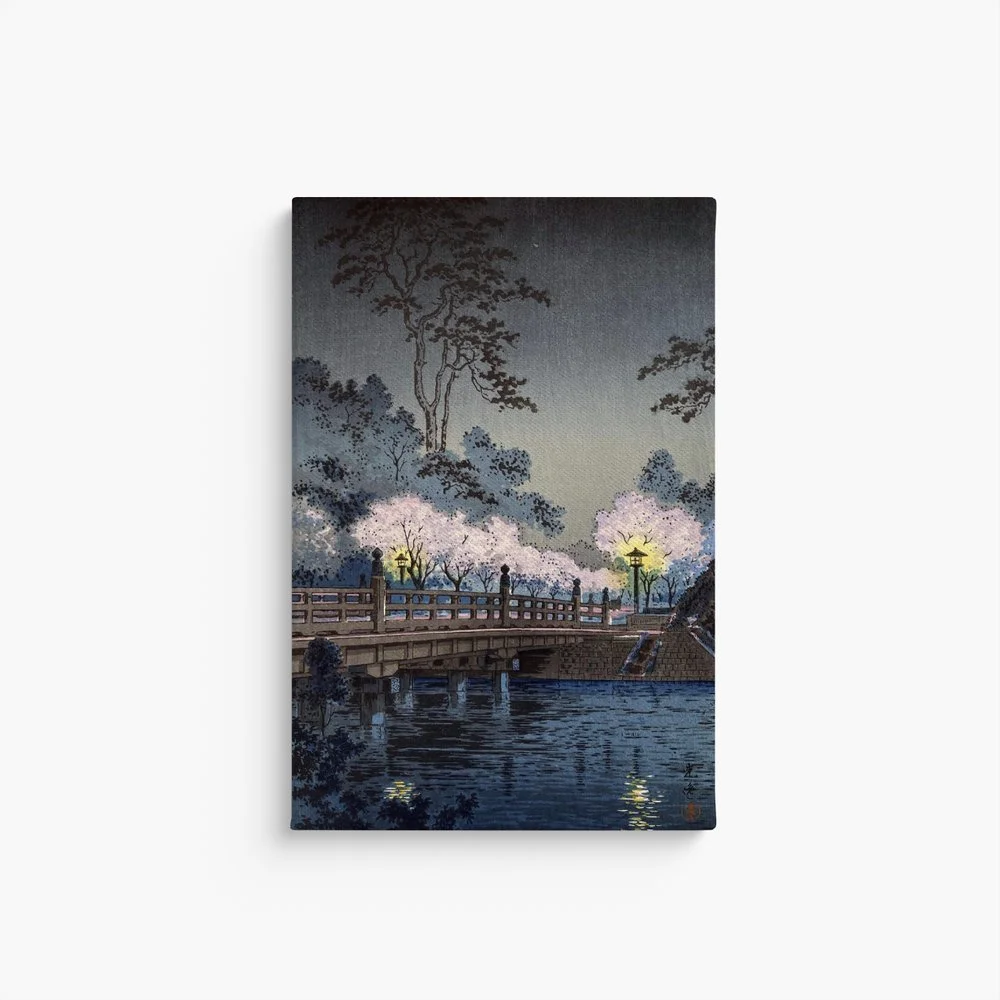 Image 2 of 4
 Image 3 of 4
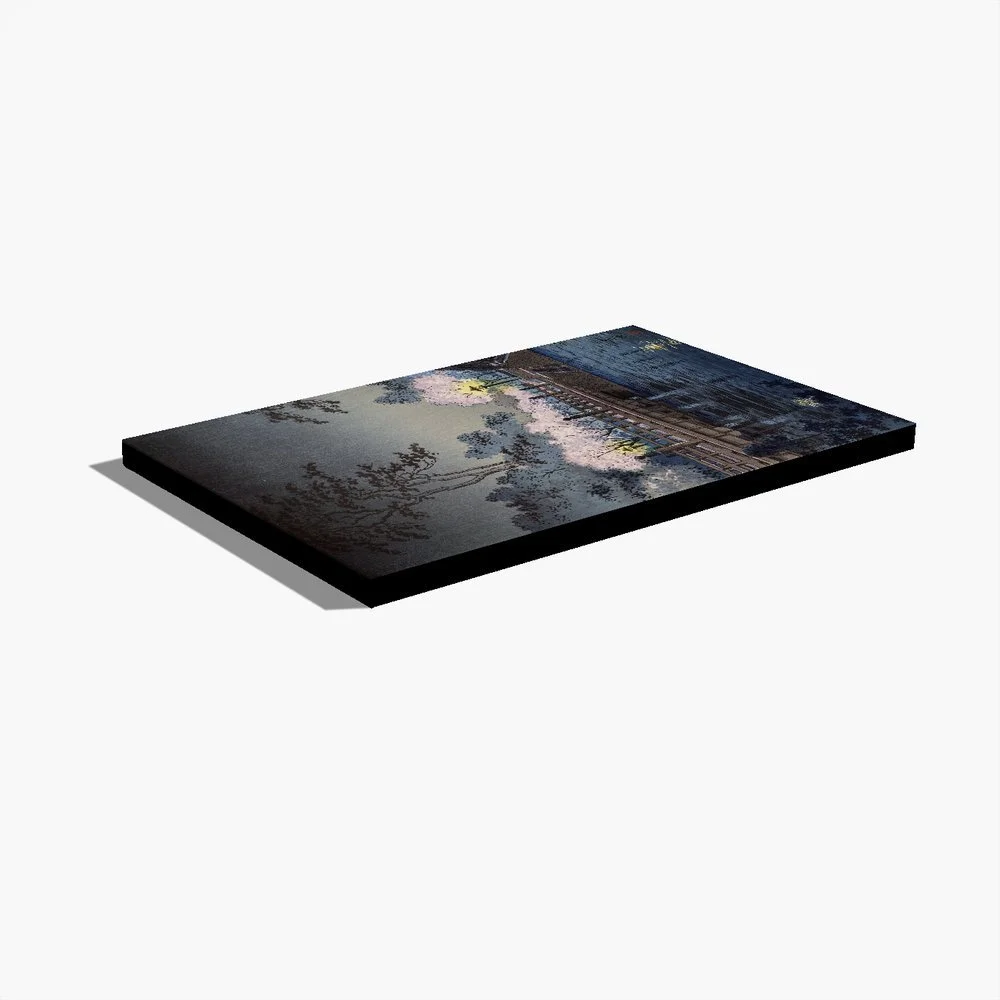 Image 4 of 4
Premium quality canvas print of Koitsu Tsuchiya’s “Benkei Bridge” woodblock painting
Transform your living space into a peaceful haven with art that speaks to the soul. This canvas reprint evokes the serene beauty of nature, filling your home with a sense of calm and awe.
More About the Art:
Koitsu Tsuchiya’s “Benkei Bridge” is a luminous meditation on old Tokyo, rendered with the quiet poetry that defines the finest works of the Shin Hanga movement. The print, titled 弁慶橋 and belonging to Koitsu’s Tokyo Views / 東京風景 series, was first published in April 1933 by Doi Sadaichi / Doi Hangaten in the ōban format.
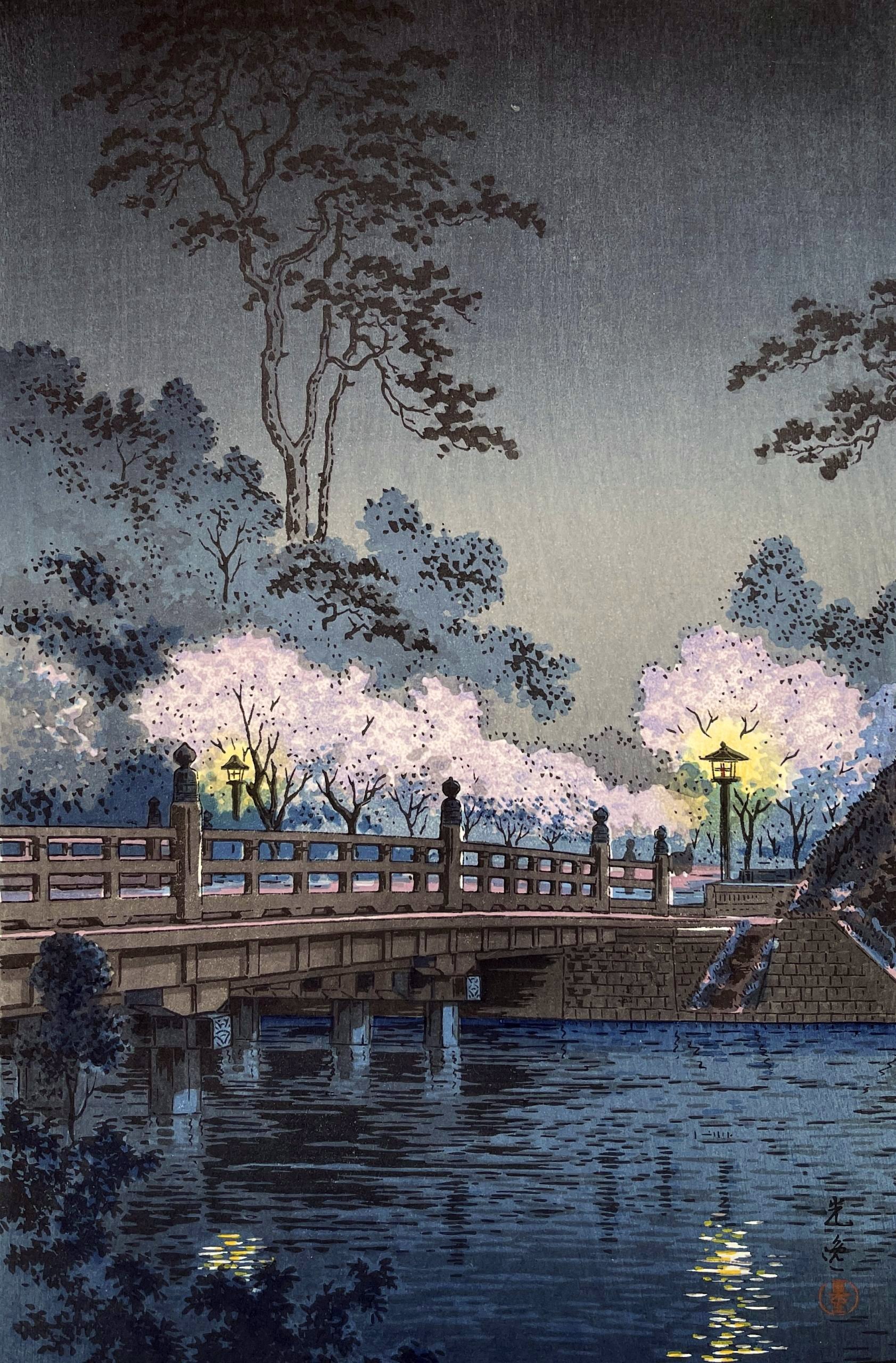
In this work, Koitsu transforms Benkei Bridge from a city landmark into a scene of hushed enchantment. The bridge rises over the dark, still water of Benkei-bori, its graceful structure reflected below like a memory suspended between past and present. Koitsu’s genius lies in atmosphere: the subdued glow, the soft gradations of evening or night, and the delicate balance between architectural form and surrounding shadow. The scene is not merely observed; it is felt. The bridge appears almost theatrical, illuminated against the darkness, yet never harshly so. Light lingers on the railings and water, giving the composition a restrained, dreamlike radiance.
The subject itself carries deep historical resonance. Benkei Bridge spans Benkei-bori between Kioichō in Chiyoda and Moto-Akasaka in Minato. Japanese local sources note that the bridge was originally associated with Benkei Kozaemon, a master carpenter involved in the construction of Edo Castle, and that in 1889 the bridge was moved or rebuilt at its present location after the earlier bridge became unnecessary in the Kanda area.
This history enriches Koitsu’s image. Benkei Bridge was not simply a utilitarian crossing; it was admired as a picturesque Tokyo landmark, especially with the cherry blossoms along Benkei-bori. Chiyoda historical materials describe it as a famous Meiji- and Taishō-era sight, beloved enough to appear in postcards and prints. Koitsu’s 1933 version belongs to that tradition of urban remembrance: he captures Tokyo not as a modern metropolis in motion, but as a city haunted by older forms, older waters, and the lingering elegance of Edo.
What makes “Benkei Bridge” so compelling is its emotional restraint. There is no dramatic crowd, no narrative spectacle, no overt sentimentality. Instead, Koitsu allows mood to carry meaning. The bridge becomes a vessel of stillness; the water becomes a mirror of time. In the refined language of Shin Hanga, he presents Tokyo as both real and imagined—a place of stone, timber, lantern-light, and silence, where modern life pauses long enough for beauty to reveal itself.
More About the Artist:
Koitsu Tsuchiya’s prints preserve, with quiet brilliance, the lyrical beauty of Japan’s landscapes. Through delicate modulations of light and shadow, he infused his scenes with a spellbinding atmosphere, transforming familiar vistas into visions of poetic stillness.
Born in 1870 near Hamamatsu, Koitsu was given the name Koichi. At the age of fifteen, he moved to Tokyo to study woodblock printing under Matsuzaki, a carver associated with the ukiyo-e master Kiyochika Kobayashi. Before long, however, he left Matsuzaki’s tutelage and became a direct pupil of Kiyochika himself. For nineteen years, Koitsu lived in Kiyochika’s household, devoting himself to the study and practice of Japanese woodblock printing.
His earliest prints depicted scenes from the Sino-Japanese War of 1894–95, and he later worked for a time as a lithographer. In 1931, a fortuitous meeting with the publisher Watanabe marked a decisive turning point in his artistic life. From that moment onward, Koitsu Tsuchiya dedicated himself to the creation of Japanese landscape prints in the Shin Hanga style, producing works celebrated for their serenity, refinement, and luminous beauty.
Premium quality canvas print of Koitsu Tsuchiya’s “Benkei Bridge” woodblock painting
Transform your living space into a peaceful haven with art that speaks to the soul. This canvas reprint evokes the serene beauty of nature, filling your home with a sense of calm and awe.
More About the Art:
Koitsu Tsuchiya’s “Benkei Bridge” is a luminous meditation on old Tokyo, rendered with the quiet poetry that defines the finest works of the Shin Hanga movement. The print, titled 弁慶橋 and belonging to Koitsu’s Tokyo Views / 東京風景 series, was first published in April 1933 by Doi Sadaichi / Doi Hangaten in the ōban format.
In this work, Koitsu transforms Benkei Bridge from a city landmark into a scene of hushed enchantment. The bridge rises over the dark, still water of Benkei-bori, its graceful structure reflected below like a memory suspended between past and present. Koitsu’s genius lies in atmosphere: the subdued glow, the soft gradations of evening or night, and the delicate balance between architectural form and surrounding shadow. The scene is not merely observed; it is felt. The bridge appears almost theatrical, illuminated against the darkness, yet never harshly so. Light lingers on the railings and water, giving the composition a restrained, dreamlike radiance.
The subject itself carries deep historical resonance. Benkei Bridge spans Benkei-bori between Kioichō in Chiyoda and Moto-Akasaka in Minato. Japanese local sources note that the bridge was originally associated with Benkei Kozaemon, a master carpenter involved in the construction of Edo Castle, and that in 1889 the bridge was moved or rebuilt at its present location after the earlier bridge became unnecessary in the Kanda area.
This history enriches Koitsu’s image. Benkei Bridge was not simply a utilitarian crossing; it was admired as a picturesque Tokyo landmark, especially with the cherry blossoms along Benkei-bori. Chiyoda historical materials describe it as a famous Meiji- and Taishō-era sight, beloved enough to appear in postcards and prints. Koitsu’s 1933 version belongs to that tradition of urban remembrance: he captures Tokyo not as a modern metropolis in motion, but as a city haunted by older forms, older waters, and the lingering elegance of Edo.
What makes “Benkei Bridge” so compelling is its emotional restraint. There is no dramatic crowd, no narrative spectacle, no overt sentimentality. Instead, Koitsu allows mood to carry meaning. The bridge becomes a vessel of stillness; the water becomes a mirror of time. In the refined language of Shin Hanga, he presents Tokyo as both real and imagined—a place of stone, timber, lantern-light, and silence, where modern life pauses long enough for beauty to reveal itself.
More About the Artist:
Koitsu Tsuchiya’s prints preserve, with quiet brilliance, the lyrical beauty of Japan’s landscapes. Through delicate modulations of light and shadow, he infused his scenes with a spellbinding atmosphere, transforming familiar vistas into visions of poetic stillness.
Born in 1870 near Hamamatsu, Koitsu was given the name Koichi. At the age of fifteen, he moved to Tokyo to study woodblock printing under Matsuzaki, a carver associated with the ukiyo-e master Kiyochika Kobayashi. Before long, however, he left Matsuzaki’s tutelage and became a direct pupil of Kiyochika himself. For nineteen years, Koitsu lived in Kiyochika’s household, devoting himself to the study and practice of Japanese woodblock printing.
His earliest prints depicted scenes from the Sino-Japanese War of 1894–95, and he later worked for a time as a lithographer. In 1931, a fortuitous meeting with the publisher Watanabe marked a decisive turning point in his artistic life. From that moment onward, Koitsu Tsuchiya dedicated himself to the creation of Japanese landscape prints in the Shin Hanga style, producing works celebrated for their serenity, refinement, and luminous beauty.