

 Image 1 of 1
Early Summer in Sanzen-in — Takeji Asano
Premium quality canvas print of “Early Summer in Sanzen-in” by Takeji Asano
Fresh green foliage surrounds a warm timber temple, mossy garden, and still pond. Takeji Asano’s Early Summer in Sanzen-in brings the sheltered beauty of a Kyoto garden to landscape canvas, reproduced over a sturdy 1.5-inch wood stretcher.
Product details: Canvas reproduction over a sturdy 1.5-inch wood stretcher. Available in 24 × 16 in. ($259 CAD) and 36 × 24 in. ($299 CAD). No returns accepted.
More About the Art
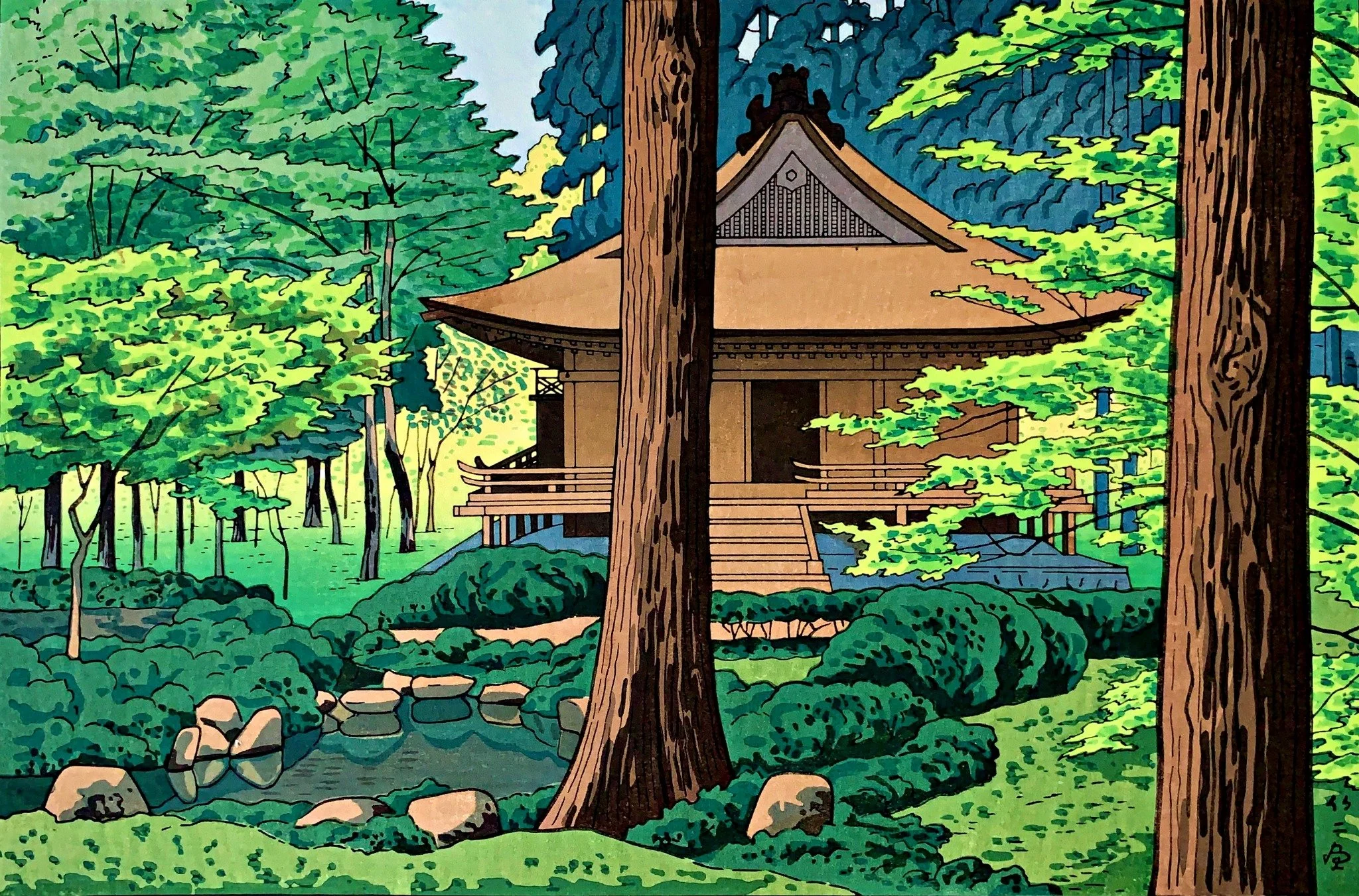
Early Summer in Sanzen-in invites the viewer into a garden filled with layered greens. A warm brown temple building stands among tall trunks and spreading foliage, its pale roof rising against dark blue-green trees. The scene feels sheltered, with the architecture surrounded by living forms. Across the foreground, mossy ground, rounded shrubs, and stones lead toward a small pool, giving the garden both intimacy and a clear sense of depth.
Two large trunks establish the composition. One rises near the centre, interrupting the building behind it; another stands close to the right edge. Their bark is drawn with long, dark marks that contrast with the broken shapes of the foliage. These strong verticals make the viewer feel situated among the trees. They also divide the broad landscape into connected glimpses, encouraging the eye to move around each trunk and discover what lies beyond.
The colour is especially fresh. Lime and yellow-green leaves catch the light, while turquoise, emerald, and deep teal gather beneath them. Rather than giving every tree the same appearance, Asano varies the shapes and density of the foliage. Fine branches show through some areas; others become close masses of dark colour. Small touches of pale blue sky keep the upper scene open, bringing a breath of light into the woodland enclosure. The changing tones suggest a garden experienced at walking pace, where each opening reveals another small variation of leaf and shadow.
The temple provides a warm centre within this cool abundance. Its sweeping roof, triangular gable, veranda, and central steps are described through clear lines and broad ochre surfaces. Repeated posts and rails introduce an orderly rhythm. Leaves overlap the roof and obscure parts of the building, allowing the garden and architecture to share the image. The hall remains distinct, yet it belongs fully to its setting.
At the lower left, the pond adds another register of stillness. Pale stones mark its edge and cast small reflections into the dark water. Nearby shrubs form rounded, repeating shapes, and patches of bright green ground separate them. These details are modest in scale, but they reward close attention. The eye can follow a stone, a narrow strip of earth, or a change in green back toward the temple steps.
Sanzen-in is a Tendai Buddhist temple in Ōhara, Kyoto. Its official guide identifies the Yūsei-en and Shūheki-en gardens and the Ōjō-Gokuraku-in, or Amida Hall, among its grounds. The temple traces its origins to Saichō and received the name Sanzen-in in 1871. This setting gives the landscape a particular cultural presence, while the image remains immediately approachable through the familiar pleasures of trees, water, shade, and carefully tended ground.
Unsōdō catalogues Asano’s woodblock design as Early Summer in Sanzen-In, 三千院夏, catalogue number TA16. Its broad format gives the garden room to unfold, balancing the hall with the trees and pond rather than isolating a single feature. Reproduced on landscape canvas, the supplied image preserves this full arrangement. It brings a luminous green atmosphere to an interior, while the warm timber and measured lines of the building give the scene a quiet, enduring structure.
More About the Artist
Takeji Asano (1900–1998) was a Kyoto-born painter and woodblock artist whose work moved between carefully observed landscapes and imaginative creative prints. He is particularly associated with views of familiar places, where buildings, vegetation, weather, and light become parts of a balanced design. Early Summer in Sanzen-in presents this ability through a temple garden: the location is recognizable, but its effect depends just as strongly on colour, rhythm, and the relationship between near and distant forms.
Asano’s early training was in painting. He graduated from the Kyoto School of Arts and Crafts in 1919 and the Kyoto Municipal School of Painting in 1923. His studies centred on Japanese-style painting, although he also explored oil painting. In 1927 he entered the school led by Tsuchida Bakusen. This background gave him several ways to organize an image, combining attention to natural forms with an awareness of how line and colour could hold a composition together.
Around 1930 he began working in woodblock printmaking. The landscapes of Kobayashi Kiyochika helped inspire his interest in famous-place prints. During the following decades, he created views of Kyoto, Osaka, Tokyo, Nara, and other parts of Japan. Kyoto Seika University describes his landscapes as the result of sketching places and translating them through a distinctive softness of form and a secure command of multicolour woodblock technique. His subjects included both older landmarks and the changing life around them.
His name is associated with two approaches to modern Japanese prints. In his work with Unsōdō, a publishing house in Kyoto, he supplied designs for collaborative landscape editions. The publisher began issuing his work in the early 1950s. Alongside these designs, Asano pursued sōsaku-hanga, or creative prints, in which he valued drawing, carving, and printing the work himself. These related practices allowed him to explore recognizable scenery as well as a freer visual language.
The distinction matters when looking at a reproduction of an Unsōdō design such as Early Summer in Sanzen-in. The clear edges, repeated leaf marks, and strongly defined architecture belong to an image conceived for woodblock printing. They show the expressive possibilities of shapes translated into blocks and colour impressions. The garden’s apparent ease rests on a precise arrangement: large trunks anchor the foreground, foliage establishes distance, and warm architecture gives the many greens a steady point of reference.
Asano’s later creative work expanded into people, animals, birds, and other subjects treated with simplified forms and an often playful spirit. Fuchū Art Museum has emphasized the warmth and freedom of these prints. The American artist Ben Shahn visited Asano’s studio in 1960, beginning an important artistic friendship. These works reveal another side of an artist who could observe a place carefully while remaining open to invention, humour, and unexpected relationships between forms.
His legacy has been sustained through exhibitions and substantial institutional collections. After his death, his family donated approximately 1,500 works to Kyoto Seika University. Their range helps place the serene landscape designs within a much larger career. In Early Summer in Sanzen-in, the qualities that make his famous-place prints so inviting remain easy to see: firm structure, generous colour, and an attentive view of the everyday experience of standing in a garden.
Sources for the artwork and artist
Premium quality canvas print of “Early Summer in Sanzen-in” by Takeji Asano
Fresh green foliage surrounds a warm timber temple, mossy garden, and still pond. Takeji Asano’s Early Summer in Sanzen-in brings the sheltered beauty of a Kyoto garden to landscape canvas, reproduced over a sturdy 1.5-inch wood stretcher.
Product details: Canvas reproduction over a sturdy 1.5-inch wood stretcher. Available in 24 × 16 in. ($259 CAD) and 36 × 24 in. ($299 CAD). No returns accepted.
More About the Art
Early Summer in Sanzen-in invites the viewer into a garden filled with layered greens. A warm brown temple building stands among tall trunks and spreading foliage, its pale roof rising against dark blue-green trees. The scene feels sheltered, with the architecture surrounded by living forms. Across the foreground, mossy ground, rounded shrubs, and stones lead toward a small pool, giving the garden both intimacy and a clear sense of depth.
Two large trunks establish the composition. One rises near the centre, interrupting the building behind it; another stands close to the right edge. Their bark is drawn with long, dark marks that contrast with the broken shapes of the foliage. These strong verticals make the viewer feel situated among the trees. They also divide the broad landscape into connected glimpses, encouraging the eye to move around each trunk and discover what lies beyond.
The colour is especially fresh. Lime and yellow-green leaves catch the light, while turquoise, emerald, and deep teal gather beneath them. Rather than giving every tree the same appearance, Asano varies the shapes and density of the foliage. Fine branches show through some areas; others become close masses of dark colour. Small touches of pale blue sky keep the upper scene open, bringing a breath of light into the woodland enclosure. The changing tones suggest a garden experienced at walking pace, where each opening reveals another small variation of leaf and shadow.
The temple provides a warm centre within this cool abundance. Its sweeping roof, triangular gable, veranda, and central steps are described through clear lines and broad ochre surfaces. Repeated posts and rails introduce an orderly rhythm. Leaves overlap the roof and obscure parts of the building, allowing the garden and architecture to share the image. The hall remains distinct, yet it belongs fully to its setting.
At the lower left, the pond adds another register of stillness. Pale stones mark its edge and cast small reflections into the dark water. Nearby shrubs form rounded, repeating shapes, and patches of bright green ground separate them. These details are modest in scale, but they reward close attention. The eye can follow a stone, a narrow strip of earth, or a change in green back toward the temple steps.
Sanzen-in is a Tendai Buddhist temple in Ōhara, Kyoto. Its official guide identifies the Yūsei-en and Shūheki-en gardens and the Ōjō-Gokuraku-in, or Amida Hall, among its grounds. The temple traces its origins to Saichō and received the name Sanzen-in in 1871. This setting gives the landscape a particular cultural presence, while the image remains immediately approachable through the familiar pleasures of trees, water, shade, and carefully tended ground.
Unsōdō catalogues Asano’s woodblock design as Early Summer in Sanzen-In, 三千院夏, catalogue number TA16. Its broad format gives the garden room to unfold, balancing the hall with the trees and pond rather than isolating a single feature. Reproduced on landscape canvas, the supplied image preserves this full arrangement. It brings a luminous green atmosphere to an interior, while the warm timber and measured lines of the building give the scene a quiet, enduring structure.
More About the Artist
Takeji Asano (1900–1998) was a Kyoto-born painter and woodblock artist whose work moved between carefully observed landscapes and imaginative creative prints. He is particularly associated with views of familiar places, where buildings, vegetation, weather, and light become parts of a balanced design. Early Summer in Sanzen-in presents this ability through a temple garden: the location is recognizable, but its effect depends just as strongly on colour, rhythm, and the relationship between near and distant forms.
Asano’s early training was in painting. He graduated from the Kyoto School of Arts and Crafts in 1919 and the Kyoto Municipal School of Painting in 1923. His studies centred on Japanese-style painting, although he also explored oil painting. In 1927 he entered the school led by Tsuchida Bakusen. This background gave him several ways to organize an image, combining attention to natural forms with an awareness of how line and colour could hold a composition together.
Around 1930 he began working in woodblock printmaking. The landscapes of Kobayashi Kiyochika helped inspire his interest in famous-place prints. During the following decades, he created views of Kyoto, Osaka, Tokyo, Nara, and other parts of Japan. Kyoto Seika University describes his landscapes as the result of sketching places and translating them through a distinctive softness of form and a secure command of multicolour woodblock technique. His subjects included both older landmarks and the changing life around them.
His name is associated with two approaches to modern Japanese prints. In his work with Unsōdō, a publishing house in Kyoto, he supplied designs for collaborative landscape editions. The publisher began issuing his work in the early 1950s. Alongside these designs, Asano pursued sōsaku-hanga, or creative prints, in which he valued drawing, carving, and printing the work himself. These related practices allowed him to explore recognizable scenery as well as a freer visual language.
The distinction matters when looking at a reproduction of an Unsōdō design such as Early Summer in Sanzen-in. The clear edges, repeated leaf marks, and strongly defined architecture belong to an image conceived for woodblock printing. They show the expressive possibilities of shapes translated into blocks and colour impressions. The garden’s apparent ease rests on a precise arrangement: large trunks anchor the foreground, foliage establishes distance, and warm architecture gives the many greens a steady point of reference.
Asano’s later creative work expanded into people, animals, birds, and other subjects treated with simplified forms and an often playful spirit. Fuchū Art Museum has emphasized the warmth and freedom of these prints. The American artist Ben Shahn visited Asano’s studio in 1960, beginning an important artistic friendship. These works reveal another side of an artist who could observe a place carefully while remaining open to invention, humour, and unexpected relationships between forms.
His legacy has been sustained through exhibitions and substantial institutional collections. After his death, his family donated approximately 1,500 works to Kyoto Seika University. Their range helps place the serene landscape designs within a much larger career. In Early Summer in Sanzen-in, the qualities that make his famous-place prints so inviting remain easy to see: firm structure, generous colour, and an attentive view of the everyday experience of standing in a garden.
Sources for the artwork and artist