

 Image 1 of 1
Clear Storm at Imazu — Katsuyuki Nishijima
Premium quality canvas print of “Clear Storm at Imazu” by Katsuyuki Nishijima
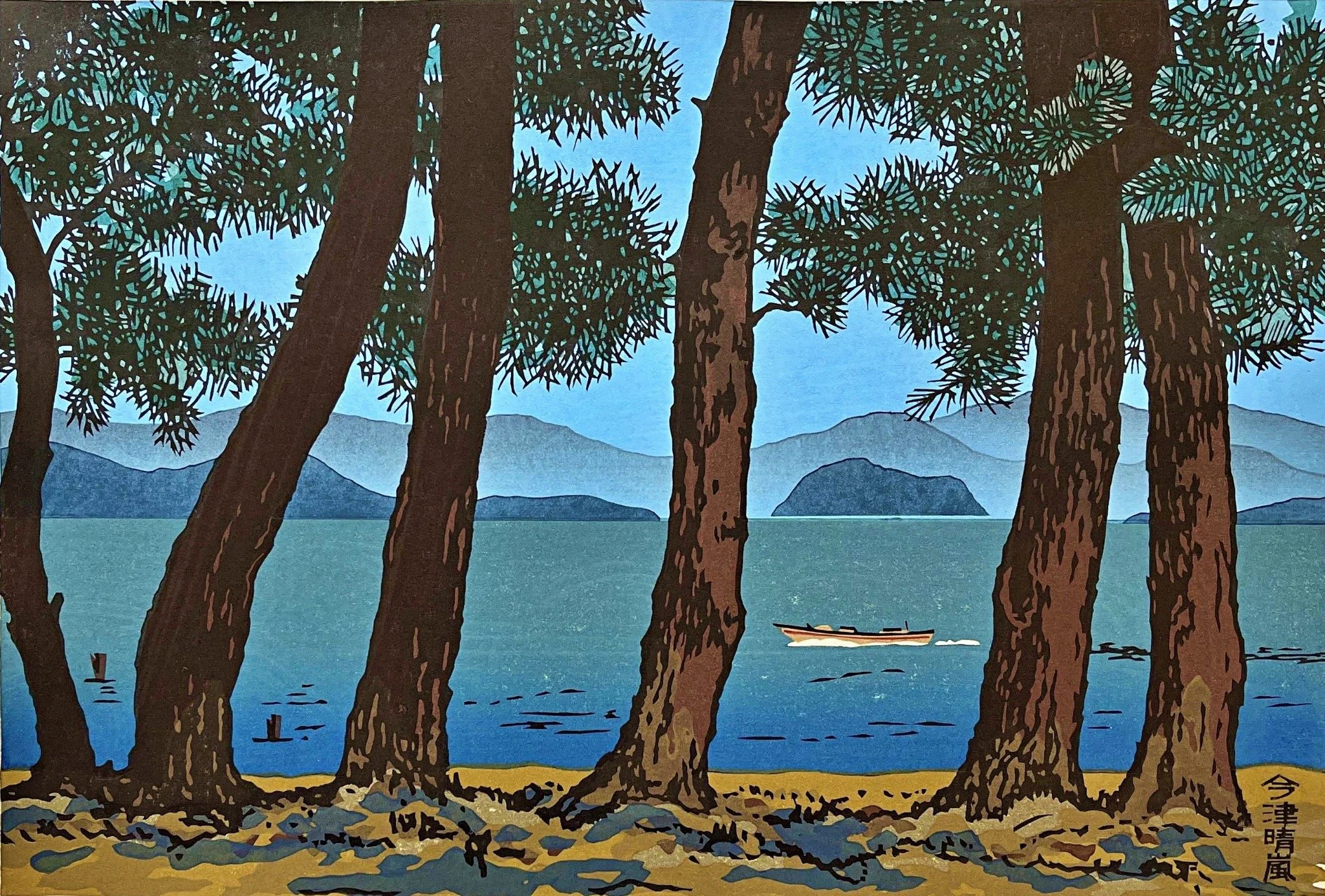
Dark pine trunks open onto luminous blue water and layered distant hills in Katsuyuki Nishijima’s Clear Storm at Imazu. A small boat gives the broad landscape a quiet sense of motion. This landscape canvas reproduction is stretched over a sturdy 1.5-inch wood stretcher.
Product details: Canvas reproduction over a sturdy 1.5-inch wood stretcher. Available in 24 × 16 in. ($259 CAD) and 36 × 24 in. ($299 CAD). No returns accepted.
More About the Art
A row of pine trunks stands close to the viewer in Clear Storm at Imazu, dividing the blue expanse of the lake into a sequence of irregular openings. Some trees rise almost vertically; others lean across the image. Their dark brown surfaces carry short, lighter marks that suggest textured bark. Behind them, a small boat crosses a broad stretch of water, its pale wake making a delicate accent against the surrounding blue.
The image bears a Japanese title inscription at the lower right, identifying its Imazu setting. Katsuyuki Nishijima's landscape combines strong outlines with broad colour shapes, giving the view both clarity and a decorative rhythm. The trees do not merely border the scene. Their spacing determines how the lake is encountered, opening a succession of views toward the distant hills. Each interval offers a slightly different balance of land, sky, water, and moving boat.
The nearest trees provide the picture's strongest structure. Their roots spread across a narrow band of golden earth, where scattered stones introduce cooler grey and green notes. Dark branches and fine needles gather above, leaving patches of bright sky between them. This close framework gives the viewer a clear position beside the shore. The lake is seen from within the shelter of the trees, rather than from an unrestricted, panoramic vantage point.
Distance develops through a series of coloured bands. The water occupies a wide middle area, changing subtly from brighter blue to a more muted green-blue. Beyond it, hills overlap in softer tones. Their contours are simpler than the bark and roots in the foreground, allowing the eye to distinguish near detail from far-off mass. A darker island-like shape interrupts one of the lighter mountain layers, giving the horizon an additional point of focus.
The boat is small enough to preserve the scale of the landscape but bright enough to be immediately noticed. Its light hull and warm upper edge form a narrow horizontal accent between two trunks. The wake extends to one side in pale marks. Around it, short dark strokes suggest slight movement across the water's surface. Nothing else needs to happen for the scene to feel alive; the passing craft provides a measured change within the larger stillness.
Colour holds the contrasting areas together. Brown trunks anchor the view, while blue water and sky create its spaciousness. The golden shore adds warmth at the lower edge and makes the cool lake seem more luminous. Green needles link the trees with the distant land. Each colour has a clear role, yet the outlines prevent neighbouring shapes from losing their individual character. The image remains readable both as a recognizable landscape and as a carefully balanced arrangement.
This canvas reproduction preserves the full horizontal composition of the supplied image. The row of pines gives it a strong presence across a wall, while smaller details reward a closer approach. Following the trunks upward reveals the intricate needles; looking between them opens the lake and its distant hills. That gradual shift from enclosure to openness gives the work its enduring interest, offering a quiet view shaped by the rhythm of trees and the passing movement of water.
More About the Artist
Katsuyuki Nishijima, born in Yamaguchi Prefecture in 1945, is a Japanese woodblock printmaker whose work brings close attention to traditional buildings and the landscapes around them. His subjects include shopfronts, tiled roofs, thatched farmhouses, waterways, and quiet stretches of town. Strong outlines and broad areas of colour give these familiar places an immediate presence. Small variations within roofs, walls, foliage, and sky then invite a slower kind of looking, revealing how much visual interest can be held within an apparently modest scene.
Nishijima trained at the Mikumo publishing house in Kyoto between 1964 and 1968. This period gave him sustained experience of woodblock printmaking and its practical demands. A print develops through the relationship between a design, the carved surfaces that carry it, and the colours transferred to paper. Learning that relationship requires attention to both the whole composition and the smallest marks. His later images show a particularly clear understanding of how large colour shapes and fine linear details can support one another.
During the second half of the 1960s, he exhibited with the Kyoto Independents. He also explored stencil dyeing and printing, especially between 1969 and 1972. From 1972, traditional architecture became a central subject in his limited edition woodblocks. His series include views associated with the Sixty-Nine Stations of the Kisokaidō and scenes of Kyoto streets. These projects place everyday buildings within a continuing Japanese tradition of looking closely at roads, settlements, and the distinctive appearance of particular places.
Nishijima's practice is associated with sōsaku-hanga, often translated as creative prints. This approach places the artist at the centre of designing, carving, and printing. The Philbrook Museum of Art describes the individual command of these stages as an essential quality of his work. His pictures therefore belong to a tradition in which the marks of the image emerge through an artist's sustained engagement with the material process, from the decisions of the initial design to the pressure and colour of the printed impression.
Traditional architecture offers him a remarkably varied visual language. Roof tiles can become closely repeated dark strokes; a plaster wall can provide a broad interval of light; wooden frames can divide a facade into strong geometric shapes. A street or bank may lead the eye into depth, while an overhanging tree closes part of the view. These are qualities visible across his work, and they help explain why a building or quiet landscape can carry a composition without relying on a dramatic event.
Human presence is often suggested through inhabited structures and traces of use. A doorway, a roofline, or a boat can give a setting a sense of ordinary life even when no figure occupies the scene. Nishijima's landscapes can be enjoyed both as recognizable places and as arrangements of colour and line. The two experiences reinforce each other: close looking makes the construction of the picture clearer, while also making the setting feel more particular. His woodblocks are represented in museum collections in Japan and abroad, including American institutions identified by the Philbrook Museum.
Premium quality canvas print of “Clear Storm at Imazu” by Katsuyuki Nishijima
Dark pine trunks open onto luminous blue water and layered distant hills in Katsuyuki Nishijima’s Clear Storm at Imazu. A small boat gives the broad landscape a quiet sense of motion. This landscape canvas reproduction is stretched over a sturdy 1.5-inch wood stretcher.
Product details: Canvas reproduction over a sturdy 1.5-inch wood stretcher. Available in 24 × 16 in. ($259 CAD) and 36 × 24 in. ($299 CAD). No returns accepted.
More About the Art
A row of pine trunks stands close to the viewer in Clear Storm at Imazu, dividing the blue expanse of the lake into a sequence of irregular openings. Some trees rise almost vertically; others lean across the image. Their dark brown surfaces carry short, lighter marks that suggest textured bark. Behind them, a small boat crosses a broad stretch of water, its pale wake making a delicate accent against the surrounding blue.
The image bears a Japanese title inscription at the lower right, identifying its Imazu setting. Katsuyuki Nishijima's landscape combines strong outlines with broad colour shapes, giving the view both clarity and a decorative rhythm. The trees do not merely border the scene. Their spacing determines how the lake is encountered, opening a succession of views toward the distant hills. Each interval offers a slightly different balance of land, sky, water, and moving boat.
The nearest trees provide the picture's strongest structure. Their roots spread across a narrow band of golden earth, where scattered stones introduce cooler grey and green notes. Dark branches and fine needles gather above, leaving patches of bright sky between them. This close framework gives the viewer a clear position beside the shore. The lake is seen from within the shelter of the trees, rather than from an unrestricted, panoramic vantage point.
Distance develops through a series of coloured bands. The water occupies a wide middle area, changing subtly from brighter blue to a more muted green-blue. Beyond it, hills overlap in softer tones. Their contours are simpler than the bark and roots in the foreground, allowing the eye to distinguish near detail from far-off mass. A darker island-like shape interrupts one of the lighter mountain layers, giving the horizon an additional point of focus.
The boat is small enough to preserve the scale of the landscape but bright enough to be immediately noticed. Its light hull and warm upper edge form a narrow horizontal accent between two trunks. The wake extends to one side in pale marks. Around it, short dark strokes suggest slight movement across the water's surface. Nothing else needs to happen for the scene to feel alive; the passing craft provides a measured change within the larger stillness.
Colour holds the contrasting areas together. Brown trunks anchor the view, while blue water and sky create its spaciousness. The golden shore adds warmth at the lower edge and makes the cool lake seem more luminous. Green needles link the trees with the distant land. Each colour has a clear role, yet the outlines prevent neighbouring shapes from losing their individual character. The image remains readable both as a recognizable landscape and as a carefully balanced arrangement.
This canvas reproduction preserves the full horizontal composition of the supplied image. The row of pines gives it a strong presence across a wall, while smaller details reward a closer approach. Following the trunks upward reveals the intricate needles; looking between them opens the lake and its distant hills. That gradual shift from enclosure to openness gives the work its enduring interest, offering a quiet view shaped by the rhythm of trees and the passing movement of water.
More About the Artist
Katsuyuki Nishijima, born in Yamaguchi Prefecture in 1945, is a Japanese woodblock printmaker whose work brings close attention to traditional buildings and the landscapes around them. His subjects include shopfronts, tiled roofs, thatched farmhouses, waterways, and quiet stretches of town. Strong outlines and broad areas of colour give these familiar places an immediate presence. Small variations within roofs, walls, foliage, and sky then invite a slower kind of looking, revealing how much visual interest can be held within an apparently modest scene.
Nishijima trained at the Mikumo publishing house in Kyoto between 1964 and 1968. This period gave him sustained experience of woodblock printmaking and its practical demands. A print develops through the relationship between a design, the carved surfaces that carry it, and the colours transferred to paper. Learning that relationship requires attention to both the whole composition and the smallest marks. His later images show a particularly clear understanding of how large colour shapes and fine linear details can support one another.
During the second half of the 1960s, he exhibited with the Kyoto Independents. He also explored stencil dyeing and printing, especially between 1969 and 1972. From 1972, traditional architecture became a central subject in his limited edition woodblocks. His series include views associated with the Sixty-Nine Stations of the Kisokaidō and scenes of Kyoto streets. These projects place everyday buildings within a continuing Japanese tradition of looking closely at roads, settlements, and the distinctive appearance of particular places.
Nishijima's practice is associated with sōsaku-hanga, often translated as creative prints. This approach places the artist at the centre of designing, carving, and printing. The Philbrook Museum of Art describes the individual command of these stages as an essential quality of his work. His pictures therefore belong to a tradition in which the marks of the image emerge through an artist's sustained engagement with the material process, from the decisions of the initial design to the pressure and colour of the printed impression.
Traditional architecture offers him a remarkably varied visual language. Roof tiles can become closely repeated dark strokes; a plaster wall can provide a broad interval of light; wooden frames can divide a facade into strong geometric shapes. A street or bank may lead the eye into depth, while an overhanging tree closes part of the view. These are qualities visible across his work, and they help explain why a building or quiet landscape can carry a composition without relying on a dramatic event.
Human presence is often suggested through inhabited structures and traces of use. A doorway, a roofline, or a boat can give a setting a sense of ordinary life even when no figure occupies the scene. Nishijima's landscapes can be enjoyed both as recognizable places and as arrangements of colour and line. The two experiences reinforce each other: close looking makes the construction of the picture clearer, while also making the setting feel more particular. His woodblocks are represented in museum collections in Japan and abroad, including American institutions identified by the Philbrook Museum.