

 Image 1 of 5
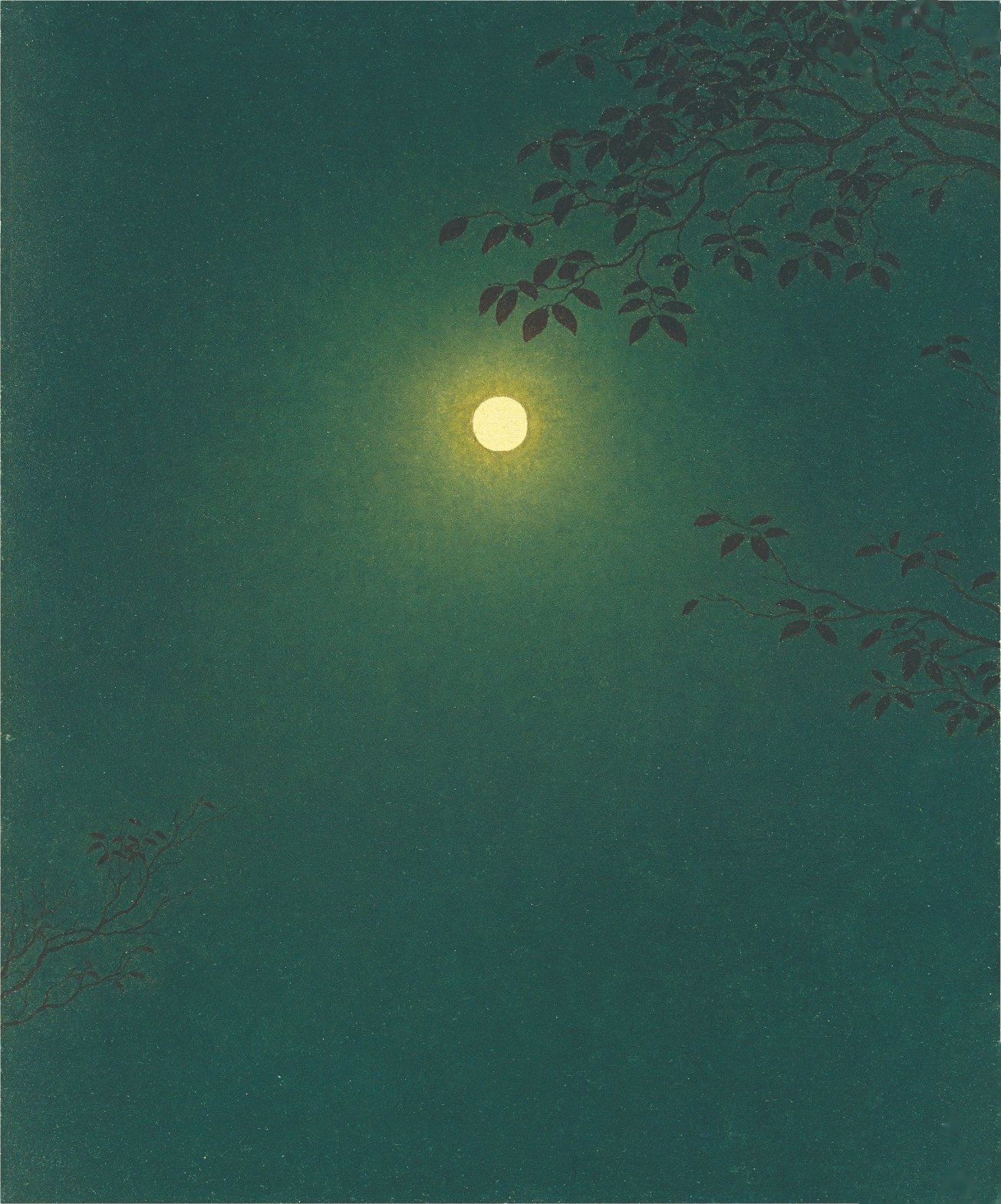 Image 2 of 5
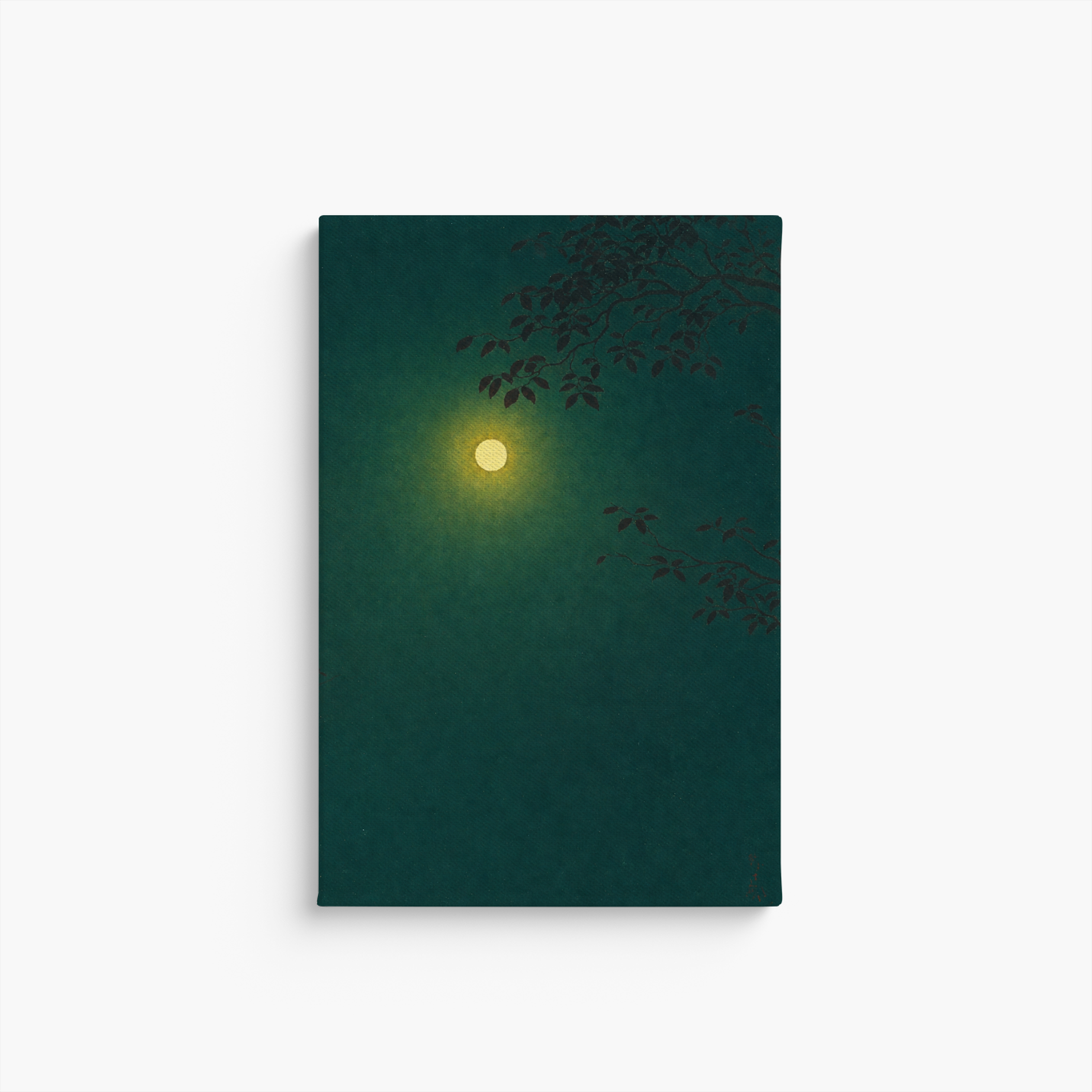 Image 3 of 5
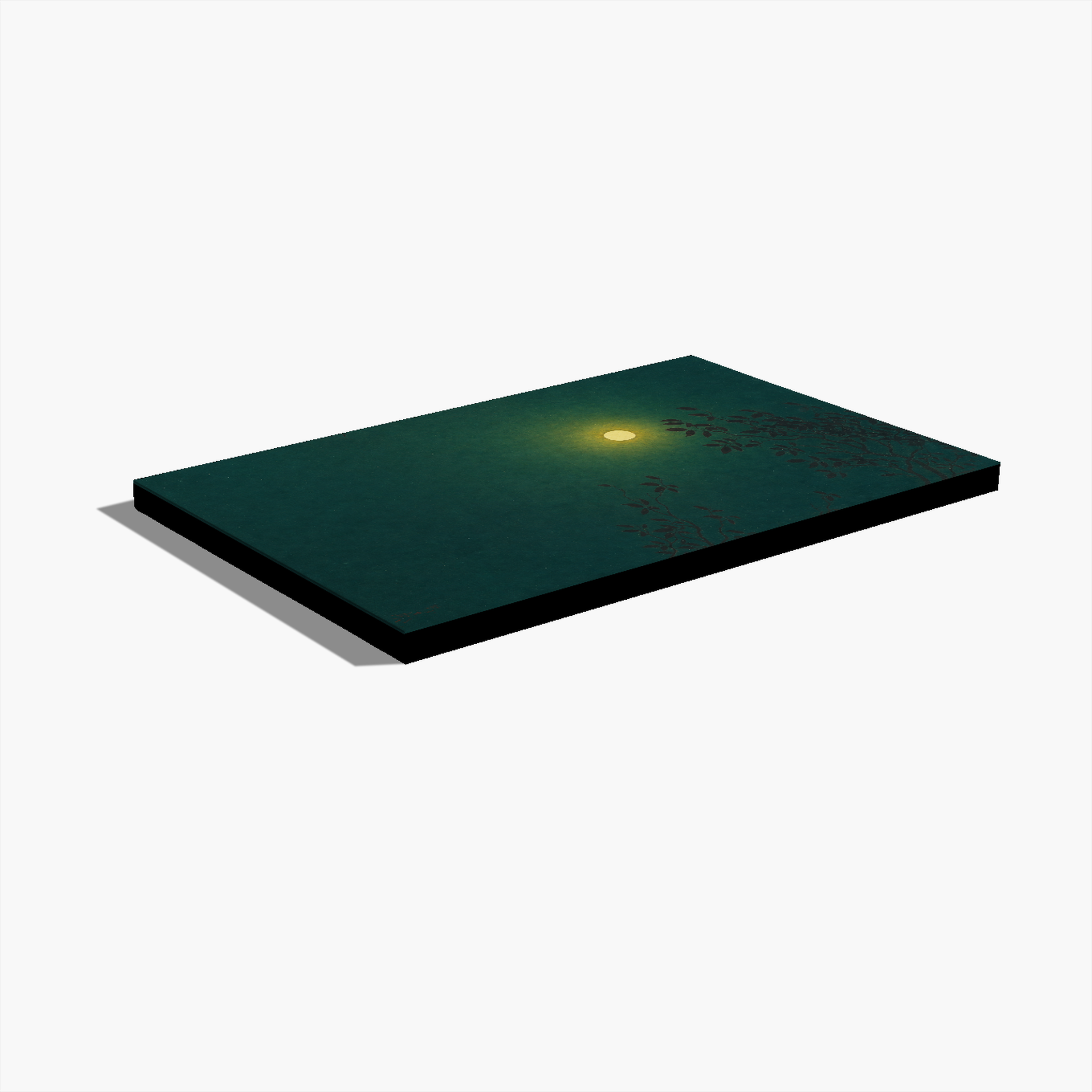 Image 4 of 5
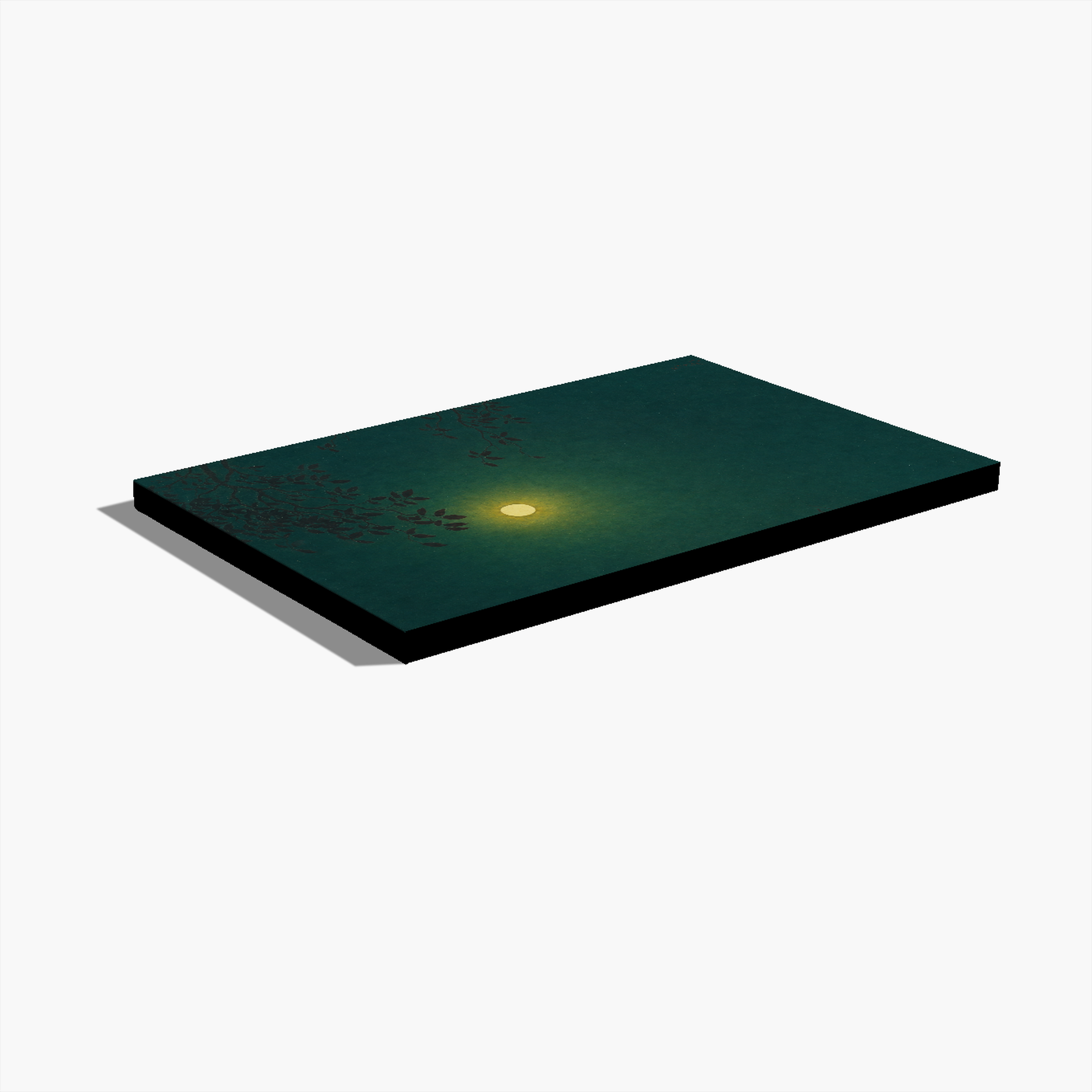 Image 5 of 5
Yajūrō Takashima’s “Full Moon” (1963) (Copy)
Premium quality canvas print of Yajūrō Takashima’s “Full Moon” (Mangetsu) painting
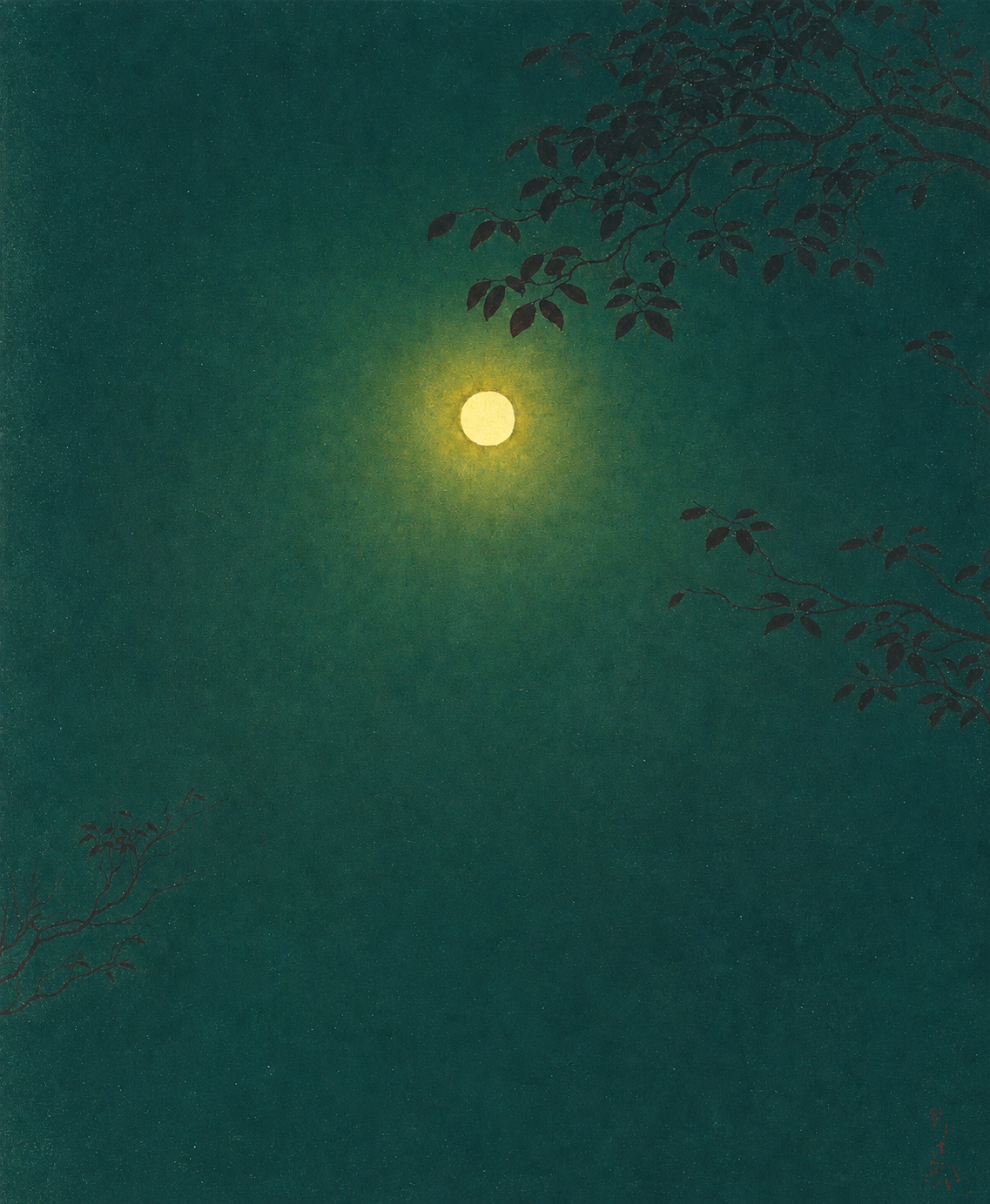
Transform your living space into a place of stillness and contemplation with Yajūrō Takashima’s extraordinary Full Moon. This canvas reprint captures one of the most mysterious and meditative images in modern Japanese painting: a luminous moon suspended alone within an immense field of darkness. Built on a sturdy 1.5" wood frame, it offers a substantial gallery-style presence while preserving the severe simplicity, subtle tonal depth, and haunting beauty of Takashima’s original oil painting.
More About the Art:
Yajūrō Takashima’s Full Moon (Mangetsu), created around 1963, is one of the defining works of his mature career and one of the most striking representations of the moon in modern Japanese art. The painting is held by the Institute of Medical Science at the University of Tokyo, which identifies the work as dating from 1963. Recent retrospective materials likewise date it to approximately 1963. (The University of Tokyo)
At first glance, the composition could hardly be simpler. A full moon appears against an almost limitless dark sky. There is no landscape, no building, no tree, no human figure, and no narrative detail to explain what we are seeing. Nearly everything that might ordinarily locate the viewer within a recognizable world has been removed. What remains is light and darkness.
Yet this radical simplicity gives the painting its extraordinary intensity.
The moon does not behave like a decorative object placed against a black background. It seems to hover, distant yet immediate, luminous yet strangely silent. Takashima’s meticulous realism gives the lunar disc a physical presence, while the surrounding darkness has its own depth and density. The result is not an astronomical study and not simply a romantic moonlit scene. It is closer to a meditation on perception itself.
This distinction was fundamental to Takashima’s intention. Exhibition materials devoted to his work explain that in paintings such as Full Moon, the artist was interested not only in depicting the glowing moon, but in using the moon as a means of confronting the darkness around it. The moon and the surrounding void function as opposites that reveal one another. (大阪中之島美術館)
That idea transforms the image. The bright circle initially attracts the eye, but gradually the surrounding darkness becomes equally important. The viewer begins to notice that the moon occupies only a small portion of the composition. Darkness is the true expanse.
Takashima therefore reverses our expectations. Instead of painting darkness as an empty background against which the moon appears, he gives darkness a presence of its own. The moon becomes a point of illumination through which the surrounding space can be experienced.
This tension between light and darkness runs throughout Takashima’s mature work. He repeatedly painted candles, suns, and moons—subjects in which light becomes visible precisely because it is surrounded by something darker. These motifs became some of the most distinctive elements of his artistic identity, and museums today regard them as central to understanding his art. (大阪中之島美術館)
In Full Moon, this investigation reaches an extreme form of purity. There is nothing extraneous. The familiar landscape elements found in earlier moonlit paintings have disappeared, leaving the viewer alone with the essential relationship between illumination and void.
The effect can be unexpectedly emotional. The moon may suggest solitude, permanence, distance, serenity, or even unease. It feels both familiar and unreachable. We recognize it instantly, yet the darkness surrounding it removes every ordinary reference point. The painting seems to exist outside a particular landscape and almost outside time.
This quality gives Full Moon a remarkable relationship to Japanese aesthetic traditions, even though Takashima worked primarily in Yōga, or Western-style oil painting. Japanese art and literature have for centuries treated the moon as a subject of contemplation, seasonal awareness, transience, and spiritual reflection. Takashima approaches that ancient subject through the material language of modern oil painting, but the contemplative impulse remains.
His treatment, however, is unusually austere.
There are no clouds drifting romantically across the sky and no distant mountains reflecting moonlight. Unlike many traditional Japanese moon scenes, nothing distracts from the elemental encounter. The image has been reduced almost to an icon: one luminous form surrounded by darkness.
That reduction creates an atmosphere approaching meditation.
The viewer is encouraged to remain before the image rather than move quickly past it. At first the eye looks toward the moon. Then it moves outward into the darkness. Eventually the relationship between the two becomes the painting’s true subject.
Takashima’s realism is essential to this experience. Although sometimes described in terms approaching photorealism, his art is not simply concerned with reproducing appearances. The careful observation of physical reality serves a deeper purpose. Through intense attention to a single object—a candle flame, a fruit, a flower, the sun, or the moon—he searches for something universal within the visible world.
Full Moon therefore possesses an unusual duality. It is extraordinarily literal and deeply mysterious at the same time. It depicts exactly what its title promises: a full moon. Yet the longer one looks, the less straightforward the image becomes.
Is the moon the subject, or is the darkness the subject? Is the image peaceful or unsettling? Does the luminous circle appear distant in the sky, or almost close enough to touch?
Takashima leaves these questions unresolved.
The painting is also significant within the development of his later lunar works. During his later years, after moving to the quieter surroundings of Chiba Prefecture, his moon paintings became increasingly stripped of surrounding scenery. The landscape gradually disappeared until little remained besides the moon itself and the surrounding night. This movement toward simplicity gave the later works an increasingly concentrated, almost spiritual character.
In Full Moon, that process reaches one of its most memorable expressions.
The composition may appear minimal, but it is not empty. The darkness holds enormous visual weight. The moon provides focus, but the surrounding space creates the emotional experience. It is this balance that makes the painting so powerful in a contemporary interior.
As a canvas reprint, Full Moon brings a completely different presence to a room than a conventional landscape or decorative image. Its simplicity allows it to work particularly well in minimalist, modern, Japanese-inspired, or contemplative interiors. Against a quiet wall, the luminous moon becomes a subtle focal point, drawing attention without overwhelming its surroundings.
It is especially effective in a bedroom, study, reading room, meditation area, hallway, or living space where calm and visual simplicity are desired. The large field of darkness can create a sense of depth, while the moon provides a single luminous point around which the room seems to settle.
The work also pairs beautifully with natural materials such as wood, stone, linen, and understated furnishings. Its monochromatic character gives it unusual versatility, while its emotional intensity prevents it from becoming merely decorative.
What makes Full Moon unforgettable is ultimately its refusal to tell the viewer what to feel. It presents something ancient and universal with almost absolute simplicity: darkness, pierced by light.
Takashima turns that elemental relationship into a profound visual experience. The moon becomes a point of stillness. The surrounding night becomes an immeasurable space. And the viewer is left before both, quietly contemplating what exists between illumination and the unknown.
More About the Artist:
Yajūrō Takashima was one of the most singular figures in twentieth-century Japanese painting. Born in 1890 in what is now Kurume, Fukuoka Prefecture, he pursued a path radically different from that of many artists of his generation. Although he is generally classified as a Yōga painter—an artist working in the Western tradition of oil painting—his career was marked by an intense independence from artistic institutions, movements, and fashionable schools. (Art Platform Japan (APJ))
His original name was Yaju Takashima, and he was born into a prosperous family involved in sake brewing. He became interested in painting while still young, but his education initially led him in another direction. After attending school in Fukuoka and the former Eighth Higher School in Nagoya, he entered the Department of Fisheries in the Faculty of Agriculture at Tokyo Imperial University, today the University of Tokyo. (没後50年 髙島野十郎展)
In 1916, Takashima graduated at the top of his class.
Such an academic achievement could easily have led to a conventional professional career. Instead, he chose painting.
This decision reveals something fundamental about Takashima’s character. He was willing to abandon an established path in order to pursue an intensely personal artistic ideal. Rather than entering one of the dominant art societies of the period and building his reputation through institutional exhibitions, he increasingly followed his own course.
He was largely self-taught as a painter. Although he knew the artistic currents of his time and encountered other artists, he did not bind himself permanently to a particular school or association. In 1928 he participated in the formation of the Kurogyūkai group with other artists, but after its dissolution in 1930 he largely remained independent of organized artistic circles. (Mitaka Sports and Culture Foundation)
That same year, Takashima embarked on an important journey abroad.
Beginning in 1930, he travelled to Europe by way of the United States and spent approximately three years abroad, travelling and sketching in different places before returning to Japan in 1933. (JMApps) His contact with European painting broadened his visual experience, but he did not return as an imitator of a particular Western school.
Instead, he continued developing an increasingly personal form of realism.
After returning to Japan, Takashima lived and worked in several locations, including Fukuoka and Tokyo. In his later years he moved to Chiba Prefecture, seeking a quieter environment away from urban development. He continued painting landscapes and still lifes with extraordinary attention to physical detail. (JMApps)
His subjects often appear deceptively ordinary.
Flowers, fruit, vegetables, ponds, fields, candles, the sun, and the moon recur throughout his work. Yet Takashima approached these objects with such concentration that they acquire an almost uncanny intensity. A simple still life can appear strangely monumental. A candle flame seems to contain an entire world of darkness. A moon becomes less a celestial body than a doorway into the night.
This quality distinguishes his realism from mere photographic imitation.
Takashima believed deeply in looking. His art suggests that if an artist observes reality with sufficient concentration and sincerity, an ordinary thing can reveal something much larger than itself. His meticulous technique therefore served a philosophical purpose. Accuracy was not an end in itself; it was a means of penetrating more deeply into the nature of what was seen.
His famous candle paintings illustrate this perfectly.
Takashima repeatedly painted a single burning candle surrounded by darkness. Many of these small paintings were not originally intended for public exhibition. Instead, they were reportedly given to friends and acquaintances, making them unusually intimate objects within his body of work. Over time, these candle paintings became among the works most closely associated with his name.
The flame is tiny, yet it changes everything around it.
The same principle governs his paintings of the moon.
Light interested Takashima precisely because of its relationship with darkness. His paintings of candles, suns, and moons do not merely celebrate luminous objects. They investigate what happens at the boundary between visibility and obscurity.
This is why Full Moon is so central to understanding his work.
The moon is reduced to an almost absolute form, surrounded by darkness that occupies nearly the entire canvas. The work reveals Takashima at his most uncompromising. He eliminates almost everything associated with conventional landscape painting and concentrates on a single relationship: light existing within darkness.
Takashima’s personal life has contributed to his reputation as a fiercely independent or even solitary painter. He never married and often lived simply, dedicating himself with unusual intensity to painting. However, recent scholarship and major retrospective exhibitions have sought to move beyond the simplistic image of an isolated eccentric. Surviving letters, diaries, and testimony reveal a more complex figure who maintained meaningful relationships while remaining exceptionally committed to his artistic ideals. (大阪中之島美術館)
His position outside the mainstream art establishment also affected his reputation during his lifetime.
Although he held individual exhibitions and continued working for decades, he never achieved the widespread fame enjoyed by many leading modern Japanese painters. His work only began receiving sustained institutional reassessment after his death in 1975.
A major turning point came in 1986, when the Fukuoka Prefectural Museum of Art organized his first substantial retrospective. From that point onward, exhibitions and scholarship gradually revealed the scale and distinctiveness of his achievement. (没後50年 髙島野十郎展)
Today, Takashima occupies an increasingly important position in discussions of modern Japanese painting.
Recent museum retrospectives have emphasized both the remarkable technical precision of his work and the depth of the ideas behind it. A major fiftieth-anniversary retrospective organized in 2025–26 brought together more than 160 works, including previously unseen paintings, and examined the development of his art from his youth and European period through his mature landscapes, still lifes, and celebrated images of light and darkness. (大阪中之島美術館)
These exhibitions have helped reveal that Takashima cannot be easily placed within a conventional narrative of modern Japanese art.
Technically, he was a Yōga painter working in oil on canvas. Historically, he belonged to a generation negotiating the relationship between Japanese culture and Western painting. Yet his mature artistic language feels almost entirely personal.
His paintings neither imitate European modernism nor retreat into traditional Japanese forms. Instead, he uses Western oil painting to pursue questions that are at once visual, philosophical, and deeply individual.
This is particularly evident in his fascination with nature.
Takashima did not paint landscapes merely to record attractive scenery. His fields, trees, ponds, and skies often possess an unusual intensity of observation. Every element appears carefully encountered rather than casually represented. The ordinary becomes extraordinary because of the seriousness with which he attends to it.
His still lifes possess the same quality. Fruits and flowers are rendered with extraordinary specificity, yet they often seem suspended in a strange silence. Familiar objects become almost mysterious simply because they have been looked at so closely.
This capacity to make ordinary reality feel unfamiliar is one of the defining qualities of Takashima’s art.
In his paintings of light, that transformation becomes even more powerful.
The candle, sun, and moon are among the most universal images imaginable. Every person knows them. Yet Takashima strips away familiarity until they become strange again. A flame is no longer merely a flame; it becomes an event within darkness. The moon is no longer a picturesque element in a landscape; it becomes a luminous presence surrounded by immeasurable space.
His work can therefore feel both realistic and spiritual without belonging straightforwardly to religious painting.
Takashima maintained a longstanding interest in Buddhist thought, and recent retrospective scholarship has explored the relationship between his worldview and his relentless commitment to observation. Yet the strength of his paintings lies in their refusal to become illustrations of doctrine. They remain grounded in physical things—the surface of fruit, the structure of a flower, the texture of earth, the glow of a flame.
The spiritual dimension emerges from attention itself.
This is perhaps why Full Moon feels so timeless. It does not require knowledge of a specific story or belief system. Anyone can recognize the experience of looking upward at a full moon in darkness. Takashima removes everything unnecessary until only that fundamental encounter remains.
The work currently belongs to the Institute of Medical Science at the University of Tokyo, an especially interesting connection given that Takashima himself graduated from Tokyo Imperial University decades earlier. University sources identify Mangetsu as a 1963 work in the institute’s collection. (The University of Tokyo)
Takashima died in 1975 at the age of eighty-five, after a lifetime spent pursuing painting with remarkable independence. (Art Platform Japan (APJ)) His reputation has grown substantially since his death, and his work now attracts viewers precisely because it seems resistant to fashion.
There is nothing temporary about the questions at the heart of his paintings.
What does it mean to look closely? How does light reveal darkness? How can an ordinary object contain something immeasurable? How much can be removed from an image before what remains becomes even more powerful?
Full Moon offers perhaps the purest expression of these questions.
As a canvas print, the painting brings Takashima’s austere and contemplative vision into the modern home. Its extraordinary simplicity makes it especially suited to interiors that value silence, balance, and depth. The luminous moon offers focus, while the surrounding darkness creates a sense of spaciousness and mystery.
To live with Full Moon is to live with an image that never quite exhausts itself. From across a room it appears almost elemental—a pale circle against darkness. Viewed more closely, it becomes something deeper: an invitation to contemplate light, distance, solitude, and the vastness that surrounds what we are able to see.
Please note: This premium canvas reprint is built on a sturdy 1.5" wood frame for a substantial gallery-style presence. Please review all artwork, size, and product details carefully before ordering, as returns are not accepted for this item.
Premium quality canvas print of Yajūrō Takashima’s “Full Moon” (Mangetsu) painting
Transform your living space into a place of stillness and contemplation with Yajūrō Takashima’s extraordinary Full Moon. This canvas reprint captures one of the most mysterious and meditative images in modern Japanese painting: a luminous moon suspended alone within an immense field of darkness. Built on a sturdy 1.5" wood frame, it offers a substantial gallery-style presence while preserving the severe simplicity, subtle tonal depth, and haunting beauty of Takashima’s original oil painting.
More About the Art:
Yajūrō Takashima’s Full Moon (Mangetsu), created around 1963, is one of the defining works of his mature career and one of the most striking representations of the moon in modern Japanese art. The painting is held by the Institute of Medical Science at the University of Tokyo, which identifies the work as dating from 1963. Recent retrospective materials likewise date it to approximately 1963. (The University of Tokyo)
At first glance, the composition could hardly be simpler. A full moon appears against an almost limitless dark sky. There is no landscape, no building, no tree, no human figure, and no narrative detail to explain what we are seeing. Nearly everything that might ordinarily locate the viewer within a recognizable world has been removed. What remains is light and darkness.
Yet this radical simplicity gives the painting its extraordinary intensity.
The moon does not behave like a decorative object placed against a black background. It seems to hover, distant yet immediate, luminous yet strangely silent. Takashima’s meticulous realism gives the lunar disc a physical presence, while the surrounding darkness has its own depth and density. The result is not an astronomical study and not simply a romantic moonlit scene. It is closer to a meditation on perception itself.
This distinction was fundamental to Takashima’s intention. Exhibition materials devoted to his work explain that in paintings such as Full Moon, the artist was interested not only in depicting the glowing moon, but in using the moon as a means of confronting the darkness around it. The moon and the surrounding void function as opposites that reveal one another. (大阪中之島美術館)
That idea transforms the image. The bright circle initially attracts the eye, but gradually the surrounding darkness becomes equally important. The viewer begins to notice that the moon occupies only a small portion of the composition. Darkness is the true expanse.
Takashima therefore reverses our expectations. Instead of painting darkness as an empty background against which the moon appears, he gives darkness a presence of its own. The moon becomes a point of illumination through which the surrounding space can be experienced.
This tension between light and darkness runs throughout Takashima’s mature work. He repeatedly painted candles, suns, and moons—subjects in which light becomes visible precisely because it is surrounded by something darker. These motifs became some of the most distinctive elements of his artistic identity, and museums today regard them as central to understanding his art. (大阪中之島美術館)
In Full Moon, this investigation reaches an extreme form of purity. There is nothing extraneous. The familiar landscape elements found in earlier moonlit paintings have disappeared, leaving the viewer alone with the essential relationship between illumination and void.
The effect can be unexpectedly emotional. The moon may suggest solitude, permanence, distance, serenity, or even unease. It feels both familiar and unreachable. We recognize it instantly, yet the darkness surrounding it removes every ordinary reference point. The painting seems to exist outside a particular landscape and almost outside time.
This quality gives Full Moon a remarkable relationship to Japanese aesthetic traditions, even though Takashima worked primarily in Yōga, or Western-style oil painting. Japanese art and literature have for centuries treated the moon as a subject of contemplation, seasonal awareness, transience, and spiritual reflection. Takashima approaches that ancient subject through the material language of modern oil painting, but the contemplative impulse remains.
His treatment, however, is unusually austere.
There are no clouds drifting romantically across the sky and no distant mountains reflecting moonlight. Unlike many traditional Japanese moon scenes, nothing distracts from the elemental encounter. The image has been reduced almost to an icon: one luminous form surrounded by darkness.
That reduction creates an atmosphere approaching meditation.
The viewer is encouraged to remain before the image rather than move quickly past it. At first the eye looks toward the moon. Then it moves outward into the darkness. Eventually the relationship between the two becomes the painting’s true subject.
Takashima’s realism is essential to this experience. Although sometimes described in terms approaching photorealism, his art is not simply concerned with reproducing appearances. The careful observation of physical reality serves a deeper purpose. Through intense attention to a single object—a candle flame, a fruit, a flower, the sun, or the moon—he searches for something universal within the visible world.
Full Moon therefore possesses an unusual duality. It is extraordinarily literal and deeply mysterious at the same time. It depicts exactly what its title promises: a full moon. Yet the longer one looks, the less straightforward the image becomes.
Is the moon the subject, or is the darkness the subject? Is the image peaceful or unsettling? Does the luminous circle appear distant in the sky, or almost close enough to touch?
Takashima leaves these questions unresolved.
The painting is also significant within the development of his later lunar works. During his later years, after moving to the quieter surroundings of Chiba Prefecture, his moon paintings became increasingly stripped of surrounding scenery. The landscape gradually disappeared until little remained besides the moon itself and the surrounding night. This movement toward simplicity gave the later works an increasingly concentrated, almost spiritual character.
In Full Moon, that process reaches one of its most memorable expressions.
The composition may appear minimal, but it is not empty. The darkness holds enormous visual weight. The moon provides focus, but the surrounding space creates the emotional experience. It is this balance that makes the painting so powerful in a contemporary interior.
As a canvas reprint, Full Moon brings a completely different presence to a room than a conventional landscape or decorative image. Its simplicity allows it to work particularly well in minimalist, modern, Japanese-inspired, or contemplative interiors. Against a quiet wall, the luminous moon becomes a subtle focal point, drawing attention without overwhelming its surroundings.
It is especially effective in a bedroom, study, reading room, meditation area, hallway, or living space where calm and visual simplicity are desired. The large field of darkness can create a sense of depth, while the moon provides a single luminous point around which the room seems to settle.
The work also pairs beautifully with natural materials such as wood, stone, linen, and understated furnishings. Its monochromatic character gives it unusual versatility, while its emotional intensity prevents it from becoming merely decorative.
What makes Full Moon unforgettable is ultimately its refusal to tell the viewer what to feel. It presents something ancient and universal with almost absolute simplicity: darkness, pierced by light.
Takashima turns that elemental relationship into a profound visual experience. The moon becomes a point of stillness. The surrounding night becomes an immeasurable space. And the viewer is left before both, quietly contemplating what exists between illumination and the unknown.
More About the Artist:
Yajūrō Takashima was one of the most singular figures in twentieth-century Japanese painting. Born in 1890 in what is now Kurume, Fukuoka Prefecture, he pursued a path radically different from that of many artists of his generation. Although he is generally classified as a Yōga painter—an artist working in the Western tradition of oil painting—his career was marked by an intense independence from artistic institutions, movements, and fashionable schools. (Art Platform Japan (APJ))
His original name was Yaju Takashima, and he was born into a prosperous family involved in sake brewing. He became interested in painting while still young, but his education initially led him in another direction. After attending school in Fukuoka and the former Eighth Higher School in Nagoya, he entered the Department of Fisheries in the Faculty of Agriculture at Tokyo Imperial University, today the University of Tokyo. (没後50年 髙島野十郎展)
In 1916, Takashima graduated at the top of his class.
Such an academic achievement could easily have led to a conventional professional career. Instead, he chose painting.
This decision reveals something fundamental about Takashima’s character. He was willing to abandon an established path in order to pursue an intensely personal artistic ideal. Rather than entering one of the dominant art societies of the period and building his reputation through institutional exhibitions, he increasingly followed his own course.
He was largely self-taught as a painter. Although he knew the artistic currents of his time and encountered other artists, he did not bind himself permanently to a particular school or association. In 1928 he participated in the formation of the Kurogyūkai group with other artists, but after its dissolution in 1930 he largely remained independent of organized artistic circles. (Mitaka Sports and Culture Foundation)
That same year, Takashima embarked on an important journey abroad.
Beginning in 1930, he travelled to Europe by way of the United States and spent approximately three years abroad, travelling and sketching in different places before returning to Japan in 1933. (JMApps) His contact with European painting broadened his visual experience, but he did not return as an imitator of a particular Western school.
Instead, he continued developing an increasingly personal form of realism.
After returning to Japan, Takashima lived and worked in several locations, including Fukuoka and Tokyo. In his later years he moved to Chiba Prefecture, seeking a quieter environment away from urban development. He continued painting landscapes and still lifes with extraordinary attention to physical detail. (JMApps)
His subjects often appear deceptively ordinary.
Flowers, fruit, vegetables, ponds, fields, candles, the sun, and the moon recur throughout his work. Yet Takashima approached these objects with such concentration that they acquire an almost uncanny intensity. A simple still life can appear strangely monumental. A candle flame seems to contain an entire world of darkness. A moon becomes less a celestial body than a doorway into the night.
This quality distinguishes his realism from mere photographic imitation.
Takashima believed deeply in looking. His art suggests that if an artist observes reality with sufficient concentration and sincerity, an ordinary thing can reveal something much larger than itself. His meticulous technique therefore served a philosophical purpose. Accuracy was not an end in itself; it was a means of penetrating more deeply into the nature of what was seen.
His famous candle paintings illustrate this perfectly.
Takashima repeatedly painted a single burning candle surrounded by darkness. Many of these small paintings were not originally intended for public exhibition. Instead, they were reportedly given to friends and acquaintances, making them unusually intimate objects within his body of work. Over time, these candle paintings became among the works most closely associated with his name.
The flame is tiny, yet it changes everything around it.
The same principle governs his paintings of the moon.
Light interested Takashima precisely because of its relationship with darkness. His paintings of candles, suns, and moons do not merely celebrate luminous objects. They investigate what happens at the boundary between visibility and obscurity.
This is why Full Moon is so central to understanding his work.
The moon is reduced to an almost absolute form, surrounded by darkness that occupies nearly the entire canvas. The work reveals Takashima at his most uncompromising. He eliminates almost everything associated with conventional landscape painting and concentrates on a single relationship: light existing within darkness.
Takashima’s personal life has contributed to his reputation as a fiercely independent or even solitary painter. He never married and often lived simply, dedicating himself with unusual intensity to painting. However, recent scholarship and major retrospective exhibitions have sought to move beyond the simplistic image of an isolated eccentric. Surviving letters, diaries, and testimony reveal a more complex figure who maintained meaningful relationships while remaining exceptionally committed to his artistic ideals. (大阪中之島美術館)
His position outside the mainstream art establishment also affected his reputation during his lifetime.
Although he held individual exhibitions and continued working for decades, he never achieved the widespread fame enjoyed by many leading modern Japanese painters. His work only began receiving sustained institutional reassessment after his death in 1975.
A major turning point came in 1986, when the Fukuoka Prefectural Museum of Art organized his first substantial retrospective. From that point onward, exhibitions and scholarship gradually revealed the scale and distinctiveness of his achievement. (没後50年 髙島野十郎展)
Today, Takashima occupies an increasingly important position in discussions of modern Japanese painting.
Recent museum retrospectives have emphasized both the remarkable technical precision of his work and the depth of the ideas behind it. A major fiftieth-anniversary retrospective organized in 2025–26 brought together more than 160 works, including previously unseen paintings, and examined the development of his art from his youth and European period through his mature landscapes, still lifes, and celebrated images of light and darkness. (大阪中之島美術館)
These exhibitions have helped reveal that Takashima cannot be easily placed within a conventional narrative of modern Japanese art.
Technically, he was a Yōga painter working in oil on canvas. Historically, he belonged to a generation negotiating the relationship between Japanese culture and Western painting. Yet his mature artistic language feels almost entirely personal.
His paintings neither imitate European modernism nor retreat into traditional Japanese forms. Instead, he uses Western oil painting to pursue questions that are at once visual, philosophical, and deeply individual.
This is particularly evident in his fascination with nature.
Takashima did not paint landscapes merely to record attractive scenery. His fields, trees, ponds, and skies often possess an unusual intensity of observation. Every element appears carefully encountered rather than casually represented. The ordinary becomes extraordinary because of the seriousness with which he attends to it.
His still lifes possess the same quality. Fruits and flowers are rendered with extraordinary specificity, yet they often seem suspended in a strange silence. Familiar objects become almost mysterious simply because they have been looked at so closely.
This capacity to make ordinary reality feel unfamiliar is one of the defining qualities of Takashima’s art.
In his paintings of light, that transformation becomes even more powerful.
The candle, sun, and moon are among the most universal images imaginable. Every person knows them. Yet Takashima strips away familiarity until they become strange again. A flame is no longer merely a flame; it becomes an event within darkness. The moon is no longer a picturesque element in a landscape; it becomes a luminous presence surrounded by immeasurable space.
His work can therefore feel both realistic and spiritual without belonging straightforwardly to religious painting.
Takashima maintained a longstanding interest in Buddhist thought, and recent retrospective scholarship has explored the relationship between his worldview and his relentless commitment to observation. Yet the strength of his paintings lies in their refusal to become illustrations of doctrine. They remain grounded in physical things—the surface of fruit, the structure of a flower, the texture of earth, the glow of a flame.
The spiritual dimension emerges from attention itself.
This is perhaps why Full Moon feels so timeless. It does not require knowledge of a specific story or belief system. Anyone can recognize the experience of looking upward at a full moon in darkness. Takashima removes everything unnecessary until only that fundamental encounter remains.
The work currently belongs to the Institute of Medical Science at the University of Tokyo, an especially interesting connection given that Takashima himself graduated from Tokyo Imperial University decades earlier. University sources identify Mangetsu as a 1963 work in the institute’s collection. (The University of Tokyo)
Takashima died in 1975 at the age of eighty-five, after a lifetime spent pursuing painting with remarkable independence. (Art Platform Japan (APJ)) His reputation has grown substantially since his death, and his work now attracts viewers precisely because it seems resistant to fashion.
There is nothing temporary about the questions at the heart of his paintings.
What does it mean to look closely? How does light reveal darkness? How can an ordinary object contain something immeasurable? How much can be removed from an image before what remains becomes even more powerful?
Full Moon offers perhaps the purest expression of these questions.
As a canvas print, the painting brings Takashima’s austere and contemplative vision into the modern home. Its extraordinary simplicity makes it especially suited to interiors that value silence, balance, and depth. The luminous moon offers focus, while the surrounding darkness creates a sense of spaciousness and mystery.
To live with Full Moon is to live with an image that never quite exhausts itself. From across a room it appears almost elemental—a pale circle against darkness. Viewed more closely, it becomes something deeper: an invitation to contemplate light, distance, solitude, and the vastness that surrounds what we are able to see.
Please note: This premium canvas reprint is built on a sturdy 1.5" wood frame for a substantial gallery-style presence. Please review all artwork, size, and product details carefully before ordering, as returns are not accepted for this item.