

 Image 1 of 1
Azuma Gorge — Kawase Hasui (1943)
Premium quality canvas print of “Azuma Gorge” by Kawase Hasui
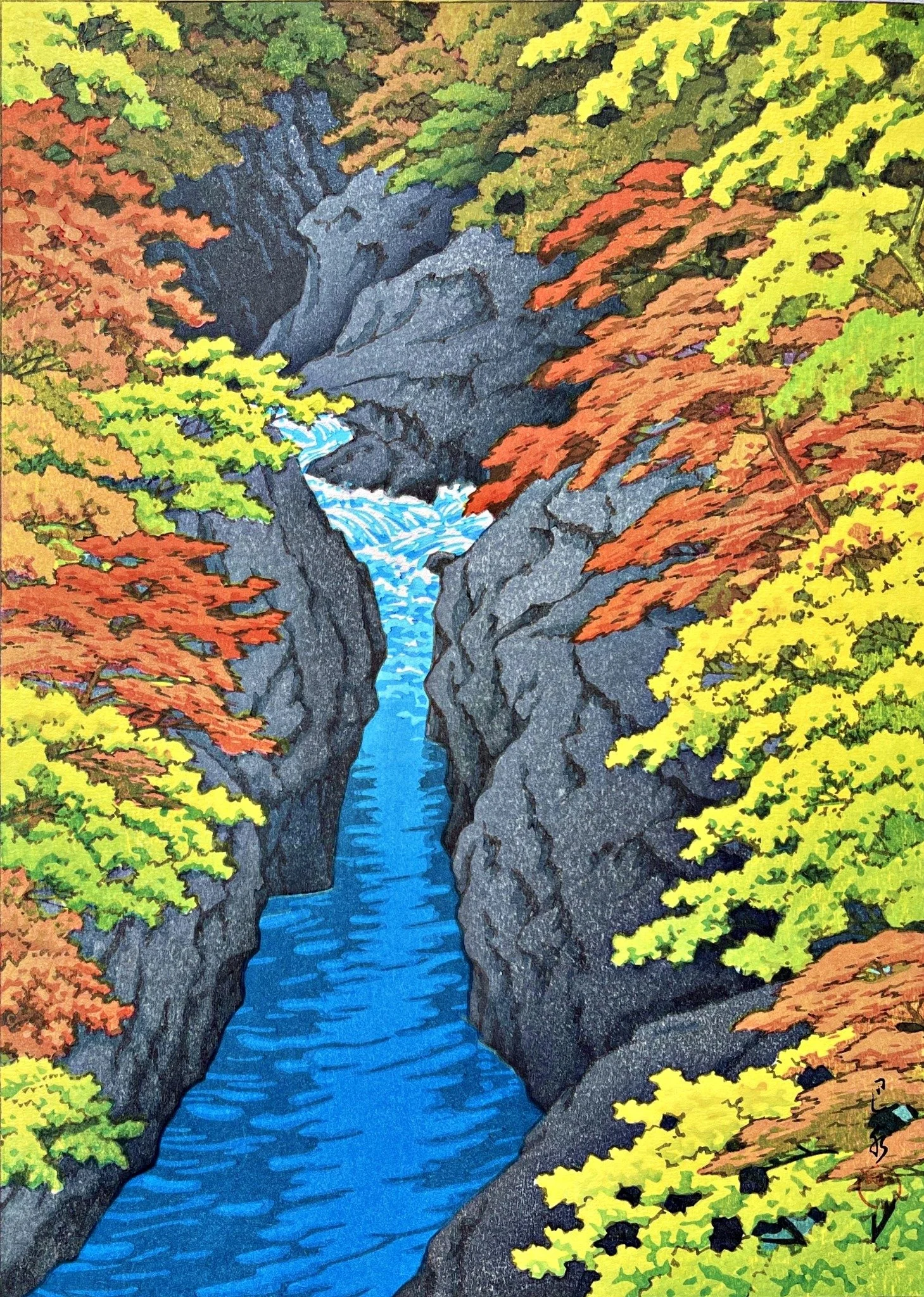
Brilliant autumn leaves frame a blue river flowing between tall grey cliffs. Kawase Hasui’s Azuma Gorge brings the warmth of red and golden foliage together with the calm of deep water, reproduced on canvas over a sturdy 1.5-inch wood stretcher.
Product details: Canvas reproduction over a sturdy 1.5-inch wood stretcher. Available in 16 × 24 in. ($259 CAD) and 24 × 36 in. ($299 CAD). No returns accepted.
More About the Art
Azuma Gorge opens a passage into a brilliant autumn landscape. A blue river runs between high grey cliffs, while branches bearing red, orange, yellow, and green leaves extend across the rock faces. Near the upper centre, white water tumbles through a narrow opening before entering the deeper channel below. Kawase Hasui brings these elements close together within a vertical composition, allowing the eye to move from the broad foreground river toward the smaller rapids and enclosing foliage.
The water gives the image its clearest continuous shape. It widens at the lower edge, bends around the projecting rocks, and narrows as it travels into the gorge. Short, darker marks suggest gentle ripples across the nearer surface. Farther upstream, sharper white curves and broken blue passages describe the force of the current. The contrast lets the river appear both restful and active, with quieter water flowing toward the viewer from the more turbulent distance.
The cliffs establish another rhythm. Their irregular faces are divided by cracks, sharp edges, and dark vertical recesses. Some planes catch a lighter grey, while others retreat into almost black shadow. These differences give the gorge weight and depth without overwhelming the clear design. The rock walls seem to press inward around the river, yet the open blue channel prevents the view from feeling closed. It remains an inviting route through the landscape.
Autumn foliage spreads over these strong mineral forms in layered clusters. Red and orange branches reach inward from both sides, often running diagonally across the cliffs. Yellow leaves brighten the upper and lower edges, and patches of green keep the season varied. The foliage is arranged as distinct shapes rather than an undifferentiated canopy. Small interruptions of dark rock remain visible between the leaves, making the bright colours more vivid and giving the branches room to breathe.
There is no visible figure, building, or bridge to interrupt the encounter with water, stone, and trees. Scale emerges through the relationship between the broad foreground and the distant white rapids. The high viewpoint reveals the river’s surface while preserving the height of the cliffs. Hasui makes the view feel immediate and substantial, with enough detail to suggest the particular character of the gorge and enough simplification to keep its larger movement clear.
Known in Japanese as Azuma-kyō, 吾妻峡, the design was first printed in 1943 and published by Watanabe Shōzaburō. The Cleveland Museum of Art dates its example to 1943. The Los Angeles County Museum of Art records a 1947 impression and explicitly notes the earlier printing date; the Museum of Fine Arts, Boston also holds an example dated 1947. These dates belong to the print’s publication history and do not establish the edition represented by this canvas reproduction.
The supplied image is reproduced in its portrait composition, preserving the blue channel, towering cliffs, bright foliage, and distant rapids. Its autumn colours bring warmth and energy to a room, while the river gives the arrangement a steady centre. From a distance, the strong shapes remain clear. Closer viewing reveals the different leaf clusters, uneven rock surfaces, and changing patterns of water that make this enclosed landscape feel spacious and alive.
More About the Artist
Kawase Hasui (1883–1957) devoted much of his career to Japanese landscapes seen through changing seasons, weather, and light. His woodblock prints include quiet waterways, temple grounds, coastal villages, mountain roads, and snowy streets. Azuma Gorge presents a particularly vivid expression of that interest. Here, the close relationship between blue water, grey rock, and autumn leaves gives the landscape a strong structure while keeping its seasonal atmosphere at the centre of the experience.
Born in Tokyo with the given name Bunjiro, Hasui studied both Western-style and Japanese-style painting. His teachers included Okada Saburosuke, and in 1910 he entered the studio of Kaburaki Kiyokata. The work of Itō Shinsui, another artist associated with Kiyokata’s circle, helped turn his attention toward landscape printmaking. His early prints appeared in the late 1910s, beginning a sustained relationship with the publisher Watanabe Shōzaburō that continued through much of his mature career.
Watanabe played a central role in shin-hanga, meaning “new prints,” a movement that renewed Japanese woodblock production during the early twentieth century. The process brought together a designer, specialist block carvers, printers, and a publisher. Traditional skills remained essential, while the finished images explored observed light, depth, and atmosphere. Hasui’s designs offered these craftspeople a rich range of subjects, from fine rain and falling snow to broad expanses of water and carefully balanced architectural forms.
Travel and sketching supplied material for his landscapes. He journeyed across Japan, recording both well-known places and quieter settings. His work often makes a modest corner of a town or an unoccupied stretch of landscape feel worthy of sustained attention. In Azuma Gorge, there is no human activity to explain the view. The changing width of the river, layered foliage, and tall cliffs are enough to establish a complete world within the picture.
His career also passed through major disruption. The Great Kantō Earthquake of 1923 destroyed Watanabe’s premises, woodblocks, and print stock, and Hasui lost his sketchbooks. He continued working, producing landscapes over the following decades and remaining active after the Second World War. His output eventually encompassed more than six hundred prints, alongside illustrations for publications, posters, menus, and postcards. This varied activity extended the reach of his imagery beyond individual landscape sheets.
In 1953, Japan’s Cultural Properties Protection Committee documented the making of Snow at Zōjōji Temple. The project recorded the coordinated craft involved in producing a traditional colour woodblock print. It also offers a useful way to understand Hasui’s achievement: the image and its realization were closely connected. Drawn contours, carved lines, areas of colour, and the printer’s handling of tone all contributed to the finished impression.
Azuma Gorge reveals that relationship through a remarkably clear arrangement. The solid cliffs are separated into irregular planes; leaves overlap them in bright clusters; white rapids introduce a concentrated point of movement. The river connects these contrasting surfaces from the foreground to the distance. Hasui gives each element its own character while making the entire composition feel coherent. His landscape invites the viewer to stay with the scene, noticing how much variety can unfold within a single channel of water.
Sources for the artwork and artist
Cleveland Museum of Art — Azuma Gorge, 1943; artist, Watanabe Shōzaburō, medium and design image
Los Angeles County Museum of Art — Azuma Gorge; 1947 impression, first printed 1943
Museum of Fine Arts, Boston — Azuma Gorge (Azuma-kyō), 1947; collection example 50.2853
Tokyo Fuji Art Museum — Kawase Hasui biography and the 1953 documentation of woodblock production
Premium quality canvas print of “Azuma Gorge” by Kawase Hasui
Brilliant autumn leaves frame a blue river flowing between tall grey cliffs. Kawase Hasui’s Azuma Gorge brings the warmth of red and golden foliage together with the calm of deep water, reproduced on canvas over a sturdy 1.5-inch wood stretcher.
Product details: Canvas reproduction over a sturdy 1.5-inch wood stretcher. Available in 16 × 24 in. ($259 CAD) and 24 × 36 in. ($299 CAD). No returns accepted.
More About the Art
Azuma Gorge opens a passage into a brilliant autumn landscape. A blue river runs between high grey cliffs, while branches bearing red, orange, yellow, and green leaves extend across the rock faces. Near the upper centre, white water tumbles through a narrow opening before entering the deeper channel below. Kawase Hasui brings these elements close together within a vertical composition, allowing the eye to move from the broad foreground river toward the smaller rapids and enclosing foliage.
The water gives the image its clearest continuous shape. It widens at the lower edge, bends around the projecting rocks, and narrows as it travels into the gorge. Short, darker marks suggest gentle ripples across the nearer surface. Farther upstream, sharper white curves and broken blue passages describe the force of the current. The contrast lets the river appear both restful and active, with quieter water flowing toward the viewer from the more turbulent distance.
The cliffs establish another rhythm. Their irregular faces are divided by cracks, sharp edges, and dark vertical recesses. Some planes catch a lighter grey, while others retreat into almost black shadow. These differences give the gorge weight and depth without overwhelming the clear design. The rock walls seem to press inward around the river, yet the open blue channel prevents the view from feeling closed. It remains an inviting route through the landscape.
Autumn foliage spreads over these strong mineral forms in layered clusters. Red and orange branches reach inward from both sides, often running diagonally across the cliffs. Yellow leaves brighten the upper and lower edges, and patches of green keep the season varied. The foliage is arranged as distinct shapes rather than an undifferentiated canopy. Small interruptions of dark rock remain visible between the leaves, making the bright colours more vivid and giving the branches room to breathe.
There is no visible figure, building, or bridge to interrupt the encounter with water, stone, and trees. Scale emerges through the relationship between the broad foreground and the distant white rapids. The high viewpoint reveals the river’s surface while preserving the height of the cliffs. Hasui makes the view feel immediate and substantial, with enough detail to suggest the particular character of the gorge and enough simplification to keep its larger movement clear.
Known in Japanese as Azuma-kyō, 吾妻峡, the design was first printed in 1943 and published by Watanabe Shōzaburō. The Cleveland Museum of Art dates its example to 1943. The Los Angeles County Museum of Art records a 1947 impression and explicitly notes the earlier printing date; the Museum of Fine Arts, Boston also holds an example dated 1947. These dates belong to the print’s publication history and do not establish the edition represented by this canvas reproduction.
The supplied image is reproduced in its portrait composition, preserving the blue channel, towering cliffs, bright foliage, and distant rapids. Its autumn colours bring warmth and energy to a room, while the river gives the arrangement a steady centre. From a distance, the strong shapes remain clear. Closer viewing reveals the different leaf clusters, uneven rock surfaces, and changing patterns of water that make this enclosed landscape feel spacious and alive.
More About the Artist
Kawase Hasui (1883–1957) devoted much of his career to Japanese landscapes seen through changing seasons, weather, and light. His woodblock prints include quiet waterways, temple grounds, coastal villages, mountain roads, and snowy streets. Azuma Gorge presents a particularly vivid expression of that interest. Here, the close relationship between blue water, grey rock, and autumn leaves gives the landscape a strong structure while keeping its seasonal atmosphere at the centre of the experience.
Born in Tokyo with the given name Bunjiro, Hasui studied both Western-style and Japanese-style painting. His teachers included Okada Saburosuke, and in 1910 he entered the studio of Kaburaki Kiyokata. The work of Itō Shinsui, another artist associated with Kiyokata’s circle, helped turn his attention toward landscape printmaking. His early prints appeared in the late 1910s, beginning a sustained relationship with the publisher Watanabe Shōzaburō that continued through much of his mature career.
Watanabe played a central role in shin-hanga, meaning “new prints,” a movement that renewed Japanese woodblock production during the early twentieth century. The process brought together a designer, specialist block carvers, printers, and a publisher. Traditional skills remained essential, while the finished images explored observed light, depth, and atmosphere. Hasui’s designs offered these craftspeople a rich range of subjects, from fine rain and falling snow to broad expanses of water and carefully balanced architectural forms.
Travel and sketching supplied material for his landscapes. He journeyed across Japan, recording both well-known places and quieter settings. His work often makes a modest corner of a town or an unoccupied stretch of landscape feel worthy of sustained attention. In Azuma Gorge, there is no human activity to explain the view. The changing width of the river, layered foliage, and tall cliffs are enough to establish a complete world within the picture.
His career also passed through major disruption. The Great Kantō Earthquake of 1923 destroyed Watanabe’s premises, woodblocks, and print stock, and Hasui lost his sketchbooks. He continued working, producing landscapes over the following decades and remaining active after the Second World War. His output eventually encompassed more than six hundred prints, alongside illustrations for publications, posters, menus, and postcards. This varied activity extended the reach of his imagery beyond individual landscape sheets.
In 1953, Japan’s Cultural Properties Protection Committee documented the making of Snow at Zōjōji Temple. The project recorded the coordinated craft involved in producing a traditional colour woodblock print. It also offers a useful way to understand Hasui’s achievement: the image and its realization were closely connected. Drawn contours, carved lines, areas of colour, and the printer’s handling of tone all contributed to the finished impression.
Azuma Gorge reveals that relationship through a remarkably clear arrangement. The solid cliffs are separated into irregular planes; leaves overlap them in bright clusters; white rapids introduce a concentrated point of movement. The river connects these contrasting surfaces from the foreground to the distance. Hasui gives each element its own character while making the entire composition feel coherent. His landscape invites the viewer to stay with the scene, noticing how much variety can unfold within a single channel of water.
Sources for the artwork and artist
Cleveland Museum of Art — Azuma Gorge, 1943; artist, Watanabe Shōzaburō, medium and design image
Los Angeles County Museum of Art — Azuma Gorge; 1947 impression, first printed 1943
Museum of Fine Arts, Boston — Azuma Gorge (Azuma-kyō), 1947; collection example 50.2853
Tokyo Fuji Art Museum — Kawase Hasui biography and the 1953 documentation of woodblock production