

 Image 1 of 1
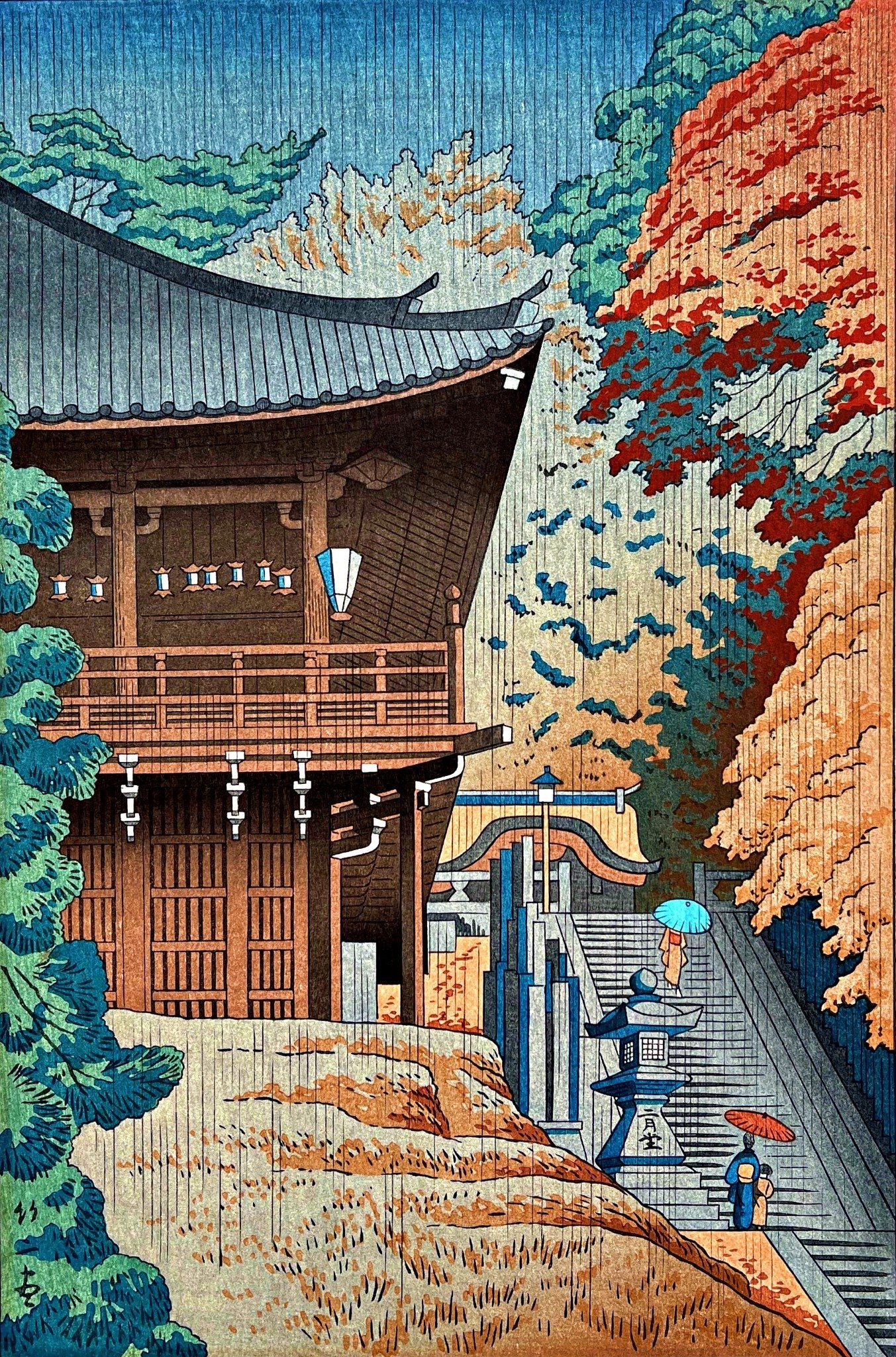
Autumn in Nigatsudo Temple — Takeji Asano (1953)
Premium quality canvas print of “Autumn in Nigatsudo Temple” by Takeji Asano
A projecting temple hall, rain-darkened steps, bright autumn foliage and small umbrellas create a richly layered view in Takeji Asano’s Autumn in Nigatsudo Temple. This portrait canvas reproduction is stretched over a sturdy 1.5-inch wood stretcher.
Product details: Canvas reproduction over a sturdy 1.5-inch wood stretcher. Available in 16 × 24 in. ($259 CAD) and 24 × 36 in. ($299 CAD). No returns accepted.
More About the Art
A dark wooden hall projects into the foreground of Autumn in Nigatsudo Temple. Its curved roof and layered supporting timbers establish a substantial form at the left, while a long flight of steps leads into the temple grounds on the right. Small figures carry bright umbrellas beneath fine vertical lines of rain. Pale and red foliage fills the surrounding space. Takeji Asano brings these elements together in a portrait composition that feels both closely enclosed and open to a gradual journey through the setting.
The original woodblock design was published by Unsōdō in 1953. A recorded first edition identifies its title, artist, publisher, and date. The image concentrates on the experience of moving through a temple precinct under autumn weather. Architecture, planting, steps, and visitors all contribute to that experience. The hall's large scale gives the foreground weight, while the smaller figures and repeated divisions of the stairway carry the eye toward more distant buildings and the narrow spaces between them.
The roof is especially important to the composition. Its dark surface stretches outward with a gently lifted edge, partly sheltering the timber structure below. Fine divisions suggest tiles, boards, and layered construction. Beneath it, a balustrade and closely spaced posts introduce another set of measured lines. The hall remains legible as a carefully built object, yet its edges are softened by the surrounding trees and rain. It belongs within the weather rather than standing apart from the landscape.
The steps establish a different rhythm. Their repeated pale bands narrow into the distance, giving the view a clear direction. Upright posts and smaller architectural details reinforce that movement. The stairway also provides a stage for the visitors, whose umbrellas appear as compact circles of colour. A turquoise umbrella catches the eye farther up the path, while warmer red and orange notes appear lower down. These accents make the place feel used without overwhelming the larger arrangement of buildings and foliage.
Autumn colour changes across the image. Bright red leaves gather near the upper right, while paler cream and muted peach shapes spread through the middle and foreground. Dark green trees provide a cooler contrast behind and beside the hall. The neighbouring colours remain clearly separated, allowing each area to contribute its own texture. Looking between them reveals how Asano balances large architectural surfaces with many smaller organic forms, keeping the scene detailed while preserving a coherent overall structure.
Rain supplies a unifying layer. Fine, closely repeated lines descend through sky, trees, and open spaces, making the weather visible without hiding the forms beneath it. The darker roof and timber respond differently from the pale foliage and steps. This variation keeps the view from becoming uniform. The umbrellas provide the clearest human response to the conditions, but the whole landscape seems shaped by the same damp atmosphere, connecting near surfaces and distant passages through a shared visual rhythm.
This canvas reproduction preserves the supplied image's full portrait composition. From across a room, the projecting roof and bright autumn trees establish a strong contrast. Closer attention reveals timber joints, stair divisions, small figures, and the delicate rain pattern. The eye can move gradually from the nearest hall toward the distant path, then return through the changing foliage. The work offers an attentive view of a familiar kind of place, where architecture and season are experienced together through ordinary movement and weather.
More About the Artist
Takeji Asano (1900–1998) was a Kyoto-born painter and woodblock artist whose work moved between carefully observed landscapes and imaginative creative prints. He is particularly associated with views of familiar places, where buildings, vegetation, weather, and light become parts of a balanced design. Autumn in Nigatsudo Temple presents this ability through a temple precinct: the location is recognizable, but its effect depends just as strongly on colour, rhythm, and the relationship between near and distant forms.
Asano’s early training was in painting. He graduated from the Kyoto School of Arts and Crafts in 1919 and the Kyoto Municipal School of Painting in 1923. His studies centred on Japanese-style painting, although he also explored oil painting. In 1927 he entered the school led by Tsuchida Bakusen. This background gave him several ways to organize an image, combining attention to natural forms with an awareness of how line and colour could hold a composition together.
Around 1930 he began working in woodblock printmaking. The landscapes of Kobayashi Kiyochika helped inspire his interest in famous-place prints. During the following decades, he created views of Kyoto, Osaka, Tokyo, Nara, and other parts of Japan. Kyoto Seika University describes his landscapes as the result of sketching places and translating them through a distinctive softness of form and a secure command of multicolour woodblock technique. His subjects included both older landmarks and the changing life around them.
His name is associated with two approaches to modern Japanese prints. In his work with Unsōdō, a publishing house in Kyoto, he supplied designs for collaborative landscape editions. The publisher began issuing his work in the early 1950s. Alongside these designs, Asano pursued sōsaku-hanga, or creative prints, in which he valued drawing, carving, and printing the work himself. These related practices allowed him to explore recognizable scenery as well as a freer visual language.
The distinction matters when looking at a reproduction of an Unsōdō design such as Autumn in Nigatsudo Temple. Its clear edges, repeated rain lines, and strongly defined architecture belong to an image conceived for woodblock printing. Broad areas of colour and carefully placed details serve different purposes within the same composition. The projecting hall establishes a substantial foreground, while steps and smaller figures carry the eye farther into the temple grounds. Seasonal colour and built structure become equally important to the view.
Asano’s later creative work expanded into people, animals, birds, and other subjects treated with simplified forms and an often playful spirit. Fuchū Art Museum has emphasized the warmth and freedom of these prints. The American artist Ben Shahn visited Asano’s studio in 1960, beginning an important artistic friendship. These works reveal another side of an artist who could observe a place carefully while remaining open to invention, humour, and unexpected relationships between forms.
His legacy has been sustained through exhibitions and substantial institutional collections. After his death, his family donated approximately 1,500 works to Kyoto Seika University. Their range helps place the serene landscape designs within a much larger career. In Autumn in Nigatsudo Temple, the qualities that make his famous-place prints so inviting remain easy to see: firm structure, generous colour, and an attentive view of the everyday experience of walking through temple grounds.
Sources for the artwork and artist
- Nipponprints — Autumn in Nigatsudo Temple; first edition 1953, Unsōdō
- Art Platform Japan, National Center for Art Research — Dictionary of Artists in Japan: Asano Takeji; Kyoto birthplace and dates 1900–1998
- Kyoto Seika University — Asano Takeji: Famous-Place Prints; training, Kiyochika, sketching and the university collection
- Fuchū Art Museum — The Woodblock World of Asano Takeji; landscape and creative prints, Ben Shahn and later subjects
- Gallery Nii Tokyo — Asano Takeji; artist biography and chronology, training, exhibitions and later work
Premium quality canvas print of “Autumn in Nigatsudo Temple” by Takeji Asano
A projecting temple hall, rain-darkened steps, bright autumn foliage and small umbrellas create a richly layered view in Takeji Asano’s Autumn in Nigatsudo Temple. This portrait canvas reproduction is stretched over a sturdy 1.5-inch wood stretcher.
Product details: Canvas reproduction over a sturdy 1.5-inch wood stretcher. Available in 16 × 24 in. ($259 CAD) and 24 × 36 in. ($299 CAD). No returns accepted.
More About the Art
A dark wooden hall projects into the foreground of Autumn in Nigatsudo Temple. Its curved roof and layered supporting timbers establish a substantial form at the left, while a long flight of steps leads into the temple grounds on the right. Small figures carry bright umbrellas beneath fine vertical lines of rain. Pale and red foliage fills the surrounding space. Takeji Asano brings these elements together in a portrait composition that feels both closely enclosed and open to a gradual journey through the setting.
The original woodblock design was published by Unsōdō in 1953. A recorded first edition identifies its title, artist, publisher, and date. The image concentrates on the experience of moving through a temple precinct under autumn weather. Architecture, planting, steps, and visitors all contribute to that experience. The hall's large scale gives the foreground weight, while the smaller figures and repeated divisions of the stairway carry the eye toward more distant buildings and the narrow spaces between them.
The roof is especially important to the composition. Its dark surface stretches outward with a gently lifted edge, partly sheltering the timber structure below. Fine divisions suggest tiles, boards, and layered construction. Beneath it, a balustrade and closely spaced posts introduce another set of measured lines. The hall remains legible as a carefully built object, yet its edges are softened by the surrounding trees and rain. It belongs within the weather rather than standing apart from the landscape.
The steps establish a different rhythm. Their repeated pale bands narrow into the distance, giving the view a clear direction. Upright posts and smaller architectural details reinforce that movement. The stairway also provides a stage for the visitors, whose umbrellas appear as compact circles of colour. A turquoise umbrella catches the eye farther up the path, while warmer red and orange notes appear lower down. These accents make the place feel used without overwhelming the larger arrangement of buildings and foliage.
Autumn colour changes across the image. Bright red leaves gather near the upper right, while paler cream and muted peach shapes spread through the middle and foreground. Dark green trees provide a cooler contrast behind and beside the hall. The neighbouring colours remain clearly separated, allowing each area to contribute its own texture. Looking between them reveals how Asano balances large architectural surfaces with many smaller organic forms, keeping the scene detailed while preserving a coherent overall structure.
Rain supplies a unifying layer. Fine, closely repeated lines descend through sky, trees, and open spaces, making the weather visible without hiding the forms beneath it. The darker roof and timber respond differently from the pale foliage and steps. This variation keeps the view from becoming uniform. The umbrellas provide the clearest human response to the conditions, but the whole landscape seems shaped by the same damp atmosphere, connecting near surfaces and distant passages through a shared visual rhythm.
This canvas reproduction preserves the supplied image's full portrait composition. From across a room, the projecting roof and bright autumn trees establish a strong contrast. Closer attention reveals timber joints, stair divisions, small figures, and the delicate rain pattern. The eye can move gradually from the nearest hall toward the distant path, then return through the changing foliage. The work offers an attentive view of a familiar kind of place, where architecture and season are experienced together through ordinary movement and weather.
More About the Artist
Takeji Asano (1900–1998) was a Kyoto-born painter and woodblock artist whose work moved between carefully observed landscapes and imaginative creative prints. He is particularly associated with views of familiar places, where buildings, vegetation, weather, and light become parts of a balanced design. Autumn in Nigatsudo Temple presents this ability through a temple precinct: the location is recognizable, but its effect depends just as strongly on colour, rhythm, and the relationship between near and distant forms.
Asano’s early training was in painting. He graduated from the Kyoto School of Arts and Crafts in 1919 and the Kyoto Municipal School of Painting in 1923. His studies centred on Japanese-style painting, although he also explored oil painting. In 1927 he entered the school led by Tsuchida Bakusen. This background gave him several ways to organize an image, combining attention to natural forms with an awareness of how line and colour could hold a composition together.
Around 1930 he began working in woodblock printmaking. The landscapes of Kobayashi Kiyochika helped inspire his interest in famous-place prints. During the following decades, he created views of Kyoto, Osaka, Tokyo, Nara, and other parts of Japan. Kyoto Seika University describes his landscapes as the result of sketching places and translating them through a distinctive softness of form and a secure command of multicolour woodblock technique. His subjects included both older landmarks and the changing life around them.
His name is associated with two approaches to modern Japanese prints. In his work with Unsōdō, a publishing house in Kyoto, he supplied designs for collaborative landscape editions. The publisher began issuing his work in the early 1950s. Alongside these designs, Asano pursued sōsaku-hanga, or creative prints, in which he valued drawing, carving, and printing the work himself. These related practices allowed him to explore recognizable scenery as well as a freer visual language.
The distinction matters when looking at a reproduction of an Unsōdō design such as Autumn in Nigatsudo Temple. Its clear edges, repeated rain lines, and strongly defined architecture belong to an image conceived for woodblock printing. Broad areas of colour and carefully placed details serve different purposes within the same composition. The projecting hall establishes a substantial foreground, while steps and smaller figures carry the eye farther into the temple grounds. Seasonal colour and built structure become equally important to the view.
Asano’s later creative work expanded into people, animals, birds, and other subjects treated with simplified forms and an often playful spirit. Fuchū Art Museum has emphasized the warmth and freedom of these prints. The American artist Ben Shahn visited Asano’s studio in 1960, beginning an important artistic friendship. These works reveal another side of an artist who could observe a place carefully while remaining open to invention, humour, and unexpected relationships between forms.
His legacy has been sustained through exhibitions and substantial institutional collections. After his death, his family donated approximately 1,500 works to Kyoto Seika University. Their range helps place the serene landscape designs within a much larger career. In Autumn in Nigatsudo Temple, the qualities that make his famous-place prints so inviting remain easy to see: firm structure, generous colour, and an attentive view of the everyday experience of walking through temple grounds.
Sources for the artwork and artist
- Nipponprints — Autumn in Nigatsudo Temple; first edition 1953, Unsōdō
- Art Platform Japan, National Center for Art Research — Dictionary of Artists in Japan: Asano Takeji; Kyoto birthplace and dates 1900–1998
- Kyoto Seika University — Asano Takeji: Famous-Place Prints; training, Kiyochika, sketching and the university collection
- Fuchū Art Museum — The Woodblock World of Asano Takeji; landscape and creative prints, Ben Shahn and later subjects
- Gallery Nii Tokyo — Asano Takeji; artist biography and chronology, training, exhibitions and later work