

 Image 1 of 1
Arakawa River in Snow — Kawase Hasui (c. 1930s)
Premium quality canvas print of “Arakawa River in Snow” by Kawase Hasui
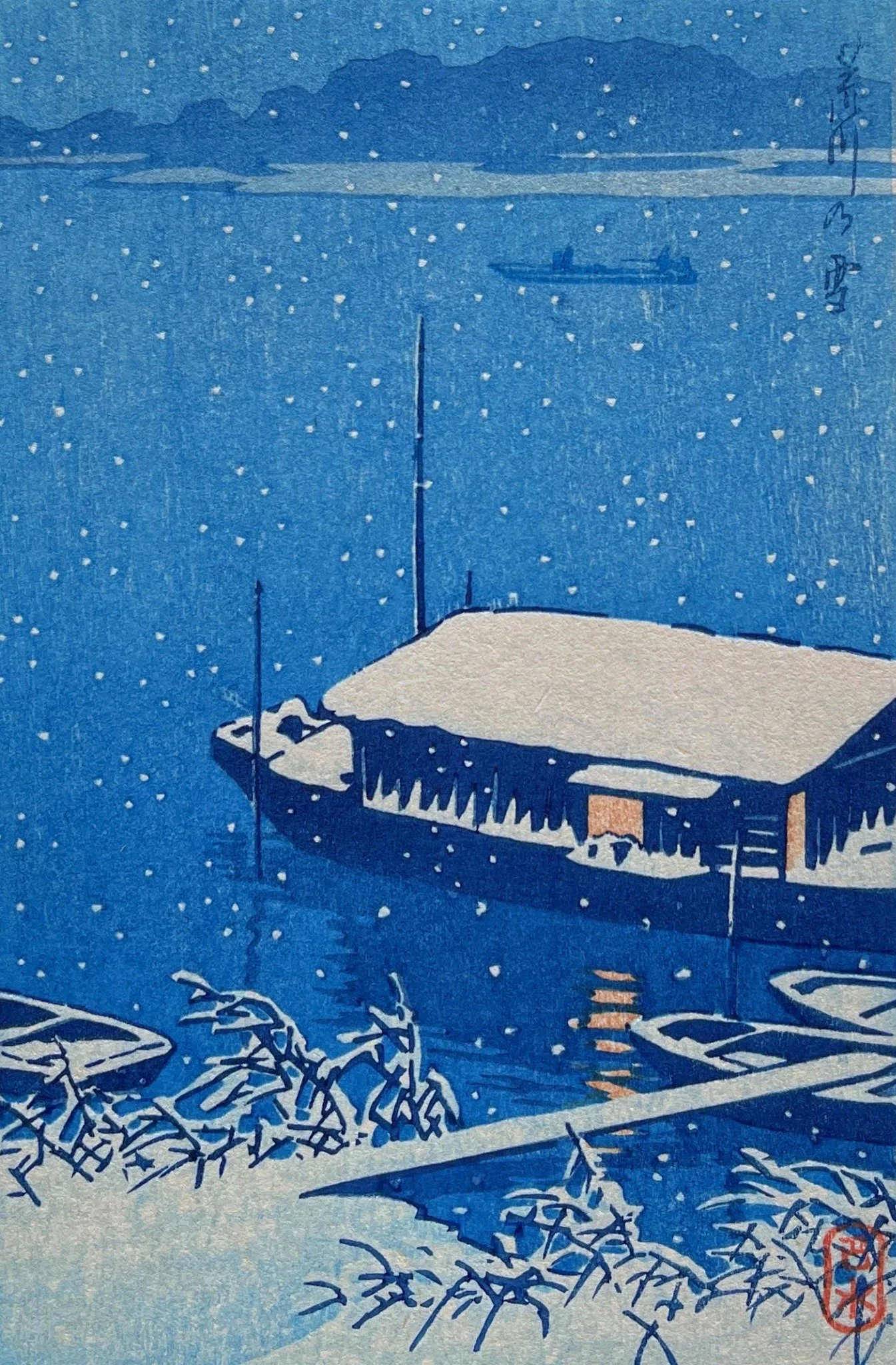
Warm windows glow within a snow-covered riverboat as white flakes drift across a world of deep blue. Kawase Hasui’s Arakawa River in Snow brings a quiet sense of winter shelter into your home as a portrait canvas reproduction over a sturdy 1.5-inch wood stretcher.
Product details: Canvas reproduction over a sturdy 1.5-inch wood stretcher. Available in 16 × 24 in. ($259 CAD) and 24 × 36 in. ($299 CAD). No returns accepted.
More About the Art
Arakawa River in Snow gathers a winter riverside scene into an almost continuous field of blue. Large, irregular snowflakes fall across the sky, distant bank, open water, and boats. At the centre of attention, a covered riverboat carries a thick white blanket of snow on its broad roof. Two warm, peach-coloured windows interrupt its dark side, and a short trail of orange reflections glimmers in the water below. Dark reflections extend beneath the hull and poles.
The boat enters from the right, bringing its shelter close to the viewer while leaving the left side of the river open. Snow has collected along its edges, turning small ledges and uneven surfaces into a sequence of pale shapes. Thin poles rise from and beside the vessel. Their narrow vertical lines connect the substantial roof with the expanse above, giving the composition height without disturbing the feeling of stillness.
Smaller boats occupy the nearer edges. Their interiors and rims are picked out in white, while the surrounding water remains a deep, resonant blue. Snow-covered stems and branches form a more intricate foreground, spreading across the lower part of the image. A long diagonal line of snow leads from this near bank toward the boats at the right. These overlapping forms create a clear sense of proximity and place the viewer beside the water.
Farther away, a small dark boat rests within the broad middle distance. Beyond it, a pale horizontal band marks the opposite shore, with an undulating silhouette rising behind. The forms are simplified by distance and snowfall. Their quieter edges allow the nearer boat, white roof, and illuminated openings to remain prominent. The river feels spacious even though the composition contains relatively few distinct objects.
The snowflakes are essential to the image’s rhythm. Some gather against the dark hull, others drift across the lighter blue water, and many appear high above the distant shoreline. Their changing shapes keep the surface lively. Against this scattered white pattern, the reflected window light forms a small, deliberate vertical sequence. It offers a point of warmth without breaking the enveloping winter atmosphere.
Kawase Hasui’s design is also known as Snow at Arakawa River or Snow on the Arakawa River. Its Japanese title is Arakawa no yuki, 荒川の雪. The Virginia Museum of Fine Arts and the Harn Museum of Art date their examples approximately to the 1930s. Issued by Watanabe Shōzaburō, it belongs to the smaller print formats through which Hasui’s landscapes also circulated, concentrating a broad experience of weather and place into an intimate image.
This portrait canvas reproduction preserves the supplied composition, including the upper snowfall, distant bank, covered boat, warm windows, and snowy foreground. Across a room, its blues and whites create a clear, calming presence. Close viewing reveals the differing shapes of snow, the fine poles, small boats, and broken reflections. The scene’s emotional centre remains modest: a little light within a large winter landscape. That balance gives the work its welcoming sense of quiet shelter and makes the river’s stillness feel immediate.
More About the Artist
Kawase Hasui (1883–1957) was a Japanese artist whose colour woodblock landscapes give particular attention to the experience of a place under changing light and weather. His subjects range from temple grounds and city waterways to mountain villages, country roads, and coastal views. Arakawa River in Snow shows how a relatively simple arrangement of boats, water, snowfall, and illuminated windows can create a landscape with both clarity and emotional warmth.
Born in Tokyo with the given name Bunjiro, Hasui developed his art through more than one form of training. He studied Western-style painting under Okada Saburosuke and, in 1910, entered the studio of the Japanese-style painter Kaburaki Kiyokata. His early working life also included illustration and commercial design. These experiences helped him build images in which the larger arrangement remains clear while smaller details reward close attention.
An important turn came through the landscape prints of Itō Shinsui, another artist associated with Kiyokata’s studio. Hasui began working with the publisher Watanabe Shōzaburō in 1918. That collaboration became central to shin-hanga, or “new prints,” a renewal of Japanese woodblock production during the early twentieth century. Traditional craft skills remained essential, while artists explored observed scenery, tonal depth, and new ways of expressing atmosphere through colour and light.
Travel and sketching supplied much of Hasui’s subject matter. He journeyed widely across Japan, recording places that later became finished print designs. Museums have emphasized his interest in intimate settings as well as famous landmarks. A quiet waterway or a familiar group of buildings could become compelling when seen through particular weather. In the Arakawa design, the changing appearance of snow on boats and vegetation gives an ordinary riverside setting its distinctive character.
The finished woodblock print depended on coordinated work by designer, carvers, printers, and publisher. Hasui established the image, while specialist skills gave its lines and colour passages their material form. The Arakawa scene places several demands within a small space: broad blue areas, a dark hull, fine poles, scattered snowflakes, and small warm reflections. Their balance shows how much expressive variety can arise from a restrained arrangement of forms and colours.
His career continued through substantial disruption. The Great Kantō Earthquake of 1923 destroyed Watanabe’s premises, woodblocks, and print stock, and Hasui’s sketchbooks were also lost. He continued producing landscapes, and remained active after the Second World War. His work ultimately encompassed more than six hundred prints. Alongside larger designs, his output included illustrations and small formats, extending the range of settings in which people could encounter his art.
In 1953, the making of Snow at Zōjōji Temple was documented by Japan’s Cultural Properties Protection Committee, recording the coordinated skills involved in traditional print production. This recognition provides a useful perspective on Hasui’s achievement: his images were inseparable from the crafts through which they were realized. The strong silhouettes and delicate tonal relationships of his landscapes depended on careful decisions at every stage.
Arakawa River in Snow offers an especially direct encounter with that achievement. The warm windows occupy only a small part of the picture, yet they guide the eye through the much larger field of blue and white. Near and distant boats establish space, while the snowfall connects every part of the view. Hasui makes the landscape feel unified without making it uniform, leaving room for detail, atmosphere, and a quiet sense of human shelter.
Sources for the artwork and artist
Premium quality canvas print of “Arakawa River in Snow” by Kawase Hasui
Warm windows glow within a snow-covered riverboat as white flakes drift across a world of deep blue. Kawase Hasui’s Arakawa River in Snow brings a quiet sense of winter shelter into your home as a portrait canvas reproduction over a sturdy 1.5-inch wood stretcher.
Product details: Canvas reproduction over a sturdy 1.5-inch wood stretcher. Available in 16 × 24 in. ($259 CAD) and 24 × 36 in. ($299 CAD). No returns accepted.
More About the Art
Arakawa River in Snow gathers a winter riverside scene into an almost continuous field of blue. Large, irregular snowflakes fall across the sky, distant bank, open water, and boats. At the centre of attention, a covered riverboat carries a thick white blanket of snow on its broad roof. Two warm, peach-coloured windows interrupt its dark side, and a short trail of orange reflections glimmers in the water below. Dark reflections extend beneath the hull and poles.
The boat enters from the right, bringing its shelter close to the viewer while leaving the left side of the river open. Snow has collected along its edges, turning small ledges and uneven surfaces into a sequence of pale shapes. Thin poles rise from and beside the vessel. Their narrow vertical lines connect the substantial roof with the expanse above, giving the composition height without disturbing the feeling of stillness.
Smaller boats occupy the nearer edges. Their interiors and rims are picked out in white, while the surrounding water remains a deep, resonant blue. Snow-covered stems and branches form a more intricate foreground, spreading across the lower part of the image. A long diagonal line of snow leads from this near bank toward the boats at the right. These overlapping forms create a clear sense of proximity and place the viewer beside the water.
Farther away, a small dark boat rests within the broad middle distance. Beyond it, a pale horizontal band marks the opposite shore, with an undulating silhouette rising behind. The forms are simplified by distance and snowfall. Their quieter edges allow the nearer boat, white roof, and illuminated openings to remain prominent. The river feels spacious even though the composition contains relatively few distinct objects.
The snowflakes are essential to the image’s rhythm. Some gather against the dark hull, others drift across the lighter blue water, and many appear high above the distant shoreline. Their changing shapes keep the surface lively. Against this scattered white pattern, the reflected window light forms a small, deliberate vertical sequence. It offers a point of warmth without breaking the enveloping winter atmosphere.
Kawase Hasui’s design is also known as Snow at Arakawa River or Snow on the Arakawa River. Its Japanese title is Arakawa no yuki, 荒川の雪. The Virginia Museum of Fine Arts and the Harn Museum of Art date their examples approximately to the 1930s. Issued by Watanabe Shōzaburō, it belongs to the smaller print formats through which Hasui’s landscapes also circulated, concentrating a broad experience of weather and place into an intimate image.
This portrait canvas reproduction preserves the supplied composition, including the upper snowfall, distant bank, covered boat, warm windows, and snowy foreground. Across a room, its blues and whites create a clear, calming presence. Close viewing reveals the differing shapes of snow, the fine poles, small boats, and broken reflections. The scene’s emotional centre remains modest: a little light within a large winter landscape. That balance gives the work its welcoming sense of quiet shelter and makes the river’s stillness feel immediate.
More About the Artist
Kawase Hasui (1883–1957) was a Japanese artist whose colour woodblock landscapes give particular attention to the experience of a place under changing light and weather. His subjects range from temple grounds and city waterways to mountain villages, country roads, and coastal views. Arakawa River in Snow shows how a relatively simple arrangement of boats, water, snowfall, and illuminated windows can create a landscape with both clarity and emotional warmth.
Born in Tokyo with the given name Bunjiro, Hasui developed his art through more than one form of training. He studied Western-style painting under Okada Saburosuke and, in 1910, entered the studio of the Japanese-style painter Kaburaki Kiyokata. His early working life also included illustration and commercial design. These experiences helped him build images in which the larger arrangement remains clear while smaller details reward close attention.
An important turn came through the landscape prints of Itō Shinsui, another artist associated with Kiyokata’s studio. Hasui began working with the publisher Watanabe Shōzaburō in 1918. That collaboration became central to shin-hanga, or “new prints,” a renewal of Japanese woodblock production during the early twentieth century. Traditional craft skills remained essential, while artists explored observed scenery, tonal depth, and new ways of expressing atmosphere through colour and light.
Travel and sketching supplied much of Hasui’s subject matter. He journeyed widely across Japan, recording places that later became finished print designs. Museums have emphasized his interest in intimate settings as well as famous landmarks. A quiet waterway or a familiar group of buildings could become compelling when seen through particular weather. In the Arakawa design, the changing appearance of snow on boats and vegetation gives an ordinary riverside setting its distinctive character.
The finished woodblock print depended on coordinated work by designer, carvers, printers, and publisher. Hasui established the image, while specialist skills gave its lines and colour passages their material form. The Arakawa scene places several demands within a small space: broad blue areas, a dark hull, fine poles, scattered snowflakes, and small warm reflections. Their balance shows how much expressive variety can arise from a restrained arrangement of forms and colours.
His career continued through substantial disruption. The Great Kantō Earthquake of 1923 destroyed Watanabe’s premises, woodblocks, and print stock, and Hasui’s sketchbooks were also lost. He continued producing landscapes, and remained active after the Second World War. His work ultimately encompassed more than six hundred prints. Alongside larger designs, his output included illustrations and small formats, extending the range of settings in which people could encounter his art.
In 1953, the making of Snow at Zōjōji Temple was documented by Japan’s Cultural Properties Protection Committee, recording the coordinated skills involved in traditional print production. This recognition provides a useful perspective on Hasui’s achievement: his images were inseparable from the crafts through which they were realized. The strong silhouettes and delicate tonal relationships of his landscapes depended on careful decisions at every stage.
Arakawa River in Snow offers an especially direct encounter with that achievement. The warm windows occupy only a small part of the picture, yet they guide the eye through the much larger field of blue and white. Near and distant boats establish space, while the snowfall connects every part of the view. Hasui makes the landscape feel unified without making it uniform, leaving room for detail, atmosphere, and a quiet sense of human shelter.
Sources for the artwork and artist