

 Image 1 of 1
A Lighthouse — Attributed to Gyosui
A Quiet Light on the Water
A small golden beacon holds its place across still blue water, framed by the sheltering branches of a pine. This canvas reproduction brings home the quiet reassurance of a distant light and the spacious calm of an evening shore.
Product Details
Artist attribution: Attributed to Gyosui
Series: Hasegawa’s Night Scenes
Artwork date: Early twentieth century; surviving impressions are commonly dated to the 1910s.
Canvas reproduction stretched over a 1.5-inch wood stretcher.
16 × 24 inches — C$259
24 × 36 inches — C$299
No returns accepted.
More About the Art
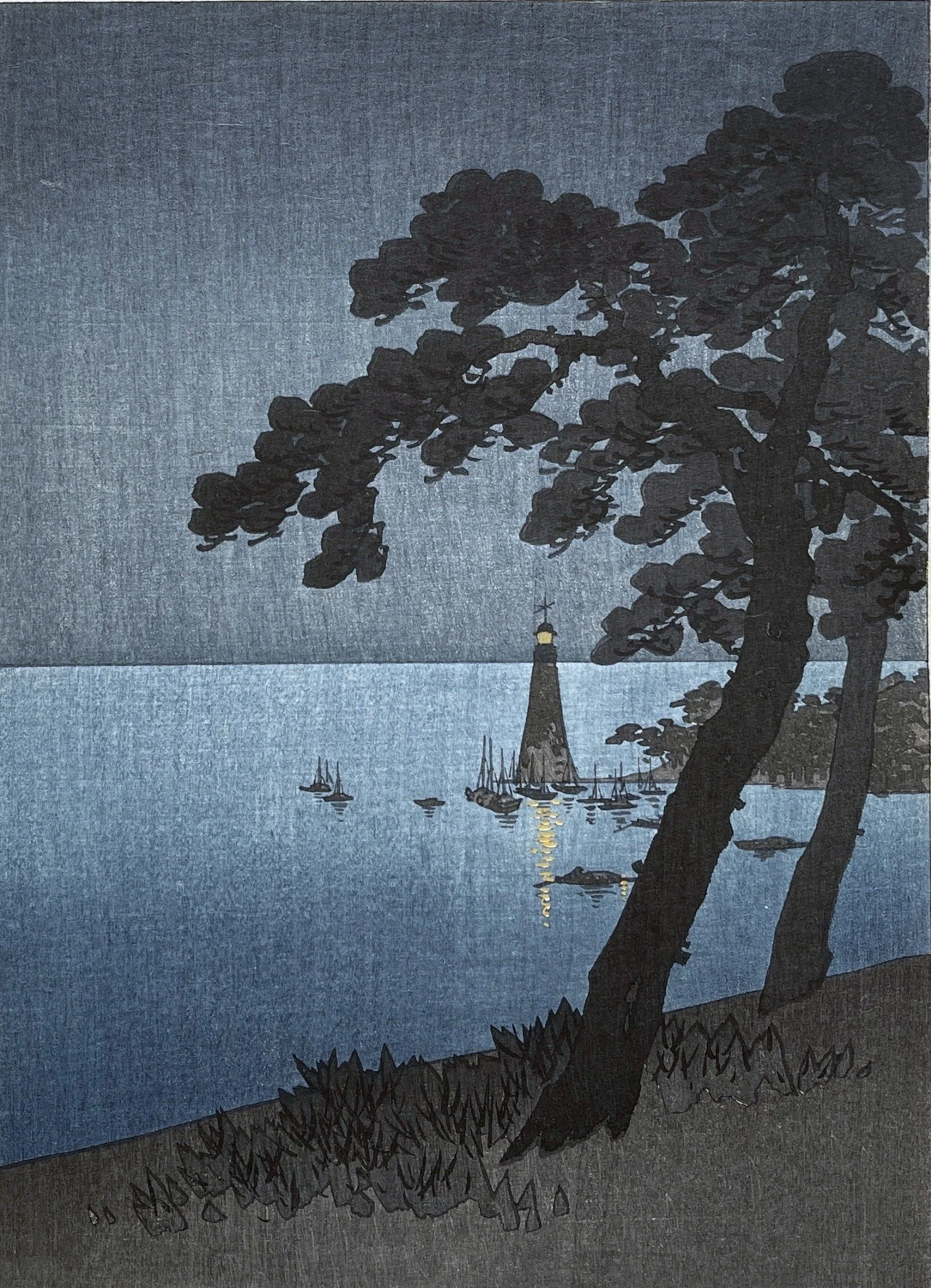
A Lighthouse brings together a dark pine, an open stretch of blue water, and a single warm light. The viewer stands on a sloping shore, looking past the foreground trees toward a slender lighthouse surrounded by small boats. The design belongs to the group generally known as Hasegawa’s Night Scenes. It is commonly dated to the early twentieth century, with surviving impressions often catalogued as prints of the 1910s.
The pine is the image’s most immediate presence. Its broad trunk rises from the lower right, leaning inward as its branches spread across the sky. Rounded masses of foliage overlap in near-black silhouettes. Openings between them reveal patches of blue, giving the tree a pattern that is both dense and airy. A second trunk reinforces the foreground, creating a close boundary beside the expansive water.
The shoreline runs diagonally across the bottom of the composition. Small, pointed plants interrupt its edge, their dark outlines repeating the sharper accents of the boats’ masts. This strip of land places us firmly on the near shore. We look outward from a sheltered position, with the tree beside us and the lighthouse across the water. That arrangement gives the distant scene an intimate point of entry.
Beyond the pine, the water occupies a broad, uncluttered space. Boats appear at different distances, some gathered close to the lighthouse and others standing apart. Their low hulls and narrow masts are drawn with economical lines. These small marks introduce human activity without crowding the view. No individual story is explained, leaving the harbour’s quiet presence available to the viewer’s own imagination.
The lighthouse’s shape is simple and emphatic. Its tapered body rises above the nearby boats, ending in a small yellow light that attracts the eye immediately. The tower is not oversized within the composition. Its importance comes from that bright accent and the clear vertical line it adds among the horizontal water and irregular pine branches. A slight structure above the lantern completes its silhouette.
Below the beacon, yellow reflections descend in separated strokes. Their broken rhythm suggests a lightly moving surface, allowing the warm colour to travel toward us without becoming a solid stripe. The reflection provides a connection between the distant tower and the nearer water. It also gives the scene a gentle pulse: the light remains steady at its source while its appearance changes across the surface.
The palette is restrained. Several shades of blue establish distance and atmosphere, while dark grey and black give weight to the shore and trees. The lighthouse light supplies a small but memorable contrast. With so much of the image held in cool tones, its warmth can suggest reassurance or welcome. Those associations belong to our response to the scene; they do not require an invented history for the lighthouse.
The composition rewards two kinds of looking. From a distance, its great pine silhouette and open blue water establish an immediate sense of calm. Up close, the boats, shoreline plants, and reflected light become more apparent. Presented as a canvas reproduction, A Lighthouse offers an atmosphere of quiet attention, with a modest beacon holding its place within the wide evening landscape.
More About the Artist
The designer associated with A Lighthouse is generally identified by the artist name Gyosui, but the person behind that name has not been securely established for this print. This is an important distinction when discussing the work. The image has a documented place in Hasegawa’s Night Scenes, while its authorship is less certain. An account of the artist therefore begins with the surviving print records and the publishing world in which the design circulated.
Marc Kahn’s catalogue-based study of Hasegawa’s Night Scenes lists A Lighthouse under Gyosui. He explains that Hasegawa’s original catalogue did not provide artist attributions and that some impressions were issued without an artist seal. His identifications rely on seals encountered on surviving copies. The supplied image does not show a readable signature or seal, so it cannot settle the full identity of its designer on its own.
Modern commercial catalogues are divided. Ohmi Gallery attributes this design to Suzuki Gyosui, while other dealers identify Kawanabe Gyosui. These names should not be treated as interchangeable. Japan’s National Diet Library records Suzuki Gyosui, written 鈴木御水, with the life dates 1898–1982. It separately records Kawanabe Kyōsui, written 河鍋暁翠, with the dates 1868–1935. Getty also records Gyōsui as an alternative name for Kawanabe Kyōsui. Similar romanized names can obscure the fact that these records concern different individuals.
Kawanabe Kyōsui was a painter and the daughter of Kawanabe Kyōsai, as confirmed by the Joshibi Art Museum. Her career has its own well-documented history. That history should not be transferred to A Lighthouse simply because some dealers use her surname. Equally, the existence of an authority record for Suzuki Gyosui does not establish that Suzuki designed this particular image. Until firmer evidence links a named individual to the print, “attributed to Gyosui” is the careful credit.
The publishing context is clearer. Hasegawa Takejirō built a business around Japanese illustrated publications for readers abroad. He worked with artists and translators on woodblock-illustrated books, particularly his Japanese Fairy Tale series, which appeared in several languages. His use of textured crepe paper became a distinctive feature of many of these books. Single-sheet prints formed another part of this publishing activity, bringing Japanese images into the hands of overseas collectors and visitors.
Hasegawa’s Night Scenes belongs to that wider exchange. The surviving catalogue material brings together compact landscapes by several designers. Rivers, shorelines, temples, boats, and small sources of light recur across the group. Some designs were printed in different colour schemes, including blue and sepia. This variety reminds us that a familiar composition could take on a different atmosphere in another published version. A print’s design, its particular printing, and its later reproduction are related but distinct objects.
Such prints also emerged from a collaborative craft. A designer developed the image; carvers prepared the wooden printing blocks; printers applied colour and transferred it to paper; and the publisher organized production and distribution. The completed woodblock print therefore reflects both visual invention and skilled making. These general roles help explain the work’s historical setting, even where the names of everyone involved in an individual impression remain unknown.
For the viewer, A Lighthouse is an introduction to that tradition through a remarkably economical scene. The large pine, distant boats, and warm beacon create depth with few essential elements. Its continuing appeal does not depend on a complete biography. The work preserves a clear visual relationship between shelter and openness, darkness and light, and a distant place made approachable by the quiet act of looking.
Sources
A Quiet Light on the Water
A small golden beacon holds its place across still blue water, framed by the sheltering branches of a pine. This canvas reproduction brings home the quiet reassurance of a distant light and the spacious calm of an evening shore.
Product Details
Artist attribution: Attributed to Gyosui
Series: Hasegawa’s Night Scenes
Artwork date: Early twentieth century; surviving impressions are commonly dated to the 1910s.
Canvas reproduction stretched over a 1.5-inch wood stretcher.
16 × 24 inches — C$259
24 × 36 inches — C$299
No returns accepted.
More About the Art
A Lighthouse brings together a dark pine, an open stretch of blue water, and a single warm light. The viewer stands on a sloping shore, looking past the foreground trees toward a slender lighthouse surrounded by small boats. The design belongs to the group generally known as Hasegawa’s Night Scenes. It is commonly dated to the early twentieth century, with surviving impressions often catalogued as prints of the 1910s.
The pine is the image’s most immediate presence. Its broad trunk rises from the lower right, leaning inward as its branches spread across the sky. Rounded masses of foliage overlap in near-black silhouettes. Openings between them reveal patches of blue, giving the tree a pattern that is both dense and airy. A second trunk reinforces the foreground, creating a close boundary beside the expansive water.
The shoreline runs diagonally across the bottom of the composition. Small, pointed plants interrupt its edge, their dark outlines repeating the sharper accents of the boats’ masts. This strip of land places us firmly on the near shore. We look outward from a sheltered position, with the tree beside us and the lighthouse across the water. That arrangement gives the distant scene an intimate point of entry.
Beyond the pine, the water occupies a broad, uncluttered space. Boats appear at different distances, some gathered close to the lighthouse and others standing apart. Their low hulls and narrow masts are drawn with economical lines. These small marks introduce human activity without crowding the view. No individual story is explained, leaving the harbour’s quiet presence available to the viewer’s own imagination.
The lighthouse’s shape is simple and emphatic. Its tapered body rises above the nearby boats, ending in a small yellow light that attracts the eye immediately. The tower is not oversized within the composition. Its importance comes from that bright accent and the clear vertical line it adds among the horizontal water and irregular pine branches. A slight structure above the lantern completes its silhouette.
Below the beacon, yellow reflections descend in separated strokes. Their broken rhythm suggests a lightly moving surface, allowing the warm colour to travel toward us without becoming a solid stripe. The reflection provides a connection between the distant tower and the nearer water. It also gives the scene a gentle pulse: the light remains steady at its source while its appearance changes across the surface.
The palette is restrained. Several shades of blue establish distance and atmosphere, while dark grey and black give weight to the shore and trees. The lighthouse light supplies a small but memorable contrast. With so much of the image held in cool tones, its warmth can suggest reassurance or welcome. Those associations belong to our response to the scene; they do not require an invented history for the lighthouse.
The composition rewards two kinds of looking. From a distance, its great pine silhouette and open blue water establish an immediate sense of calm. Up close, the boats, shoreline plants, and reflected light become more apparent. Presented as a canvas reproduction, A Lighthouse offers an atmosphere of quiet attention, with a modest beacon holding its place within the wide evening landscape.
More About the Artist
The designer associated with A Lighthouse is generally identified by the artist name Gyosui, but the person behind that name has not been securely established for this print. This is an important distinction when discussing the work. The image has a documented place in Hasegawa’s Night Scenes, while its authorship is less certain. An account of the artist therefore begins with the surviving print records and the publishing world in which the design circulated.
Marc Kahn’s catalogue-based study of Hasegawa’s Night Scenes lists A Lighthouse under Gyosui. He explains that Hasegawa’s original catalogue did not provide artist attributions and that some impressions were issued without an artist seal. His identifications rely on seals encountered on surviving copies. The supplied image does not show a readable signature or seal, so it cannot settle the full identity of its designer on its own.
Modern commercial catalogues are divided. Ohmi Gallery attributes this design to Suzuki Gyosui, while other dealers identify Kawanabe Gyosui. These names should not be treated as interchangeable. Japan’s National Diet Library records Suzuki Gyosui, written 鈴木御水, with the life dates 1898–1982. It separately records Kawanabe Kyōsui, written 河鍋暁翠, with the dates 1868–1935. Getty also records Gyōsui as an alternative name for Kawanabe Kyōsui. Similar romanized names can obscure the fact that these records concern different individuals.
Kawanabe Kyōsui was a painter and the daughter of Kawanabe Kyōsai, as confirmed by the Joshibi Art Museum. Her career has its own well-documented history. That history should not be transferred to A Lighthouse simply because some dealers use her surname. Equally, the existence of an authority record for Suzuki Gyosui does not establish that Suzuki designed this particular image. Until firmer evidence links a named individual to the print, “attributed to Gyosui” is the careful credit.
The publishing context is clearer. Hasegawa Takejirō built a business around Japanese illustrated publications for readers abroad. He worked with artists and translators on woodblock-illustrated books, particularly his Japanese Fairy Tale series, which appeared in several languages. His use of textured crepe paper became a distinctive feature of many of these books. Single-sheet prints formed another part of this publishing activity, bringing Japanese images into the hands of overseas collectors and visitors.
Hasegawa’s Night Scenes belongs to that wider exchange. The surviving catalogue material brings together compact landscapes by several designers. Rivers, shorelines, temples, boats, and small sources of light recur across the group. Some designs were printed in different colour schemes, including blue and sepia. This variety reminds us that a familiar composition could take on a different atmosphere in another published version. A print’s design, its particular printing, and its later reproduction are related but distinct objects.
Such prints also emerged from a collaborative craft. A designer developed the image; carvers prepared the wooden printing blocks; printers applied colour and transferred it to paper; and the publisher organized production and distribution. The completed woodblock print therefore reflects both visual invention and skilled making. These general roles help explain the work’s historical setting, even where the names of everyone involved in an individual impression remain unknown.
For the viewer, A Lighthouse is an introduction to that tradition through a remarkably economical scene. The large pine, distant boats, and warm beacon create depth with few essential elements. Its continuing appeal does not depend on a complete biography. The work preserves a clear visual relationship between shelter and openness, darkness and light, and a distant place made approachable by the quiet act of looking.