
Japanese art on canvas
Tree Scene 126
Hajime Namiki · 2007
From $99 CAD
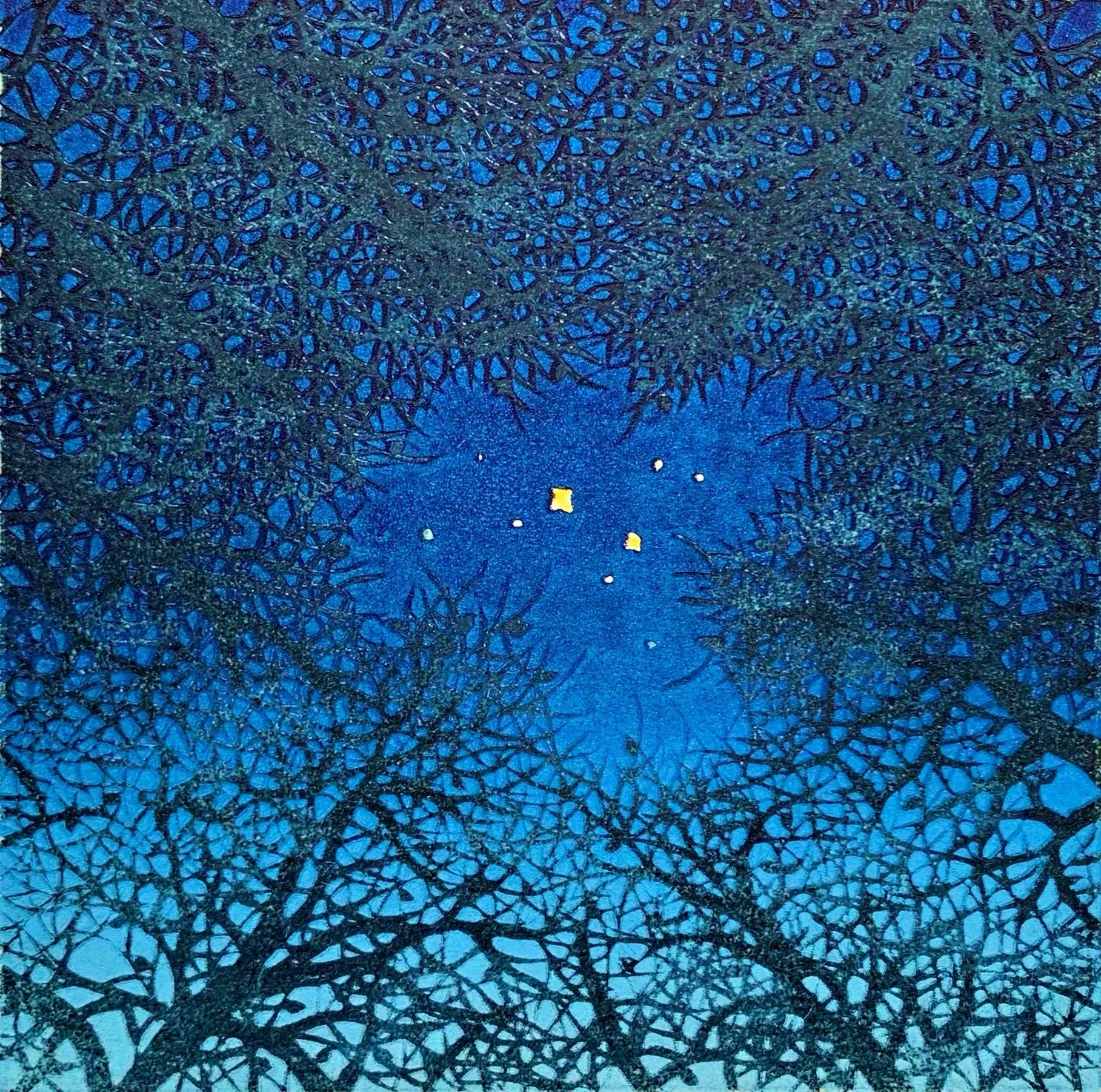
A luminous blue night opens through an intricate canopy of branches, where small stars and warm yellow accents shine in the quiet centre. Hajime Namiki’s Tree Scene 126 brings the intimacy of looking upward beneath trees to a square canvas reproduction over a sturdy 1.5-inch wood stretcher.
| 8 × 8 in. | $99 CAD |
|---|---|
| 12 × 12 in. | $149 CAD |
Choose your canvas size and quantity below. All prices are in CAD.
Artwork titles and dates identify the original work. Review the product details and available options before ordering.
Ask about this print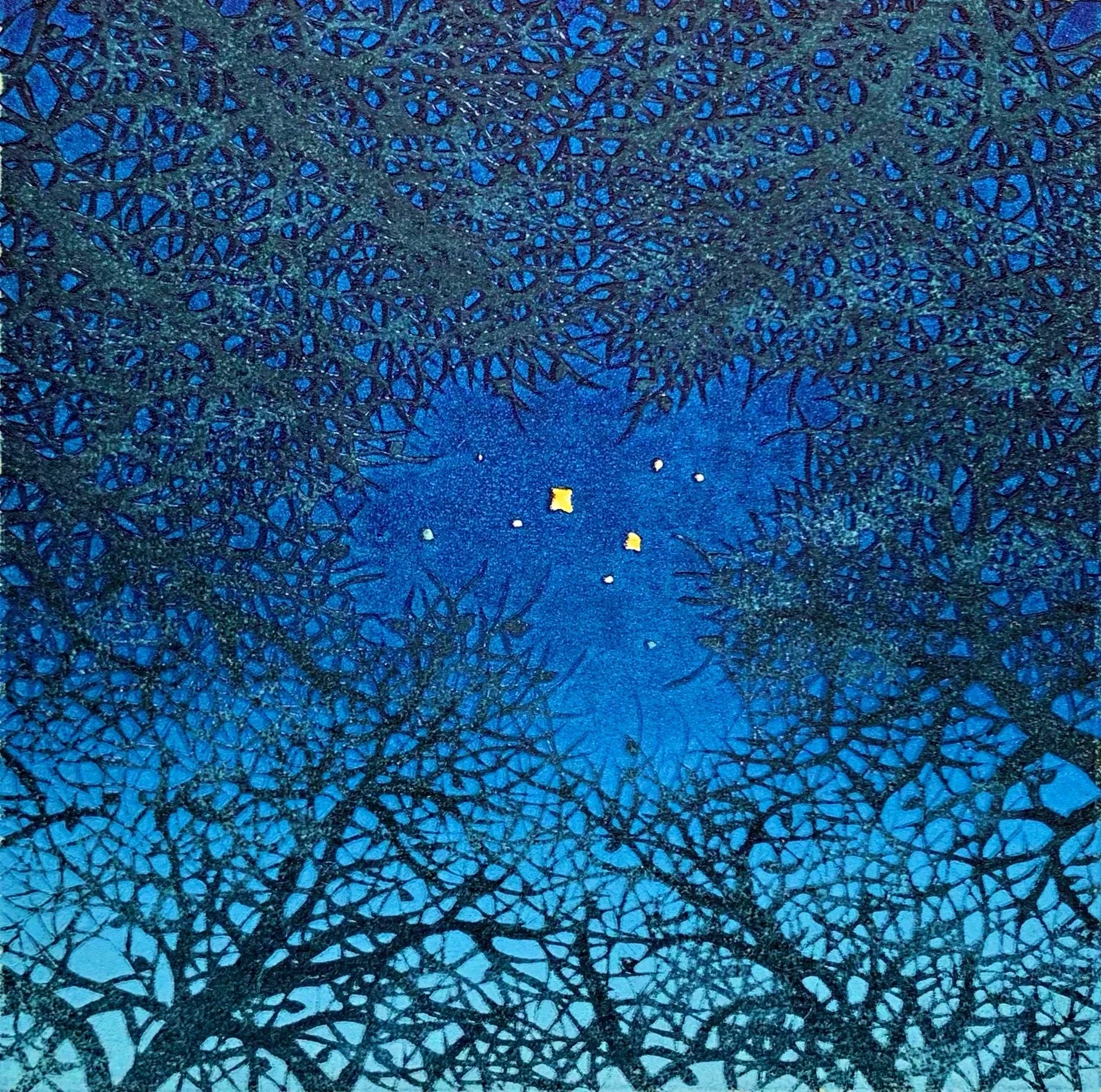
Premium quality canvas print of “Tree Scene 126” by Hajime Namiki
A luminous blue night opens through an intricate canopy of branches, where small stars and warm yellow accents shine in the quiet centre. Hajime Namiki’s Tree Scene 126 brings the intimacy of looking upward beneath trees to a square canvas reproduction over a sturdy 1.5-inch wood stretcher.
Product details: Canvas reproduction over a sturdy 1.5-inch wood stretcher. Available in 8 × 8 in. ($99 CAD) and 12 × 12 in. ($149 CAD). No returns accepted.
More About the Art
Tree Scene 126 draws the eye upward into a world of deep blue and interwoven branches. The trees surround a small opening in the canopy, where scattered points of pale light appear against the night. Two warmer yellow shapes give the centre a quiet radiance. Close foliage and distant sky meet within a nearly square composition, creating the feeling of looking up from beneath a sheltered grove.
Hajime Namiki created the woodblock design in 2007. Galerie Shinkura records the title as Tree Scene 126 and dates its original edition to that year. Within Namiki’s extensive Tree Scene sequence, this small, upward-looking view concentrates on the relationship between a close canopy and the open sky. Its subject is an intimate encounter with trees and starlight, expressed through a contemporary Japanese printmaker’s distinctive treatment of pattern and colour.
Around the edges, the branches form a dense network of dark, angular lines. Some curve gently while others divide into fine forks. Small blue spaces remain visible between them, preventing the canopy from becoming a single solid mass. Looking closely reveals a continual exchange between light and dark, with each opening helping to describe the shape of the surrounding growth.
The blue changes across the image. Near the lower edge, lighter turquoise brings a cool brightness to the foliage. Higher in the composition, deeper blue and muted green tones gather around the open sky. These shifts suggest different layers of branches without requiring a conventional horizon or a clearly marked foreground. Colour provides the sense of space, inviting the eye to move slowly.
At the centre, the pattern becomes less crowded. A few slender branches reach into the opening, but the sky has room to breathe. The scattered stars feel especially delicate beside the surrounding lattice. Their irregular spacing gives the night a natural, unarranged quality, while the two warmer accents gently draw attention back toward the middle of the composition.
This upward viewpoint changes how a landscape can be experienced. There is no path to follow and no building to locate. Instead, the viewer is surrounded by the living structure of the trees. The opening above suggests depth and distance, while the enclosing branches offer a feeling of closeness. Shelter and openness share the same small space.
The image also rewards attention as an arrangement of shapes. The branches can first be read as a nearly abstract texture, then gradually become a canopy overhead. That movement between pattern and recognition gives the work a lasting visual interest. It remains calm from across a room, yet offers many small intersections and changes of colour at a closer distance.
Original impressions of Tree Scene 126 are documented as colour woodblock prints with silver embellishment. Here, the supplied image is reproduced on canvas, retaining its intricate branch pattern, blue palette, and bright central accents. The canvas is stretched over a sturdy 1.5-inch wood frame and is available in two square sizes. Its enclosed, luminous atmosphere brings a contemplative accent to a reading corner, bedroom, or quiet living space.
More About the Artist
Hajime Namiki (born 1947) is a Japanese artist whose woodblock prints give trees a striking contemporary presence. His subjects include branching canopies, solitary trees, flowering specimens, forests, and views of Mount Fuji. Across these images, careful carving and concentrated colour turn familiar natural forms into compositions that can feel both intimate and expansive. Tree Scene 126 shows this approach through its intricate canopy and small opening onto the night sky.
Born in Tokyo, Namiki began his artistic training in sculpture. Galerie Shinkura records that he studied under the sculptor Shigeru Ogura in 1965, learning wood carving as part of that training. He joined the Japanese Sculpture Association in 1974 and began making woodblock prints in 1978. These dates describe a gradual development from working with carved form toward creating images through the carved surface of a printing block.
That background offers a useful way to appreciate his prints. A branch in a finished image may appear almost effortless, but its shape depends upon deliberate decisions about what to leave and what to remove. In Namiki’s work, a tree can be read as a structure of connected parts: trunk, limb, twig, and the small spaces between them. The balance between solidity and openness gives his compositions their distinctive clarity.
Namiki carries out the carving and printing of his works himself. An account published by the Hendricks Art Collection follows a visit to his home and studio in 1996. It describes his use of a hard cherrywood surface for fine detail, together with repeated printing in closely related shades. This direct studio observation helps explain how the branching networks in his images acquire such precise edges and rich variation.
Metallic leaf is another documented feature of his original prints. The Hendricks account describes the application of gold or silver during the printing process, and the Museum of Fine Arts, Houston catalogues Tree Scene 113 as a woodblock print with silver leaf. These materials belong to the original works on paper. In a canvas reproduction, their appearance is represented through the colours and textures captured in the source image.
His career has also reached audiences beyond Japan. Galerie Shinkura records exhibitions in several Japanese cities and woodblock lectures and demonstrations in Wisconsin during the 1990s. The Hendricks Art Collection presented his work in the United States and documented acquisitions of his prints by public institutions. LACMA’s collection includes Tree Scene 83, a colour woodblock print dated 1998, providing a museum record of his sustained exploration of the tree motif.
The appeal of that motif lies partly in its range. A single tree can suggest strength or isolation; a flowering crown can bring lightness and abundance; a canopy viewed from below can make the viewer feel enclosed within nature. Namiki’s compositions bring these possibilities into focus through the relationship between line and colour. Their emotional character develops from the visual arrangement, allowing each viewer to make a personal connection.
Tree Scene 126 offers a particularly quiet expression of those qualities. Its small stars draw attention beyond the branches, while the dense canopy keeps the experience close and tactile. Namiki’s detailed work invites the eye to pause at individual shapes before returning to the whole. The result is an image in which natural growth, disciplined craftsmanship, and the spaciousness of night remain in gentle balance.
Sources for the artwork and artist
Premium quality canvas print of “Tree Scene 126” by Hajime Namiki
A luminous blue night opens through an intricate canopy of branches, where small stars and warm yellow accents shine in the quiet centre. Hajime Namiki’s Tree Scene 126 brings the intimacy of looking upward beneath trees to a square canvas reproduction over a sturdy 1.5-inch wood stretcher.
Product details: Canvas reproduction over a sturdy 1.5-inch wood stretcher. Available in 8 × 8 in. ($99 CAD) and 12 × 12 in. ($149 CAD). No returns accepted.
More About the Art
Tree Scene 126 draws the eye upward into a world of deep blue and interwoven branches. The trees surround a small opening in the canopy, where scattered points of pale light appear against the night. Two warmer yellow shapes give the centre a quiet radiance. Close foliage and distant sky meet within a nearly square composition, creating the feeling of looking up from beneath a sheltered grove.
Hajime Namiki created the woodblock design in 2007. Galerie Shinkura records the title as Tree Scene 126 and dates its original edition to that year. Within Namiki’s extensive Tree Scene sequence, this small, upward-looking view concentrates on the relationship between a close canopy and the open sky. Its subject is an intimate encounter with trees and starlight, expressed through a contemporary Japanese printmaker’s distinctive treatment of pattern and colour.
Around the edges, the branches form a dense network of dark, angular lines. Some curve gently while others divide into fine forks. Small blue spaces remain visible between them, preventing the canopy from becoming a single solid mass. Looking closely reveals a continual exchange between light and dark, with each opening helping to describe the shape of the surrounding growth.
The blue changes across the image. Near the lower edge, lighter turquoise brings a cool brightness to the foliage. Higher in the composition, deeper blue and muted green tones gather around the open sky. These shifts suggest different layers of branches without requiring a conventional horizon or a clearly marked foreground. Colour provides the sense of space, inviting the eye to move slowly.
At the centre, the pattern becomes less crowded. A few slender branches reach into the opening, but the sky has room to breathe. The scattered stars feel especially delicate beside the surrounding lattice. Their irregular spacing gives the night a natural, unarranged quality, while the two warmer accents gently draw attention back toward the middle of the composition.
This upward viewpoint changes how a landscape can be experienced. There is no path to follow and no building to locate. Instead, the viewer is surrounded by the living structure of the trees. The opening above suggests depth and distance, while the enclosing branches offer a feeling of closeness. Shelter and openness share the same small space.
The image also rewards attention as an arrangement of shapes. The branches can first be read as a nearly abstract texture, then gradually become a canopy overhead. That movement between pattern and recognition gives the work a lasting visual interest. It remains calm from across a room, yet offers many small intersections and changes of colour at a closer distance.
Original impressions of Tree Scene 126 are documented as colour woodblock prints with silver embellishment. Here, the supplied image is reproduced on canvas, retaining its intricate branch pattern, blue palette, and bright central accents. The canvas is stretched over a sturdy 1.5-inch wood frame and is available in two square sizes. Its enclosed, luminous atmosphere brings a contemplative accent to a reading corner, bedroom, or quiet living space.
More About the Artist
Hajime Namiki (born 1947) is a Japanese artist whose woodblock prints give trees a striking contemporary presence. His subjects include branching canopies, solitary trees, flowering specimens, forests, and views of Mount Fuji. Across these images, careful carving and concentrated colour turn familiar natural forms into compositions that can feel both intimate and expansive. Tree Scene 126 shows this approach through its intricate canopy and small opening onto the night sky.
Born in Tokyo, Namiki began his artistic training in sculpture. Galerie Shinkura records that he studied under the sculptor Shigeru Ogura in 1965, learning wood carving as part of that training. He joined the Japanese Sculpture Association in 1974 and began making woodblock prints in 1978. These dates describe a gradual development from working with carved form toward creating images through the carved surface of a printing block.
That background offers a useful way to appreciate his prints. A branch in a finished image may appear almost effortless, but its shape depends upon deliberate decisions about what to leave and what to remove. In Namiki’s work, a tree can be read as a structure of connected parts: trunk, limb, twig, and the small spaces between them. The balance between solidity and openness gives his compositions their distinctive clarity.
Namiki carries out the carving and printing of his works himself. An account published by the Hendricks Art Collection follows a visit to his home and studio in 1996. It describes his use of a hard cherrywood surface for fine detail, together with repeated printing in closely related shades. This direct studio observation helps explain how the branching networks in his images acquire such precise edges and rich variation.
Metallic leaf is another documented feature of his original prints. The Hendricks account describes the application of gold or silver during the printing process, and the Museum of Fine Arts, Houston catalogues Tree Scene 113 as a woodblock print with silver leaf. These materials belong to the original works on paper. In a canvas reproduction, their appearance is represented through the colours and textures captured in the source image.
His career has also reached audiences beyond Japan. Galerie Shinkura records exhibitions in several Japanese cities and woodblock lectures and demonstrations in Wisconsin during the 1990s. The Hendricks Art Collection presented his work in the United States and documented acquisitions of his prints by public institutions. LACMA’s collection includes Tree Scene 83, a colour woodblock print dated 1998, providing a museum record of his sustained exploration of the tree motif.
The appeal of that motif lies partly in its range. A single tree can suggest strength or isolation; a flowering crown can bring lightness and abundance; a canopy viewed from below can make the viewer feel enclosed within nature. Namiki’s compositions bring these possibilities into focus through the relationship between line and colour. Their emotional character develops from the visual arrangement, allowing each viewer to make a personal connection.
Tree Scene 126 offers a particularly quiet expression of those qualities. Its small stars draw attention beyond the branches, while the dense canopy keeps the experience close and tactile. Namiki’s detailed work invites the eye to pause at individual shapes before returning to the whole. The result is an image in which natural growth, disciplined craftsmanship, and the spaciousness of night remain in gentle balance.
Sources for the artwork and artist
- Galerie Shinkura — Hajime Namiki; Tree Scene 126 dated 2007, original edition size, artist biography and exhibitions
- Ronin Gallery — Tree Scene 126 (2007); woodblock medium and silver embellishment of an original impression
- C. J. Campbell collection — owned impression of Tree Scene 126; 2007 date, colour woodblock, silver leaf and stars
- Hendricks Art Collection — firsthand studio visit, carving and printing methods, exhibitions and institutional acquisitions
- Los Angeles County Museum of Art — Tree Scene 83 (1998); artist born in Tokyo in 1947 and colour woodblock medium
- Museum of Fine Arts, Houston — Tree Scene 113; Namiki Hajime and woodblock printing with silver leaf
- Nipponprints — Tree Scene 126; first edition 2007 and description of night sky through tree branches
- Unsōdō — Hajime Namiki Tree Scene 158; self-carving and printing, artistic training and career chronology