
Japanese art on canvas
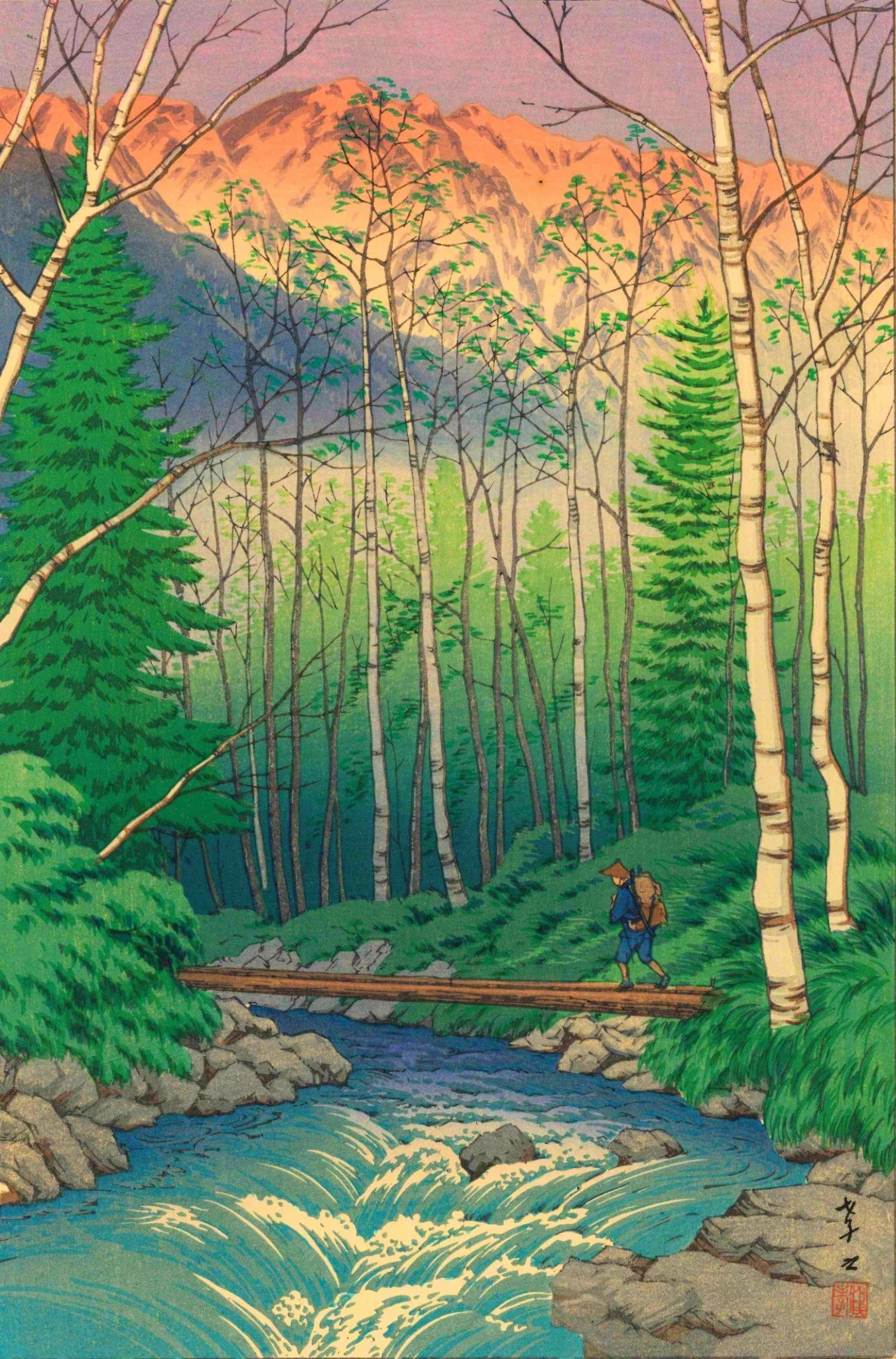
Takegawa River at Dawn
Itō Takashi · 1932
From $259 CAD
Warm dawn touches the mountain peaks above a green woodland and a rushing turquoise stream. Itō Takashi’s Takegawa River at Dawn brings the freshness and quiet wonder of Japan’s mountain landscape into your home, reproduced on canvas over a sturdy 1.5-inch wood stretcher.
| 16 × 24 in. | $259 CAD |
|---|---|
| 24 × 36 in. | $299 CAD |
Choose your canvas size and quantity below. All prices are in CAD.
Artwork titles and dates identify the original work. Review the product details and available options before ordering.
Ask about this print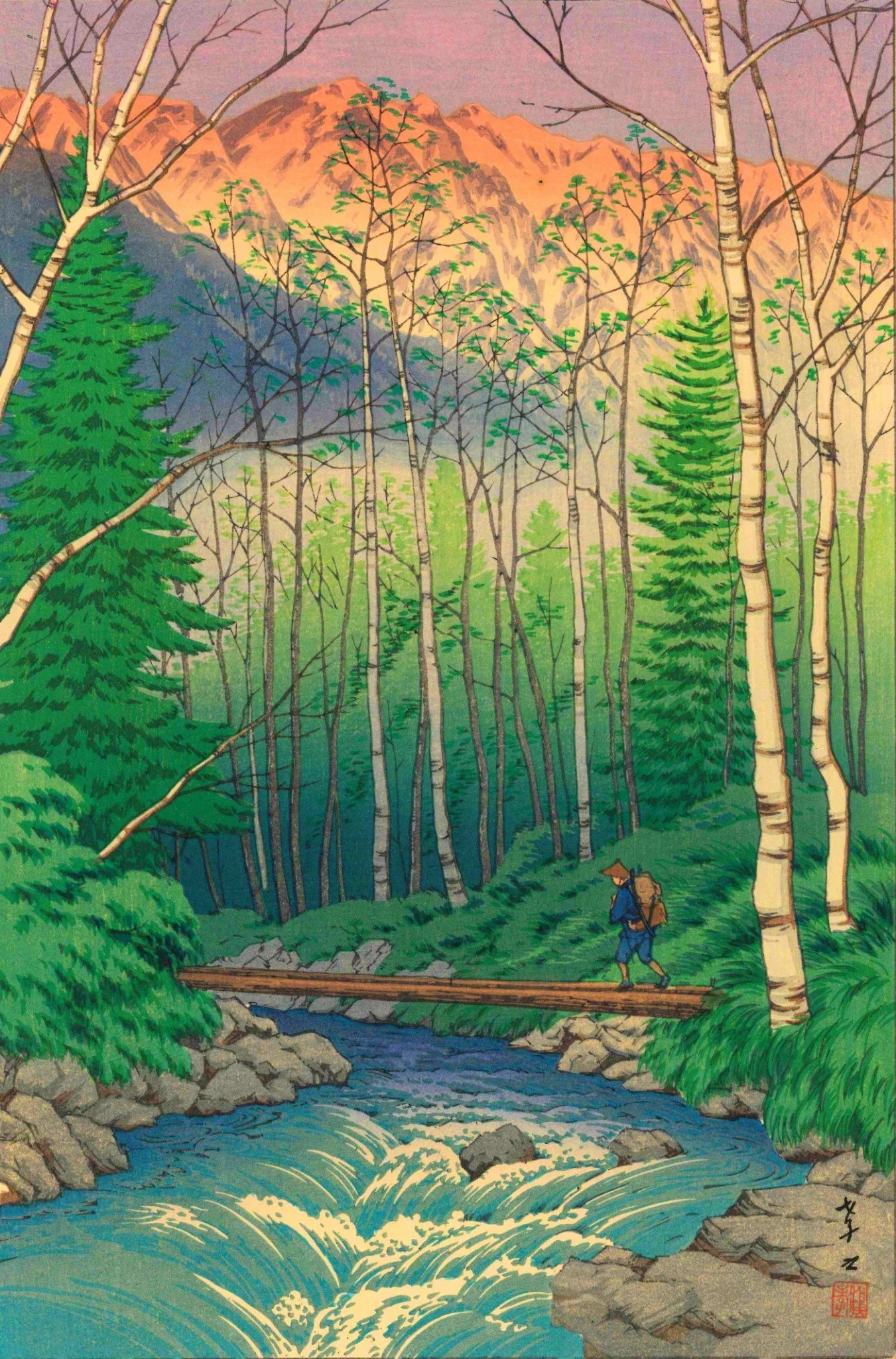
Premium quality canvas print of “Takegawa River at Dawn” by Itō Takashi
Warm dawn touches the mountain peaks above a green woodland and a rushing turquoise stream. Itō Takashi’s Takegawa River at Dawn brings the freshness and quiet wonder of Japan’s mountain landscape into your home, reproduced on canvas over a sturdy 1.5-inch wood stretcher.
Product details: Canvas reproduction over a sturdy 1.5-inch wood stretcher. Available in 16 × 24 in. ($259 CAD) and 24 × 36 in. ($299 CAD). No returns accepted.
More About the Art
Takegawa River at Dawn opens within a mountain woodland as the first light reaches the peaks. In the foreground, turquoise water breaks into pale foam around grey rocks. Above it, a narrow wooden bridge carries a solitary traveller between green banks. Slender trees rise through the middle distance, while the mountains beyond glow salmon pink and warm orange. The scene combines the freshness of moving water with the quiet spectacle of a landscape becoming visible at daybreak.
The river creates an immediate sense of movement. Its curves gather toward the lower edge of the composition, where long, pale strokes describe water spilling over a rocky ledge. Darker blue passages give depth to the current between the stones. The stream feels close enough to hear. It also draws the eye back into the image, beneath the bridge and toward the shaded woodland beyond.
The bridge offers a brief horizontal pause within this movement. Its warm brown surface crosses the cool water without railings or elaborate supports. On it walks a small figure in blue, wearing a broad hat and carrying a load. The traveller’s forward step gives the composition a human rhythm. Details of identity and destination remain open, allowing the crossing itself to become the point of connection between the viewer and the landscape.
Trees establish both distance and enclosure. Large, pale trunks frame the sides, their dark markings clearly visible against the green slopes. Behind them, thinner trunks and crossing branches create a delicate screen. Evergreen foliage forms deeper, denser shapes at left and right. Through these overlapping layers, the eye gradually reaches the high rock faces, passing from the intimate scale of the riverbank into the breadth of the mountains.
The strongest warmth appears at the top. Orange and rose colour the mountain ridge, with darker marks defining creases and exposed rock. Below, blue-grey shadows descend toward the forest. The pink sky connects these contrasting zones, giving the mountain light an atmosphere of its own. The image’s freshness comes partly from this meeting of warm distance and cool foreground, held together by the vertical movement of the trees.
Itō Takashi designed the original colour woodblock print in 1932. Ronin Gallery dates the design to July and identifies its publisher as Watanabe Shōzaburō. The Japanese title is Akeyuku Takegawa, written 明け行く岳川; English catalogues also use Dawn at Takegawa and River at Dawn. The Los Angeles County Museum of Art records the work as Dawn at Takegawa, Japan Alps, locating its subject within Japan’s mountain landscape.
The design belongs to shin-hanga, the twentieth-century renewal of Japanese woodblock printing. Its fine branches, layered colour, and flowing water bring together a painter’s sensitivity and the precision of woodblock craft. Presented as a canvas reproduction, Takegawa River at Dawn gives these relationships room to unfold. From a distance, the glowing ridge and green woodland establish a luminous presence; closer viewing reveals the traveller, the narrow crossing, and the changing patterns of the stream. It is a landscape that rewards a quiet moment of attention.
More About the Artist
Itō Takashi (1894–1982) was a Japanese painter and woodblock print designer whose landscapes bring together clear observation and an expressive sense of atmosphere. Mountain streams, wooded slopes, snowy shores, and distant peaks offered him subjects through which colour could suggest the changing character of a place. His prints belong to shin-hanga, the movement that renewed traditional woodblock production during the twentieth century, and his name is closely associated with the publisher Watanabe Shōzaburō.
Born near Hamamatsu in Shizuoka Prefecture, Itō pursued a painter’s education before becoming known for prints. His teachers included Kaburaki Kiyokata and Yūki Sōmei, and he studied at the Tokyo School of Fine Arts. This grounding in Japanese-style painting helps place his print designs within a wider artistic practice. He continued working as a painter, rather than treating woodblock design as the sole expression of his career.
His association with Watanabe began in 1922. The publisher brought artists together with specialist carvers and printers, continuing the shared workshop structure of Japanese woodblock production. Within this system, a design passed through several kinds of expertise before reaching its finished form. The Shizuoka City Tokaido Hiroshige Museum of Art describes shin-hanga as a renewal of inherited techniques that also pursued new forms of expression. Itō’s landscapes demonstrate the richness available within that continuing tradition.
Experiment was part of his approach. A 1936 Watanabe catalogue, discussed in the Lavenberg Collection’s research, records his interest in printing and overprinting. Some early works used only a small number of colours. The Great Kantō Earthquake of 1923 destroyed blocks and interrupted trials underway at Watanabe’s premises. Itō continued designing afterward, and the full-colour landscapes of the following decade reveal a remarkable range of tones, distances, and effects of light.
The painterly character of these images is one of their distinguishing qualities. Colour often changes gradually across sky, mountain, or water, rather than remaining within a uniform area. Such effects required skilled interpretation by the carvers and printers who realised the designs. In Takegawa River at Dawn, the shifting greens and blue shadows make the woodland feel layered, while the illuminated ridge appears to belong to a different register of light. Precise lines and broad atmospheric passages work together.
His subjects also reveal a sustained interest in season and weather. The Smithsonian’s National Museum of Asian Art holds Shibayamagata in Snow, Kaga Province, dated December 1929, as well as Distant View of Mt. Tateyama from Mt. Hakuba, dated June 1932. These works place winter conditions and mountain space within the same wider landscape practice. They offer useful companions to the woodland, running water, and warm dawn of the Takegawa composition.
Human figures give many of his landscapes an accessible scale. In the present image, the traveller occupies only a small part of the scene, yet the act of crossing a stream makes the setting imaginable as a lived place. The person does not compete with the mountain or woodland. Instead, a few carefully chosen details—a hat, a carried load, a forward step—suggest an encounter with a much larger world.
Itō designed prints intermittently over several decades, with work continuing into the 1960s. His landscapes are preserved in museum collections alongside those of other major shin-hanga artists, allowing their individual character to be appreciated within the movement’s broader history. Takegawa River at Dawn offers a particularly inviting introduction: its water has energy, its trees have delicacy, and its mountains carry the warmth of emerging light. Together, these elements create a scene that feels expansive while remaining closely observed.
Sources
LACMA — Dawn at Takegawa, Japan Alps; colour woodblock print, 1932
Ronin Gallery — Dawn at Takegawa; design dated July 1932; publisher Watanabe Shōzaburō
Collecting Japanese Prints — River at Dawn;1932 design and alternate English title
Artelino — Itō Takashi; painterly colour and woodblock craftsmanship
Smithsonian National Museum of Asian Art — Shibayamagata in Snow, Kaga Province, December 1929
Smithsonian National Museum of Asian Art — Distant View of Mt. Tateyama from Mt. Hakuba, June 1932
Premium quality canvas print of “Takegawa River at Dawn” by Itō Takashi
Warm dawn touches the mountain peaks above a green woodland and a rushing turquoise stream. Itō Takashi’s Takegawa River at Dawn brings the freshness and quiet wonder of Japan’s mountain landscape into your home, reproduced on canvas over a sturdy 1.5-inch wood stretcher.
Product details: Canvas reproduction over a sturdy 1.5-inch wood stretcher. Available in 16 × 24 in. ($259 CAD) and 24 × 36 in. ($299 CAD). No returns accepted.
More About the Art
Takegawa River at Dawn opens within a mountain woodland as the first light reaches the peaks. In the foreground, turquoise water breaks into pale foam around grey rocks. Above it, a narrow wooden bridge carries a solitary traveller between green banks. Slender trees rise through the middle distance, while the mountains beyond glow salmon pink and warm orange. The scene combines the freshness of moving water with the quiet spectacle of a landscape becoming visible at daybreak.
The river creates an immediate sense of movement. Its curves gather toward the lower edge of the composition, where long, pale strokes describe water spilling over a rocky ledge. Darker blue passages give depth to the current between the stones. The stream feels close enough to hear. It also draws the eye back into the image, beneath the bridge and toward the shaded woodland beyond.
The bridge offers a brief horizontal pause within this movement. Its warm brown surface crosses the cool water without railings or elaborate supports. On it walks a small figure in blue, wearing a broad hat and carrying a load. The traveller’s forward step gives the composition a human rhythm. Details of identity and destination remain open, allowing the crossing itself to become the point of connection between the viewer and the landscape.
Trees establish both distance and enclosure. Large, pale trunks frame the sides, their dark markings clearly visible against the green slopes. Behind them, thinner trunks and crossing branches create a delicate screen. Evergreen foliage forms deeper, denser shapes at left and right. Through these overlapping layers, the eye gradually reaches the high rock faces, passing from the intimate scale of the riverbank into the breadth of the mountains.
The strongest warmth appears at the top. Orange and rose colour the mountain ridge, with darker marks defining creases and exposed rock. Below, blue-grey shadows descend toward the forest. The pink sky connects these contrasting zones, giving the mountain light an atmosphere of its own. The image’s freshness comes partly from this meeting of warm distance and cool foreground, held together by the vertical movement of the trees.
Itō Takashi designed the original colour woodblock print in 1932. Ronin Gallery dates the design to July and identifies its publisher as Watanabe Shōzaburō. The Japanese title is Akeyuku Takegawa, written 明け行く岳川; English catalogues also use Dawn at Takegawa and River at Dawn. The Los Angeles County Museum of Art records the work as Dawn at Takegawa, Japan Alps, locating its subject within Japan’s mountain landscape.
The design belongs to shin-hanga, the twentieth-century renewal of Japanese woodblock printing. Its fine branches, layered colour, and flowing water bring together a painter’s sensitivity and the precision of woodblock craft. Presented as a canvas reproduction, Takegawa River at Dawn gives these relationships room to unfold. From a distance, the glowing ridge and green woodland establish a luminous presence; closer viewing reveals the traveller, the narrow crossing, and the changing patterns of the stream. It is a landscape that rewards a quiet moment of attention.
More About the Artist
Itō Takashi (1894–1982) was a Japanese painter and woodblock print designer whose landscapes bring together clear observation and an expressive sense of atmosphere. Mountain streams, wooded slopes, snowy shores, and distant peaks offered him subjects through which colour could suggest the changing character of a place. His prints belong to shin-hanga, the movement that renewed traditional woodblock production during the twentieth century, and his name is closely associated with the publisher Watanabe Shōzaburō.
Born near Hamamatsu in Shizuoka Prefecture, Itō pursued a painter’s education before becoming known for prints. His teachers included Kaburaki Kiyokata and Yūki Sōmei, and he studied at the Tokyo School of Fine Arts. This grounding in Japanese-style painting helps place his print designs within a wider artistic practice. He continued working as a painter, rather than treating woodblock design as the sole expression of his career.
His association with Watanabe began in 1922. The publisher brought artists together with specialist carvers and printers, continuing the shared workshop structure of Japanese woodblock production. Within this system, a design passed through several kinds of expertise before reaching its finished form. The Shizuoka City Tokaido Hiroshige Museum of Art describes shin-hanga as a renewal of inherited techniques that also pursued new forms of expression. Itō’s landscapes demonstrate the richness available within that continuing tradition.
Experiment was part of his approach. A 1936 Watanabe catalogue, discussed in the Lavenberg Collection’s research, records his interest in printing and overprinting. Some early works used only a small number of colours. The Great Kantō Earthquake of 1923 destroyed blocks and interrupted trials underway at Watanabe’s premises. Itō continued designing afterward, and the full-colour landscapes of the following decade reveal a remarkable range of tones, distances, and effects of light.
The painterly character of these images is one of their distinguishing qualities. Colour often changes gradually across sky, mountain, or water, rather than remaining within a uniform area. Such effects required skilled interpretation by the carvers and printers who realised the designs. In Takegawa River at Dawn, the shifting greens and blue shadows make the woodland feel layered, while the illuminated ridge appears to belong to a different register of light. Precise lines and broad atmospheric passages work together.
His subjects also reveal a sustained interest in season and weather. The Smithsonian’s National Museum of Asian Art holds Shibayamagata in Snow, Kaga Province, dated December 1929, as well as Distant View of Mt. Tateyama from Mt. Hakuba, dated June 1932. These works place winter conditions and mountain space within the same wider landscape practice. They offer useful companions to the woodland, running water, and warm dawn of the Takegawa composition.
Human figures give many of his landscapes an accessible scale. In the present image, the traveller occupies only a small part of the scene, yet the act of crossing a stream makes the setting imaginable as a lived place. The person does not compete with the mountain or woodland. Instead, a few carefully chosen details—a hat, a carried load, a forward step—suggest an encounter with a much larger world.
Itō designed prints intermittently over several decades, with work continuing into the 1960s. His landscapes are preserved in museum collections alongside those of other major shin-hanga artists, allowing their individual character to be appreciated within the movement’s broader history. Takegawa River at Dawn offers a particularly inviting introduction: its water has energy, its trees have delicacy, and its mountains carry the warmth of emerging light. Together, these elements create a scene that feels expansive while remaining closely observed.
Sources for the artwork and artist
- LACMA — Dawn at Takegawa, Japan Alps; colour woodblock print, 1932
- Ronin Gallery — Dawn at Takegawa; design dated July 1932; publisher Watanabe Shōzaburō
- Yamada Shoten — Dawn at Takegawa; Japanese title 明け行く岳川
- Collecting Japanese Prints — River at Dawn;1932 design and alternate English title
- The Lavenberg Collection of Japanese Prints — Itō Takashi biography and 1936 Watanabe catalogue discussion
- Shizuoka City Tokaido Hiroshige Museum of Art — Hanga no Keshiki; artist and collaborative woodblock production
- Artelino — Itō Takashi; painterly colour and woodblock craftsmanship
- Smithsonian National Museum of Asian Art — Shibayamagata in Snow, Kaga Province, December 1929
- Smithsonian National Museum of Asian Art — Distant View of Mt. Tateyama from Mt. Hakuba, June 1932