
Japanese art on canvas
Spring Rain at Gokoku Temple
Kawase Hasui · 1932
From $259 CAD
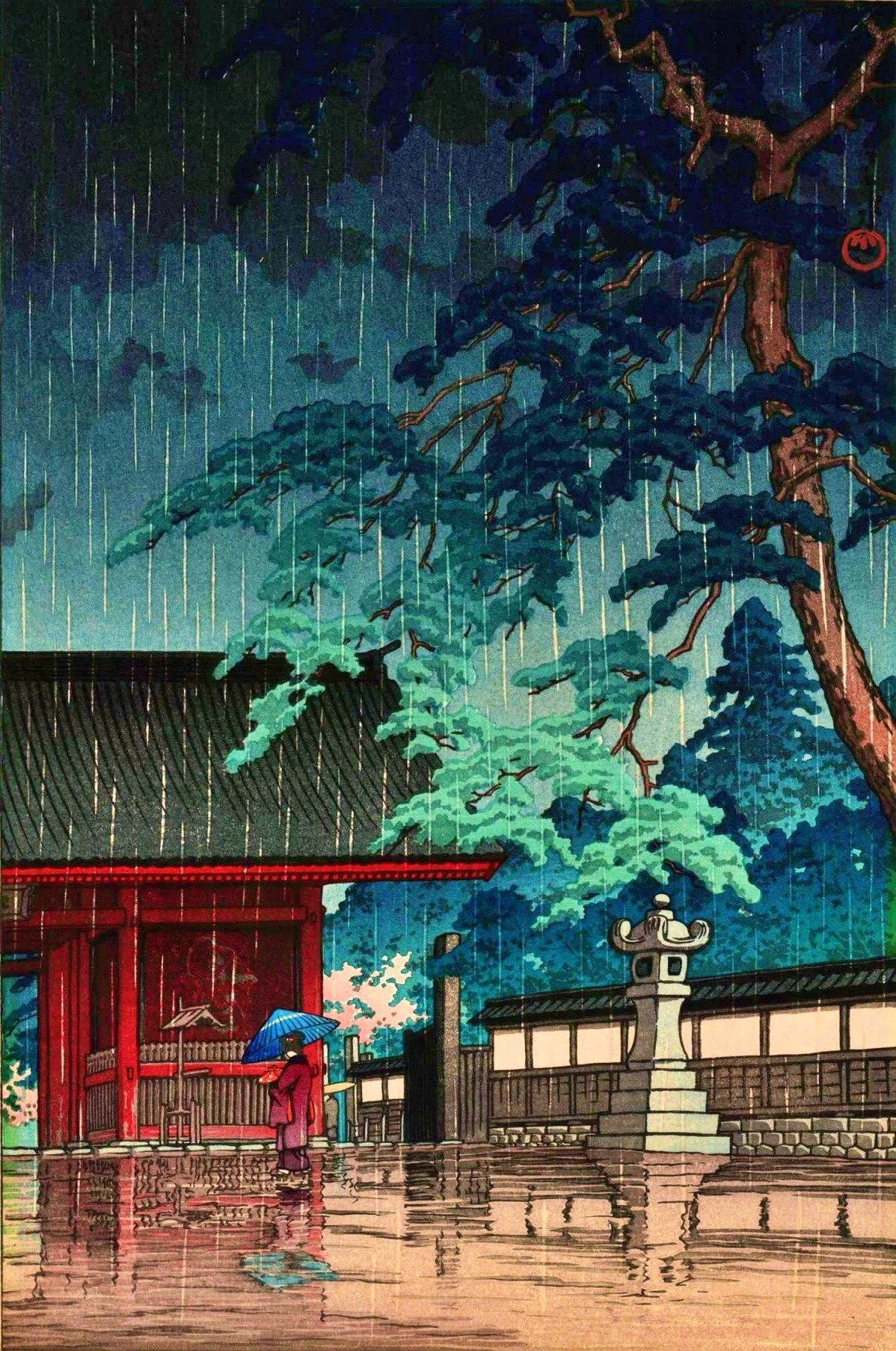
Fine rain falls beside a vermilion temple gate as a blue umbrella and spreading pine reflect across the wet ground. Kawase Hasui’s Spring Rain at Gokoku Temple brings the rich colour and quiet beauty of this Tokyo temple into your home, reproduced on canvas over a sturdy 1.5-inch wood stretcher.
| 16 × 24 in. | $259 CAD |
|---|---|
| 24 × 36 in. | $299 CAD |
Choose your canvas size and quantity below. All prices are in CAD.
Artwork titles and dates identify the original work. Review the product details and available options before ordering.
Ask about this print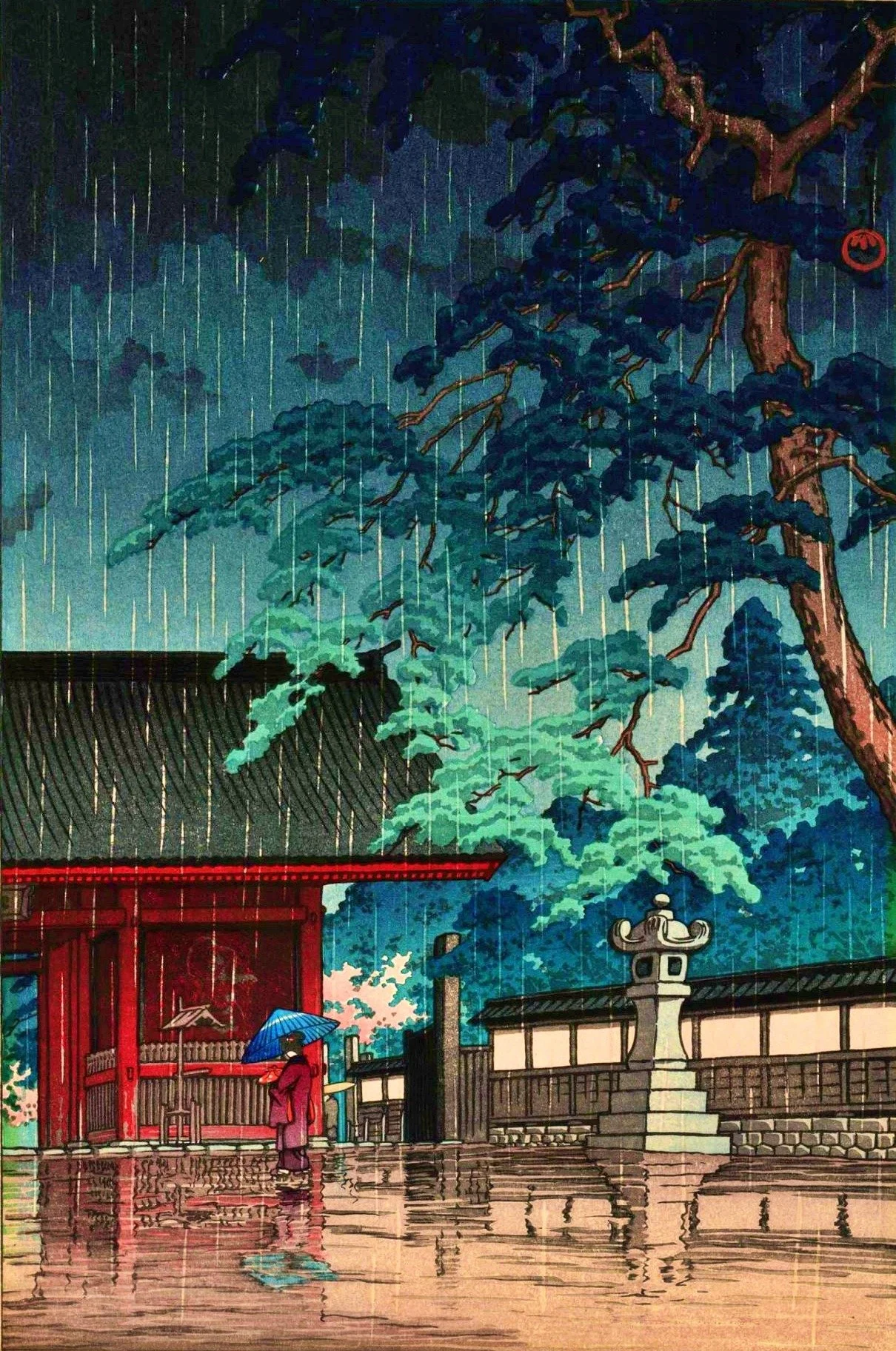
Premium quality canvas print of “Spring Rain at Gokoku Temple” by Kawase Hasui
Fine rain falls beside a vermilion temple gate as a blue umbrella and spreading pine reflect across the wet ground. Kawase Hasui’s Spring Rain at Gokoku Temple brings the rich colour and quiet beauty of this Tokyo temple into your home, reproduced on canvas over a sturdy 1.5-inch wood stretcher.
Product details: Canvas reproduction over a sturdy 1.5-inch wood stretcher. Available in 16 × 24 in. ($259 CAD) and 24 × 36 in. ($299 CAD). No returns accepted.
More About the Art
Spring Rain at Gokoku Temple brings a Tokyo temple entrance into an atmosphere of falling rain and reflected colour. A vermilion gate stands at the left beneath a broad, dark roof. Near it, a blue umbrella shelters a visitor dressed in warm red and purple tones. A stone lantern rises at the right, while a large pine extends its branches across the upper composition. Below, the wet ground gathers these forms into wavering reflections.
The pine gives the scene its height and movement. Its reddish-brown trunk rises along the right edge before dividing into twisting limbs. Dark clusters of needles spread across the sky, with lighter green passages appearing closer to the gate. The branches create a complicated network, yet openings between them keep the background visible. The tree feels close and sheltering, helping to enclose the more ordered architecture beneath it.
The temple gate introduces the strongest warm colour. Red posts, walls, and horizontal beams stand clearly against the blue-green surroundings. Fine lines describe the roof tiles and the wooden barrier near the entrance. These repeated architectural details give the gate a sense of stability. Its presence also provides a point of arrival, allowing the surrounding weather and foliage to become part of the experience of approaching a familiar place.
The umbrella adds another bright shape near the ground. Its blue canopy is small beside the roof and pine, but its angled ribs make it immediately recognisable. The clothing beneath it answers the red of the gate. This modest human presence gives scale to the buildings and trees, while offering a direct way into the atmosphere. The rain becomes something encountered at walking pace, with shelter, movement, and a destination close at hand.
Fine vertical marks pass through the composition, crossing foliage, sky, architecture, and ground. Their light colour makes the rain visible against the darker areas. At the bottom, horizontal ripples interrupt long reflections of the gate, lantern, and nearby forms. The contrast between falling lines and spreading water gives the image much of its rhythm. Warm peach tones on the wet surface balance the cool greens and deep blues above.
Kawase Hasui designed the original colour woodblock print in April 1932. Its Japanese title is Harusame (Gokokuji), written 春雨(護国寺), and it was published by Doi Sadaichi. The setting is Gokoku-ji in Tokyo’s Bunkyō district, a Shingon Buddhist temple founded in 1681 under the fifth Tokugawa shogun, Tsunayoshi, at the request of his mother, Keishōin. This history places the rain-filled view within a long-established religious landscape.
Hasui’s scene makes that setting intimate through colour, scale, and weather. The architecture is recognisable, but the rain connects every part of the view into a shared atmosphere. Presented as a canvas reproduction, Spring Rain at Gokoku Temple brings its rich blues, greens, and vermilion into a contemporary interior. From across the room, the gate and spreading pine establish the scene; closer viewing reveals the umbrella’s ribs, fine rain, roof tiles, and broken reflections. It offers a quietly absorbing image of spring in the city.
More About the Artist
Kawase Hasui (1883–1957) was a Japanese landscape artist whose woodblock designs made weather and light central to the experience of a place. Temple grounds, city streets, wooded roads, mountains, and coastlines all became subjects for his attentive observation. His images often combine clear architectural or natural forms with effects that seem more fleeting: rain across a roof, snow on a path, or reflections trembling on water. Spring Rain at Gokoku Temple brings these interests into a particularly rich arrangement.
Hasui was born in Tokyo with the given name Bunjiro. His artistic education included Western-style painting with Okada Saburosuke and Japanese-style painting under Kaburaki Kiyokata, whose studio he joined in 1910. Kiyokata gave him his artist’s name. This training helped him develop an approach in which strong outlines and carefully chosen viewpoints could work alongside convincing distance, gradual changes of colour, and sensitivity to the atmosphere of a particular setting.
The landscape prints of Itō Shinsui, another artist in Kiyokata’s circle, encouraged his interest in the woodblock medium. Hasui began collaborating with the publisher Watanabe Shōzaburō in 1918, forming an association that became central to shin-hanga, or “new prints.” The movement renewed traditional Japanese woodblock production through collaboration among artists, specialist carvers, printers, and publishers. It preserved a shared craft structure while allowing new approaches to colour, composition, and the effects of natural light.
Although Watanabe was his principal publishing partner, Hasui also designed prints for other firms. Spring Rain at Gokoku Temple was published by Doi Sadaichi in 1932. That distinction is part of the work’s history, while its imagery remains recognisably connected to Hasui’s wider landscape practice. The tall tree, architectural entrance, small human presence, and changing surface of the ground are brought together through an especially careful balance of warm and cool colour.
The production process required more than the initial design. A printer’s control of successive colours and a carver’s interpretation of fine lines were essential to the finished effect. In this scene, the pine’s branching structure and the gate’s repeated details remain legible beneath the rain. Reflections are clear enough to connect with the objects above them, yet broken enough to suggest water. The composition reveals how precision and atmosphere can support one another.
Travel and sketching gave Hasui a continuing source of subjects. He journeyed widely in Japan, while also finding many views within Tokyo and its surroundings. His career involved serious losses: the Great Kantō Earthquake of 1923 destroyed Watanabe’s premises, woodblocks, and print stock, and Hasui lost his house and sketchbooks. He continued travelling and designing afterward, building a substantial body of landscapes across the following decades.
He remained active after the Second World War and into the 1950s. In 1953, the production of Snow at Zōjōji Temple was documented by Japan’s Cultural Properties Protection Committee, preserving a record of the collaborative craft behind a finished print. His career ultimately encompassed more than six hundred designs. Museum collections now preserve a broad range of this work, allowing its individual settings and recurring interests to be considered together.
Hasui’s appeal rests in relationships that are easy to recognise but rewarding to examine. A bright umbrella gives scale and warmth to a rainy street; a tree connects open sky with built space; water extends a building through reflection. Spring Rain at Gokoku Temple offers these connections with particular clarity. Its historic setting feels approachable because the artist brings attention to an ordinary encounter with weather, shelter, and the beauty of a place seen slowly.
Sources
LACMA — Spring Rain at the Temple Gokokuji; colour woodblock print, April 1932
Christie’s — Harusame, Gokokuji; April 1932 design and publisher Doi Sadaichi
Kawase Hasui Catalogue — Spring Rain at Gokoku Temple; Japanese title and Doi publication details
Gokoku-ji Temple — Official history; 1681 foundation and temple architecture
Bunkyō City — Gokoku-ji; Shingon Buddhist affiliation and historical setting
GO TOKYO, official Tokyo travel guide — Gokoku-ji Temple in Bunkyō
Japan Museum SieboldHuis — Kawase Hasui: Capturing the Soul of Japan
Tokyo Fuji Art Museum — Kawase Hasui biography and 1953 print-production documentation
Premium quality canvas print of “Spring Rain at Gokoku Temple” by Kawase Hasui
Fine rain falls beside a vermilion temple gate as a blue umbrella and spreading pine reflect across the wet ground. Kawase Hasui’s Spring Rain at Gokoku Temple brings the rich colour and quiet beauty of this Tokyo temple into your home, reproduced on canvas over a sturdy 1.5-inch wood stretcher.
Product details: Canvas reproduction over a sturdy 1.5-inch wood stretcher. Available in 16 × 24 in. ($259 CAD) and 24 × 36 in. ($299 CAD). No returns accepted.
More About the Art
Spring Rain at Gokoku Temple brings a Tokyo temple entrance into an atmosphere of falling rain and reflected colour. A vermilion gate stands at the left beneath a broad, dark roof. Near it, a blue umbrella shelters a visitor dressed in warm red and purple tones. A stone lantern rises at the right, while a large pine extends its branches across the upper composition. Below, the wet ground gathers these forms into wavering reflections.
The pine gives the scene its height and movement. Its reddish-brown trunk rises along the right edge before dividing into twisting limbs. Dark clusters of needles spread across the sky, with lighter green passages appearing closer to the gate. The branches create a complicated network, yet openings between them keep the background visible. The tree feels close and sheltering, helping to enclose the more ordered architecture beneath it.
The temple gate introduces the strongest warm colour. Red posts, walls, and horizontal beams stand clearly against the blue-green surroundings. Fine lines describe the roof tiles and the wooden barrier near the entrance. These repeated architectural details give the gate a sense of stability. Its presence also provides a point of arrival, allowing the surrounding weather and foliage to become part of the experience of approaching a familiar place.
The umbrella adds another bright shape near the ground. Its blue canopy is small beside the roof and pine, but its angled ribs make it immediately recognisable. The clothing beneath it answers the red of the gate. This modest human presence gives scale to the buildings and trees, while offering a direct way into the atmosphere. The rain becomes something encountered at walking pace, with shelter, movement, and a destination close at hand.
Fine vertical marks pass through the composition, crossing foliage, sky, architecture, and ground. Their light colour makes the rain visible against the darker areas. At the bottom, horizontal ripples interrupt long reflections of the gate, lantern, and nearby forms. The contrast between falling lines and spreading water gives the image much of its rhythm. Warm peach tones on the wet surface balance the cool greens and deep blues above.
Kawase Hasui designed the original colour woodblock print in April 1932. Its Japanese title is Harusame (Gokokuji), written 春雨(護国寺), and it was published by Doi Sadaichi. The setting is Gokoku-ji in Tokyo’s Bunkyō district, a Shingon Buddhist temple founded in 1681 under the fifth Tokugawa shogun, Tsunayoshi, at the request of his mother, Keishōin. This history places the rain-filled view within a long-established religious landscape.
Hasui’s scene makes that setting intimate through colour, scale, and weather. The architecture is recognisable, but the rain connects every part of the view into a shared atmosphere. Presented as a canvas reproduction, Spring Rain at Gokoku Temple brings its rich blues, greens, and vermilion into a contemporary interior. From across the room, the gate and spreading pine establish the scene; closer viewing reveals the umbrella’s ribs, fine rain, roof tiles, and broken reflections. It offers a quietly absorbing image of spring in the city.
More About the Artist
Kawase Hasui (1883–1957) was a Japanese landscape artist whose woodblock designs made weather and light central to the experience of a place. Temple grounds, city streets, wooded roads, mountains, and coastlines all became subjects for his attentive observation. His images often combine clear architectural or natural forms with effects that seem more fleeting: rain across a roof, snow on a path, or reflections trembling on water. Spring Rain at Gokoku Temple brings these interests into a particularly rich arrangement.
Hasui was born in Tokyo with the given name Bunjiro. His artistic education included Western-style painting with Okada Saburosuke and Japanese-style painting under Kaburaki Kiyokata, whose studio he joined in 1910. Kiyokata gave him his artist’s name. This training helped him develop an approach in which strong outlines and carefully chosen viewpoints could work alongside convincing distance, gradual changes of colour, and sensitivity to the atmosphere of a particular setting.
The landscape prints of Itō Shinsui, another artist in Kiyokata’s circle, encouraged his interest in the woodblock medium. Hasui began collaborating with the publisher Watanabe Shōzaburō in 1918, forming an association that became central to shin-hanga, or “new prints.” The movement renewed traditional Japanese woodblock production through collaboration among artists, specialist carvers, printers, and publishers. It preserved a shared craft structure while allowing new approaches to colour, composition, and the effects of natural light.
Although Watanabe was his principal publishing partner, Hasui also designed prints for other firms. Spring Rain at Gokoku Temple was published by Doi Sadaichi in 1932. That distinction is part of the work’s history, while its imagery remains recognisably connected to Hasui’s wider landscape practice. The tall tree, architectural entrance, small human presence, and changing surface of the ground are brought together through an especially careful balance of warm and cool colour.
The production process required more than the initial design. A printer’s control of successive colours and a carver’s interpretation of fine lines were essential to the finished effect. In this scene, the pine’s branching structure and the gate’s repeated details remain legible beneath the rain. Reflections are clear enough to connect with the objects above them, yet broken enough to suggest water. The composition reveals how precision and atmosphere can support one another.
Travel and sketching gave Hasui a continuing source of subjects. He journeyed widely in Japan, while also finding many views within Tokyo and its surroundings. His career involved serious losses: the Great Kantō Earthquake of 1923 destroyed Watanabe’s premises, woodblocks, and print stock, and Hasui lost his house and sketchbooks. He continued travelling and designing afterward, building a substantial body of landscapes across the following decades.
He remained active after the Second World War and into the 1950s. In 1953, the production of Snow at Zōjōji Temple was documented by Japan’s Cultural Properties Protection Committee, preserving a record of the collaborative craft behind a finished print. His career ultimately encompassed more than six hundred designs. Museum collections now preserve a broad range of this work, allowing its individual settings and recurring interests to be considered together.
Hasui’s appeal rests in relationships that are easy to recognise but rewarding to examine. A bright umbrella gives scale and warmth to a rainy street; a tree connects open sky with built space; water extends a building through reflection. Spring Rain at Gokoku Temple offers these connections with particular clarity. Its historic setting feels approachable because the artist brings attention to an ordinary encounter with weather, shelter, and the beauty of a place seen slowly.
Sources for the artwork and artist
- LACMA — Spring Rain at the Temple Gokokuji; colour woodblock print, April 1932
- Christie’s — Harusame, Gokokuji; April 1932 design and publisher Doi Sadaichi
- Kawase Hasui Catalogue — Spring Rain at Gokoku Temple; Japanese title and Doi publication details
- Gokoku-ji Temple — Official history; 1681 foundation and temple architecture
- Bunkyō City — Gokoku-ji; Shingon Buddhist affiliation and historical setting
- GO TOKYO, official Tokyo travel guide — Gokoku-ji Temple in Bunkyō
- British Museum — Kawase Hasui biography
- Japan Museum SieboldHuis — Kawase Hasui: Capturing the Soul of Japan
- Tokyo Fuji Art Museum — Kawase Hasui biography and 1953 print-production documentation