
Japanese art on canvas
Spring Night at Inokashira
Kawase Hasui · 1931
From $259 CAD
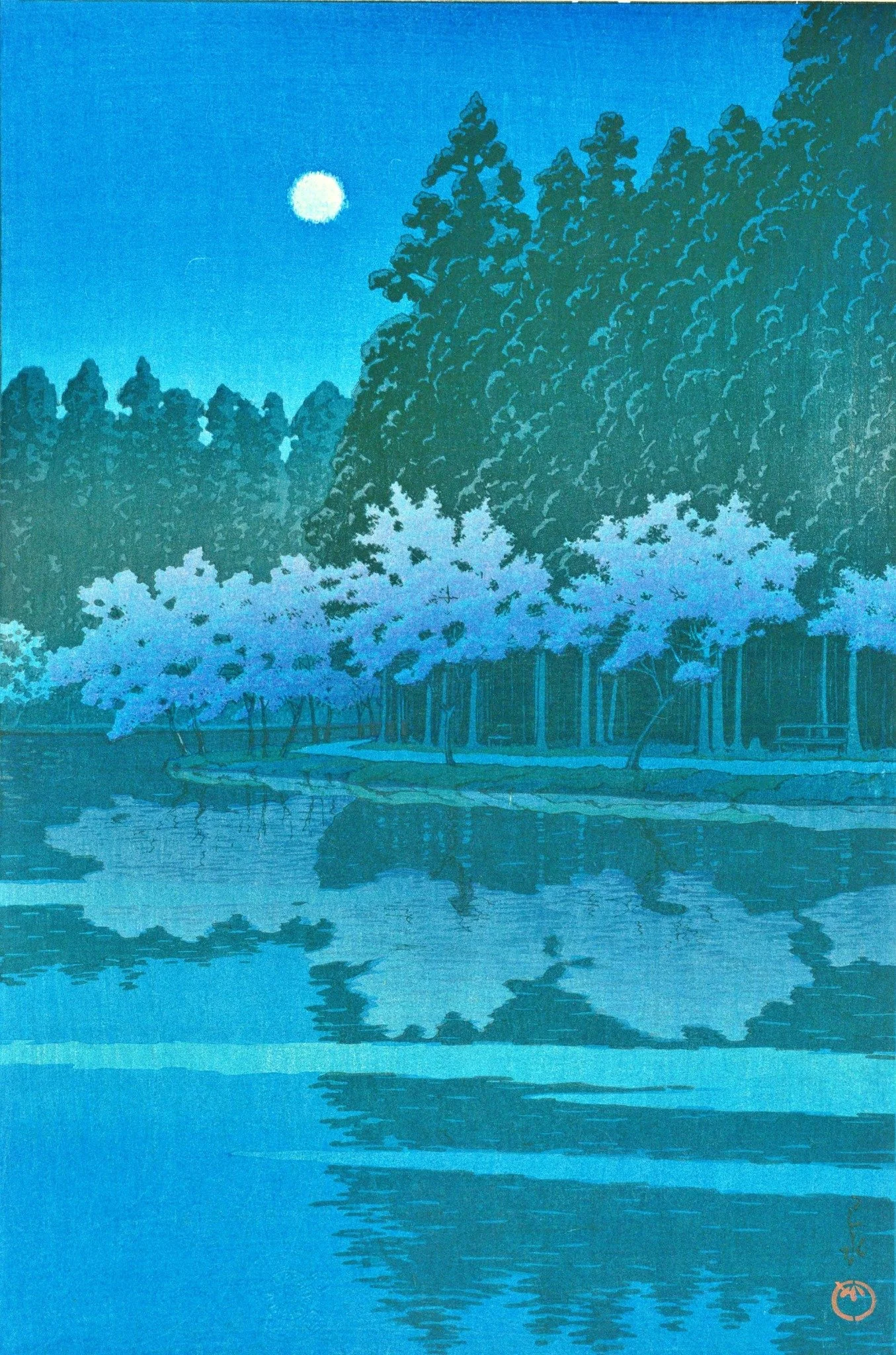
A pale moon shines above flowering cherry trees, dark woodland, and a pond filled with blue reflections. Kawase Hasui’s Spring Night at Inokashira brings the quiet beauty of a Japanese spring evening into your home, reproduced on canvas over a sturdy 1.5-inch wood stretcher.
| 16 × 24 in. | $259 CAD |
|---|---|
| 24 × 36 in. | $299 CAD |
Choose your canvas size and quantity below. All prices are in CAD.
Artwork titles and dates identify the original work. Review the product details and available options before ordering.
Ask about this print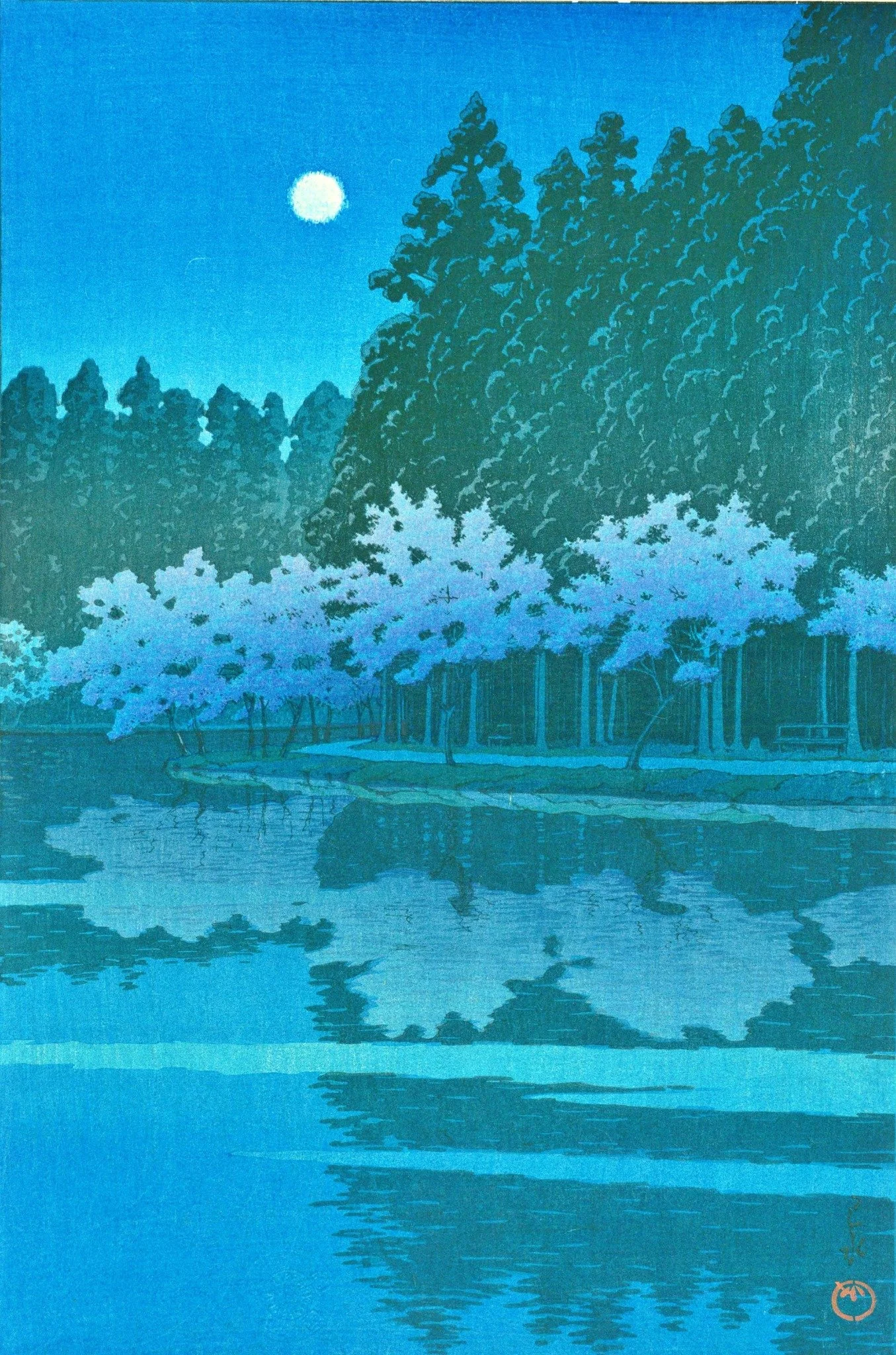
Premium quality canvas print of “Spring Night at Inokashira” by Kawase Hasui
A pale moon shines above flowering cherry trees, dark woodland, and a pond filled with blue reflections. Kawase Hasui’s Spring Night at Inokashira brings the quiet beauty of a Japanese spring evening into your home, reproduced on canvas over a sturdy 1.5-inch wood stretcher.
Product details: Canvas reproduction over a sturdy 1.5-inch wood stretcher. Available in 16 × 24 in. ($259 CAD) and 24 × 36 in. ($299 CAD). No returns accepted.
More About the Art
Spring Night at Inokashira opens onto a pond surrounded by blossoming trees beneath a pale moon. The scene is carried almost entirely by shades of blue, from the luminous sky to the dark woodland and broad reflections below. Cherry blossoms form a light, irregular band along the shore. Their delicate shapes stand between the solid mass of the taller trees and the shifting surface of the water, giving the landscape a gentle sense of renewal.
The moon occupies an open space at the upper left. Its softly edged brightness feels quiet within the expansive sky. To the right, tall trees rise in overlapping ranks, their pointed crowns making an uneven skyline. Lighter marks distinguish the foliage without breaking its overall depth. This contrast between open sky and dense woodland gives the upper composition both clarity and shelter, while directing attention toward the flowering trees below.
The blossoms introduce a more delicate rhythm. Pale clusters gather along slender trunks and spread outward above the pond. Small gaps allow glimpses of the darker trees behind them. Rather than describing each flower separately, Hasui creates a continuous impression of bloom, interrupted by fine branches and changing shades. Within the cool palette, the blossoms appear almost luminous, holding the eye along the curve of the shore.
A path follows the water’s edge. Its lighter surface passes beneath the trees, with simple benches visible along the wooded bank. These modest details make the setting approachable: a place for walking, pausing, and looking across the pond. They also provide a human measure within a scene given over to trees, sky, and water. The composition offers the feeling of a familiar park encountered during an unusually quiet hour.
Water fills much of the lower image, extending the landscape through reflection. Dark shapes echo the tall trees above, while pale passages answer the flowering branches. Short horizontal lines interrupt these forms, suggesting small movements across the pond. The reflections are recognisable without becoming exact copies. Their softened edges and changing widths allow the surface to feel active within the stillness of the overall scene.
Kawase Hasui designed the original colour woodblock print in April 1931. Its Japanese title is Inokashira no haru no yoru, written 井の頭の春の夜. Museum catalogues translate it as both Spring Night at Inokashira Park and Spring Evening at Inokashira Park. Watanabe Shōzaburō published the design. Its concentration on blue is especially effective here, bringing moon, blossoms, trees, and water into a closely connected nocturnal atmosphere.
Inokashira Park lies in western Tokyo, around the cities of Musashino and Mitaka. Opened in 1917, it is known for its central pond and cherry trees along the water. Hasui’s view transforms these familiar features through spring light and careful spacing. Presented as a canvas reproduction, Spring Night at Inokashira brings that calm colour presence into a contemporary room. From a distance, the moon and flowering shore establish the scene; closer viewing reveals the slender trunks, quiet path, benches, and delicate surface of the pond. It invites an unhurried return to the beauty of a spring evening.
More About the Artist
Kawase Hasui (1883–1957) was a Japanese artist whose landscape prints reveal how light and weather can transform the experience of a place. His subjects include snowy temple grounds, rain-filled streets, mountain settlements, and shores under moonlight. Across these settings, he combined a clear sense of structure with an atmosphere that invites sustained looking. Spring Night at Inokashira offers an especially intimate example, allowing a pond and its flowering trees to hold the entire composition.
Hasui was born in Tokyo with the given name Bunjiro. He studied Western-style painting with Okada Saburosuke before becoming a pupil of Kaburaki Kiyokata in 1910. Kiyokata gave him his artist’s name. Training in different approaches to painting helped him develop a broad visual vocabulary, in which strongly defined forms could coexist with gradual changes of tone, convincing distance, and a sensitive response to the appearance of the natural world.
The landscape prints of Itō Shinsui, another artist in Kiyokata’s circle, encouraged his interest in the woodblock medium. Hasui began working with the publisher Watanabe Shōzaburō in 1918, establishing a partnership that would shape much of his career. Their work became central to shin-hanga, or “new prints,” the movement that renewed traditional Japanese woodblock production for the twentieth century. Artists, carvers, printers, and publishers brought their different skills to a shared process.
This collaborative method gave Hasui’s designs a distinctive richness. An image needed to work through carved lines, colour blocks, and the careful handling of repeated impressions. A sky could move through several tones; a dark tree could retain numerous small details; a reflection could remain clear while suggesting movement. In Spring Night at Inokashira, these possibilities are brought together within a limited colour range, allowing changes in value and shape to carry much of the scene’s expression.
Travel and sketching were important sources for his work. He journeyed widely in Japan, gathering observations that later became woodblock designs. At the same time, Tokyo and its surroundings remained a continuing source of subjects. Familiar parks, neighbourhood bridges, and temple approaches offered occasions for close attention. In these images, the viewer often encounters a place through ordinary experience: walking beside water, noticing a lit window, or watching the weather settle across trees and buildings.
His career involved considerable disruption. The Great Kantō Earthquake of 1923 destroyed Watanabe’s premises, blocks, and print stock, while Hasui lost his house and sketchbooks. He continued travelling and designing afterward. The landscapes of the following decades show his sustained interest in the quieter character of places, including those within a changing capital. The 1931 Inokashira design belongs to this productive period, when seasonal subjects and atmospheric effects were central to his work.
Hasui remained active after the Second World War and into the 1950s. In 1953, the making of Snow at Zōjōji Temple was documented by Japan’s Cultural Properties Protection Committee, recording the collaborative craft behind a finished print. His career ultimately encompassed more than six hundred designs. Museum collections preserve a wide range of his landscapes, making it possible to appreciate both individual compositions and the consistency of his attention across decades.
The lasting appeal of his work lies in carefully observed relationships. A pale moon becomes brighter beside dark trees; blossoms gain delicacy above their broken reflections; a curving bank creates distance within a flat sheet of paper. Spring Night at Inokashira brings these relationships into a particularly serene balance. Its subject is recognisable, but its atmosphere allows the scene to remain open to memory, personal association, and the pleasure of looking slowly.
Sources
LACMA — Spring Evening at Inokashira Park; colour woodblock print, April 1931
Aichi Prefectural Museum of Art / Art Platform Japan — Spring Evening at Inokashira Park, 1931
Christie’s — Inokashira no haru no yoru; April 1931 and publisher Watanabe Shōzaburō
Kawase Hasui Catalogue — Spring Evening at Inokashira Park; title and publication details
Tokyo Metropolitan Government — Inokashira Park’s 1917 opening and setting in Musashino and Mitaka
GO TOKYO, official Tokyo travel guide — Inokashira Pond and its spring cherry blossoms
Japan Museum SieboldHuis — Kawase Hasui: Capturing the Soul of Japan
Tokyo Fuji Art Museum — Kawase Hasui biography and 1953 print-production documentation
Premium quality canvas print of “Spring Night at Inokashira” by Kawase Hasui
A pale moon shines above flowering cherry trees, dark woodland, and a pond filled with blue reflections. Kawase Hasui’s Spring Night at Inokashira brings the quiet beauty of a Japanese spring evening into your home, reproduced on canvas over a sturdy 1.5-inch wood stretcher.
Product details: Canvas reproduction over a sturdy 1.5-inch wood stretcher. Available in 16 × 24 in. ($259 CAD) and 24 × 36 in. ($299 CAD). No returns accepted.
More About the Art
Spring Night at Inokashira opens onto a pond surrounded by blossoming trees beneath a pale moon. The scene is carried almost entirely by shades of blue, from the luminous sky to the dark woodland and broad reflections below. Cherry blossoms form a light, irregular band along the shore. Their delicate shapes stand between the solid mass of the taller trees and the shifting surface of the water, giving the landscape a gentle sense of renewal.
The moon occupies an open space at the upper left. Its softly edged brightness feels quiet within the expansive sky. To the right, tall trees rise in overlapping ranks, their pointed crowns making an uneven skyline. Lighter marks distinguish the foliage without breaking its overall depth. This contrast between open sky and dense woodland gives the upper composition both clarity and shelter, while directing attention toward the flowering trees below.
The blossoms introduce a more delicate rhythm. Pale clusters gather along slender trunks and spread outward above the pond. Small gaps allow glimpses of the darker trees behind them. Rather than describing each flower separately, Hasui creates a continuous impression of bloom, interrupted by fine branches and changing shades. Within the cool palette, the blossoms appear almost luminous, holding the eye along the curve of the shore.
A path follows the water’s edge. Its lighter surface passes beneath the trees, with simple benches visible along the wooded bank. These modest details make the setting approachable: a place for walking, pausing, and looking across the pond. They also provide a human measure within a scene given over to trees, sky, and water. The composition offers the feeling of a familiar park encountered during an unusually quiet hour.
Water fills much of the lower image, extending the landscape through reflection. Dark shapes echo the tall trees above, while pale passages answer the flowering branches. Short horizontal lines interrupt these forms, suggesting small movements across the pond. The reflections are recognisable without becoming exact copies. Their softened edges and changing widths allow the surface to feel active within the stillness of the overall scene.
Kawase Hasui designed the original colour woodblock print in April 1931. Its Japanese title is Inokashira no haru no yoru, written 井の頭の春の夜. Museum catalogues translate it as both Spring Night at Inokashira Park and Spring Evening at Inokashira Park. Watanabe Shōzaburō published the design. Its concentration on blue is especially effective here, bringing moon, blossoms, trees, and water into a closely connected nocturnal atmosphere.
Inokashira Park lies in western Tokyo, around the cities of Musashino and Mitaka. Opened in 1917, it is known for its central pond and cherry trees along the water. Hasui’s view transforms these familiar features through spring light and careful spacing. Presented as a canvas reproduction, Spring Night at Inokashira brings that calm colour presence into a contemporary room. From a distance, the moon and flowering shore establish the scene; closer viewing reveals the slender trunks, quiet path, benches, and delicate surface of the pond. It invites an unhurried return to the beauty of a spring evening.
More About the Artist
Kawase Hasui (1883–1957) was a Japanese artist whose landscape prints reveal how light and weather can transform the experience of a place. His subjects include snowy temple grounds, rain-filled streets, mountain settlements, and shores under moonlight. Across these settings, he combined a clear sense of structure with an atmosphere that invites sustained looking. Spring Night at Inokashira offers an especially intimate example, allowing a pond and its flowering trees to hold the entire composition.
Hasui was born in Tokyo with the given name Bunjiro. He studied Western-style painting with Okada Saburosuke before becoming a pupil of Kaburaki Kiyokata in 1910. Kiyokata gave him his artist’s name. Training in different approaches to painting helped him develop a broad visual vocabulary, in which strongly defined forms could coexist with gradual changes of tone, convincing distance, and a sensitive response to the appearance of the natural world.
The landscape prints of Itō Shinsui, another artist in Kiyokata’s circle, encouraged his interest in the woodblock medium. Hasui began working with the publisher Watanabe Shōzaburō in 1918, establishing a partnership that would shape much of his career. Their work became central to shin-hanga, or “new prints,” the movement that renewed traditional Japanese woodblock production for the twentieth century. Artists, carvers, printers, and publishers brought their different skills to a shared process.
This collaborative method gave Hasui’s designs a distinctive richness. An image needed to work through carved lines, colour blocks, and the careful handling of repeated impressions. A sky could move through several tones; a dark tree could retain numerous small details; a reflection could remain clear while suggesting movement. In Spring Night at Inokashira, these possibilities are brought together within a limited colour range, allowing changes in value and shape to carry much of the scene’s expression.
Travel and sketching were important sources for his work. He journeyed widely in Japan, gathering observations that later became woodblock designs. At the same time, Tokyo and its surroundings remained a continuing source of subjects. Familiar parks, neighbourhood bridges, and temple approaches offered occasions for close attention. In these images, the viewer often encounters a place through ordinary experience: walking beside water, noticing a lit window, or watching the weather settle across trees and buildings.
His career involved considerable disruption. The Great Kantō Earthquake of 1923 destroyed Watanabe’s premises, blocks, and print stock, while Hasui lost his house and sketchbooks. He continued travelling and designing afterward. The landscapes of the following decades show his sustained interest in the quieter character of places, including those within a changing capital. The 1931 Inokashira design belongs to this productive period, when seasonal subjects and atmospheric effects were central to his work.
Hasui remained active after the Second World War and into the 1950s. In 1953, the making of Snow at Zōjōji Temple was documented by Japan’s Cultural Properties Protection Committee, recording the collaborative craft behind a finished print. His career ultimately encompassed more than six hundred designs. Museum collections preserve a wide range of his landscapes, making it possible to appreciate both individual compositions and the consistency of his attention across decades.
The lasting appeal of his work lies in carefully observed relationships. A pale moon becomes brighter beside dark trees; blossoms gain delicacy above their broken reflections; a curving bank creates distance within a flat sheet of paper. Spring Night at Inokashira brings these relationships into a particularly serene balance. Its subject is recognisable, but its atmosphere allows the scene to remain open to memory, personal association, and the pleasure of looking slowly.
Sources for the artwork and artist
- LACMA — Spring Evening at Inokashira Park; colour woodblock print, April 1931
- Virginia Museum of Fine Arts — Spring Night at Inokashira Park; April 1931, Japanese title and publisher
- Aichi Prefectural Museum of Art / Art Platform Japan — Spring Evening at Inokashira Park, 1931
- Christie’s — Inokashira no haru no yoru; April 1931 and publisher Watanabe Shōzaburō
- Kawase Hasui Catalogue — Spring Evening at Inokashira Park; title and publication details
- Tokyo Metropolitan Government — Inokashira Park’s 1917 opening and setting in Musashino and Mitaka
- GO TOKYO, official Tokyo travel guide — Inokashira Pond and its spring cherry blossoms
- British Museum — Kawase Hasui biography
- Japan Museum SieboldHuis — Kawase Hasui: Capturing the Soul of Japan
- Tokyo Fuji Art Museum — Kawase Hasui biography and 1953 print-production documentation