
Japanese art on canvas
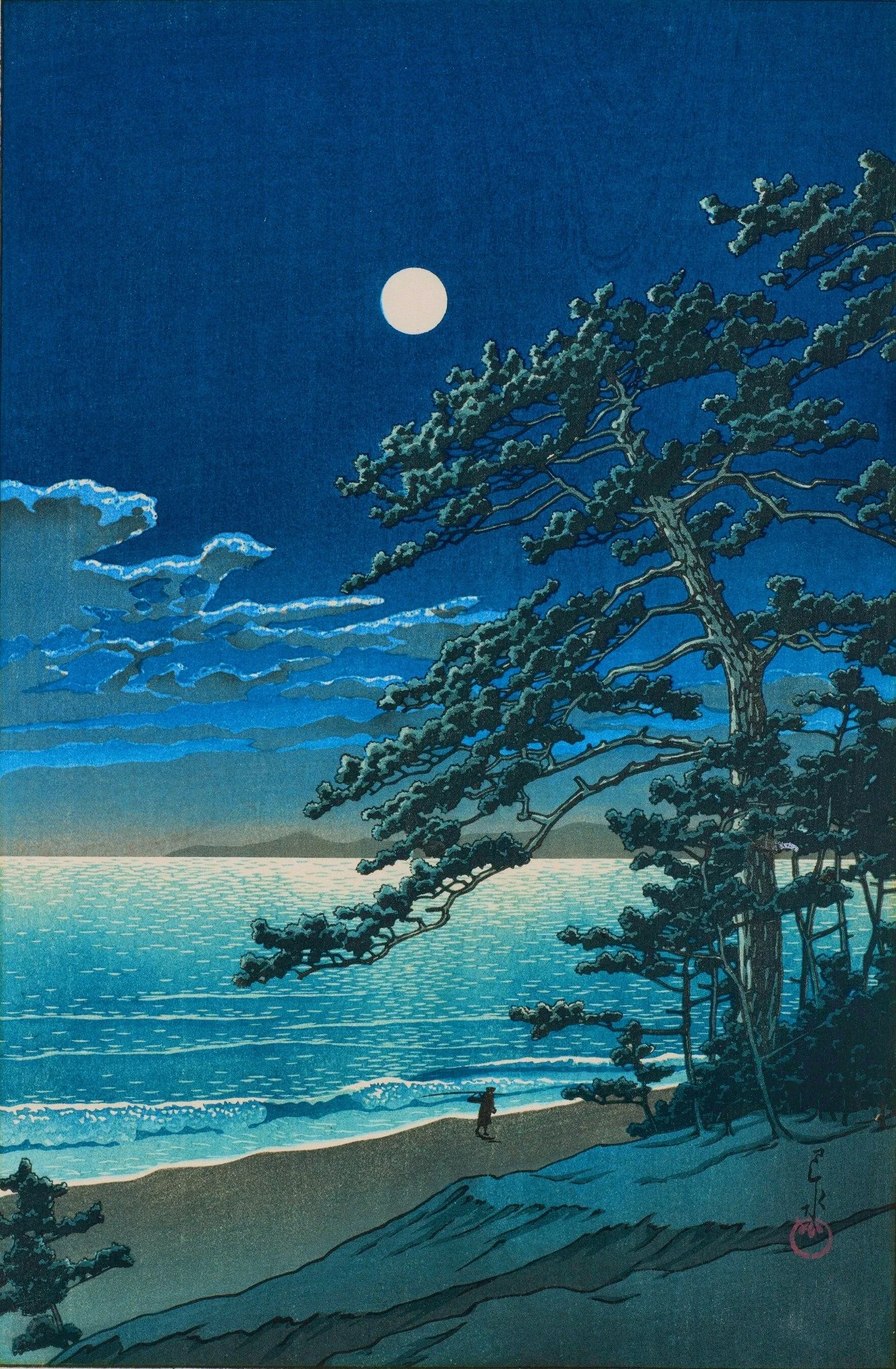
Spring Moon at Ninomiya Beach
Kawase Hasui · 1932
From $259 CAD
A full moon shines over silver surf while coastal pines lean toward the open sea. Kawase Hasui’s Spring Moon at Ninomiya Beach brings the stillness and spaciousness of a Japanese shore at night into your home, reproduced on canvas over a sturdy 1.5-inch wood stretcher.
| 16 × 24 in. | $259 CAD |
|---|---|
| 24 × 36 in. | $299 CAD |
Choose your canvas size and quantity below. All prices are in CAD.
Artwork titles and dates identify the original work. Review the product details and available options before ordering.
Ask about this print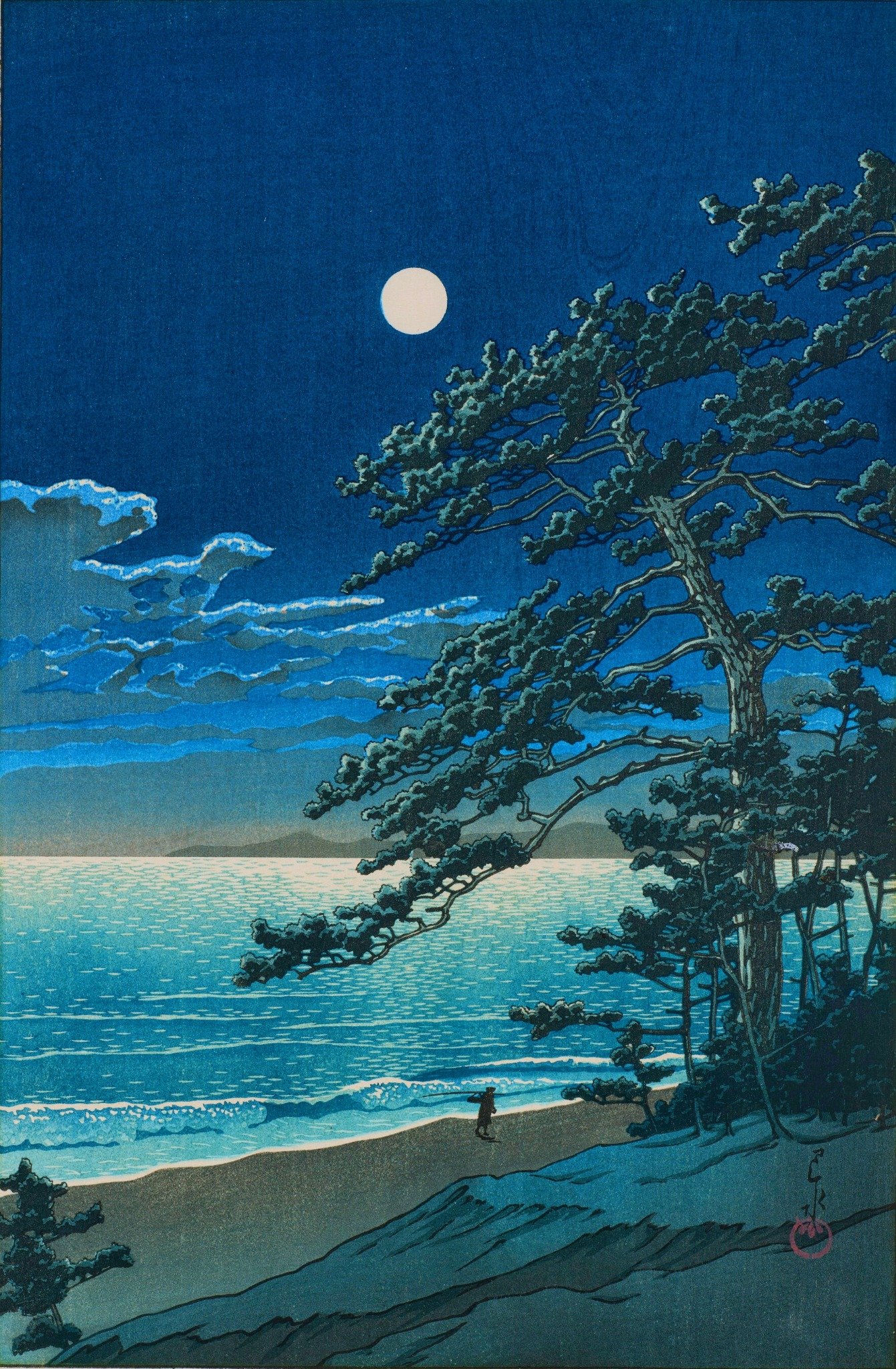
Premium quality canvas print of “Spring Moon at Ninomiya Beach” by Kawase Hasui
A full moon shines over silver surf while coastal pines lean toward the open sea. Kawase Hasui’s Spring Moon at Ninomiya Beach brings the stillness and spaciousness of a Japanese shore at night into your home, reproduced on canvas over a sturdy 1.5-inch wood stretcher.
Product details: Canvas reproduction over a sturdy 1.5-inch wood stretcher. Available in 16 × 24 in. ($259 CAD) and 24 × 36 in. ($299 CAD). No returns accepted.
More About the Art
Spring Moon at Ninomiya Beach opens onto a shore transformed by night. A clear, pale moon hangs above the sea, while a tall pine spreads its branches across the right side of the composition. Below, silver marks gather on the water and a line of white surf follows the dark beach. A single small figure appears near the shore. The image feels spacious and quiet, with every element finding its place within a cool blue atmosphere.
The pine provides the strongest structure. Its trunk rises from the shadowed foreground, then divides into long, angular branches reaching toward the open sky and water. Dense clusters of needles create irregular masses, edged in lighter tones that separate them from the darkness behind. Smaller trunks gather nearby. Together they establish a close, textured foreground through which the wider view of the coast becomes visible.
Against these complicated branches, the moon is strikingly simple. Its unbroken circular shape stands alone in a broad expanse of deep blue. Lower down, layered clouds stretch across the sky in uneven horizontal bands. Pale edges pick out their forms without making them solid or heavy.
The sea introduces a different kind of movement. Small horizontal strokes suggest light catching the surface, becoming brighter and more closely gathered toward the distance. Near the beach, waves form curved bands of white. The water is active in its detail, yet its broad level expanse balances the rising pine. Looking across it, the eye can move from individual glints to the continuous line of the horizon.
The beach curves diagonally through the lower composition. Its dark, open surface offers a resting place between the patterned water and the dense trees. The solitary figure is small enough that clothing and identity remain indistinct. This modest human presence makes the scale of the landscape easier to feel, while leaving the scene open to an individual response. No particular story is needed to appreciate the meeting of shore, sea, and moonlight.
Hasui designed the original colour woodblock print in March 1932. Its Japanese title is Haru no tsuki, Ninomiya kaigan, and the Smithsonian identifies the publisher as Doi Sadaichi. Museum impressions preserve the composition in ink and colour on paper. Its effect comes from the relationships within the image: finely separated branches, broad shaded surfaces, repeated water marks, and a moon defined by the space around it.
Ninomiya lies in Kanagawa Prefecture on the coast of Sagami Bay. That geographic setting anchors the title in a real stretch of Japan’s shoreline. Hasui’s composition gives the coast a distinctive visual character without requiring an inventory of landmarks. The closeness of the trees and the openness of the sea are enough to make the view feel specific and inviting.
Presented as a canvas reproduction, Spring Moon at Ninomiya Beach brings this historical design into a larger, contemporary setting. Its deep blues create a calm colour presence, while the pale moon and surf provide clear points of light. From across the room, the pine and shore establish the scene; closer viewing reveals the intricate branches and changing patterns on the water. It offers a landscape to return to slowly, finding a little more space with each look.
More About the Artist
Kawase Hasui (1883–1957) was a Japanese artist celebrated for landscapes that make light, season, and weather central to the experience of a place. His woodblock designs include temple grounds, city streets, rural settlements, mountains, and coastlines. A scene may be identified by a recognisable building or a geographic title, but its atmosphere is carried just as strongly by snow on a roof, rain across a road, or light reaching the surface of water. This attention makes his work both descriptive and quietly absorbing.
Hasui was born in Tokyo with the given name Bunjiro. His education included Western-style painting with Okada Saburosuke and Japanese-style painting under Kaburaki Kiyokata, whose studio he joined in 1910. Kiyokata gave him the name Hasui. Before landscape prints became the principal focus of his career, he also worked in illustration and design. These activities gave him experience in creating images whose shapes and relationships needed to communicate clearly.
An important stimulus came from Ito Shinsui, a fellow pupil whose Eight Views of Omi encouraged Hasui’s interest in single-sheet landscape prints. Through Kiyokata he became known to the publisher Watanabe Shōzaburō, who began publishing his landscape designs in 1918–1919. This association helped establish him within shin-hanga, or “new prints,” the movement that renewed traditional Japanese woodblock production for the twentieth century.
Shin-hanga relied on shared expertise. The artist’s design was developed into a print through the work of specialist block carvers and printers, with the publisher coordinating production. New colour palettes and expressive effects emerged within that continuing craft tradition. The image therefore reflects more than a single stage of making. In Hasui’s landscapes, a finely branching tree or a subtly changing night sky can draw attention to how carefully the different parts of a composition have been brought together.
His long collaboration with Watanabe was central to his career, but he also worked with other publishers. Spring Moon at Ninomiya Beach, published by Doi Sadaichi, is an example of that broader activity. It shows how recognisable his landscape approach could remain across different publishing relationships. The pine, water, moon, and small figure are distinct subjects, yet the composition connects them through scale, spacing, and a restrained range of colour.
Travel and sketching supplied Hasui with a continuing store of subjects. He journeyed widely across Japan as modernisation changed towns and landscapes. His prints often attend to places that can feel accessible rather than ceremonial: a beach beneath trees, an ordinary lane, or a building glimpsed in passing. Viewers can enter these scenes through familiar experiences of distance, weather, and the way the world appears at the edge of day.
His working life also involved major losses. The Great Kanto Earthquake of 1923 destroyed Watanabe’s premises, woodblocks, and print stock, and Hasui’s sketchbooks were lost. He continued designing landscapes afterward. Following the Second World War, he and Watanabe resumed their collaboration amid renewed demand for Japanese prints. Across these different periods, his images continued to find audiences both in Japan and overseas.
Hasui remained active into the 1950s. In 1953, the production process of Snow at Zojoji Temple was documented by Japan’s Cultural Properties Protection Committee, preserving a record of collaborative woodblock craft. By the end of his life in 1957, he had designed more than six hundred woodblock prints over roughly four decades. Museum collections now preserve the breadth of this work, from intimate views to expansive landscapes.
Spring Moon at Ninomiya Beach offers a direct way into his art. The setting is clear enough to recognise, but the longer one looks, the more the relationships within it become visible. The branches answer the clouds; the pale moon answers the white surf; the small figure gives measure to the open shore. This balance of clarity and atmosphere allows the scene to remain compelling without insisting on a single meaning.
Sources
LACMA — Spring Moon, Ninomiya Beach; design dated March 1932
Smithsonian National Museum of Asian Art — Spring moon (Ninomiya beach); publisher Doi Sadaichi
Chazen Museum of Art — Spring Moon, Ninomiya Beach, March 1932
Takamatsu Art Museum — Travel and nostalgic landscape; collaborative printmaking
Japan Museum SieboldHuis — Kawase Hasui. Capturing the Soul of Japan
Tokyo Fuji Art Museum — Kawase Hasui biography and 1953 process record
Museum of New Zealand Te Papa Tongarewa — Kawase Hasui’s career and landscape prints
Japan Ministry of the Environment — Sagami Bay coast; Ninomiya and Kanagawa geography
Premium quality canvas print of “Spring Moon at Ninomiya Beach” by Kawase Hasui
A full moon shines over silver surf while coastal pines lean toward the open sea. Kawase Hasui’s Spring Moon at Ninomiya Beach brings the stillness and spaciousness of a Japanese shore at night into your home, reproduced on canvas over a sturdy 1.5-inch wood stretcher.
Product details: Canvas reproduction over a sturdy 1.5-inch wood stretcher. Available in 16 × 24 in. ($259 CAD) and 24 × 36 in. ($299 CAD). No returns accepted.
More About the Art
Spring Moon at Ninomiya Beach opens onto a shore transformed by night. A clear, pale moon hangs above the sea, while a tall pine spreads its branches across the right side of the composition. Below, silver marks gather on the water and a line of white surf follows the dark beach. A single small figure appears near the shore. The image feels spacious and quiet, with every element finding its place within a cool blue atmosphere.
The pine provides the strongest structure. Its trunk rises from the shadowed foreground, then divides into long, angular branches reaching toward the open sky and water. Dense clusters of needles create irregular masses, edged in lighter tones that separate them from the darkness behind. Smaller trunks gather nearby. Together they establish a close, textured foreground through which the wider view of the coast becomes visible.
Against these complicated branches, the moon is strikingly simple. Its unbroken circular shape stands alone in a broad expanse of deep blue. Lower down, layered clouds stretch across the sky in uneven horizontal bands. Pale edges pick out their forms without making them solid or heavy.
The sea introduces a different kind of movement. Small horizontal strokes suggest light catching the surface, becoming brighter and more closely gathered toward the distance. Near the beach, waves form curved bands of white. The water is active in its detail, yet its broad level expanse balances the rising pine. Looking across it, the eye can move from individual glints to the continuous line of the horizon.
The beach curves diagonally through the lower composition. Its dark, open surface offers a resting place between the patterned water and the dense trees. The solitary figure is small enough that clothing and identity remain indistinct. This modest human presence makes the scale of the landscape easier to feel, while leaving the scene open to an individual response. No particular story is needed to appreciate the meeting of shore, sea, and moonlight.
Hasui designed the original colour woodblock print in March 1932. Its Japanese title is Haru no tsuki, Ninomiya kaigan, and the Smithsonian identifies the publisher as Doi Sadaichi. Museum impressions preserve the composition in ink and colour on paper. Its effect comes from the relationships within the image: finely separated branches, broad shaded surfaces, repeated water marks, and a moon defined by the space around it.
Ninomiya lies in Kanagawa Prefecture on the coast of Sagami Bay. That geographic setting anchors the title in a real stretch of Japan’s shoreline. Hasui’s composition gives the coast a distinctive visual character without requiring an inventory of landmarks. The closeness of the trees and the openness of the sea are enough to make the view feel specific and inviting.
Presented as a canvas reproduction, Spring Moon at Ninomiya Beach brings this historical design into a larger, contemporary setting. Its deep blues create a calm colour presence, while the pale moon and surf provide clear points of light. From across the room, the pine and shore establish the scene; closer viewing reveals the intricate branches and changing patterns on the water. It offers a landscape to return to slowly, finding a little more space with each look.
More About the Artist
Kawase Hasui (1883–1957) was a Japanese artist celebrated for landscapes that make light, season, and weather central to the experience of a place. His woodblock designs include temple grounds, city streets, rural settlements, mountains, and coastlines. A scene may be identified by a recognisable building or a geographic title, but its atmosphere is carried just as strongly by snow on a roof, rain across a road, or light reaching the surface of water. This attention makes his work both descriptive and quietly absorbing.
Hasui was born in Tokyo with the given name Bunjiro. His education included Western-style painting with Okada Saburosuke and Japanese-style painting under Kaburaki Kiyokata, whose studio he joined in 1910. Kiyokata gave him the name Hasui. Before landscape prints became the principal focus of his career, he also worked in illustration and design. These activities gave him experience in creating images whose shapes and relationships needed to communicate clearly.
An important stimulus came from Ito Shinsui, a fellow pupil whose Eight Views of Omi encouraged Hasui’s interest in single-sheet landscape prints. Through Kiyokata he became known to the publisher Watanabe Shōzaburō, who began publishing his landscape designs in 1918–1919. This association helped establish him within shin-hanga, or “new prints,” the movement that renewed traditional Japanese woodblock production for the twentieth century.
Shin-hanga relied on shared expertise. The artist’s design was developed into a print through the work of specialist block carvers and printers, with the publisher coordinating production. New colour palettes and expressive effects emerged within that continuing craft tradition. The image therefore reflects more than a single stage of making. In Hasui’s landscapes, a finely branching tree or a subtly changing night sky can draw attention to how carefully the different parts of a composition have been brought together.
His long collaboration with Watanabe was central to his career, but he also worked with other publishers. Spring Moon at Ninomiya Beach, published by Doi Sadaichi, is an example of that broader activity. It shows how recognisable his landscape approach could remain across different publishing relationships. The pine, water, moon, and small figure are distinct subjects, yet the composition connects them through scale, spacing, and a restrained range of colour.
Travel and sketching supplied Hasui with a continuing store of subjects. He journeyed widely across Japan as modernisation changed towns and landscapes. His prints often attend to places that can feel accessible rather than ceremonial: a beach beneath trees, an ordinary lane, or a building glimpsed in passing. Viewers can enter these scenes through familiar experiences of distance, weather, and the way the world appears at the edge of day.
His working life also involved major losses. The Great Kanto Earthquake of 1923 destroyed Watanabe’s premises, woodblocks, and print stock, and Hasui’s sketchbooks were lost. He continued designing landscapes afterward. Following the Second World War, he and Watanabe resumed their collaboration amid renewed demand for Japanese prints. Across these different periods, his images continued to find audiences both in Japan and overseas.
Hasui remained active into the 1950s. In 1953, the production process of Snow at Zojoji Temple was documented by Japan’s Cultural Properties Protection Committee, preserving a record of collaborative woodblock craft. By the end of his life in 1957, he had designed more than six hundred woodblock prints over roughly four decades. Museum collections now preserve the breadth of this work, from intimate views to expansive landscapes.
Spring Moon at Ninomiya Beach offers a direct way into his art. The setting is clear enough to recognise, but the longer one looks, the more the relationships within it become visible. The branches answer the clouds; the pale moon answers the white surf; the small figure gives measure to the open shore. This balance of clarity and atmosphere allows the scene to remain compelling without insisting on a single meaning.
Sources for the artwork and artist
- LACMA — Spring Moon, Ninomiya Beach; design dated March 1932
- Smithsonian National Museum of Asian Art — Spring moon (Ninomiya beach); publisher Doi Sadaichi
- Chazen Museum of Art — Spring Moon, Ninomiya Beach, March 1932
- British Museum — Kawase Hasui biography
- Takamatsu Art Museum — Travel and nostalgic landscape; collaborative printmaking
- Japan Museum SieboldHuis — Kawase Hasui. Capturing the Soul of Japan
- Tokyo Fuji Art Museum — Kawase Hasui biography and 1953 process record
- Museum of New Zealand Te Papa Tongarewa — Kawase Hasui’s career and landscape prints
- Japan Ministry of the Environment — Sagami Bay coast; Ninomiya and Kanagawa geography