
Japanese art on canvas
Spring in Kurama Temple
Asano Takeji · 1952
From $259 CAD
A canvas reproduction of Spring in Kurama Temple, presented on a 1.5-inch wood stretcher.
| 16 × 24 in. | $259 CAD |
|---|---|
| 24 × 36 in. | $299 CAD |
Choose your canvas size and quantity below. All prices are in CAD.
Artwork titles and dates identify the original work. Review the product details and available options before ordering.
Ask about this printPremium quality canvas reproduction of Asano Takeji’s “Spring in Kurama Temple” (1952)
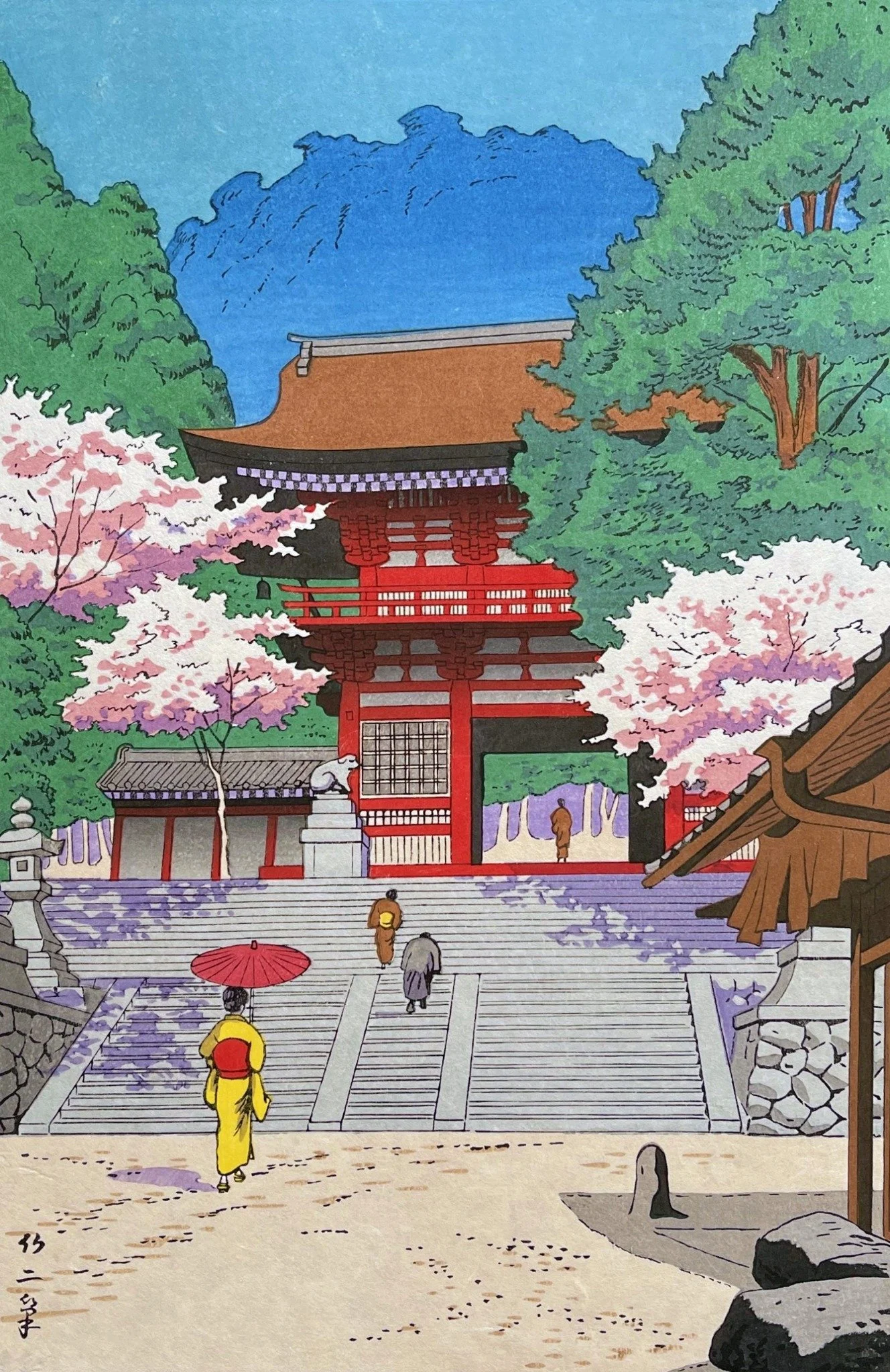
Bring the colour and calm of a spring visit into your room. In Asano Takeji’s Spring in Kurama Temple, pink blossoms frame a vermilion gate as visitors make their way up the broad steps. Reproduced on canvas over a sturdy 1.5-inch wood stretcher, the scene offers a bright, welcoming view with details to enjoy at every glance.
Product details: Canvas reproduction over a sturdy 1.5-inch wood stretcher. Available in 16 × 24 in. ($259 CAD) and 24 × 36 in. ($299 CAD). No returns accepted.
More About the Art:
Spring in Kurama Temple draws the eye from an open foreground toward a richly coloured gate. A broad flight of stone steps fills much of the lower picture, with long horizontal lines marking the ascent. Narrow divisions lead upward through them, while patches of violet shadow fall across the pale stone. The result is a clear sense of approach: the scene seems to open ahead of the viewer, one level at a time.
The gate anchors the centre of the composition. Its vermilion posts, railings and bracketed details stand out against the surrounding green trees. Above them, a broad orange-brown roof curves outward at the edges, giving the building a generous, sheltering shape. Dark areas beneath the eaves and within the entrance make the brighter red surfaces more distinct, while the repeated architectural lines provide a steady structure for the view.
Cherry blossoms soften both sides of the gate. Their white and pale pink clusters overlap branches, railings and greenery, with stronger pink and lavender patches creating variation within the flowers. Fine dark branches appear between the larger masses of colour. These irregular forms contrast with the building’s measured lines, allowing the architecture and the spring growth to remain equally noticeable.
In the foreground, a figure in a bright yellow kimono carries a red parasol. The broad circle of the parasol echoes the warm colour of the gate, while the yellow clothing provides a distinct accent against the pale ground. Farther up the stairs, smaller figures lead attention into the picture. Their changing scale gives the approach depth and suggests the unhurried movement of visitors through the temple grounds.
The surrounding details make the setting feel more particular. A stone lantern stands at the left, and a low tiled roof meets the base of the gate. On the right, part of a wooden building enters the frame above a stone foundation. Its sloping roof creates a diagonal beside the horizontal steps. These cropped structures place the viewer within the grounds, with parts of the setting continuing beyond the image.
Colour carries the sense of a bright spring day. The foreground is warm and pale, the trees contain several greens, and a broad blue wooded shape rises behind the gate beneath a lighter sky. Lavender shadows bring colour into the stonework without making it feel heavy. Seen from a distance, the reds, greens and blues form a lively whole; closer viewing reveals the individual marks within blossoms, roof tiles and branches.
The original woodblock design dates to 1952 and was published by Unsōdō. Its Japanese title, Kuramadera Haruiro, is also presented by the publisher as Kurama Temple in the Spring. UnitedArts offers this view as a canvas reproduction. The historical date refers to the design, while the canvas brings its arrangement of architecture, visitors and blossoms into a different material for display today.
On a wall, the scene can provide a fresh, colourful focal point. Its strong architectural centre keeps the image clear across a room, while the flowers and small figures reward a closer look. Canvas over a 1.5-inch wood stretcher adds physical depth to the presentation. The combination of warm red, soft pink, green and blue works comfortably with natural wood, simple furnishings and light neutral surroundings.
More About the Artist:
Asano Takeji was a Kyoto-born Japanese artist whose work encompassed landscape views and imaginative woodblock compositions. He first trained as a painter, studying Japanese painting at Kyoto’s municipal painting school and graduating in 1923. He also explored oil painting before returning to Japanese painting. That early experience gave his development more than one direction, preceding the printmaking practice that would become central to his career.
In 1927 he studied with Tsuchida Bakusen and exhibited with the Kokuga Sōsaku Kyōkai. By around 1930 he was turning seriously toward woodblock prints, and in 1931 he committed his work to printmaking. This change followed several years of painting and experimentation. The clear shapes, organised colour and attention to a recognisable setting in his landscape prints offer one way to consider how a painter’s concerns could find expression in another medium.
Asano also took part in the print culture developing around him. In 1931 he joined Tokuriki Tomikichirō and others in producing the print magazine Taishū Hanga. The British Museum records his first solo exhibition in 1942, followed by many more over the succeeding decades. These activities connect his practice with both shared publishing projects and the opportunity to present an individual body of work to an audience.
Kobayashi Kiyochika’s views of Tokyo were an important stimulus for his own images of notable places. Osaka Prefecture’s collection account traces Asano’s landscape series from 1931 to 1972, encompassing Kyoto, Osaka and locations and events elsewhere in Japan. Kyoto Seika University describes works developed from sketches of different places, with light and atmosphere shaping the familiar streets and scenery. The subject could be a city view, a temple approach or a landscape encountered through changing conditions.
His work also reached viewers through the Kyoto publisher Unsōdō, which began issuing his prints in the early 1950s. Spring in Kurama Temple belongs to this part of his practice. Its detailed gate and recognisable spring setting are held together by broad areas of colour. The small visitors make the architecture’s scale legible, while the blossoms give the formal arrangement a softer, more expansive character.
Alongside his landscape work, Asano developed freer compositions based on simplified people, animals and other forms. In this creative print practice, he could draw, carve and print the work himself. Museum accounts emphasise the bold shapes, concise colours and humour of these images. Such work shows another side of his art, in which an observed subject could be transformed through playful changes of proportion, outline and arrangement.
An encounter with the American artist Ben Shahn became part of that later story. Fuchu Art Museum records Shahn’s visit to Asano’s Kyoto studio in 1960 and the exchange that began between the two artists. The museum’s retrospective brings his lively creative prints together with the earlier landscape views, allowing their differences to be seen within one career. A scene of a familiar place and an imaginative animal image can offer distinct expressions of the same artist’s interest in form.
Public collections preserve a substantial body of this work. In 1994, Asano donated 160 woodblock prints to Osaka Prefecture. Kyoto Seika University later received approximately 1,500 works through a donation from his family. These holdings make it possible to examine the range of his subjects and approaches, from images of specific places to more freely invented compositions, and to see how varied a long engagement with woodblock printing can become.
For a present-day viewer, Spring in Kurama Temple provides an inviting introduction to that range. Its subject is easy to enter, but its effect depends on many deliberate visual relationships: a red parasol below a red gate, pale flowers against dense greenery, and figures arranged along the ascent. Looking at these connections gives the scene more than a single point of interest. Its bright overall impression can be enjoyed immediately, with further details emerging whenever you return to it.
Sources
Premium quality canvas reproduction of Asano Takeji’s “Spring in Kurama Temple” (1952)
Bring the colour and calm of a spring visit into your room. In Asano Takeji’s Spring in Kurama Temple, pink blossoms frame a vermilion gate as visitors make their way up the broad steps. Reproduced on canvas over a sturdy 1.5-inch wood stretcher, the scene offers a bright, welcoming view with details to enjoy at every glance.
Product details: Canvas reproduction over a sturdy 1.5-inch wood stretcher. Available in 16 × 24 in. ($259 CAD) and 24 × 36 in. ($299 CAD). No returns accepted.
More About the Art:
Spring in Kurama Temple draws the eye from an open foreground toward a richly coloured gate. A broad flight of stone steps fills much of the lower picture, with long horizontal lines marking the ascent. Narrow divisions lead upward through them, while patches of violet shadow fall across the pale stone. The result is a clear sense of approach: the scene seems to open ahead of the viewer, one level at a time.
The gate anchors the centre of the composition. Its vermilion posts, railings and bracketed details stand out against the surrounding green trees. Above them, a broad orange-brown roof curves outward at the edges, giving the building a generous, sheltering shape. Dark areas beneath the eaves and within the entrance make the brighter red surfaces more distinct, while the repeated architectural lines provide a steady structure for the view.
Cherry blossoms soften both sides of the gate. Their white and pale pink clusters overlap branches, railings and greenery, with stronger pink and lavender patches creating variation within the flowers. Fine dark branches appear between the larger masses of colour. These irregular forms contrast with the building’s measured lines, allowing the architecture and the spring growth to remain equally noticeable.
In the foreground, a figure in a bright yellow kimono carries a red parasol. The broad circle of the parasol echoes the warm colour of the gate, while the yellow clothing provides a distinct accent against the pale ground. Farther up the stairs, smaller figures lead attention into the picture. Their changing scale gives the approach depth and suggests the unhurried movement of visitors through the temple grounds.
The surrounding details make the setting feel more particular. A stone lantern stands at the left, and a low tiled roof meets the base of the gate. On the right, part of a wooden building enters the frame above a stone foundation. Its sloping roof creates a diagonal beside the horizontal steps. These cropped structures place the viewer within the grounds, with parts of the setting continuing beyond the image.
Colour carries the sense of a bright spring day. The foreground is warm and pale, the trees contain several greens, and a broad blue wooded shape rises behind the gate beneath a lighter sky. Lavender shadows bring colour into the stonework without making it feel heavy. Seen from a distance, the reds, greens and blues form a lively whole; closer viewing reveals the individual marks within blossoms, roof tiles and branches.
The original woodblock design dates to 1952 and was published by Unsōdō. Its Japanese title, Kuramadera Haruiro, is also presented by the publisher as Kurama Temple in the Spring. UnitedArts offers this view as a canvas reproduction. The historical date refers to the design, while the canvas brings its arrangement of architecture, visitors and blossoms into a different material for display today.
On a wall, the scene can provide a fresh, colourful focal point. Its strong architectural centre keeps the image clear across a room, while the flowers and small figures reward a closer look. Canvas over a 1.5-inch wood stretcher adds physical depth to the presentation. The combination of warm red, soft pink, green and blue works comfortably with natural wood, simple furnishings and light neutral surroundings.
More About the Artist:
Asano Takeji was a Kyoto-born Japanese artist whose work encompassed landscape views and imaginative woodblock compositions. He first trained as a painter, studying Japanese painting at Kyoto’s municipal painting school and graduating in 1923. He also explored oil painting before returning to Japanese painting. That early experience gave his development more than one direction, preceding the printmaking practice that would become central to his career.
In 1927 he studied with Tsuchida Bakusen and exhibited with the Kokuga Sōsaku Kyōkai. By around 1930 he was turning seriously toward woodblock prints, and in 1931 he committed his work to printmaking. This change followed several years of painting and experimentation. The clear shapes, organised colour and attention to a recognisable setting in his landscape prints offer one way to consider how a painter’s concerns could find expression in another medium.
Asano also took part in the print culture developing around him. In 1931 he joined Tokuriki Tomikichirō and others in producing the print magazine Taishū Hanga. The British Museum records his first solo exhibition in 1942, followed by many more over the succeeding decades. These activities connect his practice with both shared publishing projects and the opportunity to present an individual body of work to an audience.
Kobayashi Kiyochika’s views of Tokyo were an important stimulus for his own images of notable places. Osaka Prefecture’s collection account traces Asano’s landscape series from 1931 to 1972, encompassing Kyoto, Osaka and locations and events elsewhere in Japan. Kyoto Seika University describes works developed from sketches of different places, with light and atmosphere shaping the familiar streets and scenery. The subject could be a city view, a temple approach or a landscape encountered through changing conditions.
His work also reached viewers through the Kyoto publisher Unsōdō, which began issuing his prints in the early 1950s. Spring in Kurama Temple belongs to this part of his practice. Its detailed gate and recognisable spring setting are held together by broad areas of colour. The small visitors make the architecture’s scale legible, while the blossoms give the formal arrangement a softer, more expansive character.
Alongside his landscape work, Asano developed freer compositions based on simplified people, animals and other forms. In this creative print practice, he could draw, carve and print the work himself. Museum accounts emphasise the bold shapes, concise colours and humour of these images. Such work shows another side of his art, in which an observed subject could be transformed through playful changes of proportion, outline and arrangement.
An encounter with the American artist Ben Shahn became part of that later story. Fuchu Art Museum records Shahn’s visit to Asano’s Kyoto studio in 1960 and the exchange that began between the two artists. The museum’s retrospective brings his lively creative prints together with the earlier landscape views, allowing their differences to be seen within one career. A scene of a familiar place and an imaginative animal image can offer distinct expressions of the same artist’s interest in form.
Public collections preserve a substantial body of this work. In 1994, Asano donated 160 woodblock prints to Osaka Prefecture. Kyoto Seika University later received approximately 1,500 works through a donation from his family. These holdings make it possible to examine the range of his subjects and approaches, from images of specific places to more freely invented compositions, and to see how varied a long engagement with woodblock printing can become.
For a present-day viewer, Spring in Kurama Temple provides an inviting introduction to that range. Its subject is easy to enter, but its effect depends on many deliberate visual relationships: a red parasol below a red gate, pale flowers against dense greenery, and figures arranged along the ascent. Looking at these connections gives the scene more than a single point of interest. Its bright overall impression can be enjoyed immediately, with further details emerging whenever you return to it.
Sources for the artwork and artist
- Unsōdō — Kurama Temple in the Spring, TA6, first printing 1952
- Onomichi City Museum of Art — Asano Takeji, Onomichi and artist chronology
- British Museum — Asano Takeji, artist biography
- Osaka Prefecture, enoco — Asano Takeji and the prefectural collection
- Fuchu Art Museum — The Woodblock World of Asano Takeji
- Kyoto Seika University — Asano Takeji’s landscape prints and collection