
Japanese art on canvas
Spring Evening at Kintai Bridge
Kawase Hasui · 1947
From $259 CAD
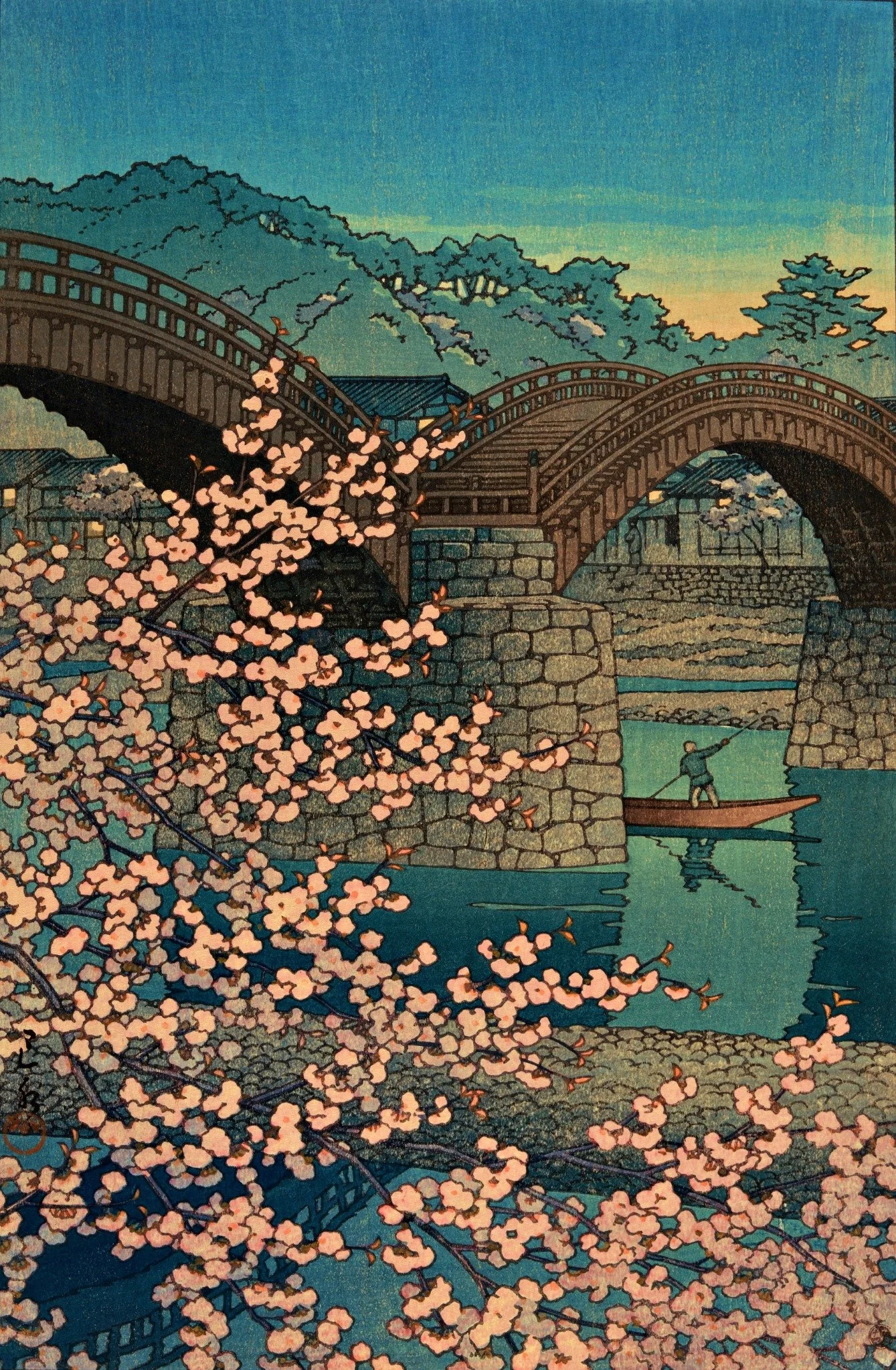
Pale cherry blossoms spread before the sweeping arches of Kintai Bridge, while a lone boatman moves through blue-green water. Kawase Hasui’s Spring Evening at Kintai Bridge brings the colour and quiet of a spring evening to a portrait canvas reproduction over a sturdy 1.5-inch wood stretcher.
| 16 × 24 in. | $259 CAD |
|---|---|
| 24 × 36 in. | $299 CAD |
Choose your canvas size and quantity below. All prices are in CAD.
Artwork titles and dates identify the original work. Review the product details and available options before ordering.
Ask about this print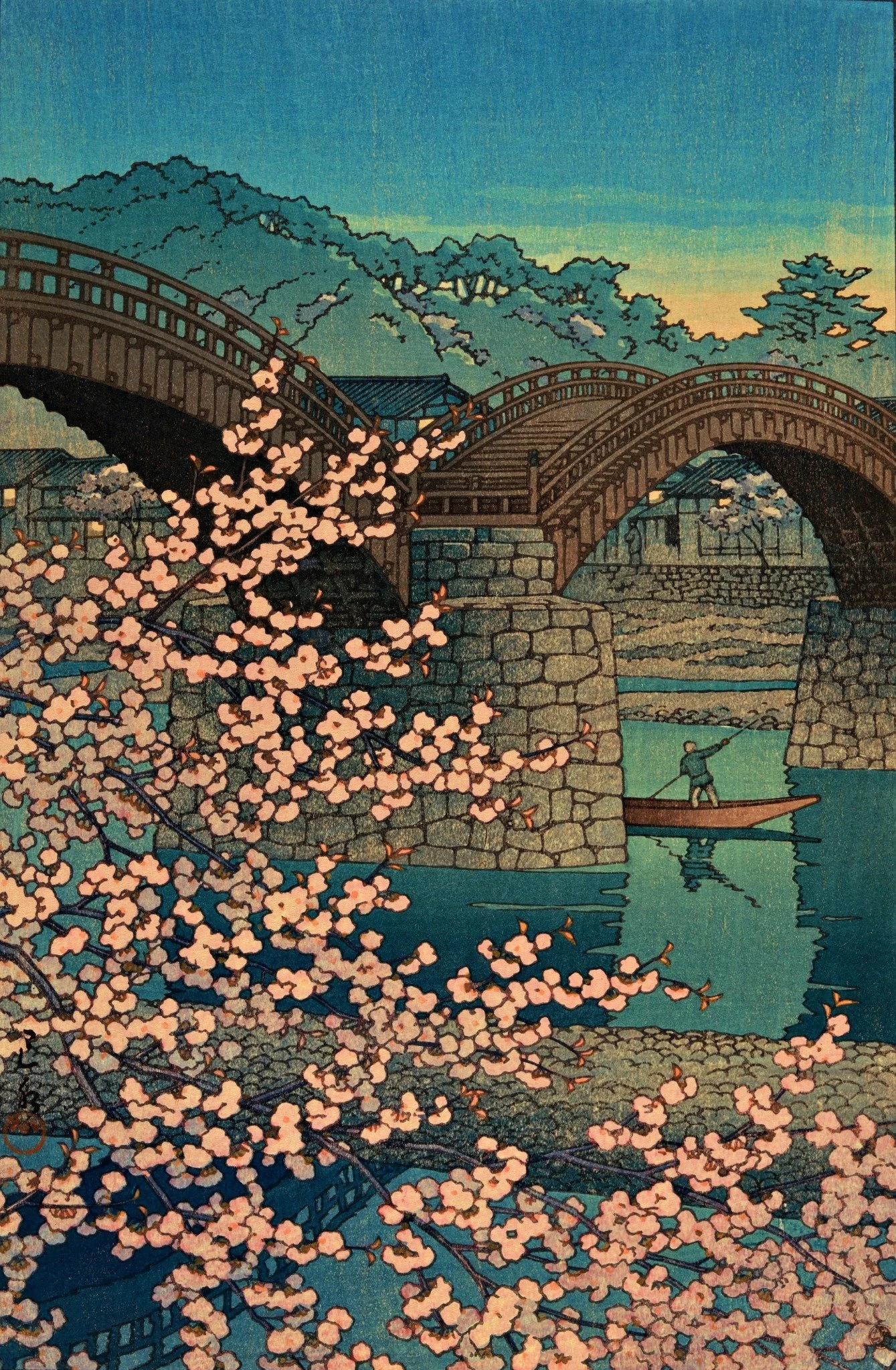
Premium quality canvas print of “Spring Evening at Kintai Bridge” by Kawase Hasui
Pale cherry blossoms spread before the sweeping arches of Kintai Bridge, while a lone boatman moves through blue-green water. Kawase Hasui’s Spring Evening at Kintai Bridge brings the colour and quiet of a spring evening to a portrait canvas reproduction over a sturdy 1.5-inch wood stretcher.
Product details: Canvas reproduction over a sturdy 1.5-inch wood stretcher. Available in 16 × 24 in. ($259 CAD) and 24 × 36 in. ($299 CAD). No returns accepted.
More About the Art
Pale pink blossoms spread across the foreground of Spring Evening at Kintai Bridge, framing an intricate arrangement of timber arches and stone piers. Beyond them, a solitary boatman guides a long, narrow craft through still blue-green water. The sky changes from deep turquoise above to a warmer light near the horizon. Kawase Hasui holds these elements together within a tall composition, balancing the closeness of flowering branches with the great weight and sweep of the bridge.
The Los Angeles County Museum of Art records the original colour woodblock print as a work of 1947. Its collection description identifies the multi-arched bridge, dense cherry blossoms, dusk setting, and lone figure on a pole boat. The date places the image in Hasui's later career, when he continued to find subjects in the changing light of familiar Japanese landscapes. Here, the architecture provides a strong framework for an especially rich seasonal view.
The bridge enters from the upper left and rises and falls in successive curves. Repeated rails and stair-like surfaces give its wooden structure a remarkable precision. The nearest span is partly cropped by the edge of the picture, suggesting that the bridge continues beyond what is shown. Its stone support occupies much of the centre, where irregular blocks create a different texture from the long, closely spaced lines of the timber above.
Cherry branches cross this substantial structure with smaller, less predictable shapes. Individual blossoms appear as clusters of pale pink against dark twigs. Some lie in front of the stonework; others spread across the water and lower edge. The flowers do more than identify spring. Their placement creates a near screen, making the viewer aware of distance and revealing the bridge through a series of openings. Delicacy and strength become equally important parts of the scene.
The boatman occupies one of those openings to the right of the central pier. A long pole extends from the figure's hands, echoing the boat's horizontal shape. This small passage of movement gives the water a human scale. Around it, dark reflections descend from the bridge supports in broken, uneven forms. The river remains spacious enough to hold both the reflections and the narrow hull without becoming crowded.
Colour gives the evening its distinctive warmth. The pink flowers stand against green-blue water and foliage, while brown timber and grey stone ground the composition. A narrow band of warmer sky appears behind the distant trees. That light does not flood every surface; instead, it provides a gentle transition between the dark upper sky and the built structures below. The result is a view that feels luminous while retaining the depth of approaching dusk.
On canvas, the supplied portrait image keeps the entire relationship between foreground blossom, bridge, boat, and sky. The arched spans are legible from across a room, while the flower clusters and timber details encourage closer attention. Hasui's picture offers a sustained experience of spring through these carefully connected parts. The eye can move from a single blossom to the distant bank, then return to the small boat passing beneath the bridge's broad curves.
More About the Artist
Kawase Hasui (1883–1957) was one of the leading landscape designers of shin-hanga, the twentieth-century renewal of Japanese woodblock printing. His pictures explore how a place changes with weather, season, and the hour of day. Snow, rain, evening light, and moonlit water recur throughout his work. Human figures are often small, giving scale to a wider setting while keeping its atmosphere central. In Spring Evening at Kintai Bridge, a boatman and the bridge's curved spans share the scene with a close screen of pale blossoms.
Born in Tokyo with the given name Bunjiro, Hasui trained in both Western-style and Japanese painting. He studied with Okada Saburosuke and later entered the studio of Kaburaki Kiyokata. These experiences helped him combine clear drawing with an attentive use of colour and tonal depth. Buildings and trees in his prints have recognizable structures, yet their appearance is transformed by the surrounding light. A dark roof, a luminous reflection, or a pale area of sky can carry as much expressive weight as the main subject.
Hasui began his association with the publisher Watanabe Shōzaburō in the late 1910s. Watanabe's enterprise brought designers, carvers, and printers together to develop new woodblock images for a contemporary audience. This collaborative process retained established Japanese techniques while making room for fresh observations of daily life and landscape. Hasui's designs depended on that cooperation. Fine architectural lines, soft transitions in the sky, and complex patterns of foliage required different kinds of skill from the artisans who translated the image into a finished impression.
Travel and sketching supplied much of his subject matter. He depicted celebrated sites as well as quieter streets, villages, coastlines, and waterways across Japan. His landscapes frequently suggest the experience of arriving at a place under a particular set of conditions. A temple may be seen through rain, a village in deep snow, or a bridge at the fading end of day. The location remains identifiable, but season and light shape the emotional character of the view.
His career continued through major upheaval. The Great Kantō Earthquake of 1923 destroyed Watanabe's premises and large quantities of print stock and blocks; Hasui also lost sketchbooks. He nevertheless continued to design new work and remained active after the Second World War. Spring Evening at Kintai Bridge dates to 1947, within that later period. The print shows a fully developed command of spatial layering, with close blossoms, substantial bridge piers, a narrow boat, and more distant buildings each occupying a distinct part of the picture.
Hasui's art is especially rewarding when viewed at different distances. From across a room, the large relationships of light and dark establish a mood. Closer inspection reveals the details that sustain it: a cluster of blossoms, a line of roof tiles, a figure's gesture, or the changing shape of a reflection. These elements remain subordinate to the whole while giving the setting a convincing texture of life. His reputation rests on that balance between precise observation and a spacious, contemplative composition. A canvas reproduction offers a contemporary way to live with the image, while the original work belongs to the rich craft tradition of Japanese colour woodblock printing.
Sources for the artwork and artist
Premium quality canvas print of “Spring Evening at Kintai Bridge” by Kawase Hasui
Pale cherry blossoms spread before the sweeping arches of Kintai Bridge, while a lone boatman moves through blue-green water. Kawase Hasui’s Spring Evening at Kintai Bridge brings the colour and quiet of a spring evening to a portrait canvas reproduction over a sturdy 1.5-inch wood stretcher.
Product details: Canvas reproduction over a sturdy 1.5-inch wood stretcher. Available in 16 × 24 in. ($259 CAD) and 24 × 36 in. ($299 CAD). No returns accepted.
More About the Art
Pale pink blossoms spread across the foreground of Spring Evening at Kintai Bridge, framing an intricate arrangement of timber arches and stone piers. Beyond them, a solitary boatman guides a long, narrow craft through still blue-green water. The sky changes from deep turquoise above to a warmer light near the horizon. Kawase Hasui holds these elements together within a tall composition, balancing the closeness of flowering branches with the great weight and sweep of the bridge.
The Los Angeles County Museum of Art records the original colour woodblock print as a work of 1947. Its collection description identifies the multi-arched bridge, dense cherry blossoms, dusk setting, and lone figure on a pole boat. The date places the image in Hasui's later career, when he continued to find subjects in the changing light of familiar Japanese landscapes. Here, the architecture provides a strong framework for an especially rich seasonal view.
The bridge enters from the upper left and rises and falls in successive curves. Repeated rails and stair-like surfaces give its wooden structure a remarkable precision. The nearest span is partly cropped by the edge of the picture, suggesting that the bridge continues beyond what is shown. Its stone support occupies much of the centre, where irregular blocks create a different texture from the long, closely spaced lines of the timber above.
Cherry branches cross this substantial structure with smaller, less predictable shapes. Individual blossoms appear as clusters of pale pink against dark twigs. Some lie in front of the stonework; others spread across the water and lower edge. The flowers do more than identify spring. Their placement creates a near screen, making the viewer aware of distance and revealing the bridge through a series of openings. Delicacy and strength become equally important parts of the scene.
The boatman occupies one of those openings to the right of the central pier. A long pole extends from the figure's hands, echoing the boat's horizontal shape. This small passage of movement gives the water a human scale. Around it, dark reflections descend from the bridge supports in broken, uneven forms. The river remains spacious enough to hold both the reflections and the narrow hull without becoming crowded.
Colour gives the evening its distinctive warmth. The pink flowers stand against green-blue water and foliage, while brown timber and grey stone ground the composition. A narrow band of warmer sky appears behind the distant trees. That light does not flood every surface; instead, it provides a gentle transition between the dark upper sky and the built structures below. The result is a view that feels luminous while retaining the depth of approaching dusk.
On canvas, the supplied portrait image keeps the entire relationship between foreground blossom, bridge, boat, and sky. The arched spans are legible from across a room, while the flower clusters and timber details encourage closer attention. Hasui's picture offers a sustained experience of spring through these carefully connected parts. The eye can move from a single blossom to the distant bank, then return to the small boat passing beneath the bridge's broad curves.
More About the Artist
Kawase Hasui (1883–1957) was one of the leading landscape designers of shin-hanga, the twentieth-century renewal of Japanese woodblock printing. His pictures explore how a place changes with weather, season, and the hour of day. Snow, rain, evening light, and moonlit water recur throughout his work. Human figures are often small, giving scale to a wider setting while keeping its atmosphere central. In Spring Evening at Kintai Bridge, a boatman and the bridge's curved spans share the scene with a close screen of pale blossoms.
Born in Tokyo with the given name Bunjiro, Hasui trained in both Western-style and Japanese painting. He studied with Okada Saburosuke and later entered the studio of Kaburaki Kiyokata. These experiences helped him combine clear drawing with an attentive use of colour and tonal depth. Buildings and trees in his prints have recognizable structures, yet their appearance is transformed by the surrounding light. A dark roof, a luminous reflection, or a pale area of sky can carry as much expressive weight as the main subject.
Hasui began his association with the publisher Watanabe Shōzaburō in the late 1910s. Watanabe's enterprise brought designers, carvers, and printers together to develop new woodblock images for a contemporary audience. This collaborative process retained established Japanese techniques while making room for fresh observations of daily life and landscape. Hasui's designs depended on that cooperation. Fine architectural lines, soft transitions in the sky, and complex patterns of foliage required different kinds of skill from the artisans who translated the image into a finished impression.
Travel and sketching supplied much of his subject matter. He depicted celebrated sites as well as quieter streets, villages, coastlines, and waterways across Japan. His landscapes frequently suggest the experience of arriving at a place under a particular set of conditions. A temple may be seen through rain, a village in deep snow, or a bridge at the fading end of day. The location remains identifiable, but season and light shape the emotional character of the view.
His career continued through major upheaval. The Great Kantō Earthquake of 1923 destroyed Watanabe's premises and large quantities of print stock and blocks; Hasui also lost sketchbooks. He nevertheless continued to design new work and remained active after the Second World War. Spring Evening at Kintai Bridge dates to 1947, within that later period. The print shows a fully developed command of spatial layering, with close blossoms, substantial bridge piers, a narrow boat, and more distant buildings each occupying a distinct part of the picture.
Hasui's art is especially rewarding when viewed at different distances. From across a room, the large relationships of light and dark establish a mood. Closer inspection reveals the details that sustain it: a cluster of blossoms, a line of roof tiles, a figure's gesture, or the changing shape of a reflection. These elements remain subordinate to the whole while giving the setting a convincing texture of life. His reputation rests on that balance between precise observation and a spacious, contemplative composition. A canvas reproduction offers a contemporary way to live with the image, while the original work belongs to the rich craft tradition of Japanese colour woodblock printing.