
Japanese art on canvas
Snow at Funabori
Kawase Hasui · 1932
From $259 CAD
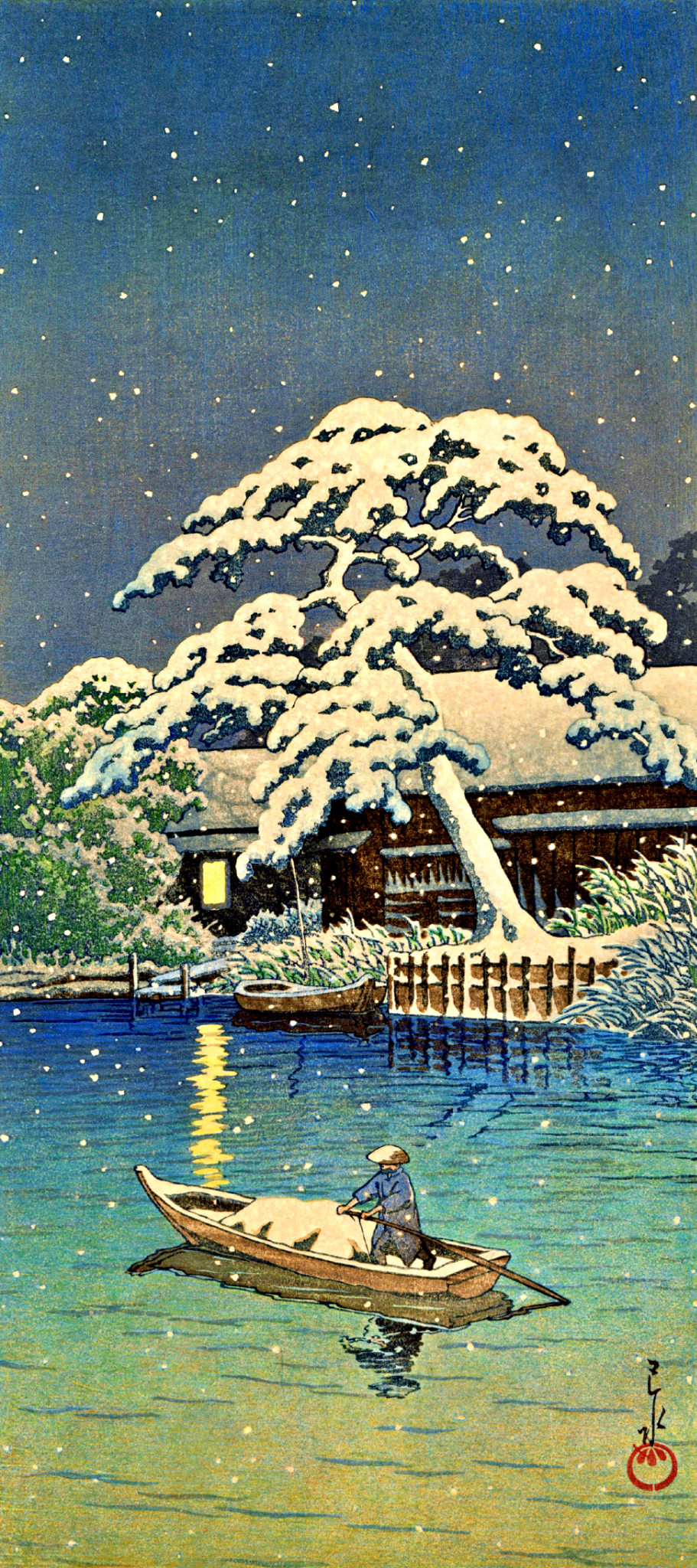
A snow-laden pine, a solitary boat, and a warm yellow light create an intimate winter sanctuary beside the water. Kawase Hasui’s Snow at Funabori brings luminous blues and quiet seasonal beauty into your home as a portrait canvas reproduction over a sturdy 1.5-inch wood stretcher.
| 16 × 24 in. | $259 CAD |
|---|---|
| 24 × 36 in. | $299 CAD |
Choose your canvas size and quantity below. All prices are in CAD.
Artwork titles and dates identify the original work. Review the product details and available options before ordering.
Ask about this print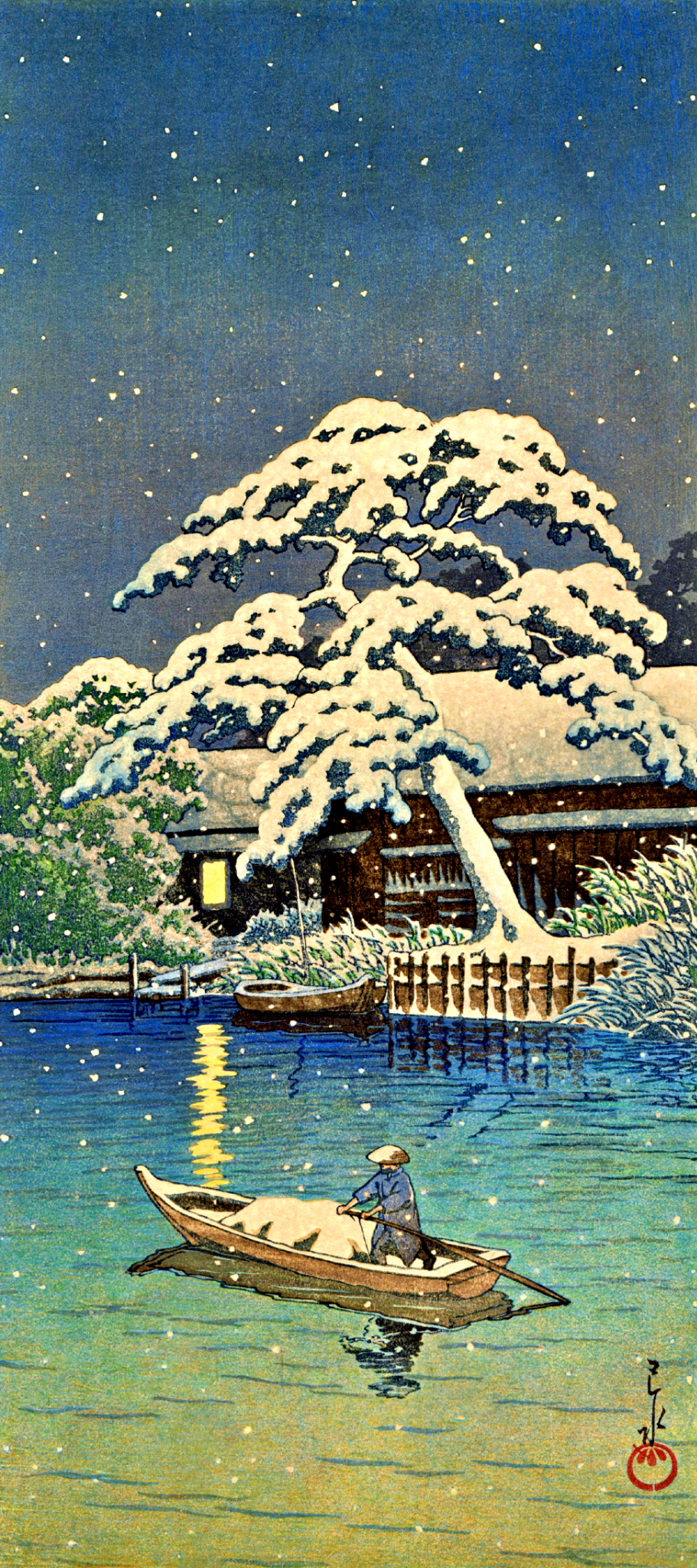
Premium quality canvas print of “Snow at Funabori” by Kawase Hasui
A snow-laden pine, a solitary boat, and a warm yellow light create an intimate winter sanctuary beside the water. Kawase Hasui’s Snow at Funabori brings luminous blues and quiet seasonal beauty into your home as a portrait canvas reproduction over a sturdy 1.5-inch wood stretcher.
Product details: Canvas reproduction over a sturdy 1.5-inch wood stretcher. Available in 16 × 24 in. ($259 CAD) and 24 × 36 in. ($299 CAD). No returns accepted.
More About the Art
Snow falls through a broad blue-grey sky above a sheltered waterway at Funabori. Beneath it, a pine bends over a low wooden building, its branches carrying thick, rounded layers of white. A vivid yellow light glows near the shore and sends a broken reflection across the water. In the foreground, a solitary figure guides a small boat through the falling flakes, giving Kawase Hasui’s winter landscape an intimate sense of continuing life.
The narrow portrait composition encourages the eye to travel slowly between sky and water. Hasui leaves a generous expanse of open air above the pine, scattering it with small, irregular white marks. Below, the tree’s canopy spreads in overlapping tiers, connecting the upper sky with the roofline and bank. The spaces between its branches preserve glimpses of blue, allowing even this heavily laden tree to retain a feeling of air and depth.
The shore offers a rich concentration of detail. Dark timber, a pale roof, snow-covered plants, and a short line of wooden posts gather around the leaning trunk. A second small boat rests near the bank. These elements are closely fitted together, yet each remains readable through its own shape or texture. The pine’s great diagonal becomes the central link, carrying the eye from the upper branches down toward the edge of the water.
Warm light gives the scene its quiet focus. The rectangular yellow glow stands against the building’s dark surfaces, while its reflection descends in separate, rippling strokes. Around that bright column, the water changes between deep blue, turquoise, and softer green. Short lines and wavering silhouettes suggest a moving surface. Hasui makes the water feel open and gently active, providing a delicate counterpoint to the settled weight of snow along the shore.
The foreground boat occupies this open space with a distinct, elongated shape. Its occupant wears blue clothing and a broad hat, holding a long oar that extends across the water to the right. Pale surfaces within the boat catch the surrounding light, while a dark reflection lies beneath the hull. The figure’s small scale keeps the snowfall and riverside setting central, suggesting ordinary movement continuing within the winter’s enveloping stillness.
Hasui designed Snow at Funabori in January 1932, during the Shōwa era, and it was published by Doi Sadaichi. Its Japanese title is Funabori no yuki, 船堀の雪. The Smithsonian’s National Museum of Asian Art identifies both date and publisher. Funabori belongs to an area of Tokyo shaped by waterways and boat transport; Edogawa Ward’s historical account of the nearby canal network records its importance to the movement of salt and other goods toward Edo.
This portrait canvas reproduction preserves the supplied image’s especially narrow composition, from the open sky and falling flakes to the foreground boat and reflections. Its blue and green passages create a luminous surrounding space, balanced by the pale snow and small yellow light. Closer looking reveals a succession of quiet relationships: branch and roof, boat and bank, moving water and settled snow. Together, they give this modest waterside scene a lasting atmosphere of shelter, patience, and gentle motion.
More About the Artist
Kawase Hasui (1883–1957) was one of the leading landscape designers of shin-hanga, the renewal of Japanese woodblock printing in the early twentieth century. His images give weather and light an active role in shaping the feeling of a place. In Snow at Funabori, a winter waterway becomes expressive through the contrast between falling flakes, a heavily laden pine, moving water, and a small source of warm light. Human activity remains part of that wider atmosphere.
Born in Tokyo with the given name Bunjiro, Hasui studied Western-style painting under Okada Saburosuke and entered the studio of Kaburaki Kiyokata in 1910. His training brought together different ways of observing and composing a scene. The clear shapes of boats, roofs, and branches in his prints coexist with carefully judged colour and tonal depth. Such qualities allow the Funabori image to remain detailed and spacious even within its unusually narrow format.
His association with Watanabe Shōzaburō helped establish his career as a landscape print designer. Watanabe published his first landscape prints in 1918–19 and became a central figure in the shin-hanga movement. The revival joined established Japanese printing methods with fresh pictorial ideas and a contemporary audience. Hasui contributed landscapes whose appeal often rested on a particular condition of season or weather, rather than on a dramatic event or an imposing monument.
Hasui also worked with other publishers. Snow at Funabori was issued by Doi Sadaichi, as recorded by the Smithsonian’s National Museum of Asian Art. This part of his career shows that his landscape practice extended beyond a single publishing partnership. The design’s balance remains distinctly his own: a broad interval of sky, a strongly placed tree, and a small human presence bring separate parts of the view into a carefully measured relationship.
Woodblock printing depended on shared expertise. The artist established the design, while carvers and printers translated it into blocks, fine lines, and successive layers of colour under the publisher’s direction. In the Funabori scene, delicate falling flakes coexist with dark architectural detail and smooth passages of water. Those varied effects reveal how a print could combine precision with softness, giving tangible form to conditions that would otherwise change from moment to moment.
Travel and sketching supplied much of Hasui’s subject matter. He explored both celebrated places and quieter settings across Japan, finding images in temple grounds, streets, villages, coastlines, and waterways. His work continued through major disruption. The Great Kantō Earthquake of 1923 destroyed Watanabe’s premises, print stock, and woodblocks, and Hasui lost sketchbooks. He nevertheless continued creating new designs and remained active after the Second World War. His output eventually exceeded six hundred print designs.
In 1953, Japan’s Cultural Properties Protection Committee documented the production of Snow at Zōjōji Temple. That record draws attention to the coordinated skills behind shin-hanga images. Hasui’s achievement belongs within this craft, in which careful observation and a designer’s decisions were realized through the work of several hands. Alongside his prints, illustrations for magazines, posters, menus, and postcards demonstrate the breadth of his activity as an image maker.
Snow at Funabori offers a particularly intimate encounter with these qualities. The boat gives the water scale, the shore light introduces warmth, and the large pine anchors the scene beneath the expansive sky. Hasui allows each detail to contribute without demanding attention in isolation. His landscape invites the viewer to linger, discovering how an ordinary waterside place can hold a remarkably full experience of winter.
Sources for the artwork and artist
Premium quality canvas print of “Snow at Funabori” by Kawase Hasui
A snow-laden pine, a solitary boat, and a warm yellow light create an intimate winter sanctuary beside the water. Kawase Hasui’s Snow at Funabori brings luminous blues and quiet seasonal beauty into your home as a portrait canvas reproduction over a sturdy 1.5-inch wood stretcher.
Product details: Canvas reproduction over a sturdy 1.5-inch wood stretcher. Available in 16 × 24 in. ($259 CAD) and 24 × 36 in. ($299 CAD). No returns accepted.
More About the Art
Snow falls through a broad blue-grey sky above a sheltered waterway at Funabori. Beneath it, a pine bends over a low wooden building, its branches carrying thick, rounded layers of white. A vivid yellow light glows near the shore and sends a broken reflection across the water. In the foreground, a solitary figure guides a small boat through the falling flakes, giving Kawase Hasui’s winter landscape an intimate sense of continuing life.
The narrow portrait composition encourages the eye to travel slowly between sky and water. Hasui leaves a generous expanse of open air above the pine, scattering it with small, irregular white marks. Below, the tree’s canopy spreads in overlapping tiers, connecting the upper sky with the roofline and bank. The spaces between its branches preserve glimpses of blue, allowing even this heavily laden tree to retain a feeling of air and depth.
The shore offers a rich concentration of detail. Dark timber, a pale roof, snow-covered plants, and a short line of wooden posts gather around the leaning trunk. A second small boat rests near the bank. These elements are closely fitted together, yet each remains readable through its own shape or texture. The pine’s great diagonal becomes the central link, carrying the eye from the upper branches down toward the edge of the water.
Warm light gives the scene its quiet focus. The rectangular yellow glow stands against the building’s dark surfaces, while its reflection descends in separate, rippling strokes. Around that bright column, the water changes between deep blue, turquoise, and softer green. Short lines and wavering silhouettes suggest a moving surface. Hasui makes the water feel open and gently active, providing a delicate counterpoint to the settled weight of snow along the shore.
The foreground boat occupies this open space with a distinct, elongated shape. Its occupant wears blue clothing and a broad hat, holding a long oar that extends across the water to the right. Pale surfaces within the boat catch the surrounding light, while a dark reflection lies beneath the hull. The figure’s small scale keeps the snowfall and riverside setting central, suggesting ordinary movement continuing within the winter’s enveloping stillness.
Hasui designed Snow at Funabori in January 1932, during the Shōwa era, and it was published by Doi Sadaichi. Its Japanese title is Funabori no yuki, 船堀の雪. The Smithsonian’s National Museum of Asian Art identifies both date and publisher. Funabori belongs to an area of Tokyo shaped by waterways and boat transport; Edogawa Ward’s historical account of the nearby canal network records its importance to the movement of salt and other goods toward Edo.
This portrait canvas reproduction preserves the supplied image’s especially narrow composition, from the open sky and falling flakes to the foreground boat and reflections. Its blue and green passages create a luminous surrounding space, balanced by the pale snow and small yellow light. Closer looking reveals a succession of quiet relationships: branch and roof, boat and bank, moving water and settled snow. Together, they give this modest waterside scene a lasting atmosphere of shelter, patience, and gentle motion.
More About the Artist
Kawase Hasui (1883–1957) was one of the leading landscape designers of shin-hanga, the renewal of Japanese woodblock printing in the early twentieth century. His images give weather and light an active role in shaping the feeling of a place. In Snow at Funabori, a winter waterway becomes expressive through the contrast between falling flakes, a heavily laden pine, moving water, and a small source of warm light. Human activity remains part of that wider atmosphere.
Born in Tokyo with the given name Bunjiro, Hasui studied Western-style painting under Okada Saburosuke and entered the studio of Kaburaki Kiyokata in 1910. His training brought together different ways of observing and composing a scene. The clear shapes of boats, roofs, and branches in his prints coexist with carefully judged colour and tonal depth. Such qualities allow the Funabori image to remain detailed and spacious even within its unusually narrow format.
His association with Watanabe Shōzaburō helped establish his career as a landscape print designer. Watanabe published his first landscape prints in 1918–19 and became a central figure in the shin-hanga movement. The revival joined established Japanese printing methods with fresh pictorial ideas and a contemporary audience. Hasui contributed landscapes whose appeal often rested on a particular condition of season or weather, rather than on a dramatic event or an imposing monument.
Hasui also worked with other publishers. Snow at Funabori was issued by Doi Sadaichi, as recorded by the Smithsonian’s National Museum of Asian Art. This part of his career shows that his landscape practice extended beyond a single publishing partnership. The design’s balance remains distinctly his own: a broad interval of sky, a strongly placed tree, and a small human presence bring separate parts of the view into a carefully measured relationship.
Woodblock printing depended on shared expertise. The artist established the design, while carvers and printers translated it into blocks, fine lines, and successive layers of colour under the publisher’s direction. In the Funabori scene, delicate falling flakes coexist with dark architectural detail and smooth passages of water. Those varied effects reveal how a print could combine precision with softness, giving tangible form to conditions that would otherwise change from moment to moment.
Travel and sketching supplied much of Hasui’s subject matter. He explored both celebrated places and quieter settings across Japan, finding images in temple grounds, streets, villages, coastlines, and waterways. His work continued through major disruption. The Great Kantō Earthquake of 1923 destroyed Watanabe’s premises, print stock, and woodblocks, and Hasui lost sketchbooks. He nevertheless continued creating new designs and remained active after the Second World War. His output eventually exceeded six hundred print designs.
In 1953, Japan’s Cultural Properties Protection Committee documented the production of Snow at Zōjōji Temple. That record draws attention to the coordinated skills behind shin-hanga images. Hasui’s achievement belongs within this craft, in which careful observation and a designer’s decisions were realized through the work of several hands. Alongside his prints, illustrations for magazines, posters, menus, and postcards demonstrate the breadth of his activity as an image maker.
Snow at Funabori offers a particularly intimate encounter with these qualities. The boat gives the water scale, the shore light introduces warmth, and the large pine anchors the scene beneath the expansive sky. Hasui allows each detail to contribute without demanding attention in isolation. His landscape invites the viewer to linger, discovering how an ordinary waterside place can hold a remarkably full experience of winter.
Sources for the artwork and artist
- Smithsonian National Museum of Asian Art — Snow at Funabori; January 1932, Kawase Hasui and publisher Doi Sadaichi
- Los Angeles County Museum of Art — Snow at Funabori; January 1932 design, exact composition and narrow portrait format
- Doi Hanga — original publisher’s Snow at Funabori listing; Japanese title, 1932 and image dimensions
- Edogawa Ward — Shinkawa heritage record; regional Funabori waterway history, salt transport and boat traffic
- British Museum — Kawase Hasui; Kiyokata, Watanabe and the first landscape prints of 1918–19
- Tokyo Fuji Art Museum — Kawase Hasui; artistic training and the 1953 documentation of woodblock production
- Japan Museum SieboldHuis — Kawase Hasui: Capturing the Soul of Japan; travel, collaborative printmaking, earthquake losses and career