
Japanese art on canvas
Pine Beach
Arai Yoshimune
From $259 CAD
A canvas reproduction of Pine Beach, presented on a 1.5-inch wood stretcher.
| 16 × 24 in. | $259 CAD |
|---|---|
| 24 × 36 in. | $299 CAD |
Choose your canvas size and quantity below. All prices are in CAD.
Artwork titles and dates identify the original work. Review the product details and available options before ordering.
Ask about this printPremium quality canvas reproduction of Arai Yoshimune’s “Pine Beach”
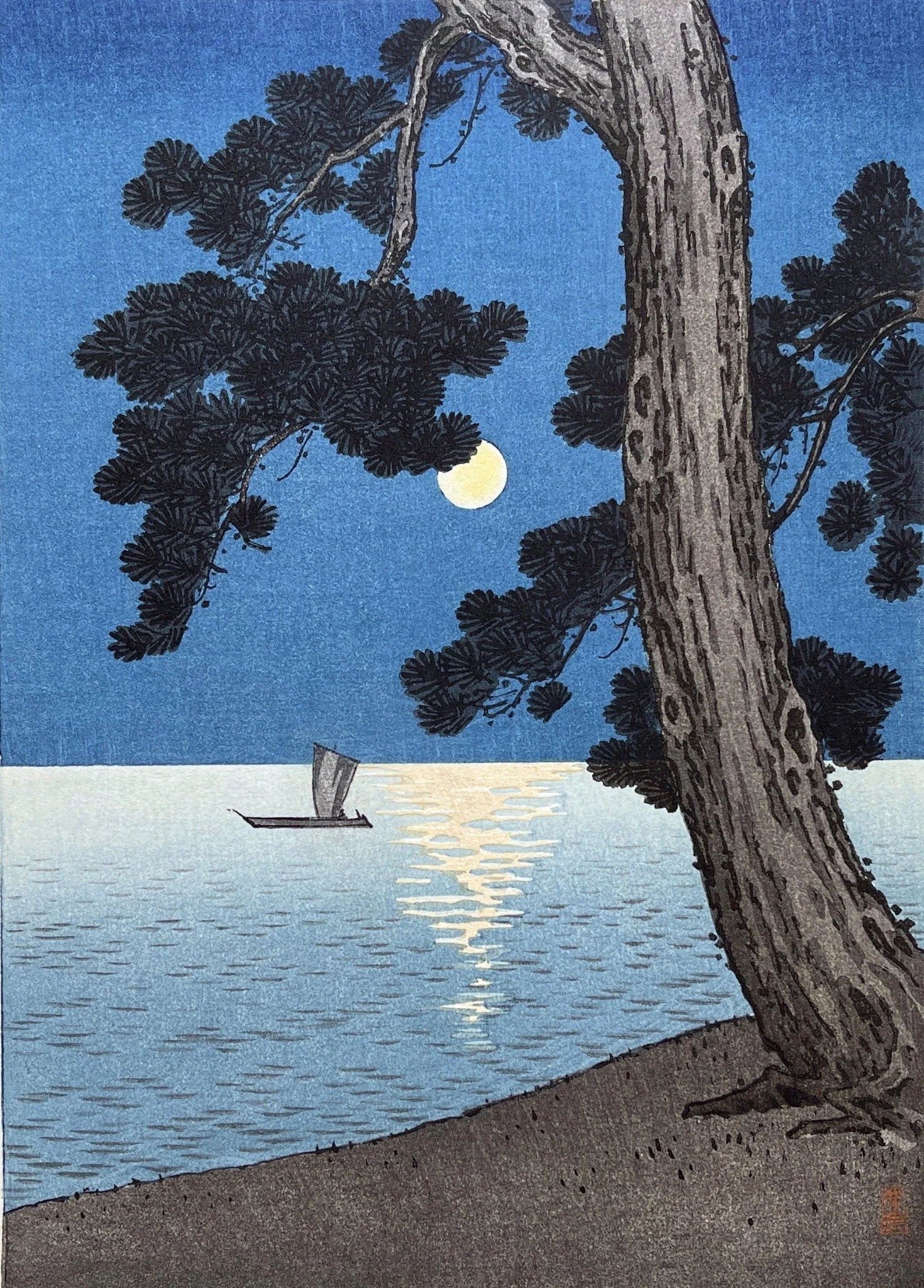
Give your room the stillness of a moonlit shore. In Arai Yoshimune’s Pine Beach, a sculptural pine frames a pale moon and its golden reflection, while a single sailboat rests against the open water. Reproduced on canvas over a sturdy 1.5-inch wood stretcher, the scene brings luminous blues and a strong natural form into your space.
Product details: Canvas reproduction over a sturdy 1.5-inch wood stretcher. Available in 16 × 24 in. ($259 CAD) and 24 × 36 in. ($299 CAD). No returns accepted.
More About the Art:
A large pine tree anchors Pine Beach, rising from the sloping shore at the lower right and continuing beyond the top of the image. Its broad trunk is marked with irregular lines, dark knots and pale ridges. Branches reach across the blue sky in uneven tiers, carrying dense clusters of needles. The tree feels close enough to examine, giving the whole scene a strong foreground presence.
The moon appears beneath one of those branching forms. Part of its round shape is hidden by the dark foliage, making the pale disc feel nestled within the tree’s outline. Around it, clear blue sky leaves space for the eye to pause. This small overlap draws attention to both the moon’s brightness and the intricate edge of the needles, bringing two very different textures together.
Below, a band of pale water extends along the horizon. The moonlight becomes a broken golden path across the sea, widening near the distance and narrowing toward the foreground. Short horizontal marks interrupt its surface, suggesting gentle ripples. The reflection gives the open water a centre of interest and connects the small bright moon with the lower half of the composition.
A single sailboat sits to the left of that illuminated path. Its slim dark hull and upright grey sail are described with just a few clear shapes. Against the size of the pine, the boat appears small and distant. It also introduces a quiet suggestion of movement into the view. The eye can follow it across the water without losing the steady presence of the tree beside the shore.
The beach forms a broad diagonal along the bottom edge. Its muted brown-grey colour relates to the pine’s bark, joining tree and ground into a continuous foreground. A few roots spread across the surface near the trunk, while small dark marks break up the otherwise simple area of shore. This firm, sloping base helps balance the open sea and sky above it.
Colour plays a large part in the image’s appeal. The rich blue sky is deeper than the pale water near the horizon, and the pine’s nearly black foliage gives both areas definition. The warm moon and reflection provide a gentle accent within this cool setting. Close up, the repeated marks in bark, needles and water create variety; from farther away, the larger blue and grey shapes hold the image together.
The portrait format makes the tree’s height especially noticeable. Its cropped trunk and branches suggest a form continuing beyond the picture, while the open water leads attention outward into the distance. You can read the scene in either direction: starting with the textured bark and moving toward the boat, or following the light back from the sea to the moon behind the needles.
As a canvas reproduction, Pine Beach offers a calm focal point with enough contrast to remain distinct across a room. Its blues, charcoal tones and warm grey shore can sit comfortably beside natural wood, soft textiles or a simple painted wall. The 1.5-inch wood stretcher gives the image physical depth, while the quiet relationships between tree, light and water reward a closer look.
More About the Artist:
Arai Yoshimune was a Japanese print artist whose work extended from illustrated books to atmospheric landscapes. He is also recorded as Utagawa Yoshimune II, a name that places him within an established family of print designers. His career offers a way to explore the connections between an artist’s training, the practical work of publishing and the quieter experience of looking at a landscape.
Yoshimune was the youngest son of Utagawa Yoshimune I and spent his childhood in Tokyo. He studied with the ukiyo-e artist Tsukioka Yoshitoshi and used the artistic name Toshiyuki before working as Yoshimune II. Following his father’s death, he was adopted by the Arai family. These overlapping family and artistic names explain why his work can appear in collections under both Arai and Utagawa. He also used the name Isshōsai.
By 1893, Arai was working within the publisher Hasegawa Takejirō’s established circle of artists, alongside Suzuki Kason and Mishima Shōsō. The publisher brought together Japanese illustrators and writers working in English to produce books for readers beyond Japan. Arai’s place in this circle connects his work to a form of print publishing in which images, translated stories and the physical character of a book were closely joined.
One documented example is The Wonderful Tea Kettle, which St Olaf College’s collection credits to Arai as illustrator, with Kate James as author or translator and Hasegawa as publisher. The book first appeared in June 1896; the college holds a February 1917 printing. Its story centres on a kettle that transforms into an animal, bringing humour and movement to the illustrated page. This gives a concrete glimpse of Arai’s activity beyond the coastal landscapes associated with his name.
These books were made through a distinctive combination of picture making and skilled production. Their illustrations were printed from carved woodblocks, while the creped paper gave the finished pages a softly wrinkled, almost fabric-like surface. Text printing, image printing and binding involved different hands. Arai worked within this collaborative process as an image designer. The resulting books carried Japanese stories in a compact form that readers could hold, turn and revisit, making the encounter with an illustration part of a tactile experience.
Alongside his book illustration, Arai contributed to Hasegawa’s Night Scenes, a body of work noted in St Olaf’s account of his career. That interest in evening landscapes provides a useful setting for appreciating Pine Beach. Here, the large pine gives the image structure, while the moon and its reflection establish a softer rhythm within the open areas of sky and water.
The composition sold here as Pine Beach also appears in a sample-print album held by the Smithsonian’s National Museum of Asian Art. Beneath the matching image, a handwritten caption reads “A pine tree on the Shore,” with the number 1260 and Hasegawa named as publisher. The album preserves the same arrangement of a close pine, open water, moonlight and a small sailboat, making it a useful reference for the image offered here as a canvas reproduction.
For today’s viewer, these different parts of Arai’s practice share the pleasure of close observation. A book illustration invites attention to a small scene; a landscape can open outward while retaining details that reward another look. In Pine Beach, the repeated lines of the needles, the rough-looking bark and the delicate reflection offer those points of discovery. The broad view feels restful, and its smaller relationships keep it engaging.
Sources
Canvas views
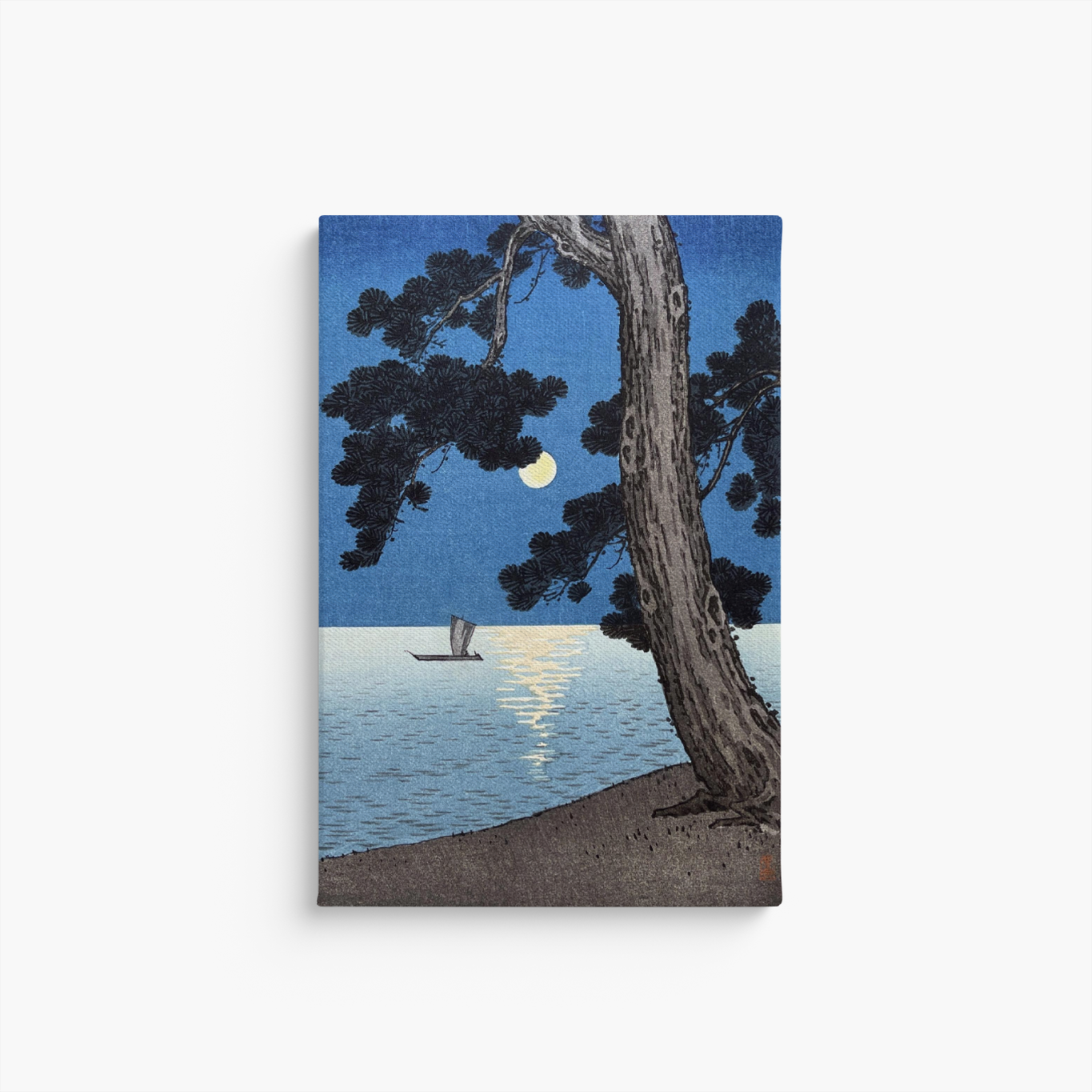
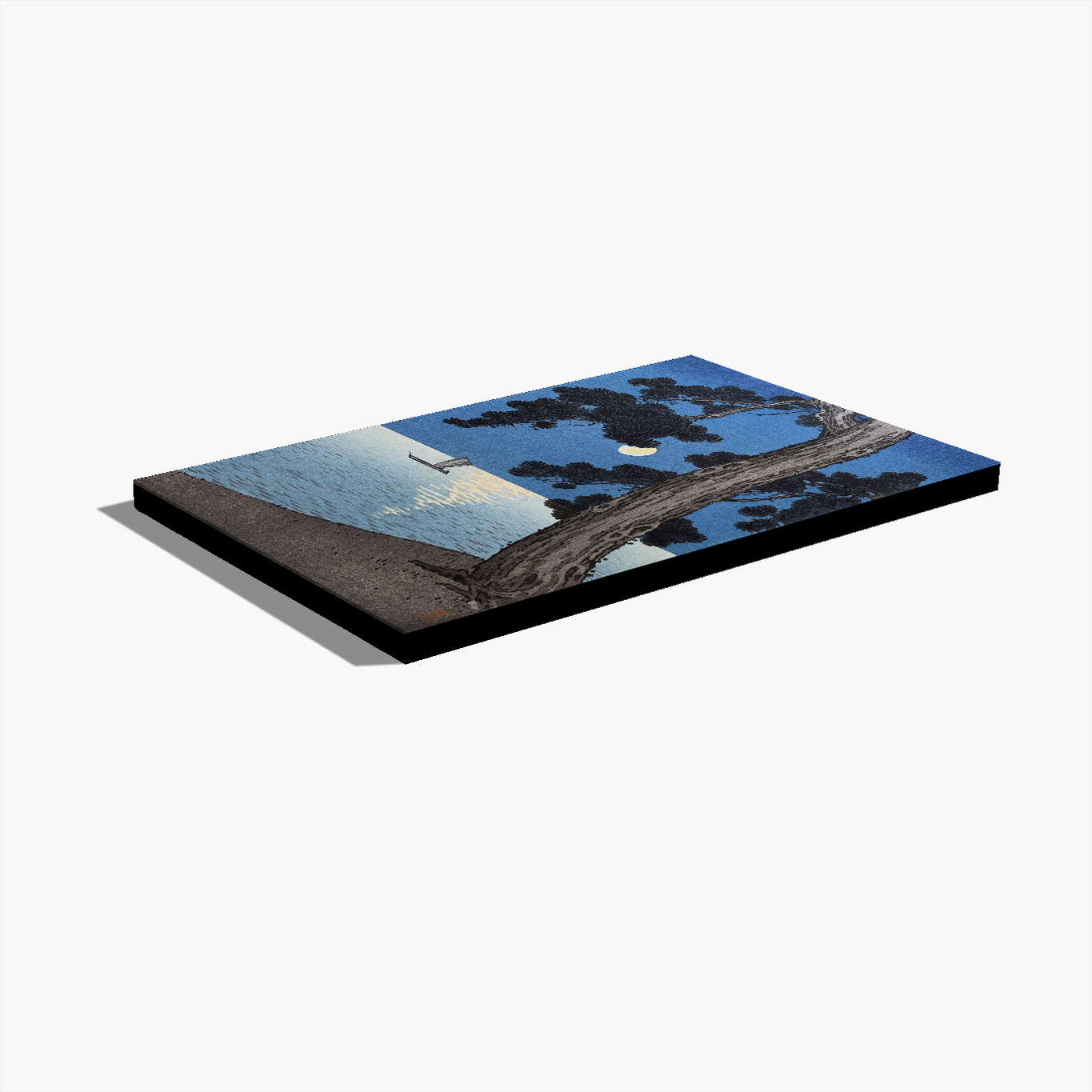
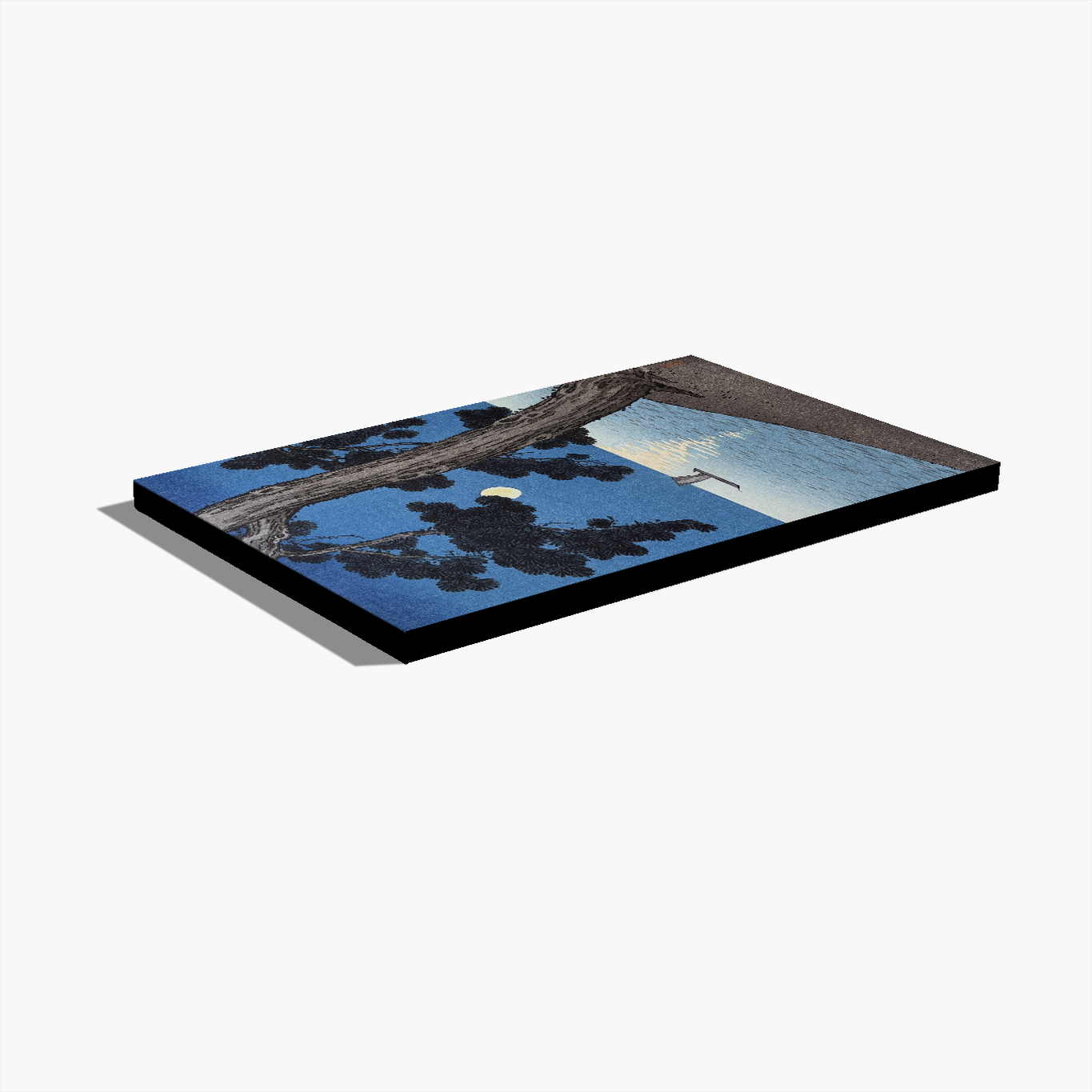
A closer look at the canvas.
Premium quality canvas reproduction of Arai Yoshimune’s “Pine Beach”
Give your room the stillness of a moonlit shore. In Arai Yoshimune’s Pine Beach, a sculptural pine frames a pale moon and its golden reflection, while a single sailboat rests against the open water. Reproduced on canvas over a sturdy 1.5-inch wood stretcher, the scene brings luminous blues and a strong natural form into your space.
Product details: Canvas reproduction over a sturdy 1.5-inch wood stretcher. Available in 16 × 24 in. ($259 CAD) and 24 × 36 in. ($299 CAD). No returns accepted.
More About the Art:
A large pine tree anchors Pine Beach, rising from the sloping shore at the lower right and continuing beyond the top of the image. Its broad trunk is marked with irregular lines, dark knots and pale ridges. Branches reach across the blue sky in uneven tiers, carrying dense clusters of needles. The tree feels close enough to examine, giving the whole scene a strong foreground presence.
The moon appears beneath one of those branching forms. Part of its round shape is hidden by the dark foliage, making the pale disc feel nestled within the tree’s outline. Around it, clear blue sky leaves space for the eye to pause. This small overlap draws attention to both the moon’s brightness and the intricate edge of the needles, bringing two very different textures together.
Below, a band of pale water extends along the horizon. The moonlight becomes a broken golden path across the sea, widening near the distance and narrowing toward the foreground. Short horizontal marks interrupt its surface, suggesting gentle ripples. The reflection gives the open water a centre of interest and connects the small bright moon with the lower half of the composition.
A single sailboat sits to the left of that illuminated path. Its slim dark hull and upright grey sail are described with just a few clear shapes. Against the size of the pine, the boat appears small and distant. It also introduces a quiet suggestion of movement into the view. The eye can follow it across the water without losing the steady presence of the tree beside the shore.
The beach forms a broad diagonal along the bottom edge. Its muted brown-grey colour relates to the pine’s bark, joining tree and ground into a continuous foreground. A few roots spread across the surface near the trunk, while small dark marks break up the otherwise simple area of shore. This firm, sloping base helps balance the open sea and sky above it.
Colour plays a large part in the image’s appeal. The rich blue sky is deeper than the pale water near the horizon, and the pine’s nearly black foliage gives both areas definition. The warm moon and reflection provide a gentle accent within this cool setting. Close up, the repeated marks in bark, needles and water create variety; from farther away, the larger blue and grey shapes hold the image together.
The portrait format makes the tree’s height especially noticeable. Its cropped trunk and branches suggest a form continuing beyond the picture, while the open water leads attention outward into the distance. You can read the scene in either direction: starting with the textured bark and moving toward the boat, or following the light back from the sea to the moon behind the needles.
As a canvas reproduction, Pine Beach offers a calm focal point with enough contrast to remain distinct across a room. Its blues, charcoal tones and warm grey shore can sit comfortably beside natural wood, soft textiles or a simple painted wall. The 1.5-inch wood stretcher gives the image physical depth, while the quiet relationships between tree, light and water reward a closer look.
More About the Artist:
Arai Yoshimune was a Japanese print artist whose work extended from illustrated books to atmospheric landscapes. He is also recorded as Utagawa Yoshimune II, a name that places him within an established family of print designers. His career offers a way to explore the connections between an artist’s training, the practical work of publishing and the quieter experience of looking at a landscape.
Yoshimune was the youngest son of Utagawa Yoshimune I and spent his childhood in Tokyo. He studied with the ukiyo-e artist Tsukioka Yoshitoshi and used the artistic name Toshiyuki before working as Yoshimune II. Following his father’s death, he was adopted by the Arai family. These overlapping family and artistic names explain why his work can appear in collections under both Arai and Utagawa. He also used the name Isshōsai.
By 1893, Arai was working within the publisher Hasegawa Takejirō’s established circle of artists, alongside Suzuki Kason and Mishima Shōsō. The publisher brought together Japanese illustrators and writers working in English to produce books for readers beyond Japan. Arai’s place in this circle connects his work to a form of print publishing in which images, translated stories and the physical character of a book were closely joined.
One documented example is The Wonderful Tea Kettle, which St Olaf College’s collection credits to Arai as illustrator, with Kate James as author or translator and Hasegawa as publisher. The book first appeared in June 1896; the college holds a February 1917 printing. Its story centres on a kettle that transforms into an animal, bringing humour and movement to the illustrated page. This gives a concrete glimpse of Arai’s activity beyond the coastal landscapes associated with his name.
These books were made through a distinctive combination of picture making and skilled production. Their illustrations were printed from carved woodblocks, while the creped paper gave the finished pages a softly wrinkled, almost fabric-like surface. Text printing, image printing and binding involved different hands. Arai worked within this collaborative process as an image designer. The resulting books carried Japanese stories in a compact form that readers could hold, turn and revisit, making the encounter with an illustration part of a tactile experience.
Alongside his book illustration, Arai contributed to Hasegawa’s Night Scenes, a body of work noted in St Olaf’s account of his career. That interest in evening landscapes provides a useful setting for appreciating Pine Beach. Here, the large pine gives the image structure, while the moon and its reflection establish a softer rhythm within the open areas of sky and water.
The composition sold here as Pine Beach also appears in a sample-print album held by the Smithsonian’s National Museum of Asian Art. Beneath the matching image, a handwritten caption reads “A pine tree on the Shore,” with the number 1260 and Hasegawa named as publisher. The album preserves the same arrangement of a close pine, open water, moonlight and a small sailboat, making it a useful reference for the image offered here as a canvas reproduction.
For today’s viewer, these different parts of Arai’s practice share the pleasure of close observation. A book illustration invites attention to a small scene; a landscape can open outward while retaining details that reward another look. In Pine Beach, the repeated lines of the needles, the rough-looking bark and the delicate reflection offer those points of discovery. The broad view feels restful, and its smaller relationships keep it engaging.
Sources for the artwork and artist
- Smithsonian National Museum of Asian Art — sample-print album, S2003.8.3745, page 17
- Japan Arts Council, Cultural Digital Library — Utagawa Yoshimune II
- St Olaf College, Japanese Crepe-paper Books — Arai Yoshimune
- St Olaf College — The Wonderful Tea Kettle, collection record
- St Olaf College — Overview of Japanese crepe-paper books