
Japanese art on canvas
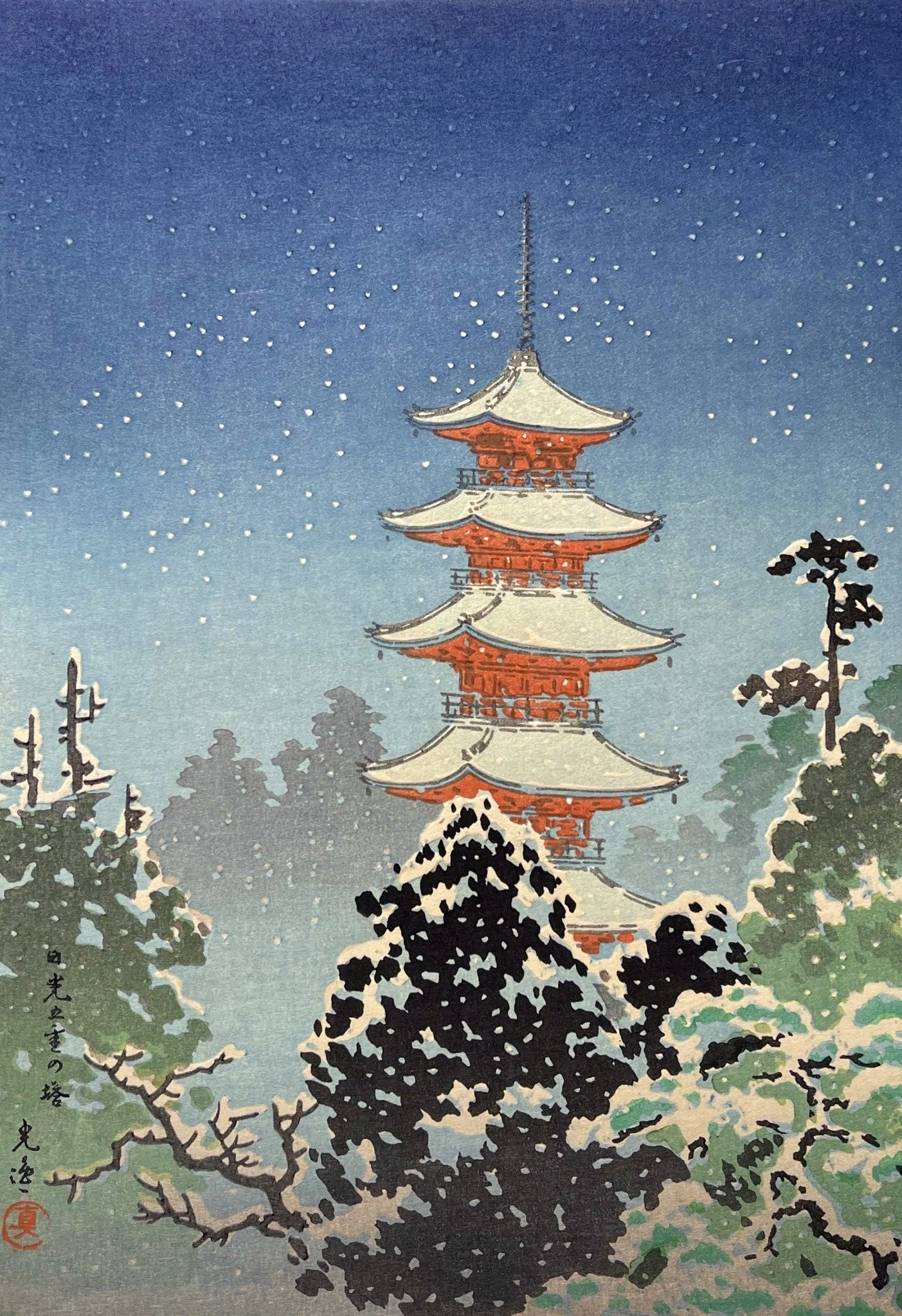
Nikko Five-Story Pagoda in Snow
Tsuchiya Koitsu · 1936
From $259 CAD
A canvas reproduction of Nikko Five-Story Pagoda in Snow, presented on a 1.5-inch wood stretcher.
| 16 × 24 in. | $259 CAD |
|---|---|
| 24 × 36 in. | $299 CAD |
Choose your canvas size and quantity below. All prices are in CAD.
Artwork titles and dates identify the original work. Review the product details and available options before ordering.
Ask about this printPremium quality canvas print of Tsuchiya Koitsu’s “Nikko Five-Story Pagoda in Snow”
Bring the stillness of falling snow into your room. In Tsuchiya Koitsu’s Nikko Five-Story Pagoda in Snow, warm red architecture rises above dark trees beneath a luminous blue sky. Reproduced on canvas over a sturdy 1.5-inch wood stretcher, this winter scene offers a striking balance of colour, quiet space and delicate detail.
Product details: Canvas reproduction over a sturdy 1.5-inch wood stretcher. Available in 16 × 24 in. ($259 CAD) and 24 × 36 in. ($299 CAD). No returns accepted.
More About the Art
In Nikko Five-Story Pagoda in Snow, winter brings an unexpected brightness to the landscape. A vermilion pagoda rises through a screen of trees, its roofs carrying broad layers of pale snow. The building stands slightly to the right of centre, surrounded by an expansive blue sky. Warm architectural colour and cool winter air meet in a composition that feels both vivid and remarkably still.
The five tiers establish a measured upward rhythm. Each roof curves outward before turning gently at its edges, and each white surface rests above a band of red timber and dark railings. The lower part of the tower is partly concealed by foliage, encouraging the eye to follow the clearer upper levels. A slender finial continues the ascent into the open sky, completing the building’s elegant vertical line.
That sky occupies a generous part of the image. Its colour moves from pale blue near the trees to deeper blue above, giving the tower a soft, luminous setting. Small white flakes scatter across this changing field. Their irregular spacing suggests movement without disrupting the calm of the scene, while the unbroken areas of colour leave room for the eye to rest between the flakes.
In the foreground, snow gathers along branches and across clusters of dark foliage. Some trees appear almost black; others carry muted green and blue tones. The pale deposits trace their irregular shapes, making each branch and leafy mass more distinct. A bare branch stretches in from the lower left, adding a fine, angular pattern against the larger, rounded forms of the trees around it.
Behind this close screen, softer grey-green trees suggest another layer of woodland. Their reduced contrast makes the pagoda seem to rise from within the landscape, with vegetation continuing around and beyond it. There are no visible figures to establish a small narrative or interrupt the view. Attention remains with the falling snow, the layered roofs and the gradual passage from dark foreground to luminous distance.
The subject belongs to the historic setting of Nikkō’s Tōshōgū Shrine. Nikkō City records the present five-story pagoda as an 1818 reconstruction of an earlier tower lost to fire. That architectural history gives the scene a further sense of continuity. Here, the building’s strong form remains legible through winter weather, while the trees and snow soften the surroundings into an intimate view of a landmark.
Doi Hanga, the publisher, catalogues this composition as Pagoda in Nikko and dates the design to 1936. Its Japanese title is 日光 五重塔, referring to Nikkō’s five-story pagoda. This canvas reproduction presents that historical woodblock design in a contemporary format. The original design date connects the image with Koitsu’s mature landscape work, when he was creating many of his prints with Doi.
For a living room, study or quiet corner, the image offers a clear focal point with an atmosphere that unfolds slowly. From across the room, the red tower and blue sky create a strong colour relationship. Closer viewing reveals railings, roof edges, branching silhouettes and individual flakes. Its appeal lies in this balance: the architecture gives the scene structure, while snowfall lends it softness, space and a gentle sense of passing time.
More About the Artist
Tsuchiya Koitsu (1870–1949) came to his mature landscape prints through a long apprenticeship and a career that extended across several periods of Japanese art. Born into a farming family in Hamamatsu, Shizuoka, he became a pupil of Kobayashi Kiyochika at sixteen. He lived with his teacher for nearly twenty years, and received the artist name Koitsu from him. This sustained connection placed him within an established tradition of woodblock design.
Kiyochika’s landscape prints explored fresh ways of representing space through perspective and shading. In its exhibition on Kiyochika, Inoue Yasuji and Koitsu, Chigasaki City Museum of Art describes Koitsu as continuing his teacher’s approach and becoming particularly accomplished in night views. That relationship provides a useful way into his art: buildings, trees and water can become expressive through the light surrounding them, as well as through their outlines.
Koitsu’s activity as a shin-hanga artist developed when he was already in his sixties. The term means “new prints” and describes a renewal of woodblock art that brought contemporary designs into an established method of production. His contribution therefore grew from experience acquired over decades. The mature prints bring an older artistic training into the visual world of the early twentieth century.
That method depended on collaboration. The artist supplied a design, specialist carvers translated it into woodblocks, and printers brought the image into colour under a publisher’s direction. The Metropolitan Museum of Art explains how separate blocks carried different colours, with guides allowing successive impressions to align. Within this shared process, a landscape could combine precise architectural detail with broader areas of colour. The finished historical print embodied the work of several skilled participants.
Doi was central to Koitsu’s landscape production. The company traces its beginnings to a shop opened by Doi Sadaichi in Tokyo in 1924, and records publishing approximately eighty Koitsu prints between 1933 and 1944. Nikko Five-Story Pagoda in Snow belongs within that sustained relationship. Doi’s own record identifies this design with 1936, placing it in a productive period when Koitsu’s experience found expression through the publisher’s woodblock workshop.
His subjects also included the city at quieter hours. Chigasaki’s 2014 exhibition presented the complete twelve prints of his Tokyo Views alongside works by Kiyochika and Yasuji. This curatorial grouping draws attention to a continuing exploration of landscape across generations. Koitsu’s interest in atmosphere connects places with the conditions in which they are seen: the same familiar architecture can feel sheltered, distant or newly revealed as light and weather change.
Water and travel scenery formed another part of his range. The Tokaido Hiroshige Museum of Art included Returning Sailboat at Yabase, from Eight Views of Ōmi, in its survey of landscape printmaking. Together with his urban subjects, such a work shows the breadth of settings available to him. The artist’s landscape practice extended beyond a single city view or architectural motif.
Koitsu’s work also has an enduring place in the public collection of Chigasaki City Museum of Art, where he is identified among the artists central to its holdings. That recognition supports viewing his prints as part of a wider artistic history, while their visual qualities remain immediately approachable. In this snowy pagoda, the warm tower, pale roofs and dark trees create a scene that can be enjoyed before any historical detail is known.
Looking closely, the pleasure comes from relationships that are simple to recognize and rewarding to revisit. Clear edges give way to softer distance; small flakes move across a broad sky; a repeated roofline rises above irregular branches. In this view of Koitsu’s work, atmosphere emerges through colour and structure together. The result invites unhurried attention, allowing a familiar subject to remain vivid through the changing experience of looking.
Sources
Premium quality canvas print of Tsuchiya Koitsu’s “Nikko Five-Story Pagoda in Snow”
Bring the stillness of falling snow into your room. In Tsuchiya Koitsu’s Nikko Five-Story Pagoda in Snow, warm red architecture rises above dark trees beneath a luminous blue sky. Reproduced on canvas over a sturdy 1.5-inch wood stretcher, this winter scene offers a striking balance of colour, quiet space and delicate detail.
Product details: Canvas reproduction over a sturdy 1.5-inch wood stretcher. Available in 16 × 24 in. ($259 CAD) and 24 × 36 in. ($299 CAD). No returns accepted.
More About the Art
In Nikko Five-Story Pagoda in Snow, winter brings an unexpected brightness to the landscape. A vermilion pagoda rises through a screen of trees, its roofs carrying broad layers of pale snow. The building stands slightly to the right of centre, surrounded by an expansive blue sky. Warm architectural colour and cool winter air meet in a composition that feels both vivid and remarkably still.
The five tiers establish a measured upward rhythm. Each roof curves outward before turning gently at its edges, and each white surface rests above a band of red timber and dark railings. The lower part of the tower is partly concealed by foliage, encouraging the eye to follow the clearer upper levels. A slender finial continues the ascent into the open sky, completing the building’s elegant vertical line.
That sky occupies a generous part of the image. Its colour moves from pale blue near the trees to deeper blue above, giving the tower a soft, luminous setting. Small white flakes scatter across this changing field. Their irregular spacing suggests movement without disrupting the calm of the scene, while the unbroken areas of colour leave room for the eye to rest between the flakes.
In the foreground, snow gathers along branches and across clusters of dark foliage. Some trees appear almost black; others carry muted green and blue tones. The pale deposits trace their irregular shapes, making each branch and leafy mass more distinct. A bare branch stretches in from the lower left, adding a fine, angular pattern against the larger, rounded forms of the trees around it.
Behind this close screen, softer grey-green trees suggest another layer of woodland. Their reduced contrast makes the pagoda seem to rise from within the landscape, with vegetation continuing around and beyond it. There are no visible figures to establish a small narrative or interrupt the view. Attention remains with the falling snow, the layered roofs and the gradual passage from dark foreground to luminous distance.
The subject belongs to the historic setting of Nikkō’s Tōshōgū Shrine. Nikkō City records the present five-story pagoda as an 1818 reconstruction of an earlier tower lost to fire. That architectural history gives the scene a further sense of continuity. Here, the building’s strong form remains legible through winter weather, while the trees and snow soften the surroundings into an intimate view of a landmark.
Doi Hanga, the publisher, catalogues this composition as Pagoda in Nikko and dates the design to 1936. Its Japanese title is 日光 五重塔, referring to Nikkō’s five-story pagoda. This canvas reproduction presents that historical woodblock design in a contemporary format. The original design date connects the image with Koitsu’s mature landscape work, when he was creating many of his prints with Doi.
For a living room, study or quiet corner, the image offers a clear focal point with an atmosphere that unfolds slowly. From across the room, the red tower and blue sky create a strong colour relationship. Closer viewing reveals railings, roof edges, branching silhouettes and individual flakes. Its appeal lies in this balance: the architecture gives the scene structure, while snowfall lends it softness, space and a gentle sense of passing time.
More About the Artist
Tsuchiya Koitsu (1870–1949) came to his mature landscape prints through a long apprenticeship and a career that extended across several periods of Japanese art. Born into a farming family in Hamamatsu, Shizuoka, he became a pupil of Kobayashi Kiyochika at sixteen. He lived with his teacher for nearly twenty years, and received the artist name Koitsu from him. This sustained connection placed him within an established tradition of woodblock design.
Kiyochika’s landscape prints explored fresh ways of representing space through perspective and shading. In its exhibition on Kiyochika, Inoue Yasuji and Koitsu, Chigasaki City Museum of Art describes Koitsu as continuing his teacher’s approach and becoming particularly accomplished in night views. That relationship provides a useful way into his art: buildings, trees and water can become expressive through the light surrounding them, as well as through their outlines.
Koitsu’s activity as a shin-hanga artist developed when he was already in his sixties. The term means “new prints” and describes a renewal of woodblock art that brought contemporary designs into an established method of production. His contribution therefore grew from experience acquired over decades. The mature prints bring an older artistic training into the visual world of the early twentieth century.
That method depended on collaboration. The artist supplied a design, specialist carvers translated it into woodblocks, and printers brought the image into colour under a publisher’s direction. The Metropolitan Museum of Art explains how separate blocks carried different colours, with guides allowing successive impressions to align. Within this shared process, a landscape could combine precise architectural detail with broader areas of colour. The finished historical print embodied the work of several skilled participants.
Doi was central to Koitsu’s landscape production. The company traces its beginnings to a shop opened by Doi Sadaichi in Tokyo in 1924, and records publishing approximately eighty Koitsu prints between 1933 and 1944. Nikko Five-Story Pagoda in Snow belongs within that sustained relationship. Doi’s own record identifies this design with 1936, placing it in a productive period when Koitsu’s experience found expression through the publisher’s woodblock workshop.
His subjects also included the city at quieter hours. Chigasaki’s 2014 exhibition presented the complete twelve prints of his Tokyo Views alongside works by Kiyochika and Yasuji. This curatorial grouping draws attention to a continuing exploration of landscape across generations. Koitsu’s interest in atmosphere connects places with the conditions in which they are seen: the same familiar architecture can feel sheltered, distant or newly revealed as light and weather change.
Water and travel scenery formed another part of his range. The Tokaido Hiroshige Museum of Art included Returning Sailboat at Yabase, from Eight Views of Ōmi, in its survey of landscape printmaking. Together with his urban subjects, such a work shows the breadth of settings available to him. The artist’s landscape practice extended beyond a single city view or architectural motif.
Koitsu’s work also has an enduring place in the public collection of Chigasaki City Museum of Art, where he is identified among the artists central to its holdings. That recognition supports viewing his prints as part of a wider artistic history, while their visual qualities remain immediately approachable. In this snowy pagoda, the warm tower, pale roofs and dark trees create a scene that can be enjoyed before any historical detail is known.
Looking closely, the pleasure comes from relationships that are simple to recognize and rewarding to revisit. Clear edges give way to softer distance; small flakes move across a broad sky; a repeated roofline rises above irregular branches. In this view of Koitsu’s work, atmosphere emerges through colour and structure together. The result invites unhurried attention, allowing a familiar subject to remain vivid through the changing experience of looking.
Sources for the artwork and artist
- Doi Hanga — Pagoda in Nikko, MB-05
- Nikkō City — Tōshōgū and the five-story pagoda
- Tokaido Hiroshige Museum of Art — Scenery through Hanga
- Chigasaki City Museum of Art — Yasuji, Kiyochika and Koitsu
- The Metropolitan Museum of Art — Woodblock Prints in the Ukiyo-e Style
- Doi Hanga — Company history
- Chigasaki City Museum — Koitsu in the art museum collection